Intercom
 Shopify
 Stripe
 Slack
Slack Notion
 Google Workspace
 Confluence

Crisp AI Explained: What It Automates and Where It Stops (2026)


Crisp is a live-chat-first help desk built for small and mid-size teams, and its AI agent, called Hugo, is now bundled into every paid plan instead of sold as a separate product. This guide covers exactly what Hugo automates inside Crisp, how you set it up, what it actually costs once you look past "included," where it stops working without a human, and who it suits.

We build AI agents for customer service ourselves, and Crisp isn't a platform we compete with, it's a help desk with its own bundled AI, the same category as Help Scout or Gorgias. We checked Crisp's own site directly for every claim below instead of working from a review aggregator.
What Crisp's AI does inside the help desk
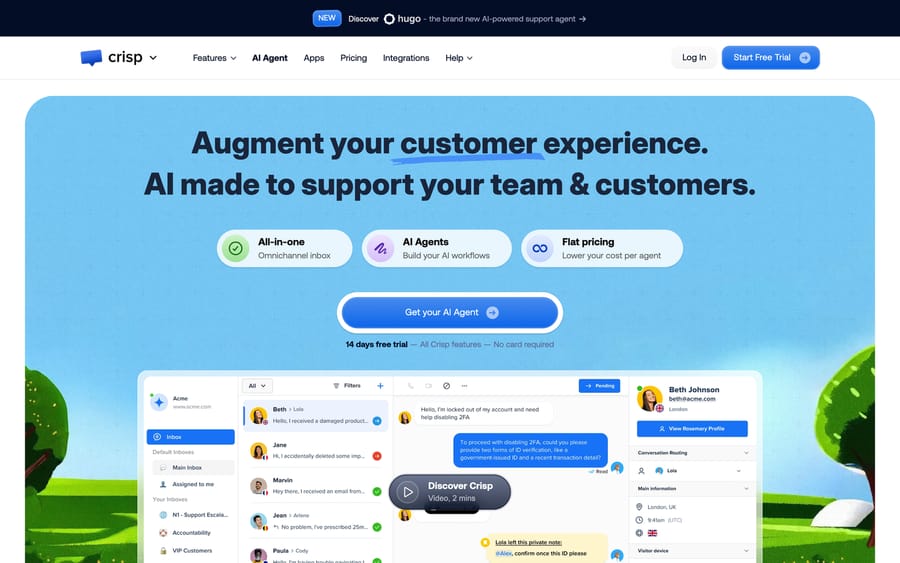
Crisp's AI agent is named Hugo, described on Crisp's own site as "your brand's most efficient support teammate." Hugo runs inside the same inbox a human agent uses, and it works in two modes: it answers customer questions directly across web chat, WhatsApp, Messenger, Instagram, and email, and it acts as an internal copilot that drafts replies, fixes grammar, and adjusts tone for a human agent handling a harder conversation.
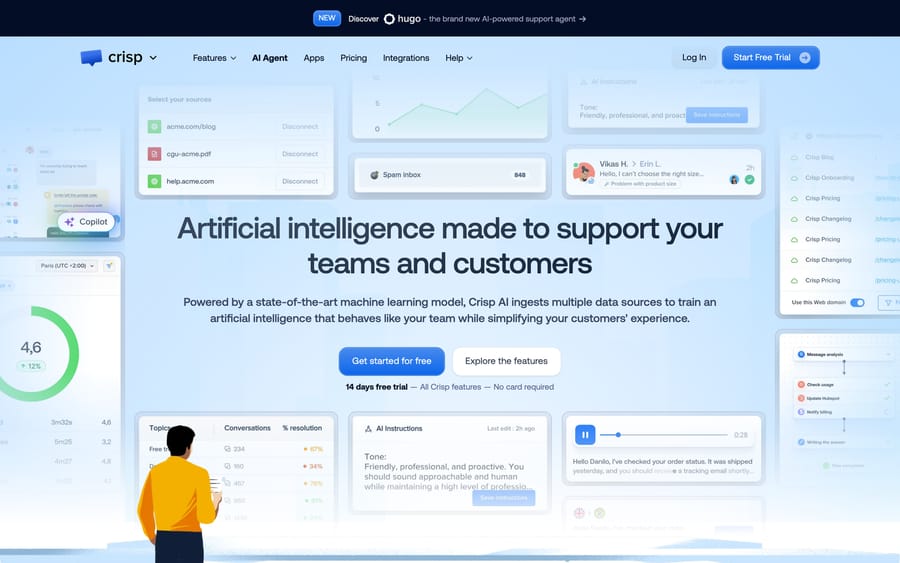
Hugo trains on a mix of sources: a website crawl, an uploaded knowledge base, "Answer Snippets" a team writes by hand, past conversation history, and imported PDFs or CSVs. That combination matters because it means Hugo isn't limited to a static FAQ, it can pick up the actual language a support team already uses in resolved tickets, closer to what a new hire learns by reading old transcripts than what a chatbot learns by reading a manual.
Hugo can also take real actions inside a conversation, beyond answering questions: Crisp's own documentation describes it checking account details, tracking orders, and issuing refunds, always constrained by the rules a team defines. That's the detail that separates a bundled help-desk AI from a simple chatbot: Hugo is wired into the same backend a human agent already works from, so a "check my order status" question can get a real answer instead of a deflection to a self-service link.
How to set up Hugo
Per Crisp's own help center, setup runs in four stages:
- Train Hugo on selected sources: website pages, a knowledge base, conversation history, or uploaded files.
- Write instructions through a guided setup that asks about tone, boundaries, escalation preferences, and business context, roughly a five-question flow instead of a blank prompt box.
- Set escalation rules for the conversations that should reach a human, and pick which channels Hugo is live on.
- Test in the Playground, Crisp's sandbox for running sample questions against the current configuration before it goes live.
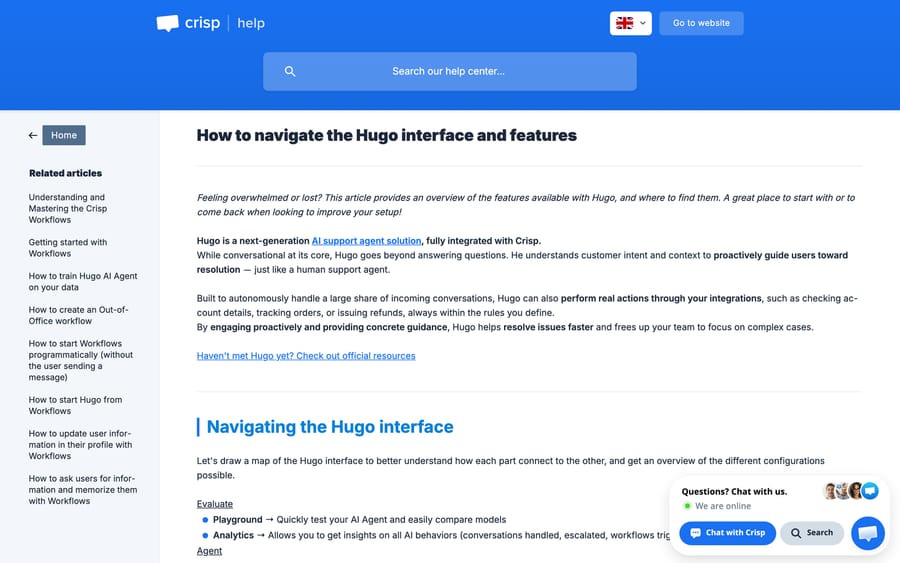
Crisp's own documentation frames this as a "few minutes" setup, which is realistic for the guided-instructions step itself. Training Hugo well, writing escalation rules that actually catch the right conversations, and checking its answers in the Playground before trusting it with live customers is the part that takes longer, the same tuning period any AI agent needs regardless of how fast the initial screen loads.
What Hugo costs
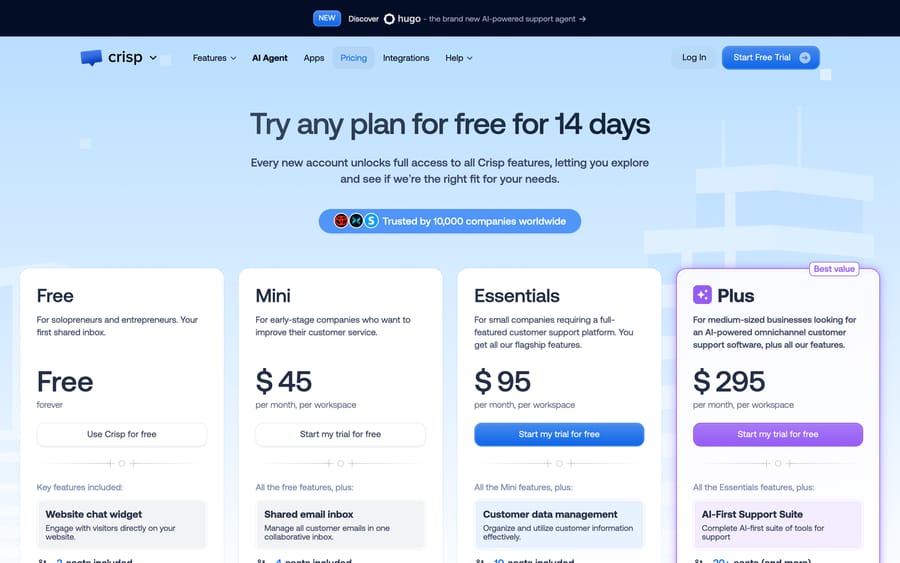
Hugo is not a separate line item, it's bundled into Crisp's plans as a monthly AI-credit allowance:
| Plan | Price/month (per workspace) | AI credits included | Approx. automated conversations |
|---|---|---|---|
| Free | $0 | None | 0 |
| Mini | $45 | $5 | ~90 |
| Essentials | $95 | $25 | ~450 |
| Plus | $295 | $75 | ~1,350 |
| Enterprise | Custom | Custom | Custom |
The Free plan gets the chat widget and shared inbox but zero AI credits, so evaluating Hugo itself requires a paid plan or the 14-day trial (no card required) that unlocks every feature. Once a plan's included credits run out, Crisp's own site states "no per-conversation fees" beyond the fair-use allotment, though the practical ceiling is still the credit pool: a team that blows through 450 Essentials-tier conversations by the third week of the month is either upgrading a tier or letting Hugo go quiet until the next billing cycle. That's a real constraint worth modeling against actual ticket volume before picking a tier.
Where Hugo stops
Hugo's real actions (order lookups, refunds) only work through the integrations a team has actually connected. Without those, Hugo answers questions from trained content but can't touch a customer's account, the same limit any help-desk AI has when it isn't wired into the systems behind it.
Crisp's own support around "confidence level" settings and fallback rules exists specifically because a generative model paraphrasing trained content can still say something the source material didn't. The safeguard is configuration, not a guarantee: a team that skips writing tight escalation rules is trusting Hugo's default judgment on when to hand off, which is a real operational choice with a real failure mode if a wrong answer reaches a customer before anyone reviews it.
Hugo is also scoped to the Crisp inbox. It doesn't extend into a separate help desk, a CRM outside Crisp's own integrations, or a workflow system; it automates conversations already inside Crisp, and the broader operational load around them (billing systems, internal ticketing, escalation to engineering) sits outside its reach.
What actual users say
Crisp holds 4.6 out of 5 across 148 verified reviews on Capterra, checked 2026-09-15. On G2, third-party reporting citing G2's own page puts it around 4.5 out of 5 with roughly 194 reviews as of the same check date; we couldn't fetch G2 directly (it blocked automated access), so treat that specific figure as secondhand until confirmed on G2 itself. Three attributed examples from Capterra:
- A Product Manager at a leisure and travel company (51-200 employees) reports "40% reduction in queries due to their AI handling mundane queries obo our agents."
- A CTO in IT services, a customer of over two years, calls it "the tool is awesome, the support team very reactive if you need anything."
- A CEO in computer software, a seven-year customer, points to "simple straightforward pricing unlike competitors where you pay extra for features."
The recurring complaint isn't about Hugo's answers, it's about reporting depth: several reviewers want to export full chat transcripts, filter by exact date ranges, and pull detailed agent-performance metrics (login times, handled versus resolved counts) without building a custom data pipeline first. That's a genuine gap for a team that wants to audit AI performance rigorously, worth knowing before assuming the analytics tab covers it.
How we researched this: we worked from Crisp's own homepage, AI product page, pricing page, and help center article on the Hugo interface (all fetched directly, 2026-09-15), plus Capterra's review page for user sentiment. G2's review page blocked our automated fetch, so its rating above is cited secondhand rather than confirmed on G2's own page directly, and we couldn't find a changelog entry pinning Hugo's original release date.
Who Crisp's AI suits
Hugo fits teams already running, or seriously evaluating, Crisp as their primary help desk, where live chat across web, WhatsApp, Messenger, and Instagram is the main support surface and email is secondary. Bundling Hugo into a fixed per-tier credit pool instead of metering exact usage optimizes for predictable plan revenue: a team unsure of its monthly conversation count has a real incentive to buy the safety margin of the next tier up rather than risk running dry mid-month.
It's a weaker fit for a team that has already standardized on a different help desk (Zendesk, Freshdesk, Gorgias, Front) and doesn't want to migrate the whole support stack just to get a bundled AI agent. Hugo isn't sold or usable separately from Crisp itself.
Where an AI agent layer fits on top
Crisp and Macha solve different problems, and Macha is not a Crisp alternative: Crisp is the help desk, Hugo is its native bundled AI, and a team happy with Crisp's inbox has no reason to rip it out. Macha is an AI agent layer that runs on top of a help desk a team already uses, specifically Zendesk, Freshdesk, Gorgias, or Front today, building agents in plain English with setup and monitoring handled by the Macha team rather than a self-serve credit dashboard to manage.
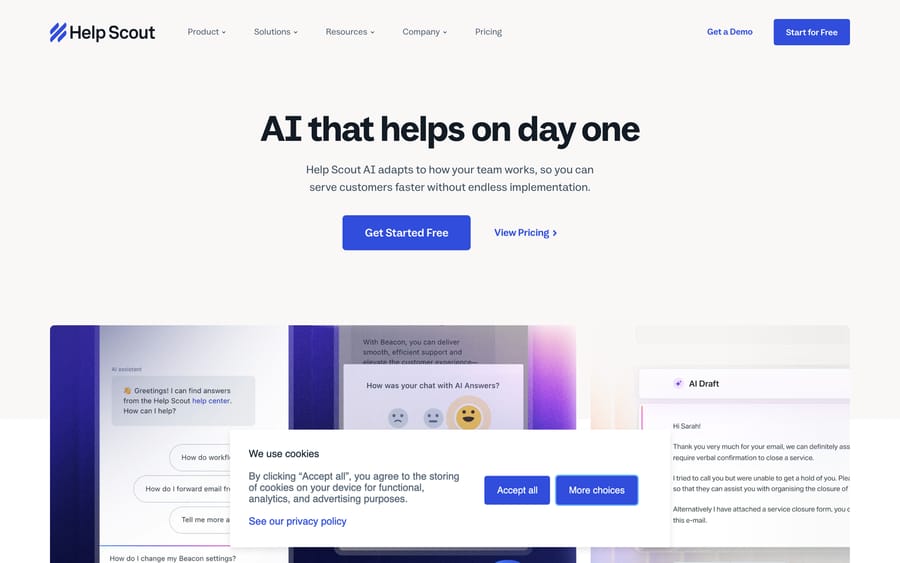
For a team already inside Crisp, Hugo is the native option to evaluate first, since it's already in the product and priced by the credit table above. Help Scout and Freshdesk each run a comparable bundled-AI model on a different help desk, covered in the Help Scout AI explainer and the Freshdesk AI explainer, useful context for seeing how native help-desk AI varies by vendor. For a team on one of Macha's four supported help desks that wants a similar automated outcome with a ticket-volume pricing model instead of a credit pool, see Macha's pricing.
If ticket volume, not conversation credits, is how a team wants to plan its AI budget, start a $50 free trial on a supported help desk to see the difference directly.
FAQ
What is Crisp AI? Crisp AI, branded Hugo, is the AI agent built into the Crisp help desk. It answers customer questions across chat, WhatsApp, Messenger, Instagram, and email, and assists human agents as an internal copilot, using content a team trains it on.
How much does Crisp AI cost? It's bundled into paid Crisp plans as a monthly credit allowance: $5 of AI credit (about 90 conversations) on the $45/mo Mini plan, $25 (about 450 conversations) on the $95/mo Essentials plan, and $75 (about 1,350 conversations) on the $295/mo Plus plan, all per workspace. The Free plan includes no AI credits.
Does Crisp have a free trial for its AI? Yes, a 14-day trial with no card required unlocks every Crisp feature, including Hugo.
What can Hugo actually do, versus just answer questions? Beyond answering from trained content, Hugo can take real actions through a team's connected integrations, such as checking account details, tracking orders, or issuing refunds, within rules the team defines.
What are the limits of Crisp's AI? It only acts through integrations a team has actually connected, it can still misstate something from imperfectly trained content without a tight escalation setup, and it's scoped entirely to the Crisp inbox, it doesn't extend to a different help desk or outside workflow system.
Is Hugo good or bad according to real users? Crisp holds 4.6/5 across 148 verified Capterra reviews, with reviewers praising responsive support and straightforward pricing. The recurring complaint is limited reporting depth, not AI answer quality, specifically the inability to export full transcripts or filter analytics by exact date ranges without extra work.
Is Macha an alternative to Crisp? No. Crisp is a help desk with its own bundled AI; Macha is an AI agent layer that runs on top of a help desk a team already uses (Zendesk, Freshdesk, Gorgias, or Front). A team on Crisp evaluates Hugo, not Macha, unless it's also moving its support stack to one of those four.
Does Crisp's AI work across every channel it supports? Yes, per Crisp's own site, Hugo deploys across web chat, WhatsApp, Messenger, Instagram, and email once trained and configured.
Sources: Crisp AI product page, Crisp pricing, Crisp help center: navigating the Hugo interface, Capterra Crisp reviews (checked 2026-09-15; Capterra blocks automated link checks, so it is cited without a link).
Automate your support workflows
Macha's agents run multi-step workflows across the tools you already connect.