







 Shopify
 Stripe
 Slack
 Notion
 Google Workspace
 Confluence


Gladly vs Salesforce Service Cloud (2026): Pricing, AI and Which One Fits


Pick Salesforce Service Cloud if your company already runs on Salesforce, your service cases need to sit next to sales, field service and billing data, and you have admins to configure it. Pick Gladly if you're a retail brand that wants voice, SMS, chat and email in one customer timeline, with less to build. Service Cloud lists editions from $25 to $550 a user a month, and new Agentforce buyers pay through Flex Credits, about $0.10 per standard action. Gladly publishes no platform price; its only public rate card charges $1.50 per AI resolution and $0.25 per AI assist. We checked every figure below on the vendors' own pages on 21 November 2026.
Key takeaways
- Salesforce Service Cloud suits companies already on Salesforce that need cases tied to CRM data, while Gladly suits retail brands that want voice, SMS and chat in one customer timeline.
- Service Cloud editions cost $25, $100, $195, $395 and $550 a user a month, and on Core and Advanced, messaging channels add $75 a user through Enhanced Messaging.
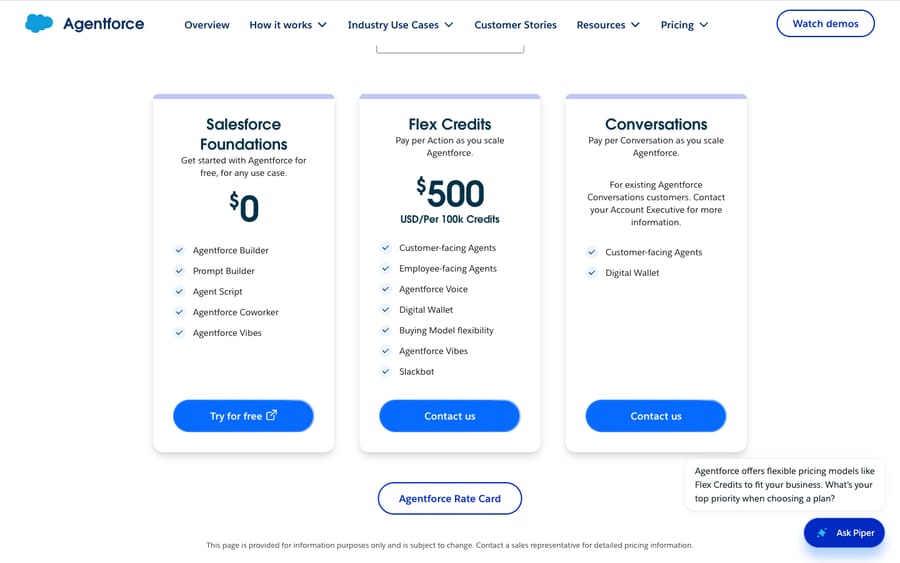
- Agentforce Flex Credits cost $500 per 100,000, which works out to $0.10 for a standard action and $0.15 for a voice action; the $2 per conversation option is for existing customers.
- Gladly's published self-serve AI rates are $1.50 per AI resolution and $0.25 per AI assist, and third-party trackers put its platform near $180 a seat with a 10-seat minimum.
- Macha runs inside Gladly at about $0.40 per ticket with setup and a dedicated success manager included, but Macha doesn't run on Salesforce Service Cloud.

Gladly vs Salesforce Service Cloud at a glance
| Gladly | Salesforce Service Cloud | |
|---|---|---|
| Built around | One lifelong conversation per customer | Cases on the Salesforce CRM platform |
| Published seat price | None; about $180 a seat with a 10-seat minimum (third-party) | Starter Suite $25, Pro Suite $100, Core $195, Advanced $395, Max $550 a user a month |
| Messaging channels | Included in the platform | Enhanced Messaging, +$75 a user a month on Core and Advanced |
| Customer-facing AI price | $1.50 per AI resolution, $0.25 per AI assist (Shopify listing) | Agentforce Flex Credits ($0.10 a standard action); $2 per conversation for existing Conversations customers |
| Voice | Native, with published per-minute rates | Service Cloud Voice; no price on the edition cards |
| Setup | G2 reviewers report about 2 months to implement | Typically Salesforce admins or a partner |
| G2 rating (21 Nov 2026) | 4.7 from 1,115 reviews | 4.4 from 8,467 reviews |
| Macha runs on it | Yes | No |
Sources: Service Cloud pricing, Agentforce pricing, Gladly pricing, Gladly on the Shopify App Store, all checked 21 November 2026.
How do Gladly and Salesforce Service Cloud prices compare?
Salesforce prints its editions. On 21 November 2026 the Service Cloud pricing page listed, per user a month:
| Edition | Price | Notes from the page |
|---|---|---|
| Starter Suite | $25 | Billed monthly or annually; "Transaction fees apply" |
| Pro Suite | $100 | Billed annually; contract required |
| Core | $195 | Billed annually |
| Advanced | $395 | Billed annually |
| Max | $550 | Billed annually; includes 2.75M Flex Credits per org per year |
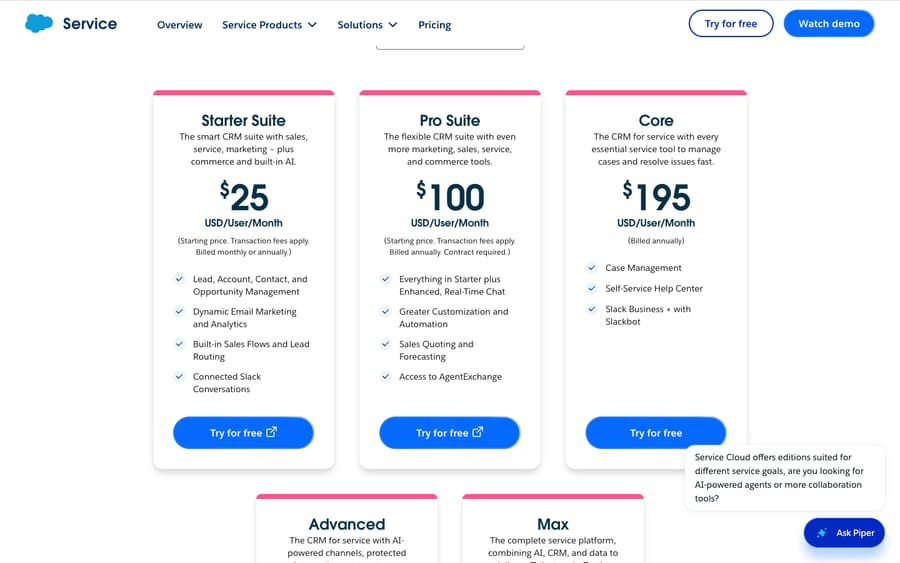
The edition price isn't the whole seat cost. Messaging channels (chat, WhatsApp, SMS and the like) come through Enhanced Messaging, which the page lists at an additional $75 a user a month on Core and Advanced. Core plus Enhanced Messaging is $270 a user before voice, AI or a partner's implementation fee. Our Zendesk vs Service Cloud comparison walks through the other add-ons.
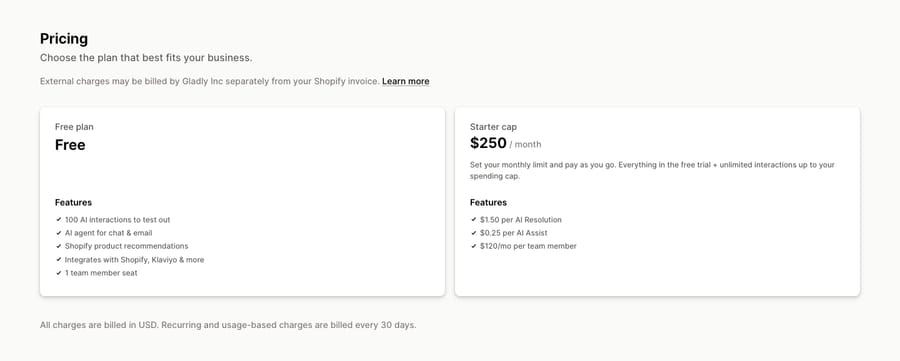
Gladly prints no edition prices. Its pricing page is a contact form, and its only public rate card is on its Shopify App Store listing: a Free plan (100 AI interactions, 1 seat) and a "Starter cap" with a $250 default monthly limit at $1.50 per AI Resolution, $0.25 per AI Assist and $120 a month per team member. For the full platform, eesel's Gladly pricing post (edited 17 June 2026) cites Hiver and smbguide for about $180 a seat a month, billed annually, with a 10-seat minimum. Gladly has renamed that package: a banner across the top of Gladly's help center pages (for example its channels page, as captured on 21 November 2026) says "Gladly Hero (the Platform) is now Gladly Team" and "Sidekick is now called Gladly (AI)". Our Gladly pricing guide has the full rate card.
A worked example: 20 agents, 1,800 AI-touched conversations
Assume 20 agents and an AI that touches 1,800 conversations a month, resolving 1,200 and handing 600 to a person.
Salesforce Service Cloud Core with Enhanced Messaging: 20 × ($195 + $75) = $5,400 a month in seats. For AI there are two meters, and Salesforce's page says they can't be used in the same org. The pricing card marks Conversations "for existing Agentforce Conversations customers", so a new buyer is on Flex Credits:
- Flex Credits (new buyers): if each conversation takes 4 standard actions (our assumption; a lookup, a policy check, a reply and an update), that's 7,200 actions × 20 credits = 144,000 credits a month, or 1,728,000 a year. Core includes 500,000 Flex Credits per org (the page doesn't give a period; we treat it as yearly, as it states for Max), and unused credits only lapse at the end of the subscription term, so you'd buy the other 1,228,000 in blocks of 100,000 at $500: 13 blocks, $6,500 a year, or about $540 a month.
- Per conversation (existing customers only): 1,800 × $2 = $3,600.
Gladly, on the published Shopify rates plus the third-party seat estimate: 20 × about $180 = about $3,600 in seats. AI: 1,200 × $1.50 + 600 × $0.25 = $1,950. That's about $5,550 a month, against about $5,940 on Service Cloud with Flex Credits ($9,000 for an existing customer on the $2 conversation meter). One caveat: the $1.50 and $0.25 rates are Gladly's only public AI prices, from a capped self-serve Shopify plan; a 20-seat contract is quoted by sales and may price AI differently.
The two Salesforce meters reward different things. The $2 conversation price is simple and caps your cost per customer, so it suits long, action-heavy conversations. Flex Credits charge per action, so Salesforce earns more the more steps an agent takes, and a short, well-designed agent costs far less. Gladly's meter is the only one of the three that charges less for a handoff than for a resolution, which pays the vendor for knowing when to stop. Seat-wise, Service Cloud's list price is higher than Gladly's estimate once you add messaging, and a company already paying for other Salesforce clouds may negotiate a different number.
What AI does each one sell?
Salesforce sells Agentforce, its agent platform, and since September 2026 it also owns Fin. Agentforce is priced on the Agentforce pricing page: Flex Credits at $500 per 100,000 (20 credits, or $0.10, for a standard action and 30, or $0.15, for a voice action), per-user Agentforce add-ons at $150 a user a month, and Max edition from $550 a user with 2.75 million Flex Credits a year included. Lower editions include some credits too: Core comes with 500,000 Flex Credits per org. A $2 per conversation meter still exists, but only for existing Agentforce Conversations customers. Our Agentforce pricing breakdown covers the edge cases.
Salesforce completed its acquisition of Fin, formerly Intercom, on September 10, 2026, and positions it alongside Agentforce. Fin's own pricing page lists Salesforce among the help desks Fin works with, at $0.99 per outcome with a 50-outcome monthly minimum. So a Service Cloud team now has two Salesforce-owned AI agents to choose between, priced on different meters. Our guide to building an AI agent for Service Cloud compares the routes.
Gladly sells Gladly AI (product names as listed on gladly.ai), configured through "Guides", plain-language workflows a CX team writes, plus a Commerce Agent and Shopping Assistant that sell in the chat, Voice AI on calls and Team Assist for human agents. Gladly bills two outcomes: per its performance dashboard documentation, a Resolved conversation is one where "Gladly AI resolved the Customer's inquiry without handing off to an Agent", an Assisted one is where it "provided at least one response to the Customer, but then handed off to an Agent", and conversations that were neither "are not considered Billable Conversations." Voice AI adds $0.06216 a minute on top of telephony, per Gladly's voice cost page (updated 3 August 2026). See our Gladly AI explainer.
Agentforce can act on anything in your Salesforce org, which is its strength, and getting there usually takes admins, Flow work and often a partner; our Service Cloud AI implementation guide covers that decision. Gladly's AI does less outside commerce and service, but a CX team can write its Guides without engineering.
Which channels does each support?
| Channel | Gladly | Salesforce Service Cloud |
|---|---|---|
| Yes | Yes (web and email case capture) | |
| Chat, WhatsApp, Messenger, SMS | Included | Through Enhanced Messaging, +$75 a user a month on Core and Advanced |
| Voice | Native; $0.01860 a minute local incoming (US) | Service Cloud Voice; no price on the edition cards |
| Yes | Through Enhanced Messaging | |
| Case and CRM data | Customer profile and timeline | Full Salesforce objects: accounts, contacts, orders, assets |
Gladly's channel documentation lists SMS/MMS, email, Instagram, Facebook Messenger, WhatsApp, voice and chat, and its features overview says "Voice is natively built into Gladly." Gladly also prints its telephony rates to five decimal places: $0.01860 a minute local incoming, $0.02794 toll-free, and $0.00273 per SMS segment on a local US number.
Service Cloud covers the same channels as separate purchases. Email comes in as cases, messaging is a paid add-on, and voice comes through Service Cloud Voice, which the edition cards don't price. The upside is that every channel lands on the same Salesforce records as the rest of the business. A retail brand that also runs field repairs, B2B wholesale accounts and a loyalty program in Salesforce gets one data model. A brand that mostly answers "where's my order" by phone and text gets a lot of platform it won't use.
What do users say about Gladly and Service Cloud?
On G2, checked 21 November 2026, Gladly rates 4.7 out of 5 from 1,115 reviews and Salesforce Service Cloud 4.4 from 8,467. Gladly's listing shows reviewer-reported averages of about 2 months to implement, 12 months to see a return, and an 11% average discount off list. Our Gladly review covers what those reviewers praise and complain about.
How do security, integrations, reporting and switching compare?
Security. Gladly's security page lists SOC 2 Type II, PCI DSS, HIPAA, GDPR and CCPA, with AES-256 encryption and data encrypted at rest and in transit. Salesforce's pricing page comparison table includes Security Center and Data Detect on Advanced and Max, sells them as add-ons on Core, and doesn't offer them on Starter Suite or Pro Suite.
Integrations. Service Cloud sits on Salesforce's platform, and the Pro Suite card lists "Access to AgentExchange", Salesforce's marketplace. G2 shows 55 integrations verified by Gladly, and Gladly's help center says its BigCommerce integration is built and maintained by Gladly. If your customer data already lives in Salesforce, that's the deciding factor.
Reporting. Salesforce reports run on the same objects as the rest of the CRM. Gladly's custom reporting runs through Insight Builder, a paid add-on, and its billing documentation bills Analyst roles per license.
Voice. Gladly publishes per-minute telephony and Voice AI rates. The Service Cloud edition cards we captured carry no Service Cloud Voice price, so get that in writing from Salesforce.
Seat tiers. The third-party $180 figure is Gladly's base package. eesel's Gladly pricing post also cites Kustomer's comparison page for a Superhero tier at about $210 a seat with a 45-seat minimum. Neither is on Gladly's site.
Switching. Moving from Gladly to Service Cloud means turning each customer timeline into contacts with case history, rebuilding Guides as Agentforce topics or Flows, and replacing Gladly's native voice with Service Cloud Voice and a telephony setup. Moving the other way is lighter on configuration but loses any case links to Salesforce sales or service objects.
Who should pick Gladly, and who should pick Service Cloud?
Gladly fits teams that:
- are a retail or DTC brand where most contacts are repeat shoppers asking about orders, returns and products;
- take a lot of calls and texts and want them native, with readable telephony costs;
- want the AI to sell in the chat, not only answer;
- don't have, or don't want to depend on, Salesforce admins.
Gladly is the wrong fit if service cases need to share records with sales, field service or billing in Salesforce, or if you need a permissions and audit model your IT team already governs.
Salesforce Service Cloud fits teams that:
- already run Salesforce as the system of record for customers;
- handle complex cases (warranty, B2B accounts, field service) that move between departments;
- have admins or a partner to configure Flows, routing and Agentforce;
- want AI that can act on any Salesforce object, and can model Flex Credit usage.
Service Cloud is the wrong fit if you're a 15-person retail support team that needs phones, texts and chat working next month.
Where Macha fits
Macha is an AI agent layer that runs inside the help desk you already use. It runs on Gladly. It doesn't run on Salesforce Service Cloud, so if you choose Service Cloud, your AI options are Salesforce's own Agentforce or Fin, which Salesforce now owns. Macha runs on Zendesk, Freshdesk, Gorgias, Front, Gladly, Crisp, HubSpot and Intercom.
On Gladly, Macha connects with an API token (Gladly integration) and works the full conversation:
- reads the conversation, its messages and the customer profile, including custom attributes;
- replies on the customer's channel, or drafts the reply as an internal note for review (safe mode);
- adds Gladly topics, changes status, and reassigns to an agent or inbox;
- sends outbound messages to existing customers on email, SMS or chat;
- starts automatically on a new conversation or a new customer message;
- looks up orders in Shopify and payments in Stripe through Macha's other connectors, as in answering Gladly order-status questions with Shopify.
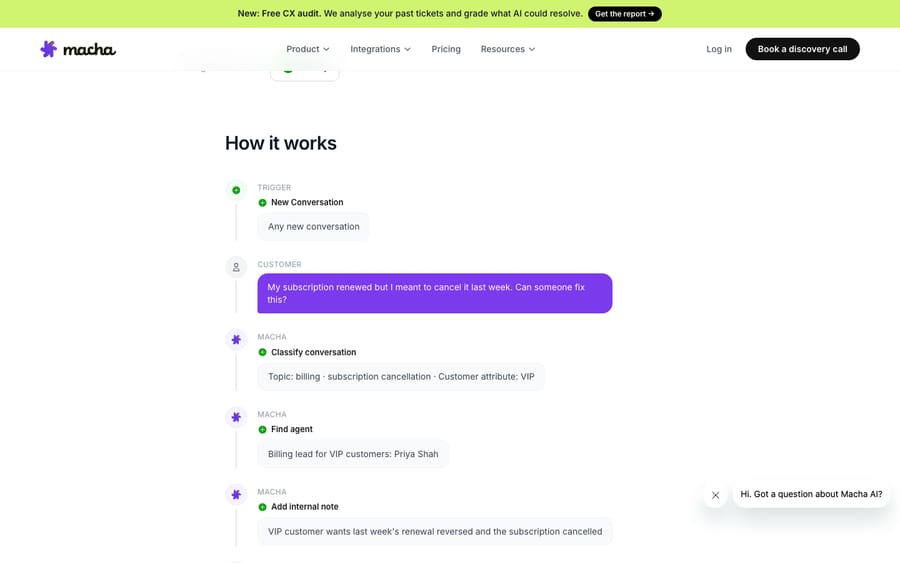
For the mechanics on Gladly, see how Gladly internal notes work, what the Gladly API exposes, and how to automate order status in Gladly.
Macha charges about $0.40 per ticket: one thread with one person is one charge, however many replies or tool calls it takes, so there's no action meter to model. The one limit is fair use: up to 50 messages per ticket. That price includes setup and a dedicated success manager who handles your changes. The Macha team analyzes your past conversations, builds the knowledge base and the agent, and runs it in safe mode until the drafts are right, on every plan and on the trial, which is $50 of free usage (about 125 tickets), no credit card, no time limit. That's the main contrast with an Agentforce rollout, where your admins or a partner do the build. See done for you and Macha on Gladly.
Macha suits a Gladly team that wants an AI agent set up and managed for it, priced per conversation rather than per action or per outcome.
Common questions
Is Gladly cheaper than Salesforce Service Cloud?
On list prices and third-party estimates, yes. Service Cloud Core is $195 a user plus $75 for Enhanced Messaging, against about $180 a seat for Gladly per third-party trackers. In our 20-agent example, Gladly came to about $5,550 a month and Service Cloud to about $5,940 with Agentforce on Flex Credits. Existing Salesforce customers may negotiate different terms.
What does Agentforce cost?
Salesforce's Agentforce pricing page lists Flex Credits at $500 per 100,000, with 20 credits for a standard action and 30 for a voice action. The $2 per conversation meter is offered only to existing Agentforce Conversations customers. Agentforce add-ons are $150 a user a month, and the Max edition from $550 a user includes 2.75 million Flex Credits a year.
Does Salesforce own Intercom now?
Yes. Salesforce completed its acquisition of Fin, the company formerly named Intercom, on September 10, 2026. Fin's pricing page lists Salesforce among the help desks Fin works with.
Can Macha run on Salesforce Service Cloud?
No. Macha runs on Gladly and the other help desks on its integrations list, but not on Service Cloud. On Service Cloud, the AI options are Agentforce and Fin.
Can Gladly replace Salesforce Service Cloud?
For a retail brand whose service is mostly orders, returns and product questions across phone, text and chat, often yes. If service cases share records with sales, field service or B2B accounts in Salesforce, replacing Service Cloud means rebuilding those links, and most companies in that position keep Salesforce. Our Gladly alternatives roundup and Gladly vs Zendesk cover the other options.
How we researched this
We checked every price on 21 November 2026 on the vendors' own pages: Service Cloud pricing, Agentforce pricing, Fin pricing, Salesforce's Fin press release, Gladly pricing (no prices), Gladly on the Shopify App Store, and Gladly's help center pages on billable conversations, voice and SMS costs, channels and features. Gladly's seat estimate comes from eesel's Gladly pricing post, citing Hiver and smbguide, and is labeled approximate. G2 figures come from G2's Gladly and Salesforce Service Cloud listings, read through Wayback Machine copies saved on 21 November 2026 because G2 blocks automated requests.
The worked example is our own arithmetic on published list prices; the four actions per conversation in the Flex Credits line is an assumption, not a Salesforce figure. Macha's Gladly capabilities come from Macha's own connector (the screen above) and its integration listing; we didn't run a live Gladly conversation for this post.
To try Macha inside your Gladly account, start a trial or see pricing.