







 Shopify
 Stripe
 Slack
 Notion
 Google Workspace
 Confluence


Gladly vs Zendesk (2026): Pricing, AI and Which One Fits Your Brand


Pick Gladly if you're a retail or ecommerce brand with a voice and SMS heavy team that wants every customer's history in one running conversation. Pick Zendesk if you want a published price, a ticket queue that several teams can share, and an ecosystem Zendesk puts at "1,800+ apps, partners and integrations", against 55 Gladly-verified integrations on G2. Zendesk lists seats from $19 to $115 an agent a month and charges $2.00 per automated resolution pay-as-you-go. Gladly publishes no platform price at all; its only public rate card, on the Shopify App Store, charges $1.50 per AI resolution, $0.25 per AI assist and $120 a month per seat. Every price below was checked on the vendor's own page on 21 November 2026.
Key takeaways
- Gladly suits retail brands that run voice, SMS and chat as one customer thread, while Zendesk suits teams that need published pricing and a shared ticket queue.
- Zendesk Suite seats cost $55 or $115 an agent a month billed annually, with automated resolutions at $2.00 pay-as-you-go and Copilot at $50 an agent on Professional and higher.
- Gladly's own pricing page lists no prices; its Shopify App Store plan charges $1.50 per AI resolution, $0.25 per AI assist and $120 a month per team member.
- Gladly's help center lists Gladly AI for Zendesk, which runs Gladly's AI agent through its own Zendesk seat on Team, Professional or Enterprise plans, so Gladly's AI no longer requires leaving Zendesk.
- Macha runs inside both Gladly and Zendesk at about $0.40 per ticket, with setup and a dedicated success manager from the Macha team included on the trial and every plan.

Gladly vs Zendesk at a glance
| Gladly | Zendesk | |
|---|---|---|
| Data model | One lifelong conversation per customer, no tickets | Tickets, one per request |
| Published seat price | None on gladly.ai; about $180 a seat with a 10-seat minimum per third-party trackers | Support Team $19, Suite Team $55, Suite Professional $115 an agent a month (annual) |
| Self-serve plan | Shopify App Store: Free (100 AI interactions, 1 seat) and a $250 monthly spending cap | Monthly billing at $25, $69 and $149 |
| AI price | $1.50 per AI resolution, $0.25 per AI assist (Shopify listing) | $2.00 per automated resolution pay-as-you-go; Copilot $50 an agent (Professional and higher) |
| Voice | Native, with published per-minute rates | Telephony included on Suite plans |
| G2 rating (checked 21 Nov 2026) | 4.7 from 1,115 reviews | 4.3 from 7,131 reviews (Zendesk for Customer Service) |
| Best for | Retail and DTC brands, 10+ agents, phone and SMS heavy | Most support teams, B2B and B2C, any size |
| Macha runs on it | Yes | Yes |
Sources: zendesk.com/pricing, gladly.ai/pricing, Gladly on the Shopify App Store, all checked 21 November 2026.
How do Gladly and Zendesk prices compare in 2026?
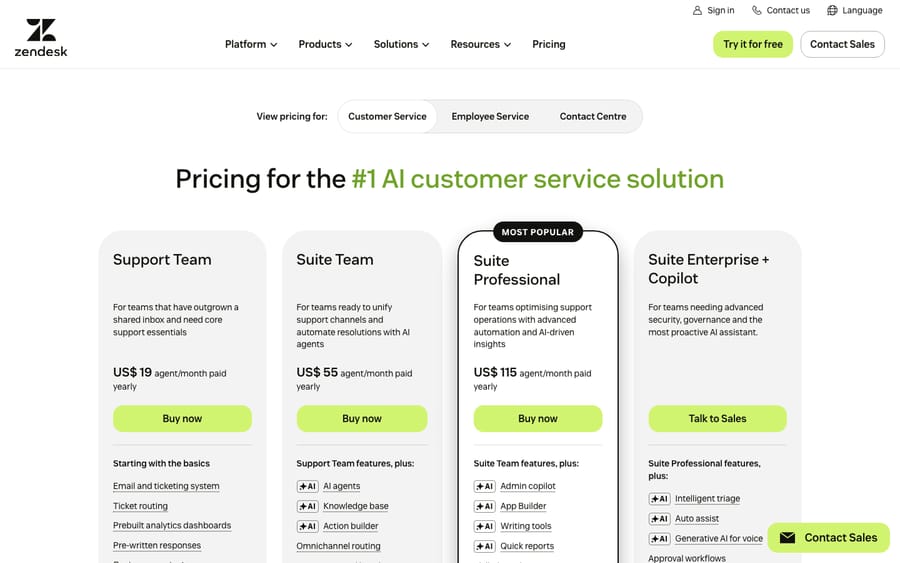
Zendesk prints its price ladder. On 21 November 2026 its pricing page listed, per agent a month:
| Zendesk plan | Billed annually | Billed monthly | Automated resolutions included |
|---|---|---|---|
| Support Team | $19 | $25 | 5 per agent a month |
| Suite Team | $55 | $69 | 5 per agent a month |
| Suite Professional | $115 | $149 | 10 per agent a month |
| Suite Enterprise | Talk to sales | Talk to sales |
Past the included allowance, automated resolutions cost $2.00 each on pay-as-you-go. Zendesk also sells a committed pack at a lower rate; from our location the page showed that rate in pounds, so we haven't quoted it in dollars. Copilot, the agent-facing AI, is a $50 per agent a month add-on, paid yearly, and Zendesk's page says it "can be added to Professional and higher plan levels." Our Zendesk pricing guide walks through every add-on.
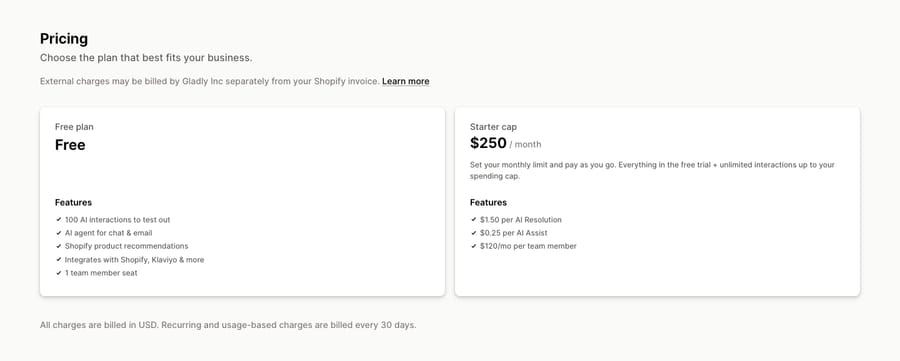
Gladly prints nothing. Its pricing page on gladly.ai is a "Contact sales" form. The only rate card Gladly publishes is on its Shopify App Store listing, which carries two self-serve plans:
- Free: 100 AI interactions to test, the AI agent for chat and email, Shopify product recommendations, and 1 team member seat.
- Starter cap: you set a monthly spending limit ($250 by default) and pay as you go at $1.50 per AI Resolution, $0.25 per AI Assist and $120 a month per team member.
For the enterprise platform, the numbers in circulation are third-party. eesel's Gladly pricing post (edited 17 June 2026) cites Hiver and smbguide for the Hero package at about $180 a seat a month, billed annually, with a 10-seat minimum, so roughly $1,800 a month before any AI. Gladly has since renamed things: a banner across the top of Gladly's help center pages (for example its channels page, as captured on 21 November 2026) says "Gladly Hero (the Platform) is now Gladly Team" and "Sidekick is now called Gladly (AI)", so expect a quote under the new names. Treat that as a starting point for a sales call, not a quote. Gladly's own billing documentation confirms the structure, if not the price: four invoice types (Subscription, Renewal, Monthly Telephony Platform and Monthly True-Up), and seats billed by what a person does. A "Task user" who replies to a customer gets billed as a Support user, which is how a busy month shows up on the True-Up invoice. We cover the full rate card in our Gladly pricing guide.
A worked example: 20 agents, 3,000 conversations, 40% handled by AI
Assume 20 agents, 3,000 customer conversations a month, the AI resolving 1,200 of them and assisting on another 600 before a handoff.
Zendesk Suite Professional: 20 × $115 = $2,300 in seats. The plan includes 10 automated resolutions per agent, so 200 of the 1,200 are covered and 1,000 bill at $2.00 = $2,000. That's $4,300 a month, or $5,300 with Copilot on every seat (Copilot needs Professional or higher, which this is).
Gladly, on the published Shopify rates plus the third-party seat estimate: 20 × about $180 = about $3,600 in seats. AI: 1,200 × $1.50 = $1,800, plus 600 × $0.25 = $150. That's about $5,550 a month. Enterprise contracts negotiate these rates, so the real figure could land lower, but nobody outside a Gladly contract can tell you by how much.
The structural difference sits in that $150 line. Zendesk charges nothing for a conversation its AI touched and then handed over; Gladly charges a quarter for it. A vendor paid only on full resolutions has an incentive to have its AI hold onto conversations it should hand off. Gladly's assist fee pays it for handing off well, which is a better incentive for the customer on the other end, even if the invoice carries an extra line.
What AI does each one sell, and what does it cost?
Zendesk includes AI agents in every Suite and Support plan and meters them by automated resolution: a monthly allowance per seat, then $2.00 each pay-as-you-go. Copilot adds suggested replies, summaries and auto-assist for human agents at $50 an agent, on Professional and higher. Our Zendesk AI pricing breakdown has the plan-by-plan detail.
Gladly sells Gladly AI, built around "Guides", step-by-step workflows that a CX team writes in plain language, plus a Commerce Agent and Shopping Assistant that sell inside the chat, Voice AI on calls and Team Assist for human agents. Gladly bills two outcomes. Its performance dashboard documentation defines a Resolved conversation as one where "Gladly AI resolved the Customer's inquiry without handing off to an Agent", an Assisted one as where it "provided at least one response to the Customer, but then handed off to an Agent", and says conversations that were neither "are not considered Billable Conversations." Voice AI is metered separately: Gladly's voice cost page (updated 3 August 2026) lists $0.06216 a minute on top of the telephony rate, charged only while Voice AI is active.
Older comparison posts quote Gladly's AI, then sold as Sidekick (now Gladly (AI), per Gladly's help center), at about $0.60 per conversation. Gladly's own pages no longer print that figure, so we haven't used it in the arithmetic. Our Gladly AI explainer covers what the AI automates and where it stops.
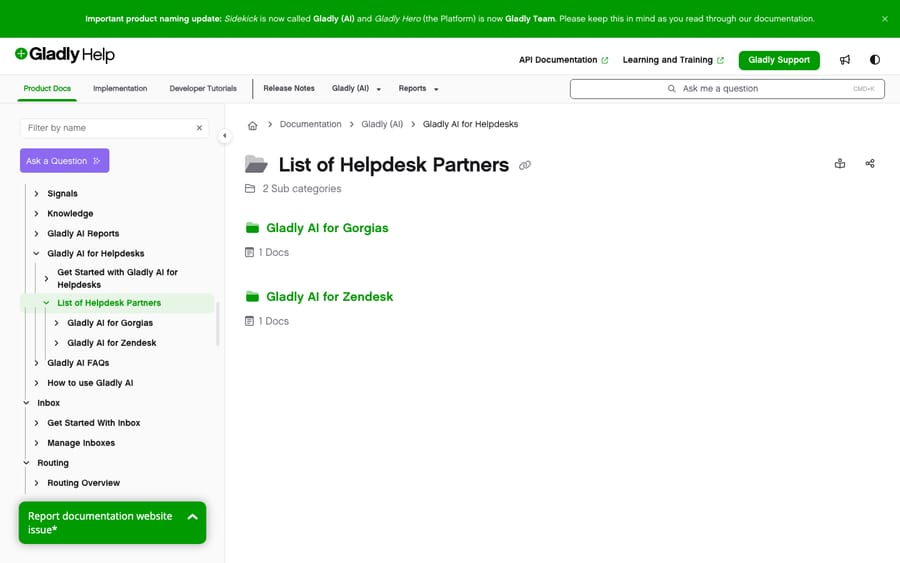
Gladly now sells its AI for other help desks. Its Gladly AI for Helpdesks page calls it "an add-on feature" used "in conjunction with your existing helpdesk", lists no price, and says to contact Gladly or your customer success manager. Its help center lists two partners: "Gladly AI for Zendesk" and "Gladly AI for Gorgias". The Zendesk setup guide says "Zendesk requires a Team, Professional, or Enterprise plan to enable this integration" and that "Gladly needs its own Zendesk seat to read and reply to customer tickets", so budget one Zendesk seat for the AI. So "Gladly vs Zendesk" is now two questions: which help desk your agents work in, and which AI answers your customers. You can pick Zendesk for the first and Gladly for the second.
Which channels does each support?
Both cover the channels a retail team needs. They differ in what's in the base price.
| Channel | Gladly | Zendesk |
|---|---|---|
| Yes | Every plan | |
| Chat | Gladly Chat, with FAQs in the widget | Messaging and live chat on Suite plans |
| Voice | Native; published per-minute rates | Telephony on Suite plans |
| SMS | SMS/MMS, published per-segment rates | Add-on on Suite plans |
| Facebook Messenger, Instagram, WhatsApp | Yes | Social and business channels on Suite plans |
Gladly's channel documentation lists SMS/MMS, email, Instagram, Facebook Messenger, WhatsApp, voice and chat, and its features overview says "Voice is natively built into Gladly." Gladly also publishes its telephony rates: $0.01860 a minute for local incoming calls and $0.02794 toll-free, with SMS at $0.00273 a segment on a local US number. Zendesk's pricing page puts messaging, live chat, telephony and social channels on the Suite plans and keeps Support Team to email.
The bigger difference is what a channel switch looks like to an agent. In Gladly, a customer who emails on Monday and calls on Thursday is in one conversation timeline, and the agent sees both. In Zendesk, those are two tickets that Zendesk can link by requester, and an agent opens the user profile to see the history. Zendesk's model is better when a request needs to move between teams with its own status and SLA. Gladly's is better when the same shopper comes back again and again.
Who should pick Gladly, and who should pick Zendesk?
Gladly fits teams that are:
- a retail, apparel, beauty or DTC brand where repeat shoppers make up most of the volume;
- phone and SMS heavy, and want voice in the same product as chat and email;
- at 10 or more agents and able to sign an annual contract through sales;
- interested in AI that sells (recommendations, in-chat checkout) as well as answers.
Gladly is the wrong fit if you need a price before a sales call, you're a B2B or SaaS team with tiered SLAs and escalations to engineering, or you depend on a long tail of marketplace apps.
Zendesk fits teams that are:
- any size, from 2 agents on Support Team to large Enterprise accounts;
- running structured queues where a request moves between tiers, teams or brands;
- relying on an app ecosystem (Zendesk's pricing page advertises 1,800+ apps, partners and integrations) for QA, workforce management, CRM sync and more;
- wanting to see the price and the AI rate before talking to anyone.
Zendesk is the wrong fit if your agents mostly spend their day on repeat phone calls from the same shoppers, or if the per-resolution rate makes every AI answer feel expensive.
A note on the queries we see: people search for how Gladly compares to Zendesk "for a retail brand moving into agentic commerce." That phrase usually means AI that can find a product, apply a discount and complete a purchase inside the chat. Gladly sells that directly (it reports a 19% conversion lift and 41% of carts saved, vendor-reported figures we haven't verified). Zendesk's AI agents focus on service. If commerce inside the conversation is the deciding feature, Gladly is ahead.
What do users say about Gladly and Zendesk?
On G2, checked 21 November 2026, Gladly rates 4.7 out of 5 from 1,115 reviews and Zendesk's main listing (Zendesk for Customer Service) rates 4.3 from 7,131. The gap in review counts mostly reflects market size: Zendesk sells to far more teams.
G2 groups Zendesk's reviews into themes. The top praise is an intuitive interface, efficient ticket management and unified omnichannel support. The top complaints are that it gets expensive as teams grow and has a steep learning curve. G2's summary of what Zendesk reviewers want next says the same thing from the admin's chair: simpler setup and onboarding for new administrators, and reporting that makes custom metrics and dashboards easier to build. Gladly's listing shows reviewer-reported averages instead: about 2 months to implement, 12 months to see a return, and an average discount of 11% off list. Take that last figure into the negotiation.
Gladly's Shopify App Store reviews (4.7 from 29) add the small-team view. A pet-supplies brand that left a 4-star review in January 2026 said Gladly was a big improvement on its previous help desk but is built for large companies, so a small team has to work around enterprise features; Gladly replied in June 2026 that it had launched a version for smaller businesses. A supplements brand with over three years on the app called the switch easy and liked having every channel in one place with no tickets, just conversations.
Where Macha fits
Macha isn't a help desk, so it doesn't compete with either. It's an AI agent layer that runs inside the help desk you already use. Macha runs on Zendesk, Freshdesk, Gorgias, Front, Gladly, Crisp, HubSpot and Intercom, so it works on both sides of this comparison, and the Gladly setup is described on the Gladly integration page.
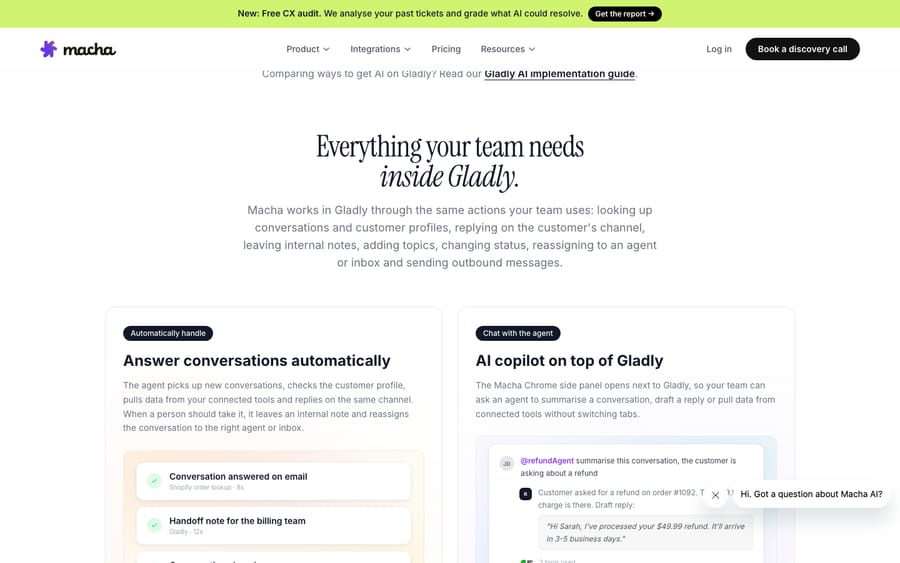
On Gladly, Macha connects with an API token and works the full conversation:
- reads the conversation, its messages and the customer profile, including custom attributes;
- replies to the customer on the channel they used;
- drafts replies as internal notes for review (safe mode), so nothing reaches a customer until you approve that category;
- adds Gladly topics, changes status, and reassigns to an agent or inbox;
- sends outbound messages to an existing customer on email, SMS or chat;
- starts automatically on a new conversation or a new customer message.
For the mechanics on Gladly, see how Gladly internal notes work, what the Gladly API exposes, and how to automate order status in Gladly.
It also looks up orders in Shopify and payments in Stripe through Macha's other connectors, which is what an order-status answer needs; see answering Gladly order-status questions with Shopify and drafting Gladly replies as internal notes. On Zendesk, Macha does the same jobs with Zendesk's own objects: internal notes, public replies, tags, status and custom fields (Macha on Zendesk).
The pricing logic is where it differs from both vendors. Macha charges about $0.40 per ticket: one thread with one person is one charge, however many replies it takes, and whether the agent resolves it or hands off. Macha's tiers are $299 a month for 750 tickets, $599 for 1,500, $1,199 for 3,000, $1,999 for 5,000, $2,999 for 7,500 and $3,999 for 10,000, with custom pricing above that. In the worked example above, the AI touches 1,800 conversations, which falls in the 3,000-ticket tier, and that tier covers resolutions and handoffs alike, where Zendesk charges $2.00 per resolution and Gladly $1.50 plus $0.25 per assist. That price includes setup and a dedicated success manager who handles your changes. The Macha team analyzes your past conversations, builds the knowledge base and the agent, and runs it in safe mode until the drafts are right. That's the done-for-you part, and it's on every plan and on the trial, which is $50 of free usage (about 125 tickets), no credit card, no time limit. More on the setup at done for you, and the Gladly specifics at Macha on Gladly.
Macha suits a team that has already picked its help desk, or is about to, and wants an AI agent working inside it without a second contract with the help desk vendor.
Common questions
Is Gladly cheaper than Zendesk?
Probably not. Zendesk Suite Professional is $115 an agent a month, published; Gladly's seat is about $180 per third-party trackers, with a 10-seat minimum. On AI, Gladly's published $1.50 per resolution is below Zendesk's $2.00 pay-as-you-go rate, but Gladly also charges $0.25 per assist. In our 20-agent example, Zendesk came to $4,300 a month and Gladly to about $5,550.
Can you use Gladly's AI on Zendesk?
Yes. Gladly's help center lists "Gladly AI for Zendesk" as one of two helpdesk partners, alongside Gorgias. Gladly describes it as an add-on with no published price. Zendesk needs to be on a Team, Professional or Enterprise plan, and Gladly's AI uses its own Zendesk seat.
Does Gladly use tickets?
No. Gladly organizes support around the customer: one conversation timeline that carries every email, chat, call and text. Zendesk creates a ticket per request and links them through the requester's profile.
Which is better for retail and ecommerce?
Gladly, for brands with repeat shoppers, phone and SMS volume, and an interest in AI that sells in the chat. Zendesk is the safer choice when you need published pricing, many marketplace apps, or queues shared across teams. Both connect to Shopify.
Is migrating from Zendesk to Gladly hard?
Plan it as a project: Zendesk's tickets have to become Gladly's customer timelines, and macros, triggers and views need rebuilding as Gladly's rules and inboxes. Our Gladly AI implementation guide covers how to plan the rollout. G2's Gladly listing puts the reviewer-reported time to implement at 2 months. If you're still choosing, our Gladly alternatives roundup and what is Gladly explainer cover the wider field, and our Gladly review sums up what users like and complain about. If you'd rather hand the rollout to an agency, we compared Gladly implementation partners and their published prices.
How we researched this
We checked every price on 21 November 2026 from the vendor's own page: Zendesk pricing, Gladly pricing (no prices), Gladly on the Shopify App Store (rated 4.7 from 29 reviews), and Gladly's help center pages on billing, billable conversations, voice and SMS costs, channels and helpdesk partners. Gladly's seat price and minimum come from eesel's Gladly pricing post, which cites Hiver and smbguide; they're labeled approximate everywhere we use them. Gladly's conversion and cart figures are vendor-reported from gladly.ai. G2 ratings and Gladly's implementation, ROI and discount averages come from G2's Gladly and Zendesk for Customer Service listings, read through Wayback Machine copies saved on 21 November 2026 because G2 blocks automated requests. Review paraphrases come from Gladly's Shopify App Store reviews, read the same day; Zendesk's ecosystem figure is from the navigation on its pricing page. Gladly's AI for Helpdesks, Zendesk setup and features overview pages were also checked that day.
The worked example is our own arithmetic on those published rates at a stated volume, not a customer's bill. The Macha capabilities come from Macha's own Gladly connector (the screen above) and its integration listing; we didn't run a live Gladly conversation for this post. We see Search Console queries for "gladly vs zendesk" and for retail and agentic-commerce comparisons, which is why the fit section addresses them directly.
To see Macha working inside your Gladly or Zendesk account, start a trial or compare the plans on pricing.