Intercom
 Shopify
 Stripe
 Slack
Slack Notion
 Google Workspace
 Confluence

How Much Does Agentforce Cost in 2026? Flex Credits, $2 Resolutions and Real Bills


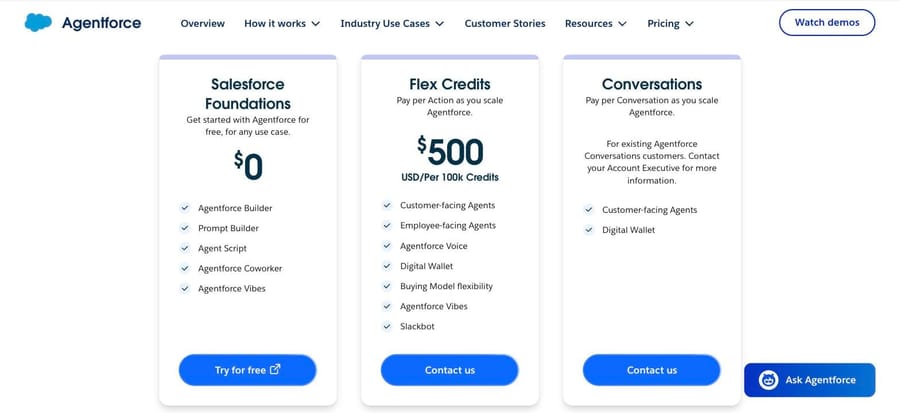
Agentforce is priced three ways: Flex Credits at $500 per 100,000 (20 credits, or 10 cents, per action), a $2 charge per resolved Help Agent conversation, and per-user licenses from $5 to $550 a month. A service agent taking three actions per conversation costs about $300 a month at 1,000 conversations and $6,000 at 20,000, before Salesforce seats, Data 360 and voice.
Key takeaways
- Agentforce costs 10 cents per action on Flex Credits, sold at $500 per 100,000 credits with 20 credits per action, or $2 per resolved Help Agent conversation, or $5 to $550 per user a month.
- A Help Agent conversation only bills as a resolved $2 session if it has at least two turns, the user's final feedback isn't explicitly negative, and the session ends without escalating to a human.
- At 5,000 conversations a month with three actions each, Flex Credits cost $1,500, while the Help Agent model at a 60% resolution rate costs $6,000 for the same volume.
- Flex Credits and Help Agent pricing meet at 12 actions per conversation at a 60% resolution rate, so per-action billing beats per-resolution billing for almost any agent needing fewer actions than that.
- A voice action costs 30 Flex Credits (15 cents) versus 20 for text, and a resolved Help Agent voice call is capped at 10 minutes per $2 resolution, so a 12-minute call bills $4.

Agentforce costs 10 cents per agent action on Flex Credits ($500 per 100,000 credits, 20 credits an action), $2 per resolved conversation on Salesforce's Help Agent, or $5 to $550 per user a month on per-user licenses. At 5,000 conversations with three actions each, Flex Credits come to $1,500 a month at list price, before Salesforce seats.
| Plan or unit | Price (list, USD) | How it's billed | What it covers | Limits and caveats |
|---|---|---|---|---|
| Salesforce Foundations | $0 | Included | Agentforce Builder, Prompt Builder, Agent Script, a starter credit grant | Needs Enterprise, Performance, Unlimited or Developer edition |
| Flex Credits | $500 per 100,000 credits | PayGo, Pre-Commit or Pre-Purchase | Customer-facing and employee agents, voice, Slackbot | 20 credits per action (30 for voice); no rollover |
| Help Agent resolution | 400 Flex Credits ($2) | Per resolved session | Salesforce's customer-facing Help Agent, actions and Data 360 queries included | Unresolved sessions free; 2-hour and 10-minute caps |
| Leads Worked (Buyer Engagement Agent) | 400 Flex Credits ($2) | Per lead engaged | Salesforce's sales agent on web, email, SMS and WhatsApp | Two per web chat that tries to create a lead; 320 credits in sandbox |
| Conversations | Not shown to new buyers | Per conversation | Customer-facing agents | "For existing Agentforce Conversations customers" |
| Agentforce User License | $5 per user per month | Per seat, plus credits | Agentforce access for every employee | Requires Flex Credits; metered usage |
| Agentforce add-ons (Sales, Service, Field Service) | $125 per user per month | Per seat | Unmetered employee usage | Employee-facing; not sold on PayGo or Pre-Commit |
| Agentforce Industries add-ons | $150 per user per month | Per seat | Unmetered usage plus industry AI | Employee-facing |
| Agentforce 1 Editions | From $550 per user per month | Per seat, annual | Add-on included, 2.5M Flex Credits per org per year | Service Cloud's page lists Max at 2.75M credits |
Prices checked 19 September 2026 on Salesforce's Agentforce pricing page and the Flex Credits rate card dated August 31, 2026. We rechecked the pricing page on 24 September 2026: Flex Credits, the per-action rates and every per-user price were unchanged, and the Conversations card still hides its price behind "For existing Agentforce Conversations customers".
Our Agentforce complete guide covers what the product does. This page covers only what it costs and why.
How does Agentforce bill: per action, per resolution or per seat?
Salesforce sells the same agents under three meters, and the choice decides your bill more than volume does.
Flex Credits: you pay per action the agent runs
A Flex Credit costs half a cent ($500 ÷ 100,000). The rate card charges 20 credits for a standard or custom action in production, so every action is 10 cents. A voice action is 30 credits, or 15 cents.
What counts as an action is defined in Salesforce Help's Flex Credits Billable Usage Types article. An action is a function the agent calls to fetch information or do something: look up an order, answer from knowledge, update a case, run a Flow. Each call is metered once "irrespective of the number of tokens processed", so a long answer costs the same as a short one. Utilities aren't billed: escalating to a human, setting a variable and moving to another topic are free. Actions are billed whether the agent picks them through LLM reasoning or runs them deterministically from your instructions. Custom actions meter the same way, with one caveat in the Help article: "Async calls to Salesforce AI in custom action implementation may incur additional charges."
That makes your agent design a pricing input. A conversation where the agent classifies the topic, answers from one knowledge action and hands off costs 10 cents. The same conversation with a customer lookup, an order lookup, a knowledge answer and a case update costs 40 cents.
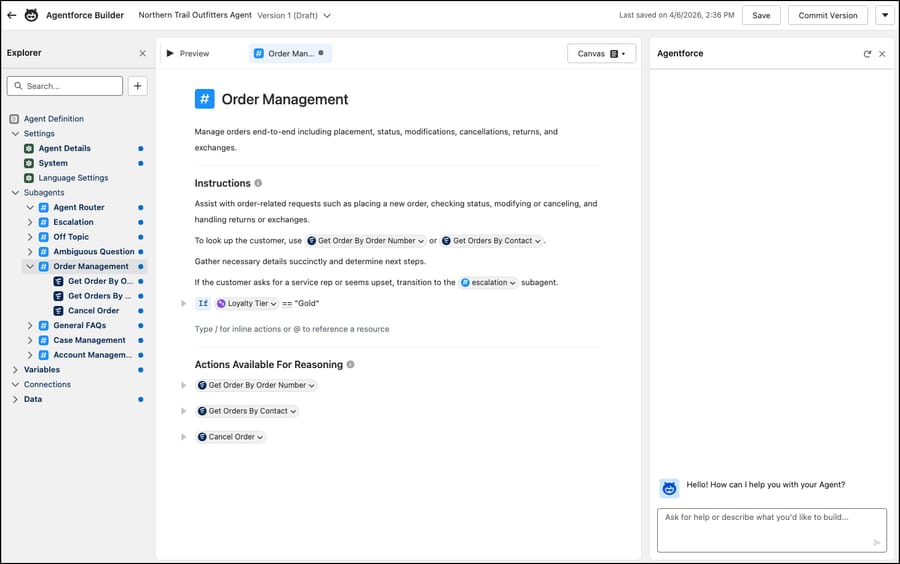
Salesforce's own Trailhead walkthrough shows how the count builds. Its sample Order Management subagent lists three actions available for reasoning: get an order by number, get orders by contact, and cancel an order. Each call to one of them is 20 credits in production. The builder's Live Test mode then traces every step of a test conversation, and only some of those steps bill.
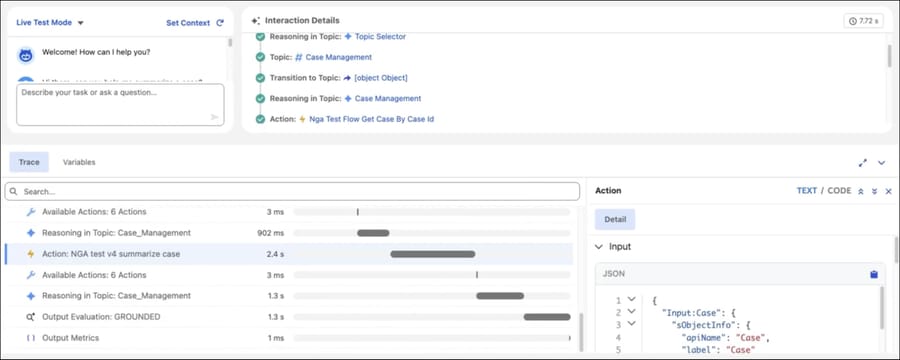
In that trace, topic selection and the transition to a new topic are free utilities. The lines marked Action, such as the Flow that fetches a case by its ID, are the billable ones, 20 credits each.
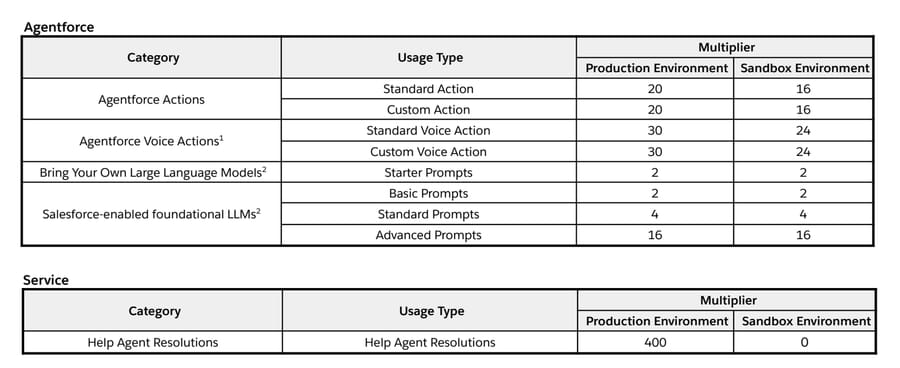
The rate card also prices things the pricing page doesn't mention. Sandbox testing is discounted to 16 credits per action. Prompts sent to Salesforce's language models by embedded AI features, such as Service Replies drafted for your human reps, cost 2, 4 or 16 credits per 2,000-token chunk depending on the model tier (Basic, Standard, Advanced). Salesforce Help says Advanced Prompts started metering on July 21, 2026. Speech-to-text is 150 credits per hour of transcription. Slackbot actions are priced per Slack workspace: 40 credits ($0.20) for a standard action and 200 ($1.00) for an advanced one. Text-to-speech costs 6,000 credits ($30) and translation 4,000 ($20) per million characters, and the pricing page says credits are "fungible across Actions, Prompts, Translations, and Voice Actions".
Help Agent: you pay $2 per resolved conversation
The rate card's Service table lists "Help Agent Resolutions" at 400 credits in production and zero in sandbox. At half a cent a credit, that's $2 per resolution. The Service Cloud price list includes "Casey, the Help Agent" in its Advanced edition.
Salesforce Help defines a billable resolution with three conditions, all of which must hold:
- The session has at least two turns between the user and the agent, so it wasn't abandoned.
- The user's final feedback isn't explicitly negative.
- The session ends without the user escalating to a human, or the final feedback is explicitly positive.
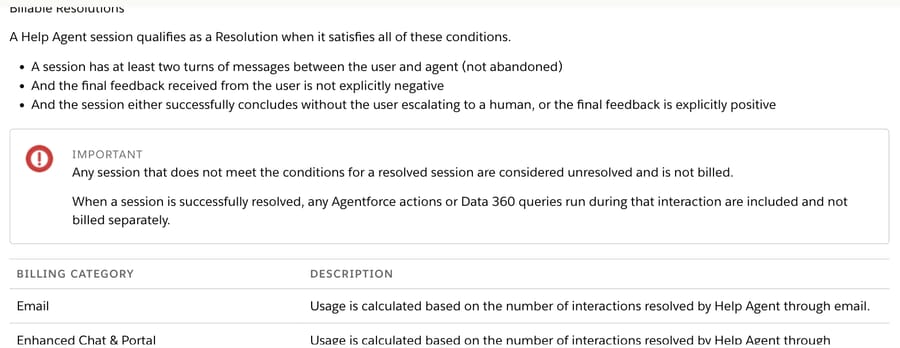
Anything else is unresolved and free. When a session does count, the actions and Data 360 queries inside it are included. Two caps apply: a messaging or email resolution covers up to two hours, and a voice resolution covers up to 10 minutes, so a resolved 12-minute call bills as two resolutions ($4).
Most customers leave no feedback at all, so condition 2 is usually met by default. Salesforce has confirmed what that means for a customer who goes quiet. SalesforceBen's guide to Agentforce pricing (July 17, 2026), written after an interview with Prasad Raje, SVP of Product for Agentforce Service, says a conversation with more than two turns, no feedback and no escalation request that runs past the session limit "is considered resolved, and $2 is billed". Asked about a customer who closes the tab and goes to a competitor, Raje said: "If a customer closes a tab, we have no visibility into why or what they do next."
Salesforce says you can check its count. Raje told SalesforceBen that if a dispute arises, Salesforce can provide a report with session counts and resolution metrics plus "turn-by-turn transcripts of the actual conversations". That lets you audit how the rule was applied, and the rule itself bills the silent session.
Leads Worked: the sales agent's $2 unit
The same rate card prices Salesforce's Buyer Engagement Agent, its sales-side counterpart to Help Agent, at 400 credits ($2) per "Leads Worked" in production and 320 in sandbox. The Help article counts one Leads Worked when a web conversation answers a prospect's questions and two when the agent also tries to create a lead, so a website chat that ends in a lead form costs $4. Outbound email, SMS and WhatsApp engagement counts per lead, deduplicated per prospect across channels in a rolling 30-day window. Unlike Help Agent, it bills the engagement whether or not the prospect converts.
Conversations: legacy, for existing customers only
The $2-per-conversation model from Agentforce's 2024 launch still has a card on the pricing page, but it shows no price to new buyers and reads "For existing Agentforce Conversations customers." The Conversations rate card is dated December 2024. Salesforce's FAQ says Flex Credits and Conversations can't run in the same org, and a Conversations customer who switches must swap all of its Conversation SKUs. If you're pricing a new deployment, ignore the $2 conversation figure that older articles quote.
Per-user licenses: for employees, not customers
The per-user options cover internal use, where an employee is the one talking to the agent.
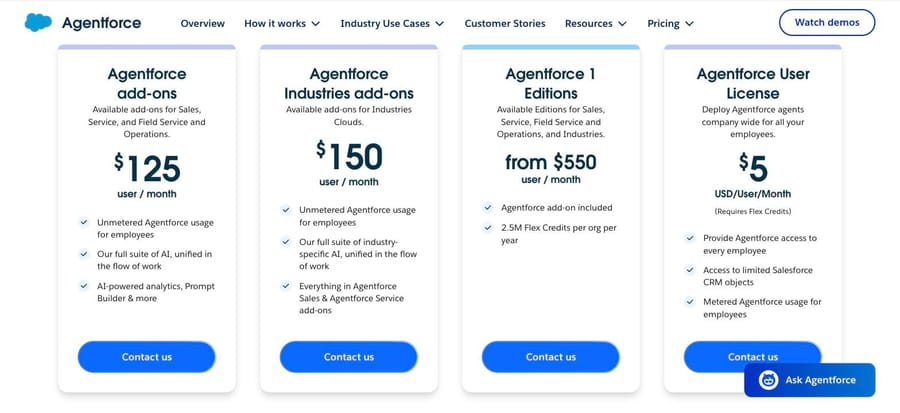
The $5 User License meters an employee's usage against Flex Credits; the $125 add-on makes it unmetered. They cross at 1,200 actions per user per month: $120 of credits ($125 − $5) buys 1,200 actions at 10 cents each. An employee who runs fewer than 1,200 actions a month, about 55 a working day over 22 working days, is cheaper on the $5 license.
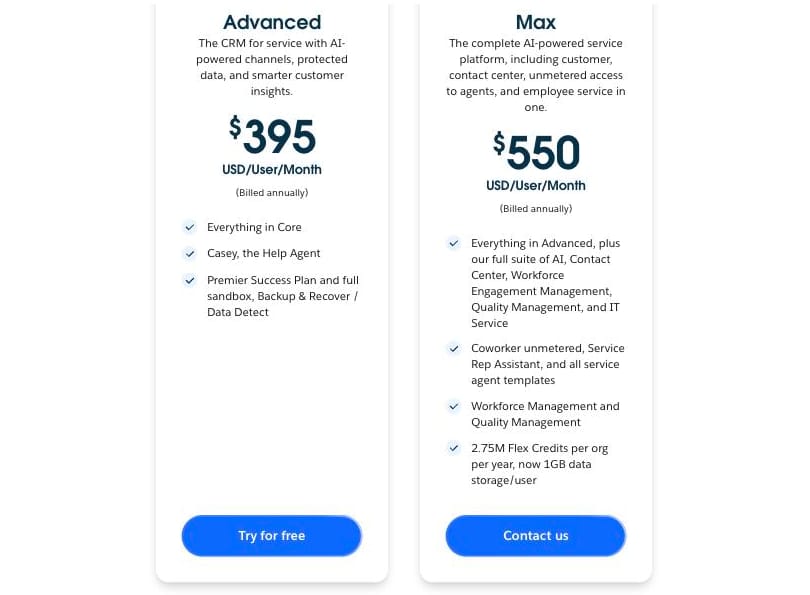
Agentforce 1 Editions bundle the add-on, the full cloud and a credit pool: 2.5 million Flex Credits per org per year on the Agentforce pricing page, but "2.75M Flex Credits per org per year" for Max ($550 per user per month, billed annually) on the Service Cloud price list. Your order form is what counts. Depending on which figure it carries, the pool works out to about 208,000 to 229,000 credits a month, or about 3,500 to 3,800 customer conversations at three actions each. The pool is per org, so it doesn't grow with seat count.
Should you buy Flex Credits on PayGo, Pre-Commit or Pre-Purchase?
Flex Credits can be bought three ways, and the choice changes who carries the risk of a wrong forecast.
- PayGo: no upfront commitment, pay for what you use. Salesforce bills it monthly in arrears.
- Pre-Commit: commit to a baseline with no upfront payment, billed monthly in arrears, with a "true-up at term end if usage is below commitment". The pricing page says it's "widely available later this year", so it isn't generally sold yet.
- Pre-Purchase: "Buy a set amount of usage for the full contract term and pay upfront." Salesforce says this is how you "save the most", but it publishes no discount.
Per the pricing page FAQ, PayGo and Pre-Commit sell Flex Credits only. Conversations, the per-user add-ons and Agentforce 1 Editions aren't available on either.
Two rules in the FAQ matter for budgeting. Unused Flex Credits "do not roll over into subsequent subscription terms", and the rate card repeats that credits must be used before the order end date. If you exceed your balance there's "no overage penalty": extra usage bills at your contracted rate, monthly in arrears. On a Pre-Purchase, over-buying loses the unused credits at term end, and on a Pre-Commit the true-up bills the shortfall. Under-buying on either only costs you the same rate later. That asymmetry pushes a careful buyer toward committing to less than the forecast says, and PayGo carries no forecast risk at all.
Salesforce's free Digital Wallet shows credit use by agent and action and sends threshold alerts; we had no org to show it from.
Is there a cheaper price on a cloud marketplace?
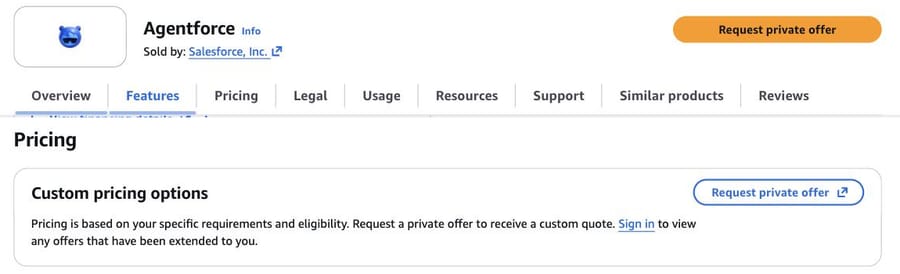
Salesforce sells more than a dozen Agentforce products on AWS Marketplace, including the main Agentforce listing, and every one we opened shows only "Custom pricing options" with a private-offer button. Azure's marketplace had no Agentforce SaaS offer on 19 September 2026, only Salesforce Office add-ins marked "Additional purchase may be required". Google Cloud lists "Agentforce Sales" with "no usage fee for this product" for the listing itself. Vendr's Salesforce page reports a $75,975 median annual contract from 2,537 purchases but no Agentforce figures. The rate card is the only public price.
What does Agentforce cost at 1,000, 5,000 and 20,000 conversations?
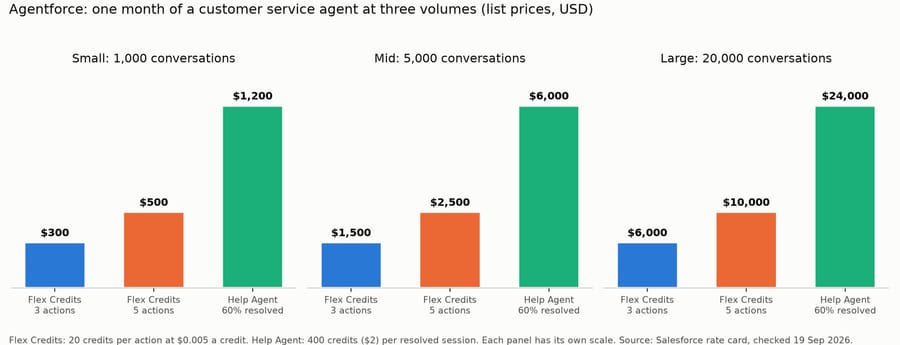
These models cost one month of a customer-facing service agent on chat and email at list price. The assumptions:
- Actions per conversation: 3 in the base case (identify the customer, look up the order, answer from knowledge), 5 in the heavier case (add a case update and a refund or return Flow). Topic changes and escalations are free, so they aren't counted.
- Resolution rate: 60% for the Help Agent model. Only resolved sessions bill.
- Volumes: small is 1,000 conversations a month, mid is 5,000 and large is 20,000.
- Excluded: Salesforce seats, Data 360 beyond included grants, voice, telephony and implementation. Those follow in the next section.
The arithmetic for Flex Credits is conversations × actions × 20 credits × $0.005. For Help Agent it's conversations × resolution rate × $2.
| Volume | Flex Credits, 3 actions | Flex Credits, 5 actions | Help Agent, 60% resolved |
|---|---|---|---|
| Small: 1,000 conversations | 60,000 credits = $300 | 100,000 credits = $500 | 600 × $2 = $1,200 |
| Mid: 5,000 conversations | 300,000 credits = $1,500 | 500,000 credits = $2,500 | 3,000 × $2 = $6,000 |
| Large: 20,000 conversations | 1,200,000 credits = $6,000 | 2,000,000 credits = $10,000 | 12,000 × $2 = $24,000 |
On Pre-Purchase, the same usage over a 12-month term rounds up to whole 100,000-credit blocks. The small case needs 720,000 credits a year, which is 8 blocks or $4,000 paid upfront ($333 a month averaged). The mid case needs 3.6 million credits, which is 36 blocks or $18,000. The large case needs 14.4 million, which is 144 blocks or $72,000. Bought as a single month, the small case would still be one $500 block, so its range runs from $300 on PayGo to $500. Any Pre-Purchase discount comes from your account executive, not the list.
Per action is cheaper than per resolution for almost every service agent. Flex Credits cost 10 cents × actions for every conversation, resolved or not. Help Agent costs $2 × the resolution rate. At a 60% resolution rate the two meet at 12 actions per conversation, and at 80% they meet at 16. Few service agents need a dozen actions for a typical chat.
Help Agent buys a different risk profile: nothing for the 40% of conversations that go to a human, and a $2 cap per conversation however long the agent's route. That certainty costs four times the base Flex Credit case.
Foundations' FAQ grants "200K Agentforce Flex credits" for "testing use cases and proof of concepts" (the page headline's 450,000 includes Data 360). At three actions that's about 3,300 test conversations, a pilot allowance rather than production volume.
What pushes an Agentforce bill up?
These lines push a real invoice above the table.
Salesforce seats. Flex Credits require Foundations, which Salesforce Help says requires an Enterprise, Performance, Unlimited or Developer edition. Service Cloud's case-management editions start at Core, $195 per user per month billed annually, then Advanced at $395 and Max at $550. A team with 10 reps that isn't on Salesforce yet adds $1,950 a month at Core before the agent answers anything. Most Agentforce buyers already pay this, which is why Salesforce can price the agent itself cheaply.
Voice. A voice action costs 30 credits, 50% more than text. A voice agent handling 2,000 calls a month at four actions a call uses 240,000 credits, or $1,200. On Help Agent, a resolved call longer than 10 minutes bills as two resolutions. Salesforce Help describes a Voice Minutes usage type for "a limited subset of eligible customers", rounded up per minute (a 61-second call bills 2) and taking precedence over voice actions, with no published rate. Telephony is priced separately and isn't in these figures.
Prompts from embedded AI. Features that call the language model directly, such as Service Replies drafting answers for human reps, bill per 2,000-token chunk. If reps draft one Service Reply on each of 5,000 cases a month and each fits in one chunk, that's 20,000 credits ($100) on a Standard model or 80,000 credits ($400) on an Advanced one. A prompt of 6,500 tokens meters as four prompts.
Data 360. Grounding in documents and records runs through Data 360, which spends the same credits at its own multipliers. The rate card prices Unstructured Processing at 150 credits per megabyte at the base tier, so processing 1 GB of manuals and PDFs would use about 150,000 credits ($750). Queries are cheap, at 3 credits per million rows processed. Tiered discounts apply after 300,000 credits a month per usage type. Re-processing updated documents spends credits again.
Testing. Sandbox actions cost 16 credits instead of 20. Running 500 test conversations at three actions in a sandbox uses 24,000 credits, or $120. It's small, but it recurs every time you change the agent.
Custom actions and licensing gates. Salesforce Help notes that some standard actions will require a per-user add-on license for "each user that accesses these actions", and says the requirement "is not technically enforced yet". Check which actions your agent relies on before you assume $5 licenses will cover your staff.
Implementation. None of this includes building the agent: cleaning CRM data, writing topics and actions, and connecting systems outside Salesforce. Three of the reviews quoted below name configuration or setup effort.
What does each billing unit reward?
Per action. Salesforce earns more when your agent takes more steps to reach the same answer. The customer can't see the difference between a two-action and a five-action conversation, but your invoice can. The incentive to design lean agents sits with you, and the tools to measure it (Digital Wallet's by-action view, the Agentforce ROI Estimator) exist because the meter makes design choices visible as cost.
Per resolution. The Help Agent aligns price with an outcome, which sounds better for the buyer, but Salesforce defines the outcome, and its definition bills a silent session with no escalation as resolved. Salesforce will show session reports and transcripts in a dispute, but the definition decides what counts. At $2 it's also the most expensive unit on this page.
Per seat. The $125 and $550 licenses make usage unmetered for employees, so Salesforce earns on headcount rather than activity. That suits heavy internal users and punishes light ones, which is why the $5 license exists.
Commitments with no rollover. Pre-Purchase and Pre-Commit both move forecasting risk to you. Unused Pre-Purchase credits are gone at the end date, and a Pre-Commit short of its baseline is trued up at term end, so the buyer carries the cost of an optimistic forecast.
Macha takes a fourth position. It bills per ticket, and a ticket is one thread with one person, charged once however many replies, tool calls or steps the agent takes. The agent's design doesn't change the charge, so there's no meter running on each action.
How does Agentforce compare with Fin, Zendesk and Freshdesk at 5,000 conversations?
The rivals below sell an AI agent for customer service and publish a price. Each figure covers agent usage only; each also needs a help desk or CRM you pay for separately. The mid volume from above is used throughout: 5,000 conversations, 60% resolved by the agent.
| Product | Billing unit | Published price | Cost at 5,000 conversations |
|---|---|---|---|
| Agentforce (Flex Credits) | Per action | 20 credits = $0.10 | $1,500 (3 actions) to $2,500 (5 actions) |
| Agentforce (Help Agent) | Per resolution | 400 credits = $2 | 3,000 × $2 = $6,000 |
| Fin (Salesforce) | Per outcome | $0.99; 50-outcome monthly minimum only when Fin runs on a help desk other than Intercom | 3,000 × $0.99 = $2,970 |
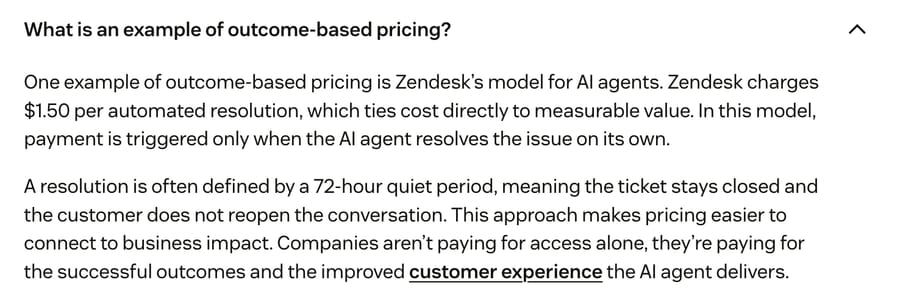
| Zendesk AI agents | Per automated resolution | Rate not on Zendesk's pricing page; $1.50 committed and $2.00 pay-as-you-go reported, minus a per-seat allowance | $4,500 committed to $6,000 pay-as-you-go, less $50 for 10 Suite Professional seats = $4,450–$5,950 |
| Freshdesk Freddy AI Agent | Per session | $49 per 100 sessions | 50 × $49 = $2,450 |
| Macha | Per ticket | $1,999 for 5,000 tickets a month | $1,999 |
Sources and dates: Fin's pricing page (rechecked 24 September 2026: the 50-outcome minimum applies to Fin on another help desk, which is the case here, not on Intercom), which also bills when Fin completes a handoff you configured; Zendesk's outcome-based pricing post (it names $1.50; Zendesk's pricing page says AI agents are billed per automated resolution but doesn't publish the rate, and third-party breakdowns report $1.50 committed and $2.00 pay-as-you-go) and its chatbot buyer's guide, with the allowance from Zendesk's resolution allowances article (since 18 May 2026 each seat earns $2, $5 or $10 a month by plan, $5 on Suite Professional, capped at $5,000 a year); Freshworks' Freshdesk pricing, where the 500 free Freddy sessions are once per account, and Freshdesk's Freddy AI add-ons article, which says the chat AI agent needs Freshdesk Omni; and Macha's pricing page. All checked in September 2026.
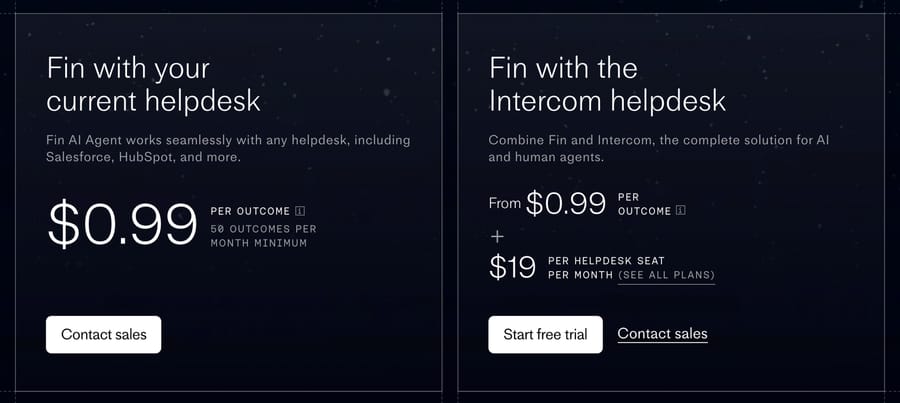
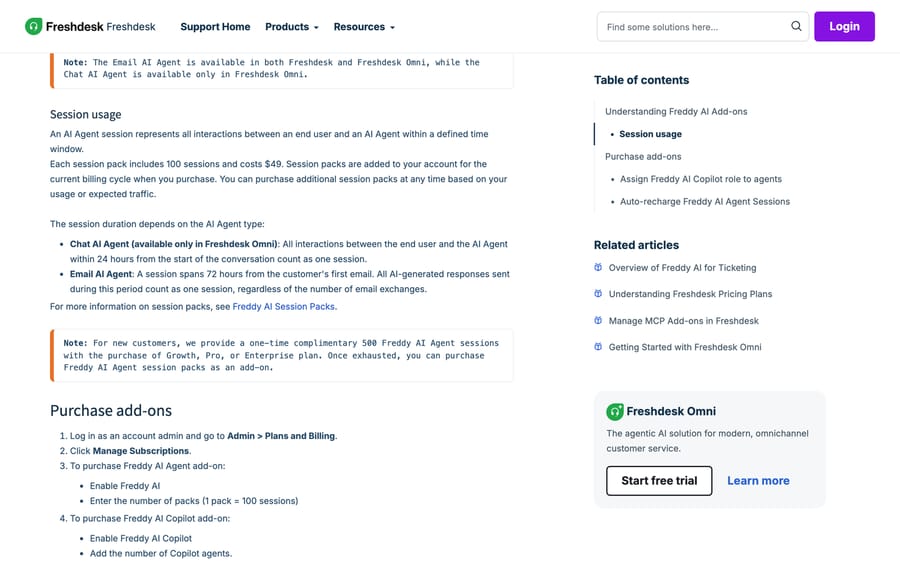
Since Salesforce completed its acquisition of Fin on 10 September 2026, the $0.99 outcome and the $2 Help Agent resolution belong to the same company. Fin works on top of other help desks; Help Agent runs inside Salesforce. Our Fin pricing breakdown and the Freddy pricing comparison go deeper on those two.
Flex Credits come out cheapest per conversation when the agent stays lean, and that's the fair reading of the table. The comparison changes once seats enter it. A Salesforce shop already pays for Service Cloud and adds only the credits. A team on another help desk would be adding a CRM platform to get the cheaper meter.
What do reviewers say about Agentforce's cost?
On 19 September 2026, Salesforce Agentforce on G2 had a 4.3 out of 5 rating from 1,694 reviews, Gartner Peer Insights showed 4.3 from 72 ratings, and Capterra's Agentforce listing had a single 5.0 review, too few to weigh. Reviewers mostly praise how close the agent sits to CRM data. The cost complaints are about predictability and setup, not the headline rate.
A verified consulting user at an enterprise (over 1,000 employees) wrote on 17 September 2026 that "The pricing is complex and this leaves my clients very confused," listing consumption costs next to hallucinations as the main dislikes. A Salesforce architect at a small business (50 or fewer employees) wrote on 16 October 2025 that "Some advanced features depend on licensing or complex configuration," and that the agent needs a strong admin setup to give consistent results. Both reviews were collected through a seller invite and marked incentivized on G2. Gartner's product page highlights one favorable and one critical review. The favorable one, from a senior manager at an IT services firm under $50M in revenue (5.0, June 15, 2026), is titled "Fast automation within Salesforce, but advanced setup can be challenging". The critical one, from a director of quality engineering at a bank with over $30B in revenue (3.0, May 13, 2026), is titled "Salesforce Agentforce Offers Unique Features With Some Challenges in Customization". Gartner asks readers to log in before showing full reviews, so we quote only the headlines.
A buyer who knows actions per conversation and resolution rate can work out the bill from the rate card, as the tables here do. A buyer who doesn't know those numbers before launch can't, and that's the confusion the consulting reviewer describes.
Which Agentforce pricing fits your team?
Choose Flex Credits on PayGo if you're already on an Enterprise-level Salesforce edition, your agent's action count is predictable, and you want to pay only for use while you learn. Start PayGo, watch Digital Wallet for a quarter, then decide whether a Pre-Purchase discount is worth the rollover risk.
Choose Help Agent if you can't predict actions per conversation, you want unresolved conversations to cost nothing, and you accept Salesforce's definition of a resolution. Budget $2 × expected resolutions, plus a Service Cloud edition that includes it; the price list shows it in Advanced.
Choose per-user licenses for employee-facing agents. Use the $5 license for staff who use the agent lightly, and the $125 add-on for anyone above roughly 1,200 actions a month.
Choose Agentforce 1 or Max if you're buying the whole service cloud anyway and your agent volume fits inside the included pool: about 3,500 to 3,800 three-action conversations a month, depending on whether your order form carries the 2.5M or 2.75M pool.
Skip Agentforce if Salesforce isn't your system of record. At 10 cents an action the agent is cheap; for a team not already on Salesforce, the Core edition at $195 per rep a month is the bigger line. If your tickets live in another help desk, an agent layer that installs on that help desk is the shorter route. Macha fits teams already running Zendesk, Freshdesk, Gorgias, Front, HubSpot or Intercom who want agents acting inside the ticket: it runs on the help desk you already use, prices per ticket at about $0.40 a ticket on published tiers, and the Macha team builds, tests and monitors the agents on every plan. See Macha's pricing, or compare other options in our guide to AI agents for customer service. For enterprise alternatives built around custom deployments, see the Sierra AI guide and the Decagon AI guide, and for a per-outcome agent that runs on other help desks, the Fin AI agent guide.
How we researched this
On 19 September 2026 we read Salesforce's pricing page, both rate cards, the Service Cloud price list, the Foundations page and the Help article defining each billable usage type in a real browser. We checked AWS, Azure, Google Cloud and Vendr, read G2, Gartner Peer Insights and Capterra, and took rival prices from their own pages. We did not build an agent: the free Developer Edition asks for a work email and acceptance of Salesforce's developer agreements, which our research rules don't allow. The monthly figures below are arithmetic on list prices, not invoices, and the product screenshots come from Salesforce's Trailhead module on the new Agentforce Builder and its Help article.
Frequently asked questions
How much does Agentforce cost per month? It depends on the meter. On Flex Credits, a customer service agent costs about 10 cents per action, so 5,000 conversations at three actions each is $1,500 a month at list price. On the Help Agent model, the same 5,000 conversations with 60% resolved cost $6,000. Per-user licenses run $5, $125, $150 or from $550 per user per month. Salesforce seats, Data 360 and voice are extra.
How are Agentforce Flex Credits consumed? Each standard or custom action the agent runs costs 20 credits ($0.10) in production and 16 in a sandbox, whatever the token count. A voice action costs 30. Escalations, variable updates and topic transitions aren't billed. Embedded AI prompts cost 2 to 16 credits per 2,000-token chunk, and a Help Agent resolution or a sales agent's Leads Worked costs 400. The figures come from Salesforce's August 31, 2026 rate card.
Is Agentforce included in Salesforce? Partly. Salesforce Foundations is a $0 add-on for Enterprise, Performance, Unlimited and Developer editions that includes Agentforce Builder and a starter grant of 200,000 Agentforce Flex Credits. Production use beyond that grant is paid, through Flex Credits, per-user add-ons or an Agentforce 1 edition such as Service Cloud Max, which includes a yearly credit pool.
Is the $2 per conversation price still available? Not to new buyers. The Conversations card on Salesforce's pricing page shows no price and says it's for existing Agentforce Conversations customers. New deployments buy Flex Credits. The only $2 unit currently offered is the Help Agent resolution, which bills only resolved sessions.
Is there an Agentforce pricing calculator? Salesforce links an Agentforce ROI Estimator from its billing documentation, and Digital Wallet shows live usage. For a quick estimate, multiply monthly conversations by actions per conversation by $0.10, then add voice at $0.15 per action.
What happens if I use more Flex Credits than I bought? Salesforce's FAQ says there's no overage penalty. Extra usage bills at your contracted rate, monthly in arrears. Unused credits don't roll over into the next term, so over-buying on Pre-Purchase is the costlier mistake.
How does Agentforce pricing compare with Microsoft Copilot Studio? Both sell prepaid or pay-as-you-go credits consumed by what the agent does. Microsoft's billing rates page charges 1 Copilot Credit for a classic answer, 2 for a generative answer and 5 for an agent action. Agentforce charges one flat 20 credits per action. Copilot Studio usage by Microsoft 365 Copilot-licensed employees is included, much as Agentforce's $125 add-on makes employee usage unmetered.
Why is Agentforce expensive for small teams? The agent's own rate isn't. At 1,000 conversations and three actions, Flex Credits cost $300 a month. The cost sits in the platform it requires: an Enterprise-level Salesforce edition per rep, Data 360 for grounding, and the admin work to build topics and actions. A small team that doesn't already run on Salesforce pays for all of that first.
Does Agentforce Voice cost more than chat? Yes. A voice action costs 30 Flex Credits ($0.15) against 20 for text, and a resolved Help Agent voice call is capped at 10 minutes per $2 resolution, so a 12-minute call bills $4. Some eligible customers are billed per minute through Agentforce Voice Minutes instead, rounded up to the next full minute, at a rate Salesforce doesn't publish. Telephony is priced separately.
Can I dispute a Help Agent resolution charge? Yes. Salesforce's SVP of Product for Agentforce Service told SalesforceBen that in a dispute Salesforce can provide session counts, resolution metrics and turn-by-turn transcripts to show how the rule was applied. The rule itself stays the same: a session with at least two turns, whose final feedback isn't explicitly negative and which ends without escalation (or with explicitly positive feedback), bills as a $2 resolution, including one where the customer simply closes the tab.
How much does Agentforce cost for developers? Nothing to start. Salesforce's Developer Edition is a free environment with Agentforce and Data 360. Its signup page says Salesforce may limit use of the generative AI features and the org, and may terminate an org that's inactive for 45 days. Production agents then bill through Flex Credits or the per-user licenses above.
If your support runs on Zendesk, Freshdesk, Gorgias, Front, HubSpot or Intercom, you can start a Macha trial with $50 of free usage and no card, and see how a per-ticket price compares with the per-action math above.
Sources: Salesforce Agentforce pricing · Flex Credits Rate Card, Aug 31 2026 · Agentforce Conversations Rate Card · Salesforce Help: Flex Credits Billable Usage Types · Salesforce Help: Agentforce Pricing · Service Cloud pricing · Salesforce Foundations · Digital Wallet · AWS Marketplace: Agentforce · Salesforce completes acquisition of Fin · Fin pricing · Zendesk outcome-based pricing · Zendesk resolution allowances · Freshdesk pricing · Microsoft Copilot Studio billing rates · G2: Salesforce Agentforce reviews · Gartner Peer Insights: Salesforce Agentforce · Capterra: Agentforce · Trailhead: the new Agentforce Builder · SalesforceBen: Complete Guide to Agentforce Pricing Options (July 17, 2026) · Salesforce Developer Edition · Freshdesk: Freddy AI add-ons
Simple per-ticket AI pricing
One thread with one person is one charge, however many replies it takes.