Intercom
 Shopify
 Stripe
 Slack
Slack Notion
 Google Workspace
 Confluence

Best Agentforce Alternatives (2026): Top 8 Compared


Salesforce Agentforce is a genuinely capable agentic AI platform — but it isn't for everyone. Because Agentforce is native to Salesforce and acts on Salesforce data, getting full value assumes you're standardized on the Salesforce platform, ready for a real implementation, and comfortable tying your AI roadmap to one CRM. If any of that doesn't describe you, this guide walks through the best Agentforce alternatives for 2026 — eight Salesforce Agentforce competitors compared honestly on pricing, deployment speed, platform lock-in, and who each is genuinely built for.

Full disclosure up front: we build Macha, one of the options below. We've tried to write this as a genuinely useful comparison rather than a pitch — every alternative here beats Agentforce on some axis and loses on others, and we say so. The list isn't a ranking — each entry is placed by the use case it actually fits, Macha included.
Why teams look beyond Agentforce
Three reasons come up again and again (Lorikeet, Fin):
- Salesforce lock-in. Agentforce is designed for teams whose system of record already is Salesforce. If you run Zendesk, Freshdesk, Front, Intercom, or Gorgias for support — or you simply don't want to bet your AI roadmap on one CRM — that gravity is a real cost, not a feature.
- Cost that's hard to predict. Agentforce bills either ~$2 per conversation (a "conversation" being a 24-hour session, resolved or not) or via Flex Credits at roughly $0.10 per action (20 credits per action, sold in packs of 100,000 for $500; Voice actions cost 30) (Salesforce, Enterprise Dreamin'). Note that Flex Credits and Conversations can't coexist in one org, and neither model includes the Salesforce platform seats and implementation you also need. For high-volume teams that adds up fast, and it's hard to forecast.
- Implementation weight. Agentforce is a platform build, not a switch you flip. Teams that want to be live in days — not a quarter — often want something lighter.
The rest of this guide is the honest shortlist. A quick-reference table first, then a deep section on each.
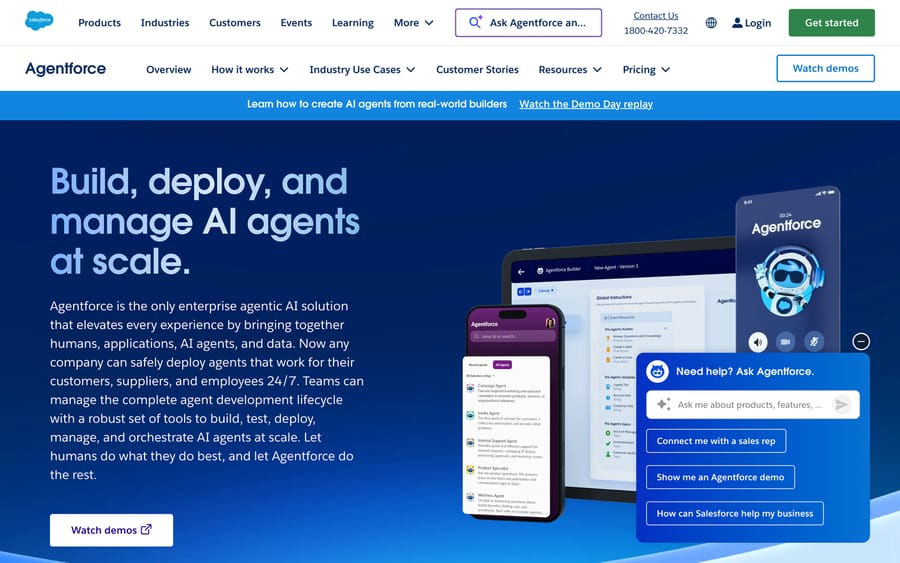
Salesforce Agentforce's homepage — the platform these alternatives are measured against.
Quick comparison
| Alternative | Pricing model | Runs on your existing helpdesk? | Best for |
|---|---|---|---|
| Macha | From $299/mo for 750 tickets (~$0.40/ticket), self-serve | Yes — Zendesk / Freshdesk / Front / Intercom / Gorgias | Teams wanting an AI layer on an existing help desk, live fast, no Salesforce dependency |
| Intercom Fin | $0.99 per outcome (published) | Native to Intercom; standalone on many helpdesks | Teams wanting transparent, outcome-priced deflection |
| Ada | Quote-only (~$70K/yr median reported) | No — standalone platform | Mid-market/enterprise wanting mature, multi-channel automation |
| Sierra | Outcome-based, quote-only (~$150K+/yr reported) | No — standalone | Large enterprises wanting a bespoke voice + chat agent |
| Decagon | Per-conversation or per-resolution, negotiated | No — standalone | Enterprises wanting a custom CX agent without Salesforce |
| Forethought | Quote-only (now part of Zendesk) | Layers on top of helpdesks | Support teams already on / moving to Zendesk |
| Kore.ai | Quote-only, enterprise | No — standalone platform | Enterprises wanting a build-it-yourself conversational AI platform |
| Cognigy | Quote-only (~$150K+/yr reported) | No — standalone platform | Enterprise contact centers with heavy voice + IVR needs |
Pricing accurate as published or widely reported July 2026; verify current terms with each vendor. Deployment models vary with scope. Third-party cost estimates for quote-only vendors are directional, not official.
1. Macha — best for an AI layer on the help desk you already run
What it is. Macha is an AI agent platform that installs on top of your existing help desk — Zendesk, Freshdesk, Front, Intercom, or Gorgias — rather than asking you to migrate into a new platform or CRM. It reads the customer's question, pulls from your connected knowledge base, docs, and past tickets, resolves the issue right inside the help desk your agents already work in, and escalates to a human with full context when it isn't confident. You build agents in plain English, template them for common workflows, and wire them to your own systems with custom tools.
Key strengths. The core contrast with Agentforce is dependency and speed. Agentforce assumes Salesforce is your system of record and involves a platform-scale build; Macha is self-serve, deploys in minutes to hours, and requires no CRM commitment. Because it layers onto the help desk you already run, your existing macros, tags, routing, and reporting stay intact — the AI slots into that workflow instead of replacing it.
Pricing reality. Macha charges per ticket — one charge per thread, however many steps an agent takes on it (drafting a reply, tagging, routing, calling a tool, resolving). It's one plan with every feature, priced on ticket volume from $299/month for 750 tickets (~$0.40/ticket) rather than per deflection or per resolution, and the model or number of tool calls doesn't change the charge. It's self-serve and starts with $50 of free usage, no credit card, so you can validate on your own tickets before committing. See pricing for the full breakdown.
Best for. Teams on a major help desk (Zendesk/Freshdesk/Front/Intercom/Gorgias) that want an AI resolution layer live quickly, with per-ticket pricing and no Salesforce dependency.
Limitations — honestly. Macha is not the pick if Salesforce is your system of record and you need agents acting natively on CRM data across sales, marketing, and service — that breadth is genuinely Agentforce's strength. Macha is focused on support resolution on a help desk you already run, not company-wide, cross-department automation. If you don't run one of the supported help desks, it isn't the fit.
2. Intercom Fin — best for transparent, outcome-priced deflection
What it is. Fin is Intercom's AI agent, and it's the alternative most often cited for pricing transparency. It's native to Intercom, but — notably — you can also buy it standalone on top of Salesforce, HubSpot, Freshworks, Zendesk, Zoho, Front, Gorgias, and others, without an Intercom plan (Fin).
Key strengths. Fin publishes $0.99 per outcome — one of the lowest public per-outcome rates in the category — where an "outcome" is a resolution, a procedure handoff, or a disqualification, and you pay only when one of those happens (Qualifications are the exception at $9.99 each) (Gleap). Standalone, there are no seat charges and no setup fees, with a 50-outcome/month minimum (a ~$49.50/month floor). That predictability is a real edge over Agentforce's per-conversation-or-credits model.
Pricing reality. $0.99 per outcome, published, with the standalone minimum above. Straightforward to forecast if you can estimate resolution volume.
Best for. Teams wanting transparent, outcome-priced deflection that launches quickly — on Intercom or on a help desk Fin supports standalone.
Limitations — honestly. There's an irony worth naming: Salesforce completed its acquisition of Intercom/Fin, for roughly $3.6 billion, on September 10, 2026 (Fin). Pricing is unchanged for now, but if your reason for leaving Agentforce is avoiding Salesforce, factor a Salesforce owner into a long-term bet.
3. Ada — best for a mature, multi-channel automation platform
What it is. Ada is one of the more established names in customer-service automation, with a mature product spanning chat, voice, email, and social across dozens of languages. It runs as a standalone platform on top of your existing stack, so it's a genuine Agentforce alternative for teams that want broad multi-channel coverage without betting on Salesforce.
Key strengths. Breadth and maturity. Ada has been doing this longer than most of the newer agentic entrants, with strong multilingual support and a wide channel footprint — useful if you serve customers across chat, voice, and social in many languages.
Pricing reality. Quote-only. Third-party reporting puts median spend around ~$70K/year, ranging into the $100K–$300K+ band for larger deployments — directional, not official, so get a real quote (Fin).
Best for. Mid-market and enterprise teams wanting mature, multi-channel automation independent of their CRM.
Limitations — honestly. Opaque pricing and enterprise onboarding — it's a real setup effort, not a self-serve launch, and costs scale into six figures for larger deployments.
4. Sierra — best for large enterprises wanting a bespoke voice + chat agent
What it is. Sierra, co-founded by former Salesforce co-CEO Bret Taylor, sits at the premium enterprise end. It builds custom, branded agents across chat and voice with heavy supervisory guardrails. Like Agentforce it's an enterprise commitment — but it's CRM-agnostic, so it's an option if you want a serious custom agent without standardizing on Salesforce.
Key strengths. Bespoke, brand-tuned agents with strong supervision, and a voice story that's genuinely enterprise-grade. If you want a flagship agent that feels custom-built, Sierra is designed for exactly that.
Pricing reality. Quote-only, outcome-based — you pay per resolved result. Third-party sources consistently estimate contracts starting around $150,000+/year, with year-one totals of $200K–$350K+ (Fin). Treat those as directional.
Best for. Large enterprises wanting a bespoke voice + chat agent with strong supervision, without Salesforce lock-in.
Limitations — honestly. Opaque, six-figure-plus pricing and multi-week-to-multi-month implementation with Sierra's team doing the build. It's a project, not a self-serve tool.
5. Decagon — best for a custom enterprise CX agent without Salesforce
What it is. Decagon is an enterprise-focused AI agent platform competing directly for the CX deals Agentforce chases. It runs on top of your existing stack without requiring a specific CRM, with agents tuned to complex, action-heavy support workflows across chat, email, and voice.
Key strengths. Action-heavy automation for enterprises that want a custom CX agent — and, usefully, it lets customers choose per-conversation or per-resolution pricing, so you can pick the model that matches your volume and risk tolerance.
Pricing reality. Negotiated / quote-only, with the per-conversation-or-per-resolution choice above. Specifics are reported rather than published, so get a quote.
Best for. Enterprises wanting a custom, action-taking CX agent while specifically avoiding the Salesforce platform commitment.
Limitations — honestly. No public pricing and an enterprise sales process; like the other bespoke platforms it's a scoped build, not a fast self-serve launch.
6. Forethought — best for support teams on (or moving to) Zendesk
What it is. Forethought focuses on the support workflow — triage, routing, and resolution — and historically layered on top of existing help desks. The important 2026 update: Forethought has been acquired by Zendesk (reported in 2026), and its capabilities are being absorbed into Zendesk's premium AI tiers (Fin).
Key strengths. Strong at support-specific triage and resolution, and — now under Zendesk — tightly aligned with the Zendesk platform. If Zendesk is your help desk, that alignment is a plus.
Pricing reality. Historically hybrid (a platform fee plus reportedly around ~$0.12 per deflection, with a reported low-six-figure annual median), but as it folds into Zendesk, expect pricing and packaging to shift toward Zendesk's AI tiers. Treat pre-acquisition figures as directional, and confirm current terms directly.
Best for. Support teams already on Zendesk, or comfortable standardizing on it.
Limitations — honestly. The acquisition means its independent roadmap is effectively gone; you're increasingly buying into the Zendesk ecosystem. If part of your goal was to avoid platform gravity, that's now a Zendesk dependency instead of a Salesforce one.
7. Kore.ai — best for a build-it-yourself enterprise conversational AI platform
What it is. Kore.ai is a long-standing enterprise conversational AI platform with structured dialog design, workflow automation, and flexible deployment (cloud, on-prem, hybrid). It's less an out-of-the-box support agent than a toolkit for building your own conversational and agentic experiences across support, IT, HR, and more.
Key strengths. Depth and control. If you have the engineering appetite to design flows precisely, need on-prem/regulated deployment options, or want one platform spanning multiple departments, Kore.ai's flexibility is the draw — and it's fully CRM-agnostic.
Pricing reality. Quote-only, enterprise. No published per-resolution rate; expect an enterprise contract and a real build.
Best for. Enterprises that want to build and own their conversational AI, with strict deployment or governance requirements.
Limitations — honestly. More building blocks than turnkey agent — time-to-value is longer, and you carry more of the design and maintenance yourself. Overkill if you just want fast support-ticket deflection.
8. Cognigy — best for enterprise contact centers with heavy voice/IVR
What it is. Cognigy is an enterprise conversational AI platform with a strong contact-center and voice/IVR heritage, offering low-code flow building and deep telephony/CCaaS integrations. It's a standalone platform, CRM-agnostic, aimed at large voice-heavy operations.
Key strengths. Voice and contact-center depth. If your center runs on IVR and phone volume as much as chat, Cognigy's telephony integrations and voice tooling are a genuine differentiator versus chat-first agents.
Pricing reality. Quote-only, with third-party estimates around $150K+/year for enterprise deployments (Fin) — directional, so confirm.
Best for. Enterprise contact centers with significant voice/IVR needs that want a CRM-agnostic platform.
Limitations — honestly. Enterprise pricing and complexity; it's aimed at contact-center scale, so it's heavier than a small support team needs for ticket deflection.
How to choose
The right Agentforce alternative comes down to a few honest questions. Work through them in order:
- What runs your support today? If it's a major help desk (Zendesk, Freshdesk, Front, Intercom, Gorgias) and you want an AI layer on top of it rather than a new platform, Macha and standalone Fin are the natural fits — they keep your existing workflow, macros, and reporting intact. If you'd rather adopt a standalone platform, look at Ada, Decagon, Kore.ai, or Cognigy.
- Are you trying to get away from Salesforce specifically? If so, note that Fin is being acquired by Salesforce — so a "no-Salesforce" mandate points more cleanly to Macha, Ada, Decagon, Sierra, Kore.ai, or Cognigy. And Forethought now sits inside Zendesk, so it trades Salesforce gravity for Zendesk gravity.
- How much implementation can you absorb? Want to be live in days and self-serve? Macha and Fin are the fast lanes. Willing to run a scoped, multi-week enterprise build for a bespoke agent? Sierra, Decagon, Ada, Kore.ai, and Cognigy are built for that.
- Do you need transparent, forecastable pricing? Fin ($0.99 per outcome) and Macha (per ticket, from $299/month for 750 tickets) publish clear models. The enterprise platforms (Sierra, Decagon, Ada, Kore.ai, Cognigy, and post-acquisition Forethought) are quote-only — expect five- to six-figure annual contracts.
- What's your primary channel? Voice-heavy contact centers should weigh Cognigy, Sierra, and Ada. Support-ticket resolution on an existing help desk favors Macha, Fin, and (if you're on Zendesk) Forethought.
A useful gut-check: match the tool to where your support already lives and how much build you're willing to own. Those two answers eliminate most of the list quickly.
For a deeper look at the category, see our guide to AI agents for customer service.
Frequently asked questions
What is the best alternative to Agentforce? There's no single best — it depends on your stack. Teams that want an AI layer on an existing help desk (Zendesk, Freshdesk, Front, Intercom, Gorgias) without a Salesforce dependency often prefer Macha or standalone Fin; those wanting the lowest published per-outcome pricing lean toward Intercom Fin; and large enterprises wanting a bespoke voice + chat agent consider Sierra, Decagon, Ada, or (for voice/IVR) Cognigy.
Why do teams look for Agentforce alternatives? Three reasons dominate: avoiding Salesforce platform lock-in, getting pricing that's easier to forecast than $2/conversation or per-action Flex Credits, and deploying faster than a platform-scale implementation. Multi-channel and regulated workflows Salesforce doesn't own natively also come up.
How much does Agentforce actually cost? Two models: roughly $2 per conversation (a 24-hour session, resolved or not), or Flex Credits at about $0.10 per action (20 credits/action, sold in 100,000-credit packs for $500; Voice actions cost 30). The two can't coexist in one org, and neither covers the Salesforce platform seats and implementation you also need — so real total cost runs higher than the headline rate.
Which Agentforce alternative is cheapest? Among alternatives with published pricing, Intercom Fin's $0.99 per outcome is one of the lowest public per-outcome rates (50-outcome/month minimum standalone). Macha uses transparent per-ticket pricing, from $299/month for 750 tickets (~$0.40/ticket). The enterprise platforms (Sierra, Decagon, Ada, Kore.ai, Cognigy, and Forethought under Zendesk) are quote-only and typically five- to six-figure annual contracts.
Do Agentforce alternatives require Salesforce? No. Macha, Ada, Sierra, Decagon, Kore.ai, and Cognigy are all CRM-agnostic. Two caveats worth knowing: Fin is being acquired by Salesforce, and Forethought is now part of Zendesk — so if avoiding a specific platform owner matters, check who owns each tool now.
Can I run an AI agent on top of my existing help desk? Yes. Macha installs on top of Zendesk, Freshdesk, Front, Intercom, or Gorgias, and Fin can run standalone on many help desks (Zendesk, Freshworks, Front, Gorgias, and more). This lets you add resolution AI without ripping out your support system.
Is Macha a help desk / a Salesforce replacement? Neither. Macha is an AI agent layer that runs on top of the help desk you already use — it doesn't replace Zendesk/Freshdesk/Front/Intercom/Gorgias, and it doesn't require Salesforce at all.
How fast can I be live compared with Agentforce? Agentforce is a platform build measured in weeks to a quarter. Self-serve options like Macha and Fin can be running on your own tickets in minutes to hours; bespoke enterprise agents (Sierra, Decagon, Ada, Kore.ai, Cognigy) run multi-week to multi-month implementations.
The bottom line
Agentforce is a strong platform if you're standardized on Salesforce — but that "if" is the whole story. If you're not, or you want pricing you can forecast, faster deployment, or freedom from CRM lock-in, the alternatives above each offer a credible path.
- Want an AI layer on the help desk you already run, live fast, no Salesforce dependency? Look at Macha (Zendesk/Freshdesk/Front/Intercom/Gorgias, per-ticket pricing) or standalone Fin.
- Want the lowest published per-outcome pricing? Intercom Fin at $0.99/outcome — just note that Salesforce now owns it.
- Want a bespoke enterprise agent? Weigh Sierra, Decagon, and Ada; add Kore.ai for build-it-yourself control and Cognigy for heavy voice/IVR.
- Already on Zendesk? Forethought now lives inside it.
Match the tool to where your support already lives and how much build you're willing to own, and the right choice gets a lot clearer.
Researched July 2026 against published vendor materials and independent alternatives roundups. Pricing is accurate as published or widely reported, and flagged where quote-only or directional. Verify current details with each vendor before deciding.
Resolve tickets automatically with AI agents
Macha's AI agents work on top of the help desk you already use — no code.