Intercom
 Shopify
 Stripe
 Slack
Slack Notion
 Google Workspace
 Confluence

Zendesk vs. Salesforce Service Cloud (2026): Real Cost & Fit


Zendesk and Salesforce Service Cloud sit at opposite ends of the same market. Zendesk is a support-first platform you can stand up in days. Service Cloud is customer service built into the Salesforce CRM — case management on the same record as sales, marketing, and billing, with near-unlimited customization. The sticker prices look comparable; the real costs and the right buyer are not. This guide uses verified June-2026 pricing (with Salesforce's add-on and AI costs modeled, not hand-waved) and stays neutral.

Short version: Zendesk wins on speed, simplicity, native omnichannel, and total cost; Salesforce wins on CRM unification, customization ceiling, analytics, and enterprise depth — if you have the budget and admins to run it.
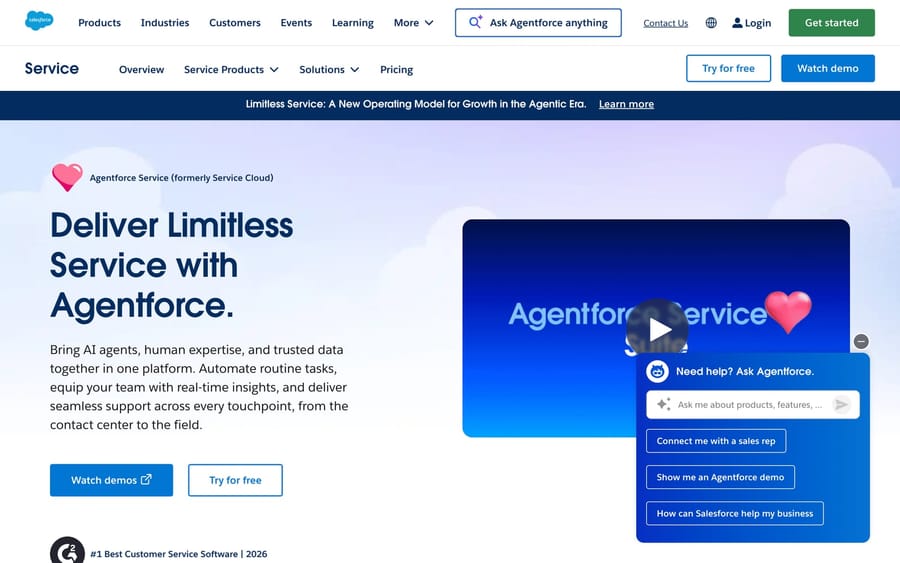
The 30-second verdict
| If you are… | Pick |
|---|---|
| A support-first team that wants value in days, not months | Zendesk |
| An SMB or mid-market CX team without a Salesforce admin | Zendesk |
| E-commerce/DTC wanting native omnichannel + voice | Zendesk |
| Already running Salesforce (Sales Cloud / Data Cloud) | Salesforce Service Cloud |
| Needing sales + service on one customer record | Salesforce Service Cloud |
| A large/regulated enterprise with admins & consultants | Salesforce Service Cloud |
| Mainly chasing better autonomous AI | Add an AI layer on either (below) |
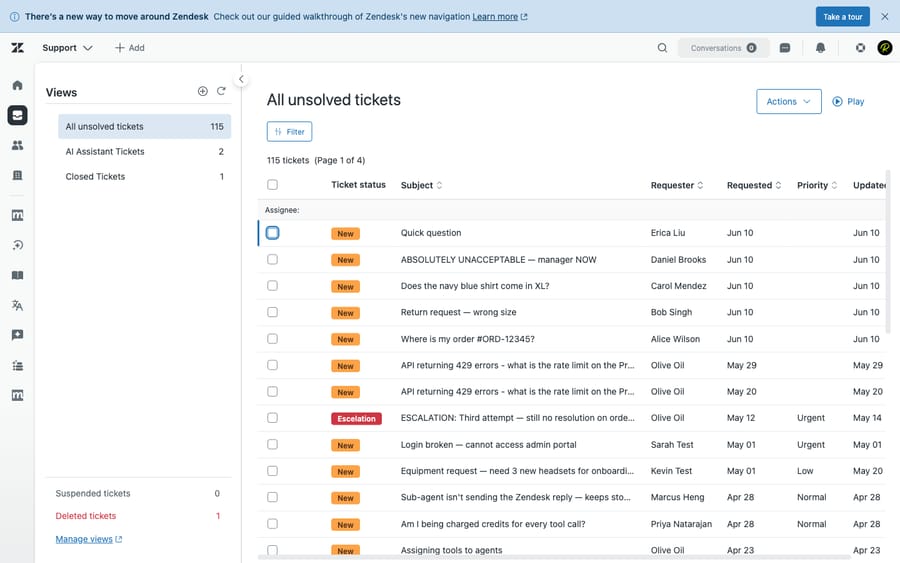
How we compared: Zendesk pricing is verified against its official page (June 2026); Salesforce Service Cloud's list pricing is public but real cost is driven by add-ons/implementation, which we flag. Features are checked against the products — and we ran Zendesk hands-on in a live test account (screenshot below). User sentiment comes from real G2, Capterra, TrustRadius, and Gartner reviews. Macha is our own product — we flag that wherever it comes up.
Pricing: the sticker vs. the real effective cost
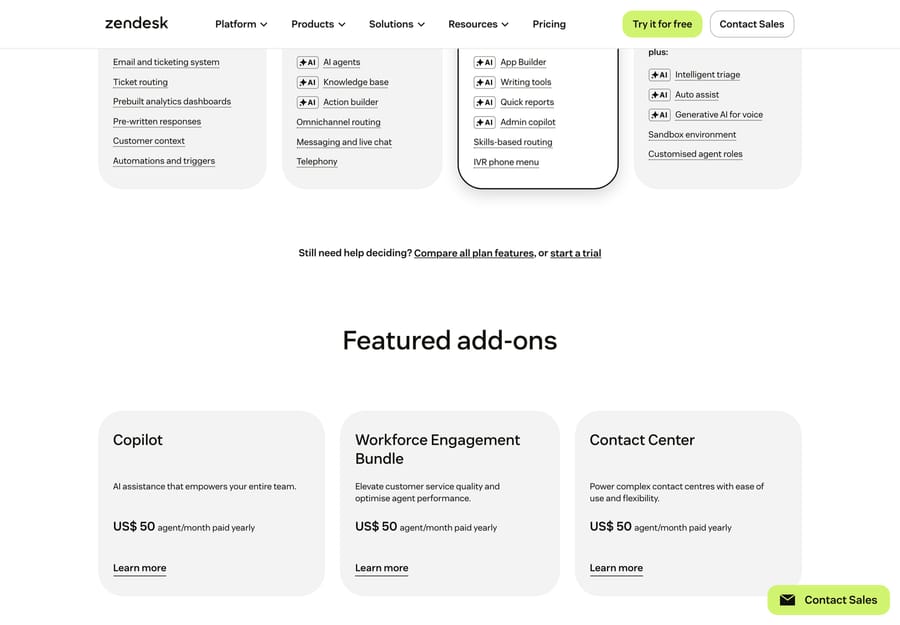
Zendesk Suite (per agent/month, annual): Support Team $19, Suite Team $55, Suite Professional $115, Suite Enterprise contact sales; Copilot/Advanced-AI add-on $50/agent. Source: Zendesk pricing, verified June 2026.
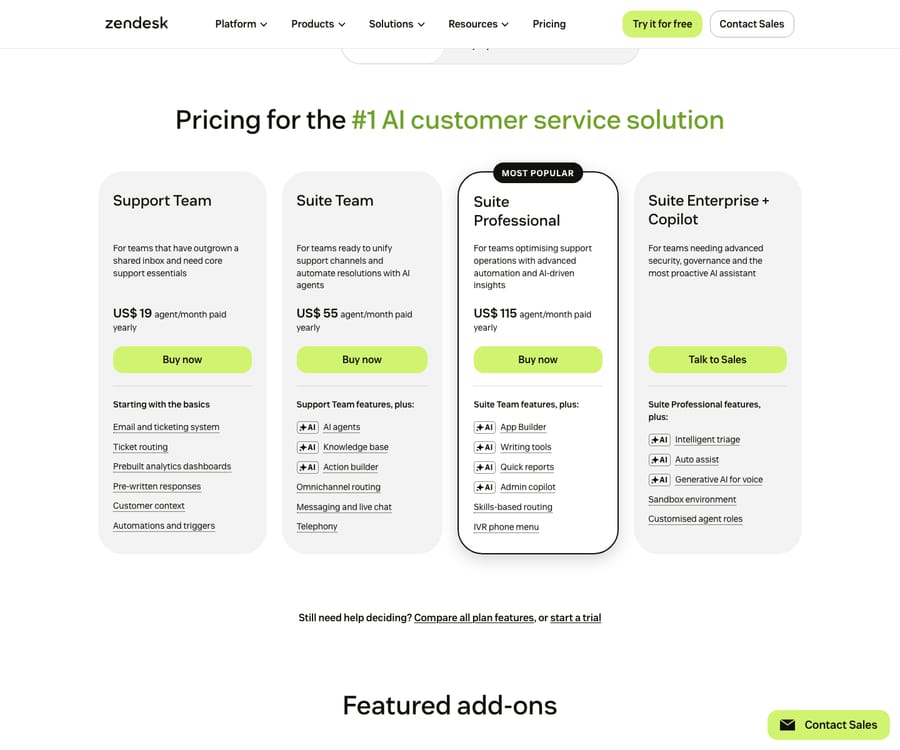
Beyond the per-seat plans, Zendesk’s AI and CX capabilities are sold as separate add-ons — each priced per agent on top of your base plan:
Salesforce Service Cloud editions (per user/month, annual):
| Edition | Price | Notes |
|---|---|---|
| Starter Suite | $25 | Very basic case management |
| Pro Suite | $100 | SMB, light customization |
| Enterprise | $165 | The "real" Service Cloud tier — Flow automation, API |
| Unlimited | $330 | More AI/sandbox/support |
| Einstein 1 Service | $500 | Bundles Agentforce + Data Cloud + Service Intelligence |
Salesforce's pricing page blocks automated access, so these are aggregator-sourced — some sources cite $175/$350 for Enterprise/Unlimited after a 2025 increase. Treat as approximate and confirm with a quote.
Here's the catch that makes Salesforce's effective cost much higher than the edition price: the real-world deployment needs add-ons.
- Digital Engagement (messaging/social/WhatsApp): +$75/user — required for true omnichannel that Zendesk includes natively.
- Service Cloud Voice: roughly $50–200/user depending on telephony model (Zendesk Talk is native).
- Data Cloud: consumption-based (bundled only at the $500 Einstein 1 tier).
- Implementation: typically $50k–$150k+ plus ongoing admin/developer headcount.
A common real-world stack — Enterprise + Digital Engagement + Voice — lands around $300–$600/user/month at list before discount, plus implementation. Zendesk's equivalent omnichannel is mostly in-box at $55–$115. (Zendesk's own comparison claims ~42% lower TCO and faster implementation — a vendor claim, but directionally consistent with independent reviews.)
The Agentforce AI math nobody shows you
Salesforce's AI (Agentforce) isn't a flat seat fee — it's consumption-based, and the math surprises people:
- $0.005 per credit; a standard AI action = 20 credits = $0.10; a voice action = $0.15.
- Or a flat $2.00 per conversation (cheaper once a conversation needs more than ~20 actions).
- The token gotcha: there's a 10,000-token threshold per action. A long, complex resolution that hits 20,001 tokens bills as 3 actions ($0.30) — costs quietly multiply on exactly the hard tickets you most want automated.
- Per-user alternatives exist (Agentforce add-on ~$125/user; Agentforce 1 Edition $550+/user).
Compare that to Zendesk's model — $50/agent Copilot plus ~$2.00 per resolution — and the honest conclusion is that both vendors make autonomous AI a meaningful line item on top of seats, and both are hard to forecast: Salesforce by token-driven consumption, Zendesk by per-resolution volume. Model it at your real ticket complexity, not the headline.
Feature-by-feature: who wins what
| Capability | Winner | Why |
|---|---|---|
| Ticketing / case mgmt & agent console | Toss-up | Zendesk is cleaner and faster to learn; Salesforce's Lightning console is more powerful but heavier |
| CRM unification (case on the Customer 360) | Salesforce (decisive) | Cases live natively on the same record as sales, marketing, billing — Zendesk's CRM is a bolt-on |
| Omnichannel | Zendesk | Native unified inbox across channels; Salesforce charges +$75 Digital Engagement for full coverage |
| Automation | Salesforce at ceiling; Zendesk for ease | Zendesk triggers are point-and-click; Salesforce Flow is far more powerful but needs admin/dev skill |
| Native AI | Split | Zendesk AI = turnkey day-one; Salesforce Agentforce = more powerful + CRM-grounded but needs config + consumption billing |
| Knowledge & self-service | Slight Zendesk | Guide/help center is strong and easy; Salesforce Knowledge needs more setup |
| Reporting / analytics | Salesforce | CRM Analytics/Tableau depth exceeds Explore for complex cross-functional reporting |
| Marketplace / ecosystem | Salesforce | AppExchange (~7,000+) dwarfs Zendesk's marketplace |
| Ease of setup & admin overhead | Zendesk (decisive) | Days–weeks, minimal IT; Salesforce typically needs admins/consultants and months |
| Voice | Zendesk | Native Talk included; Service Cloud Voice is a paid add-on |
| Customization / scalability ceiling | Salesforce | Highest ceiling for complex, regulated, multi-cloud enterprises (FedRAMP, HIPAA, data residency) |
Strengths & weaknesses, honestly
Zendesk — strengths: fastest deployment; best-in-class agent UX; native omnichannel + voice; purpose-built for support; transparent pricing; strong turnkey AI; lower TCO. Zendesk — weaknesses: shallower true-CRM/360; smaller app ecosystem; analytics less deep; AI add-on pricing opacity; lower customization ceiling; Enterprise tier now quote-only.
Salesforce Service Cloud — strengths: unified Customer 360; unmatched customization/automation (Flow); deepest analytics; largest ecosystem; enterprise compliance and data residency; sales + service on one platform. Salesforce Service Cloud — weaknesses: steep learning curve; long, expensive implementation; needs admins/consultants; fragmented add-on pricing; consumption-based AI cost is hard to forecast; overkill for support-first SMBs.
What real users say
Ratings are close on the surface, but the base and the recurring complaints differ. (Observed June 2026.)
| G2 | Capterra | Other | |
|---|---|---|---|
| Zendesk | 4.3 / 5 (~6,000+) | 4.4 / 5 (4,081) | TrustRadius 8.7/10 |
| Salesforce Service Cloud | ~7,300 reviews (now listed under "Agentforce Service")* | 4.5 / 5 (824) | "Top Rated" on TrustRadius |
\*Salesforce's G2 listing was renamed and now blends in Agentforce (AI-agent) sentiment, so its recent star average is hard to isolate — treat cross-platform rating gaps as directional, not decisive. Salesforce's review base is also much smaller on Capterra (824 vs Zendesk's 4,081).
- Zendesk — praised for feature breadth and everyday agent usability: "strong value for money considering the wide range of features" (Ifra S., Zendesk developer, Capterra, Dec 2025). The two recurring knocks are add-on/pricing creep and Zendesk's own support quality: "Their support is some of the worst I've ever experienced and keeps getting worse" (Katie Y., Head of Customer Success, Capterra, Mar 2025).
- Salesforce Service Cloud — praised for the unified customer record: "Full customer history alongside active cases made conversations feel informed" (Riley R., Legal Project Analyst, Capterra, Feb 2026). The dominant criticisms are complexity and cost: "Customization [is] powerful but overwhelming if not used to Salesforce; pricing high" (Harshul S., Sr. Tech Support Specialist, Capterra, Mar 2026), with others citing a steep learning curve and a TCO that lands well above the sticker. A common Reddit characterization is a "Jenga tower" where one change breaks dependencies.
The pattern matches the pricing story: Zendesk users complain about what they pay; Salesforce users complain about what it takes to run it.
Who each is genuinely for
- Zendesk → support-first organizations that want value in days not months; SMB → mid-market → CX-led enterprises that prioritize agent experience and omnichannel over deep CRM customization; teams without (or unwilling to staff) a Salesforce admin function; e-commerce/DTC.
- Salesforce Service Cloud → organizations already on Salesforce (Sales Cloud, Data Cloud); businesses that need sales + service on one CRM record; large, complex, or regulated enterprises (financial services, healthcare, public sector) with the budget and admin/developer resources to exploit it.
The deciding question is usually simpler than feature lists: are you already a Salesforce shop? If yes, Service Cloud's unified record is a genuine advantage worth the overhead. If not, Zendesk gets you a better support experience faster and cheaper.
Migration: the part every comparison skips
Moving between these two is a project, not a toggle — and the data models differ (Zendesk's ticket model vs Salesforce's Case/Account/Contact objects), so mapping is non-trivial.
- Zendesk → Salesforce: usually consultant-led — rebuild automations as Flows, recreate routing, import case history; budget weeks to months.
- Salesforce → Zendesk: generally faster; the work is extracting from the Salesforce data model and rebuilding reports, and agents reskill quickly on Zendesk's simpler UI.
- Both directions: macros/triggers vs Flows don't port, knowledge bases need re-import, SLAs/business hours get reconfigured, integrations (telephony, billing) are re-wired, and contract/consumption commitments can lock spend. Plan agent retraining and a parallel run.
None of this is a reason not to switch — but "the data moves fine" hides where the real effort (and cost) lives.
The AI question — powerful, but priced and locked in
Both vendors are pushing hard on AI — Zendesk AI/Copilot and Salesforce Einstein/Agentforce (Atlas reasoning engine, CRM-grounded). Both are genuinely capable. But for a team that already owns one of these platforms, both share the same two frictions: AI is a real extra cost on top of seats (Zendesk's $50/agent + per-resolution; Salesforce's consumption credits + Data Cloud dependency), and it's locked to the vendor's data model — Salesforce's AI quality in particular depends on getting your data into Data Cloud.
If autonomous resolution is the actual goal, you don't have to buy it from your help desk. An independent AI agent layer sits on top of Zendesk or Salesforce, delivers autonomous deflection without a platform migration, and prices per AI action rather than per consumption-credit or per vendor-defined resolution. A layer like Macha is helpdesk-agnostic by design — it's not a CRM or a help-desk replacement, it's the AI layer you add on top. The honest caveat: a layer is still another vendor and integration to manage, it only resolves as well as the knowledge you connect to it, and per-action pricing isn't free at high volume — it's additive to your stack, not a way out of paying for the work. (More: native AI vs. an AI layer and the best AI help desk software.)
Frequently asked questions
Is Zendesk cheaper than Salesforce Service Cloud? Almost always, once you count the real stack. Zendesk's omnichannel is mostly in-box at $55–$115/agent; Salesforce's effective cost (Enterprise + Digital Engagement + Voice + implementation + admins) commonly lands $300–$600/user before discount. Confirm both with quotes.
Should I use Service Cloud if I already use Salesforce? Usually yes — that's its strongest case. Cases on the same Customer 360 record as sales and marketing is a real advantage if you're already invested in Salesforce.
Which is easier to set up? Zendesk, decisively — days to weeks, minimal IT. Salesforce Service Cloud typically takes months and needs admins or consultants.
How does Agentforce pricing work vs. Zendesk AI? Agentforce is consumption-based (~$0.10/action or $2/conversation, with a 10k-token-per-action multiplier); Zendesk charges $50/agent plus ~$2/resolution. Both add meaningfully to seat costs and both are hard to forecast — model them at your real volume.
Can I get autonomous AI without committing to either platform's AI? Yes — an AI agent layer like Macha adds autonomous AI on top of Zendesk or Salesforce, priced per action, with no migration.
The bottom line
Choose Zendesk if you want a great support experience running fast and affordably, with native omnichannel and no admin team required. Choose Salesforce Service Cloud if you're already on Salesforce or need sales + service unified on one CRM with deep customization — and you have the budget and people to run it. Either way, keep the AI decision separate: both charge extra for AI and lock it to their platform, so if autonomous resolution is the goal, an AI layer on top is often the faster, more predictable path.
Want autonomous AI without the platform lock-in? See how Macha layers AI agents over Zendesk or Salesforce, priced per action. 7-day free trial, no credit card required. Start Trial.
Add AI agents to your Zendesk
Macha reads the ticket, drafts the reply and takes the action, inside the Zendesk you already run.