





 Shopify
 Stripe
 Slack
 Notion
 Google Workspace
 Confluence


Crisp Hugo Credits Explained: What They Cost, What Uses Them and What Happens When They Run Out


Hugo credits are the monthly AI budget on a paid Crisp plan: $5 on Mini, $25 on Essentials and $75 on Plus, counted in US dollars and spent in tokens as Hugo reads and replies. Crisp's billing guide puts a full Hugo conversation at about $0.05 to $0.10. Credits reset on the 4th of each month, Playground tests spend them too, and when they run out with pay-as-you-go off, Hugo stops answering and new conversations go to your human operators until the next reset.
Key takeaways
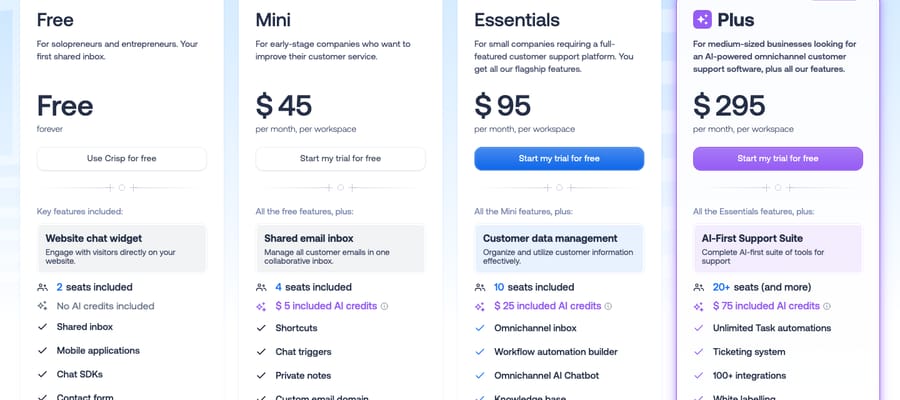
- Hugo credits are a monthly US-dollar allowance on paid Crisp plans: $5 on Mini, $25 on Essentials and $75 on Plus, with none on Free.
- Crisp's billing guide says a full Hugo-handled conversation costs about $0.05 to $0.10 in credits, so $25 covers roughly 250 to 500 conversations.
- When Hugo credits run out and pay-as-you-go is off, Hugo stops answering automatically and incoming Crisp conversations are escalated to human operators.
- Crisp's Hugo credits reset every billing cycle, currently on the 4th of the month, and Crisp says unused monthly Hugo credits do not roll over.
- Testing, training and Playground usage can use paid AI models and consume Hugo credits, including during a trial before the workspace is on a paid plan.
| Question | Answer from Crisp's billing guide (updated November 1, 2026) |
|---|---|
| What is a credit? | A US-dollar usage value spent on AI conversations, tests and other AI actions |
| Included each month | Free: none · Mini: $5 · Essentials: $25 · Plus: $75 |
| Billing unit | Tokens; a conversation "is not billed per message" |
| Average conversation | About $0.05 to $0.10 |
| Reset | Every billing cycle, currently the 4th of the month |
| Run out, pay-as-you-go off | Hugo stops; conversations escalate to human operators |
| Run out, pay-as-you-go on | Hugo keeps answering up to the limit you set |
| Playground and testing | Use paid models and consume credits |
| Workflows | Don't consume Hugo credits |
What are Hugo credits?
Crisp's Hugo billing guide says each paid plan "includes a monthly amount of Hugo credits, expressed as a USD usage value," used "when Hugo processes conversations, tests, and other AI-powered actions." The same guide says Hugo is included by default from the Mini plan up, so there's no separate AI subscription to buy. What each plan costs, seats included, is in our Crisp pricing breakdown.
Credits are token-based. A token is a slice of text the AI model reads or writes, and each conversation's cost depends on how many tokens it takes. The guide lists what moves that number: message length, conversation depth, knowledge source size, language complexity, the selected AI model, and the number of Hugo replies. The troubleshooting article adds tool usage and how often Hugo needs to search or reason before answering.
Crisp says "A Hugo conversation is not billed per message." Credits are spent on tokens, and Crisp counts a conversation from the first AI-handled message until it's resolved, routed or escalated. A two-line "what are your opening hours?" chat and a twelve-message troubleshooting session are both one conversation, but the second one uses far more tokens.
This system is new. Hugo replaced Crisp's MagicReply chatbot blocks, and the billing guide notes that a "legacy MagicReply (Deprecated) workflow block" keeps its own workflow behavior. Until February 2026, Crisp's AI replies were free; the AI Core Update post (February 1, 2026) says "AI-powered resolutions now move to a paid model," and the credit allowance replaced free.
How many conversations do Hugo credits cover?
Crisp's pricing page gives one estimate per plan, and Crisp's own $0.05 to $0.10 range gives a band around it:
| Plan | Monthly credit | Crisp's estimate | At $0.05 a conversation | At $0.10 a conversation |
|---|---|---|---|---|
| Mini ($45) | $5 | About 90 | 100 | 50 |
| Essentials ($95) | $25 | About 450 | 500 | 250 |
| Plus ($295) | $75 | About 1,350 | 1,500 | 750 |
Crisp's estimates all assume about $0.056 a conversation ($25 divided by 450), close to the cheap end of its own range. A team on a costlier model, with long troubleshooting chats or a large knowledge base, should plan on the right-hand column.
Past the allowance, the arithmetic is simple even without a published pay-as-you-go rate. By our estimate, 600 Hugo conversations a month on Essentials is $30 to $60 of usage at Crisp's $0.05 to $0.10 average, so $5 to $35 beyond the $25 credit. Crisp doesn't publish its pay-as-you-go rate, so treat that as a range, not a quote.
Turn that into days. A store on Essentials that hands Hugo 20 conversations a day uses $25 in about 22 days at Crisp's estimate, or about 12 days at $0.10. A SaaS team with 40 a day runs out in 11 days at the estimate and 6 days at the top of the range. Above roughly 15 Hugo conversations a day, the Essentials credit won't last a 30-day month even at Crisp's own estimate.
What happens when Hugo credits run out?
If pay-as-you-go is disabled, the guide says "Hugo stops answering automatically and incoming conversations are escalated to human operators" until credits reset or more usage is enabled.
- Customers keep reaching you. Nothing breaks on the chat widget. New conversations land in the inbox for a person, the same as before Hugo existed.
- Your response times change overnight. If Hugo was handling 40% of chats and your team sized itself around that, the queue grows by that 40% the day the credit runs out, and stays that way until the 4th.
- The customer experience changes quietly. The guide describes an escalation to operators, not a message to the customer, so the visible change is a wait for a person instead of an instant reply.
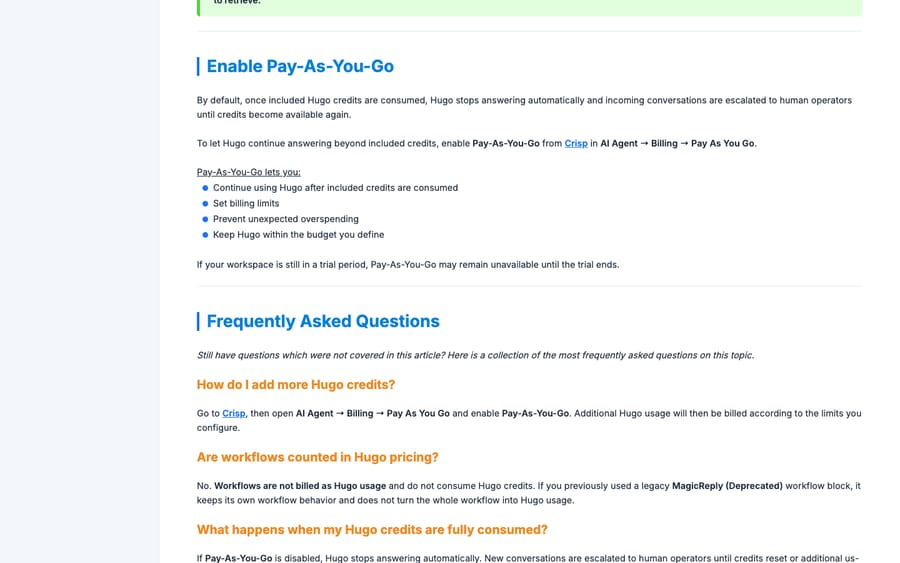
Pay-as-you-go is the switch that prevents this. You enable it under AI Agent, then Billing, then Pay As You Go, and set billing limits there. Two caveats from the guide: it doesn't publish a pay-as-you-go rate, and pay-as-you-go "may remain unavailable until the trial ends", so a trial workspace that spends its credit just stops automating.
If Hugo goes quiet mid-month, look for a private note on the conversation first. Crisp's troubleshooting article says that when credits are missing, "Crisp usually adds a private note explaining what happened." The balance itself is under AI Agent, then Agent, then Billing. The same article lists other reasons Hugo escalates instead of answering; it says the most common is that Hugo can't find a reliable enough source in your training data.
Do Hugo credits roll over?
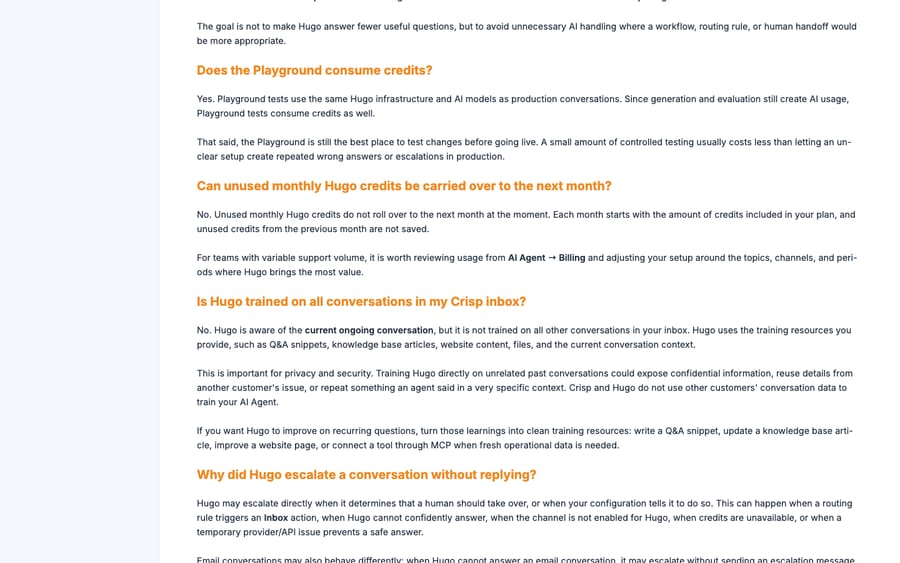
Crisp's billing guide says credits "reset every billing cycle, currently on the 4th of the month." Crisp's Hugo troubleshooting article (updated November 1, 2026) answers the rollover question directly: "Unused monthly Hugo credits do not roll over to the next month at the moment." A team that uses $10 of its $25 in a quiet month doesn't start the next month with $40.
The guide gives the 4th as the reset day rather than your subscription anniversary, so check the date in your own billing screen if your plan renews on another day. It also notes that included credits can take one to two hours to appear after a charge processes, and suggests sending a test message in the Playground if they don't refresh.
The incentive is plain: a monthly reset with no rollover means Crisp keeps the unused part of every allowance, and teams sized for their busiest month pay for credit they don't spend in quiet months. That's common in credit-based AI pricing and not unique to Crisp, but it's why the plan estimate is a ceiling for quiet months, not an average.
Does testing Hugo in the Playground use credits?
Yes. The troubleshooting article explains why: "generation and evaluation still create AI usage." The billing guide's highlighted note reads: "Hugo usage during a trial also consumes credits. Testing, training, and Playground usage can still use paid AI models, even before your workspace becomes a paid subscription."
That changes how you should test. Crisp's Playground lets you simulate customer conversations and compare model options side by side, and every simulated conversation is billed like a real one. Comparing four models on 25 test questions is 100 conversations, which at $0.05 to $0.10 is $5 to $10: all of a Mini allowance, or a fifth to two-fifths of Essentials, before a customer has seen Hugo.
Practical rules:
- Write your test set once (20 to 30 real questions from past chats) and reuse it, rather than typing new questions ad hoc.
- Compare models on a small subset, then run the full set only on the model you pick.
- Run tests early in the billing cycle if you're close to the cap, so a test burst doesn't cut off live customers near the 3rd.
How do you make Hugo credits last longer?
Crisp's guide lists three levers under "Optimize Hugo costs", and its model guide and workflow rules add two more:
- Pick a cheaper model. Hugo chooses a model automatically by default, and Crisp's model guide (updated October 26, 2026) ranks the options by "relative Hugo credit usage". Its notes say Anthropic's most capable models can use more credits and Google's Gemini models are positioned for lower usage.
- Ask for concise replies. Fewer output tokens per reply means a cheaper conversation.
- Keep knowledge sources focused. Crisp's guide lists knowledge source size as a cost factor, so a bloated crawl of your whole website costs more than a tight set of help articles and snippets.
- Use workflows for rules. The billing guide says workflows "are not billed as Hugo usage and do not consume Hugo credits." Routing by language, segment or keyword in a workflow costs nothing; asking Hugo to decide costs a conversation.
- Set a pay-as-you-go limit rather than leaving it off. A billing limit you choose keeps Hugo answering through a busy week without an open-ended bill.
How does Macha's billing compare on Crisp?
Hugo is cheaper per conversation than Macha: $0.05 to $0.10 in credits against about $0.40 per ticket. If you want an FAQ agent you train yourself, Hugo's credits are good value, and the advice above will stretch them. Our comparison of Hugo and an AI agent layer sets out where each one fits, and our roundup of AI agents for Crisp covers the other options.
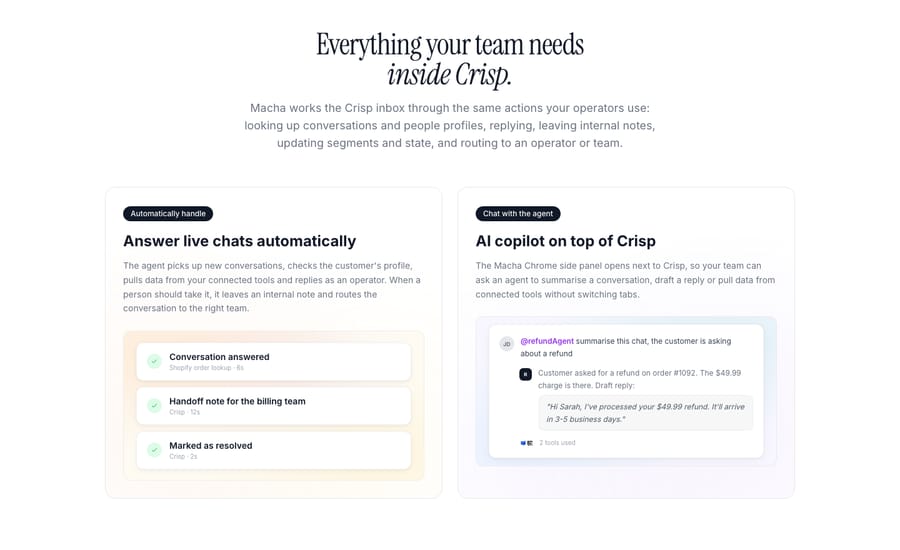
Macha fits teams on Crisp that want order, billing and policy questions handled without building the agent themselves, or that want every AI reply drafted as an internal note for an operator to approve first. Macha's agent runs inside your Crisp workspace. It reads the conversation and the customer's people profile, replies on their channel or adds an internal note, tags the conversation with segments, changes its state and routes it to an operator or team, starting on a new conversation or a new customer message, which is how teams answer Crisp chats after hours. The full tool list is on the Crisp integration page.
The billing shape is different too. Macha charges one price per ticket, whatever the model, the number of tool calls or the length of the conversation, on a monthly volume you choose up front from $299/month for 750 tickets (see pricing). There are no overages: when the month's tickets are used, agents pause until the next billing date unless you move up a tier or add a top-up, and nothing is charged without you choosing it. It's set up and run for you: the Macha team analyzes your past conversations, builds the knowledge base and the agent, and runs it in safe mode until the drafts are right, with a dedicated success manager on the trial and every plan. See Macha on Crisp, the internal-note drafting workflow, or start with $50 of free usage (about 125 tickets), no credit card, no time limit.
For Hugo's features beyond billing, read our Crisp AI explainer, and for other help desks entirely, our Crisp alternatives roundup.
Common questions
How many Hugo credits do I get on Crisp?
Mini includes $5 a month, Essentials $25 and Plus $75. The Free plan includes none. Crisp estimates those at about 90, 450 and 1,350 automated conversations.
How much does one Hugo conversation cost?
Crisp's billing guide says a full Hugo-handled conversation averages about $0.05 to $0.10. Cost rises with longer conversations, larger knowledge sources and more capable models.
Why did Hugo stop answering?
Crisp's troubleshooting article lists several causes: Hugo can't find a reliable enough source in your training data (which Crisp says is the most frequent), the channel isn't enabled for Hugo, a routing rule triggered, credits are unavailable, or a temporary provider issue. When credits are missing, Crisp usually adds a private note explaining what happened.
When do Hugo credits reset?
Every billing cycle, currently on the 4th of the month, according to Crisp's billing guide.
Do unused Hugo credits carry over?
No. Crisp's troubleshooting article says unused monthly Hugo credits do not roll over to the next month "at the moment", so unused credit is gone at the reset on the 4th.
Do Playground tests use Hugo credits?
Yes. Testing, training and Playground usage can use paid AI models and consume credits, including during a trial.
Can I use pay-as-you-go during the Crisp trial?
Crisp's guide says pay-as-you-go may remain unavailable until the trial ends, so a trial workspace stops automating when its credit is spent.
Do Crisp workflows use Hugo credits?
No. Crisp's billing guide says workflows aren't billed as Hugo usage and don't consume Hugo credits.
How we researched this
We checked every rule on this page against the source on November 21, 2026. They come from Crisp's Hugo billing guide (updated November 1, 2026), its Hugo troubleshooting article (updated November 1, 2026), its AI model guide (updated October 26, 2026), Crisp's pricing page and the February 2026 AI Core Update, all read on November 21, 2026; the two help articles were captured the same day.
The conversation counts, day counts and the Playground example are our arithmetic from Crisp's published $0.05 to $0.10 range and plan credits. We haven't run Hugo on a paid Crisp workspace, so none of these are measured Hugo costs. Macha's Crisp capabilities come from Macha's own Crisp connector, shown above, and our Crisp integration listing.