
 Shopify
 Stripe
 Slack
Slack Notion
 Google Workspace
 Confluence

How Do You Build an AI Agent for Freshdesk? API vs Connector (2026)


An AI agent on Freshdesk reads each new ticket, looks up the customer, answers from your knowledge base, and either replies or escalates. You can code that against the Freshdesk API yourself or connect a platform that already speaks Freshdesk, and the right choice depends on how much infrastructure you want to own.
Key takeaways
- An AI agent for Freshdesk can be built against the v2 REST API using GET /api/v2/tickets/[id] to read and POST /api/v2/tickets/[id]/reply to answer.
- Freshdesk automation webhooks do not sign payloads and retry a failed call every 30 minutes up to 48 times, so a home-built agent needs a secret header and idempotency.
- Freshdesk's API returns HTTP 429 with a Retry-After header when a plan's limit is hit, for example 3,000 calls an hour on newer Growth plans.
- Macha's Freshdesk connector uses an API key and gives an agent 15 tools, including Add Public Reply, Update Status and Assign Ticket.
- Macha Simulations replay past Freshdesk tickets with write tools stubbed, and the Macha team uses them to build, test and run your agent for you, included at about $0.40 a ticket from $299 a month.

You build an AI agent for Freshdesk in one of two ways: code it yourself against the Freshdesk v2 REST API (read a ticket with GET /api/v2/tickets/[id], answer with POST /api/v2/tickets/[id]/reply, start runs from an automation-rule webhook), or connect a platform such as Macha that already has a Freshdesk connector with 15 ticket tools and can run on your real tickets the same day. The API route takes weeks of production work; the connector route takes an API key and an afternoon of testing.
| Build on the Freshdesk API | Connect Macha | |
|---|---|---|
| Read/reply to tickets | You write the API client | Native connector (Freshdesk API key) |
| Trigger on new tickets | You build and host a webhook endpoint | Macha gives you the webhook URL; you add one Freshdesk automation rule |
| Ground on knowledge base | You embed + host a vector store | Search Articles tool, plus Sources for docs and websites |
| Other systems as tools | You wire each integration | Custom Tools |
| Hosting, retries, observability | Your infrastructure | Built in |
| Evaluate before go-live | You build a harness | Simulations replay past tickets |
| Setup | Your engineering team | Done for you by the Macha team, with a dedicated success manager, included |
| Time to a live agent | Weeks + ongoing | Same day |
What does a Freshdesk AI agent actually do?
The loop is the same as any support agent, wired to Freshdesk: a new ticket arrives, the agent reads it and the requester's history, it calls tools (look up the order, search your knowledge base, check a policy), and it posts a reply or routes the ticket to a human. The hard part is doing that reliably against real tickets. (New to agents generally? Start with AI agents for customer service.)
How do you build it against the Freshdesk API?
Freshdesk has a full REST API, so you can build the agent yourself. The pieces:
- Read tickets: the Freshdesk API exposes
GET /api/v2/tickets/[id]to pull the ticket, plus its conversations and the requester. - Reply / act: post a public reply with
POST /api/v2/tickets/[id]/reply, or update status and tags withPUT /api/v2/tickets/[id]. - Trigger on new tickets: a Freshdesk automation rule with a webhook action calls your endpoint when a ticket is created.
Authentication is HTTP Basic with your personal API key as the username and any dummy value as the password. A reply tool against the real Freshdesk API looks like this:
import requests
FD = "https://yourco.freshdesk.com/api/v2"
AUTH = (API_KEY, "X")   # Freshdesk API key as the username, any password

def reply_to_ticket(ticket_id: str, body: str):
    r = requests.post(f"{FD}/tickets/{ticket_id}/reply",
        json={"body": body},
        auth=AUTH, timeout=10)
    r.raise_for_status()          # handle 429 rate limits, retries
    return {"status": "sent"}
Wrap that (and a get_requester, a search_knowledge_base) as tools in an agent loop; see how to build an AI agent: from scratch vs. platform.
What production work does the API route add?
The API calls are the easy bit. A Freshdesk agent you'd trust also needs:
- A secured webhook endpoint. Freshdesk's automation webhooks don't sign payloads, so you check a shared secret sent in a custom header. You also need idempotency: Freshdesk retries a failed webhook every 30 minutes, up to 48 times, and a retried event must not double-reply.
- Rate-limit handling. Freshdesk throttles by plan (for example 3,000 calls an hour on newer Growth plans, 50 a minute on trial accounts) and returns HTTP 429 with a
Retry-Afterheader. Webhooks from automation rules are capped at 1,000 calls an hour. - Grounding in your knowledge base (embed the articles, keep them fresh), guardrails (escalate refunds, don't leak PII), 24/7 hosting, observability, and an eval harness over real historical tickets.
That's weeks of work plus upkeep, and none of it is specific to your business.
How does connecting Freshdesk through Macha work?
Macha layers on top of Freshdesk. It isn't a Freshdesk replacement or a marketplace app; you connect it with a Freshdesk API key and it works from there:
- Connect with an API key: the Freshdesk connector gives the agent 15 tools, including Get Ticket, Search Tickets, Search Contacts, Add Public Reply, Add Internal Note, Update Status, Update Tags and Assign Ticket.
- Ground on your knowledge base: the connector's Search Articles tool reads your Freshdesk solution articles, and you can add other docs, PDFs and websites as Sources.
- Any other system as a tool: Custom Tools turn your order or billing APIs into agent capabilities by describing them.
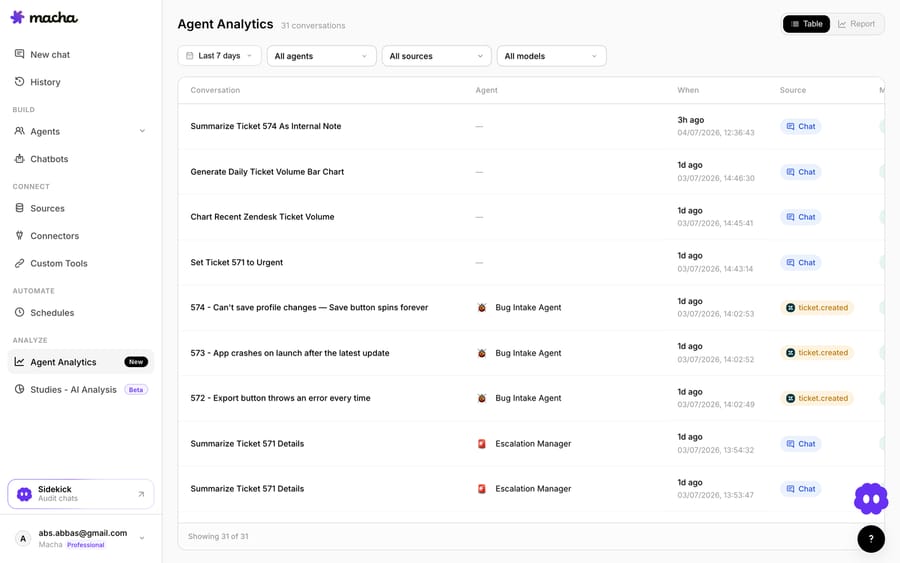
- Runs and gets tested: Ticket Created and Ticket Updated triggers start the agent through a webhook URL that Macha gives you for a Freshdesk automation rule. Agent Analytics show every run, and Simulations replay past tickets against the agent, with write tools stubbed, before it goes live.
You don't have to configure any of that yourself. Macha is the done-for-you route: you connect Freshdesk and the tools your answers come from, which takes about 15 minutes, and the Macha team analyzes about a month of your past tickets, builds the knowledge base and the agent, tests it on a sample of those tickets, and runs it in safe mode, with drafts as internal notes in Freshdesk, until the drafts are right. That's included on the trial and every plan.
Should you build or connect?
Build on the API if you need a fully custom runtime, have strict data-residency needs, or the agent is your product. For most Freshdesk teams who just want tickets resolved, a native connector gets you a measurable agent on your real tickets far faster, and you keep your model of choice. Macha is one plan priced by ticket volume, from $299 a month for up to 750 tickets, about $0.40 a ticket, which includes the setup and a dedicated success manager who handles your changes afterwards: new ticket categories, instruction edits, new tools. See pricing. You can start free on Macha with $50 of free usage, connect Freshdesk, and test an agent on your own tickets the same day.
FAQ
Is a Freshdesk AI agent the same as Freshdesk's own AI (Freddy)? Not necessarily. Freshdesk sells its own Freddy AI Agent: each account gets a one-time allowance of 500 Freddy AI Agent sessions, then pays $49 per 100 sessions. You can also run a model-agnostic agent on top of Freshdesk (via its API or a platform like Macha), which helps if you want a specific model, custom tools, or to grade the agent your own way.
Do I need to install a Freshdesk marketplace app? No. Macha connects to Freshdesk with an API key and works autonomously; it's an AI layer on top of Freshdesk, not a marketplace app you install.
Can the agent take actions, not just answer? Yes: via the Freshdesk API (update, tag, assign, route) plus your own systems' APIs as tools (order lookups, refunds), with guardrails on what it can do unattended.
How do I make sure it's accurate before it replies to customers? Ground it in your knowledge base and replay it against real historical tickets first (Macha's Simulations do this without touching customers), start with internal-note drafts, and widen autonomy per ticket type as it earns trust. On Macha the team does this part for you: it tests the agent on a sample of your past tickets, reads every draft, and keeps it in safe mode until the drafts are right.