Shopify
 Stripe
 Slack
Slack Notion
 Google Workspace
 Confluence

Inside Macha's AI Support Automation Changelog: From Ship to Live Agent


Most "AI support automation" pages you'll find are listicles — twenty tools ranked by a writer who never logged into nineteen of them. They tell you what a category claims to do. They almost never show you what actually shipped last Tuesday.

This post does the opposite. It's a behind-the-scenes look at how one platform — Macha — turns AI support automation features into working agents, read straight off our public changelog. Every date and feature below is a real, shipped entry, not a roadmap promise. The point isn't to brag about velocity for its own sake. It's to show the thing nobody explains: how a single line in an AI support automation changelog becomes an agent that resolves a ticket in your helpdesk while you're asleep.
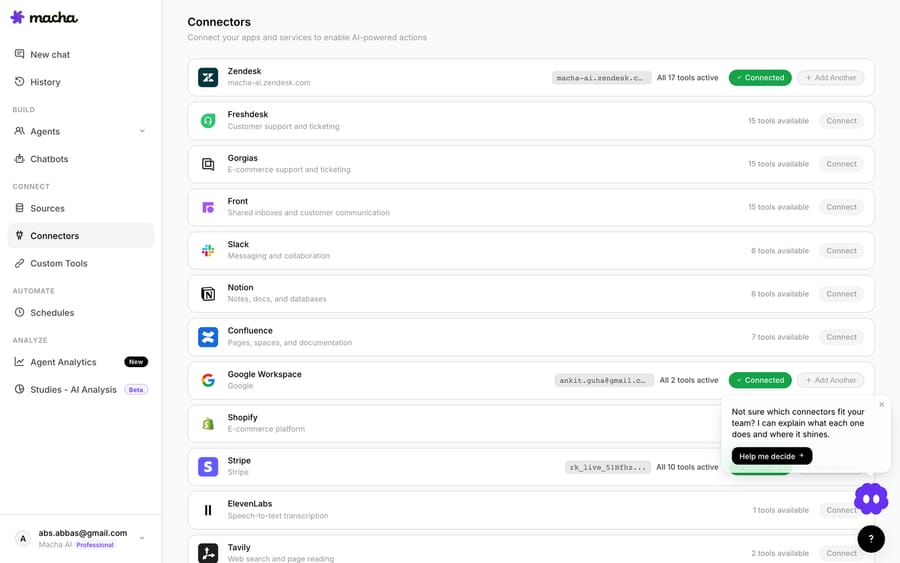
Quick framing, because it matters for everything that follows. Macha is not a helpdesk. It's an AI agent layer that sits on top of the helpdesk you already run — Zendesk, Freshdesk, Gorgias, or Front — and connects to the commerce, knowledge, and comms tools around it (Shopify, Stripe, Notion, Confluence, Slack, Google Workspace, and more). If the category is new to you, our primer on what an AI layer for support actually is explains why that distinction matters. So when we "ship a feature," we're usually shipping new surface area for an agent to act on: a new connector, a new tool, a new trigger, or a fix that makes an existing action reliable. Read the changelog with that lens and it stops looking like a list of release notes and starts looking like a map of what your agents can now do.
Changelog vs. the "best AI support automation" listicles
If you searched for AI support automation features and landed on a roundup, here's what that page is built to give you — and where it stops short. The two formats answer different questions:
| What the listicles show | What an AI support automation changelog shows |
|---|---|
| A ranked table of ~10–20 vendors with logos, star ratings, and one-line blurbs | One vendor, but every dated thing it actually shipped — connectors, tools, triggers, fixes |
| Marketing-page claims ("automates up to 80% of tickets") | Evidence: the exact feature, the date it went live, and what it unlocked |
| A snapshot frozen the day the article was written | A living record updated weekly, so you can see velocity and what gets fixed |
| Breadth to compare categories | Depth to judge whether one tool is worth committing your queue to |
Use a listicle to build a shortlist. Use a changelog to vet the finalist. A category roundup can't tell you whether a vendor fixes silent failures or ships press releases — only the shipping record can. The rest of this post is that record, organized by the four things a live agent is made of, so you can read it the way an operator would: not "who has the most logos," but "what can my agents now do, and how fast does that surface keep growing."
The pipeline: what "changelog → live agent" actually means
A live Macha agent is four things wired together:
- A connector — the helpdesk and tools it can touch (e.g. Zendesk + Shopify).
- Tools — the specific actions it's allowed to take (reply, assign, refund, tag).
- A trigger — what wakes it up (a new ticket, a Slack mention, a schedule, a webhook).
- Instructions + a model — how it decides, and which brain it uses.
Almost every changelog entry we publish makes one of those four better. A new connector adds surface area. A new tool adds an action. A new trigger adds a way to fire. A reliability fix makes an action you already rely on actually work. So the journey from "we shipped X" to "an agent now does Y in production" is short by design — most features are live in your dashboard the day they land, and you assemble them into an agent the same afternoon.
Here's the same story told four ways, using real shipping history.
1. New surface area: the connectors we shipped
An agent can only act where it's connected. So a big share of our changelog is connectors — and you can watch the addressable surface grow month by month:
| Date | Shipped | What it unlocked |
|---|---|---|
| Mar 15, 2026 | Freshdesk connector (15 tools) | Full ticket management + attachment text extraction for Freshdesk teams |
| Mar 22, 2026 | Shopify connector (7 tools) | Order lookup, customer search, refunds — commerce context on every ticket |
| Apr 9, 2026 | Confluence connector (7 tools) | Agents read and write internal wiki knowledge |
| Apr 9, 2026 | Custom API Tools | Connect any REST API as agent tools, no waiting on us |
| Jun 23, 2026 | Gorgias + Front connectors (15 tools each) | Shopify-native and shared-inbox teams get first-class support |
The June 23 release is the cleanest example of the pipeline in action. We added Gorgias (built for Shopify-native support) and Front (shared-inbox-first), each with 15 tools covering tickets, messages, customers, routing, and tags. Both connect with an API key and land under Connectors → Support with built-in agent templates. That last detail is the whole point: the connector doesn't just appear, it appears next to a template that wires the tools into a working agent so you're not starting from a blank page.
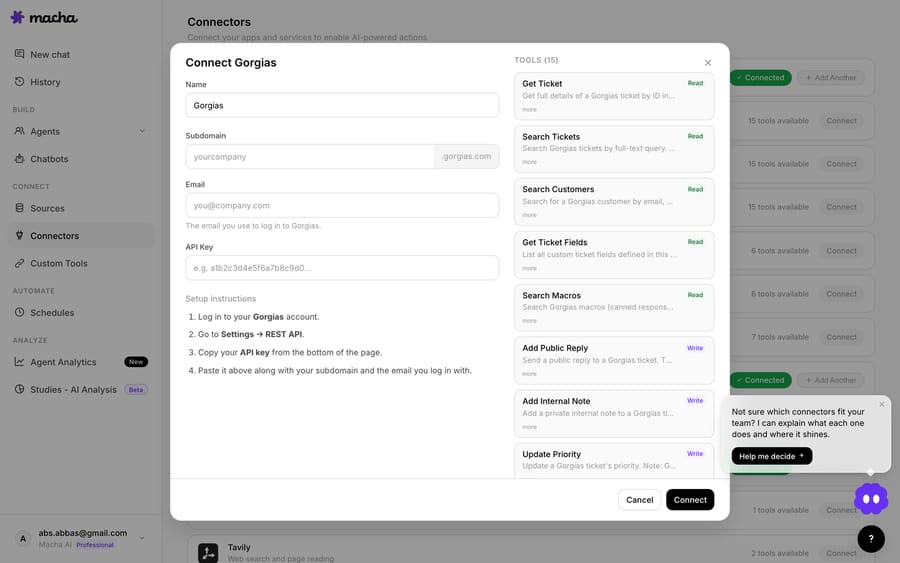
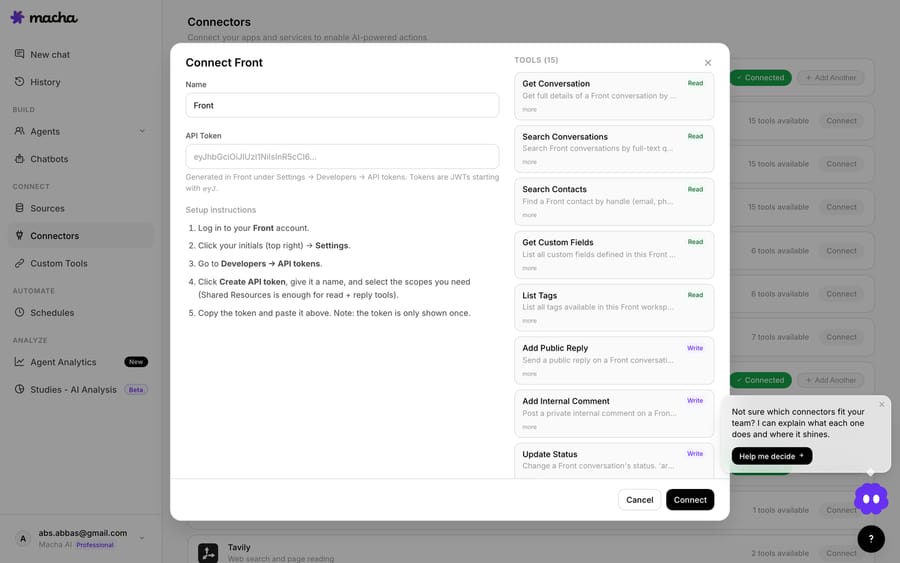
You can browse the full current set on the integrations page. The honest read on connectors: the count goes up most months, but Macha's helpdesk connectors are Zendesk, Freshdesk, Gorgias, and Front — if your team runs something else, the Custom API Tools route is the path, not a native connector.
2. New brains: agent intelligence got sharper
Surface area is useless without judgment. The other heavy theme in the changelog is making agents smarter and easier to build:
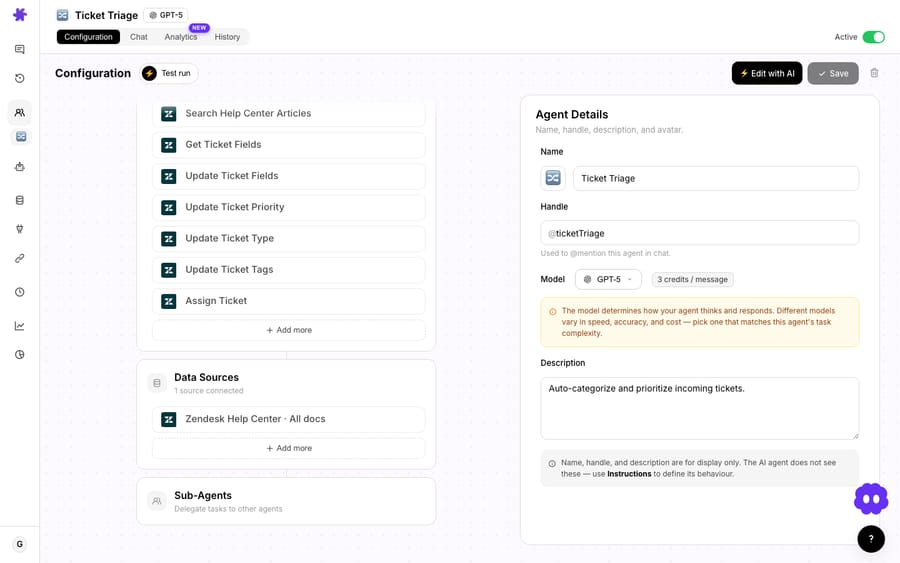
- Sub-agents (Mar 8 → Apr 3) — agents delegate to specialist sub-agents, up to three levels deep, with circular-reference prevention. By Apr 3 sub-agents could perform write operations in autonomous mode while staying read-only in interactive chat for safety.
- AI Agent Builder & Editor (Apr 3 → Apr 9) — describe what you need in plain language and Macha assembles a fully configured agent: instructions, tools, triggers, sub-agents, model. Available on every plan.
- Image vision for Zendesk attachments (Apr 17) — agents download image attachments and read them: screenshots, receipts, product photos, error dialogs.
- The model lineup (Apr 23 → Jun 17) — GPT-5.4 joined as the high-capability option; GPT-5 became the default reasoning model; GPT-5.4 Mini stayed the cheap, fast workhorse.
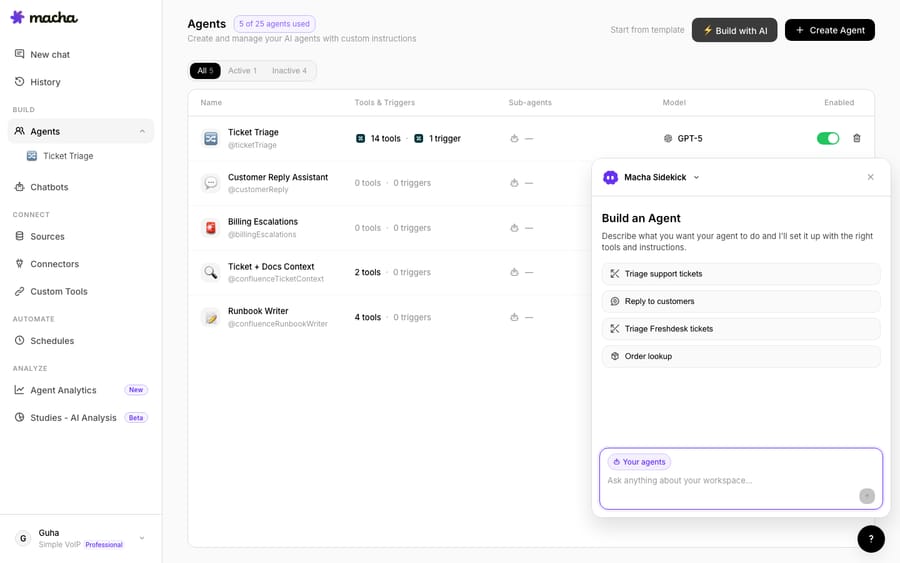
The AI Agent Builder is the most direct "changelog → live agent" tool we've shipped, because it collapses the four-step assembly into one conversation. Tell it "reply to Gorgias tickets about shipping using my help center, and escalate anything mentioning a chargeback," and it picks the connector tools, writes the instructions, and proposes a trigger. You review and save. We break down exactly how that describe-and-build flow works in the AI Agent Builder deep dive.
3. New triggers: more ways for an agent to wake up
A smart, well-connected agent that never fires is a screensaver. Triggers are how automation becomes autonomous:
- Trigger system (Mar 1) — agents run autonomously on Zendesk ticket events, Freshdesk updates, Slack mentions, and custom webhooks.
- Scheduled (cron) triggers (Mar 22 → Apr 9) — run an agent hourly or daily, with guardrails: minimum 1-hour interval, a daily run cap, and per-org concurrency limits so a misconfigured schedule can't run away.
- Custom webhooks (Apr 9) — a universal webhook URL with a signing secret, so any external system can fire an agent without a dedicated connector.
- Debounce on every event trigger (Jun 5) — batch rapid-fire events (a customer sending five messages in a row) into one agent run instead of five, with safeguards that force-fire a bucket after 25 events or a capped wait.
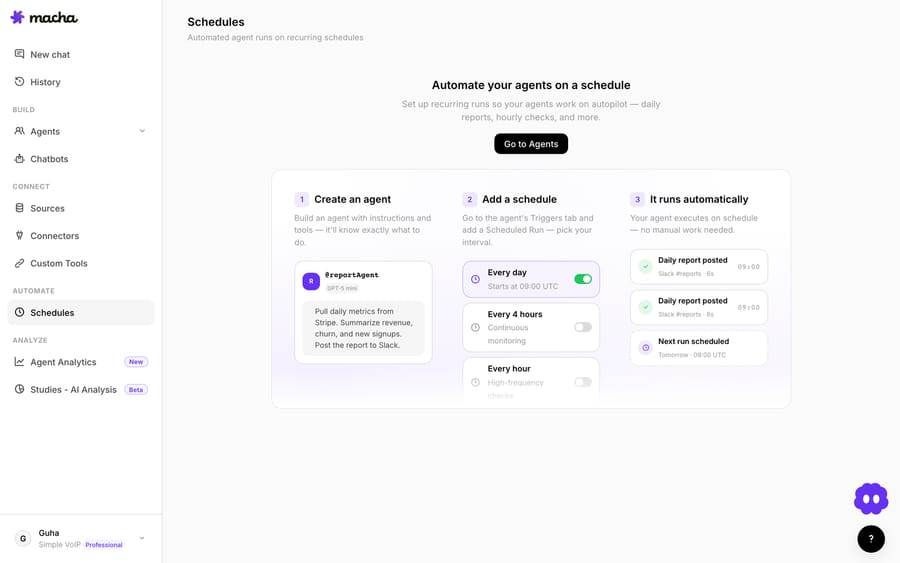
Scheduled triggers are what power the "generate weekly support reports as spreadsheets" and "daily support metrics summary in Slack" use cases — an agent that wakes itself on a clock, queries your helpdesk, and posts a digest. No human pressing run.
4. The unglamorous half: reliability is a feature
Here's the part most "features" posts skip, and the part that actually decides whether you trust an agent with a live queue. A large chunk of our changelog isn't new capability at all — it's making existing actions trustworthy. A few that matter:
- Zendesk tag updates now reliable (Jun 10) — we fixed a long-standing bug where the tag tool reported success but silently failed to apply the tag. We also stopped it from wiping the existing tag set on every write. The tool now returns the verified final tag list, so the agent sees the truth, not its own intent.
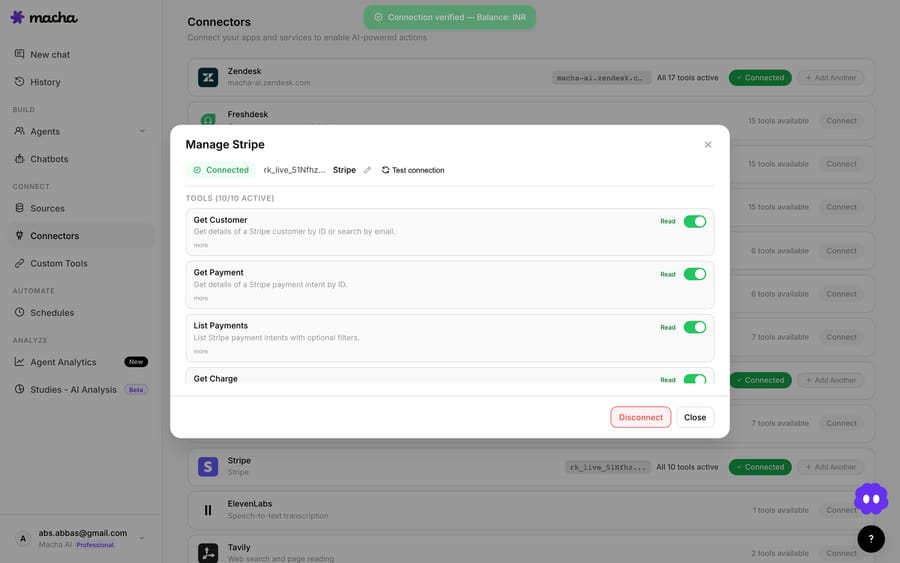
- Connector health + Test Connection + Reconnect (Apr 23) — connectors now carry a health status; when auth breaks, affected agents auto-deactivate and admins get an email, and a one-click test verifies credentials before anything goes live.
- OAuth refresh race fix (Apr 9) — concurrent token refreshes no longer clobber each other (the race that once caused a customer outage), resolved with compare-before-write logic.
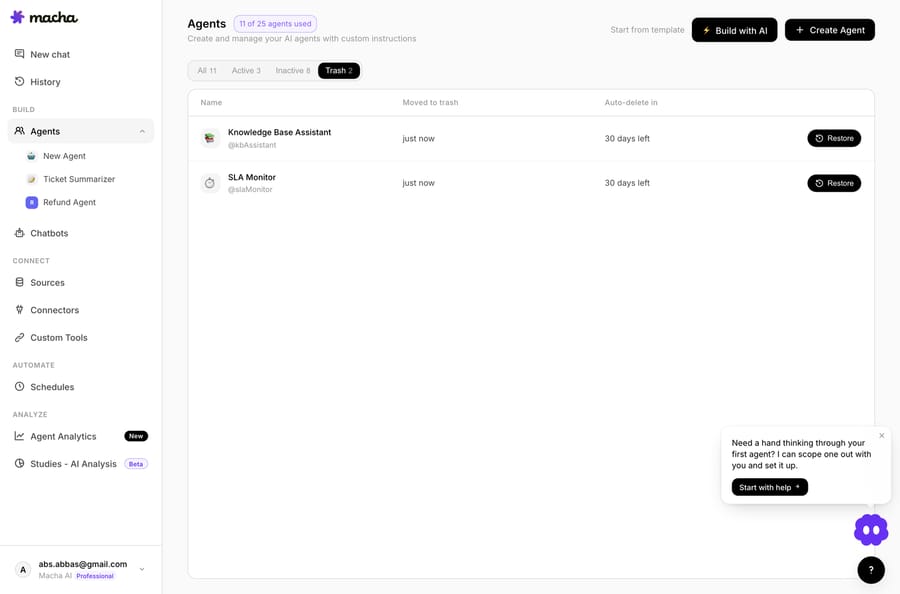
- Soft-delete agents (Jun 17) — deleting an agent now moves it to a 30-day Trash with one-click restore; its triggers are deactivated (not destroyed) so restoring brings the whole config back intact.
If you only read the headline features, you miss that the boring fixes are what make the headline features safe to deploy. An agent that adds a tag is a toy until the tag actually lands every time.
A worked example: turning the June 23 changelog into a live agent
Let's run the pipeline end to end on the most recent release, so it's concrete rather than abstract.
- Read the changelog. June 23: Gorgias connector ships, 15 tools, API-key auth, agent templates included.
- Connect. In the dashboard, Connectors → Support → Gorgias, paste the API key, run Test Connection — the same verified-credentials check from the April reliability work, so I know it's live before I build on it.
- Assemble the agent. Start from the bundled Gorgias template (or describe it to the AI Agent Builder). Tools: search tickets, get customer, add a reply, assign to a team. Instructions: answer shipping/returns FAQs from the help center, escalate billing disputes.
- Add a trigger. Gorgias custom-webhook trigger on ticket created — and because debounce shipped in June, batch a customer's rapid messages into one run.
- Pick a model. GPT-5.4 Mini at 1 credit per action for volume FAQs; reserve a higher-capability model for the escalation sub-agent.
- Go live. Save. The next matching Gorgias ticket fires the agent autonomously.
That's three weeks, at most, from "a connector appeared in the changelog" to "an agent is closing tickets in your inbox" — and most of those steps are minutes, not days. Industry benchmarks put well-implemented support AI at roughly 30–60% of tickets handled when configured properly; the speed of this pipeline is what lets you iterate toward that range instead of guessing once and hoping.
What weekly shipping costs you (the honest watch-outs)
Fast shipping is not an unalloyed good, and pretending otherwise would be the kind of marketing this post is trying to avoid.
- Not every line is for you. A changelog that moves weekly will mostly ship things your team doesn't need. Reading it as a to-do list is a mistake; read it as an option list and adopt deliberately.
- New capability deserves a test run, not blind trust. This is exactly why we ship behind confirmation modals, Test Run with real data, and read-only-in-chat defaults for write tools. Use them. Turn an agent loose on a sample before the live queue.
- Connectors are finite. Weekly velocity doesn't mean every tool you own is supported. Helpdesk-side it's Zendesk, Freshdesk, Gorgias, and Front; beyond that you're in Custom API Tools territory, which is powerful but is real configuration work.
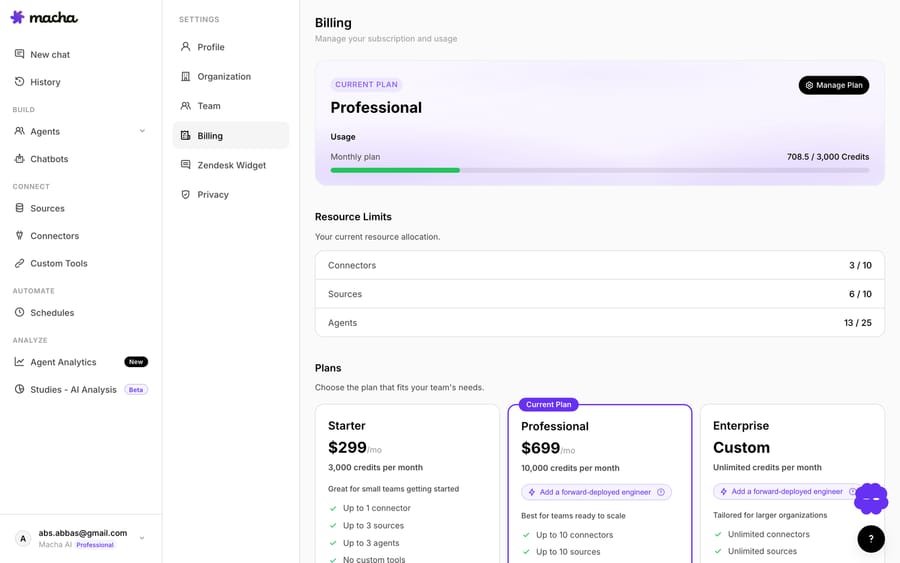
- Pricing shifts as the lineup shifts. Models and credit costs change — in fact, on Jun 17 we cut GPT-5 and GPT-5.4 credit costs, so existing plans got more responses for the same spend. That's good for you, but it means you should treat the pricing page as the source of truth rather than memorizing a number from a blog. Credits are billed per AI action, defaulting to 1 credit on GPT-5.4 Mini.
The discipline that keeps weekly shipping from becoming chaos is that the interfaces stay stable even as the surface grows. A connector you wired in March still works the same way in June — we proved that explicitly on Jun 5, when we made the agent on/off toggle preserve your existing Zendesk Triggers instead of tearing them down. Velocity underneath, stability on top.
Where this fits if you're on Zendesk
If Zendesk is your helpdesk, the changelog reads as a steady stream of new things your agents can do inside Zendesk: routing tickets to groups (May 2), reading image attachments (Apr 17), resolving custom field IDs to human labels (Apr 17), reliable tagging (Jun 10), and global OAuth so connecting is a click (Apr 9). The dedicated Macha on Zendesk page maps those to the Zendesk-specific workflows, and the broader blog covers individual features in depth as they ship.
FAQ
Where can I see Macha's actual release history? The public changelog lists every dated release — connectors, tools, triggers, model changes, and reliability fixes — going back to February 2026. Every feature referenced in this post is a real entry there.
How quickly does a new feature become usable? Most ship live to your dashboard the day they're announced. A new connector or tool is available to wire into an agent immediately; you assemble and deploy the agent yourself, typically the same session.
Does shipping weekly break my existing agents? That's an explicit design goal, not a hope. New capability lands as added surface area; existing connectors, tools, and triggers keep their interfaces. We've shipped specific work to guarantee it — soft-delete with restore, agent toggles that preserve Zendesk Triggers, and connector health checks that warn before anything fails silently.
Is Macha replacing my helpdesk? No. Macha is an AI agent layer that runs on top of Zendesk, Freshdesk, Gorgias, or Front. It builds agents that act inside the helpdesk you already use — it doesn't replace it. See the integrations page for the current connectors.
How is all of this priced? By credits, consumed per AI action — roughly 0.5–9 credits depending on the model, with the default GPT-5.4 Mini at 1 credit. Plans and current credit costs live on the pricing page; start with a 7-day free trial, no credit card required.
Read the changelog, then build
The best way to understand a support automation platform isn't a feature matrix — it's the changelog. It shows you what the team actually values, how fast they fix the unglamorous things, and whether new capability lands as a usable tool or a press release. Macha's is public for exactly that reason.
If you want to run the pipeline yourself, start a 7-day free trial, no credit card required, connect your helpdesk, and turn the most recent changelog line into a live agent. Or browse the docs for the full walkthrough, and the use cases for agents other teams have already assembled from the same building blocks.
Written by Abbas (Customer Support & AI, Macha) · Reviewed by Ankeet Guha (Co-founder & CTO) · Published 2026-06-24 · Last updated 2026-06-24.
Automate your support workflows
Macha's agents run multi-step workflows across the tools you already connect.