Shopify
 Stripe
 Slack
Slack Notion
 Google Workspace
 Confluence

How Do Macha Top-Ups Work? Extra Tickets Without Changing Your Plan


When a launch or a sale doubles ticket volume mid-month, a Macha top-up adds a one-time block of tickets on top of your current plan instead of forcing a permanent tier change. Top-ups shipped on May 30, 2026, never expire, and are spent only after the monthly allowance runs out.
Key takeaways
- A Macha top-up is a one-time block of extra tickets that sits on top of the monthly plan, so the tier, billing date and monthly fee stay the same.
- Macha spends the monthly ticket allowance first and draws on a top-up balance only after that allowance is used up, and top-ups never expire.
- JetBrains uses the same spend order for its AI top-up credits, but those credits stay valid for only 12 months from the date they were added.
- Macha's plan tiers run from $299 a month for 750 tickets to $3,999 for 10,000, about $0.40 a ticket, which is the rate to compare a top-up pack against.
- Fin charges $0.99 per outcome with no published volume discount, while a Macha top-up is a flat block of the same tickets a plan already includes.
A Macha top-up is a one-time block of extra tickets bought from the billing page that sits on top of your monthly plan: it's spent only after the month's allowance runs out, and it never expires. You keep your tier, your billing date and your monthly fee. Macha bills per ticket, meaning one thread with one person charged once however many messages or tool calls it takes, so a top-up is simply more of that same allowance.
| Question | Top-up | Moving up a tier |
|---|---|---|
| Billing | One-time purchase | Higher fee every month |
| Expiry | Never expires | Monthly allowance resets each cycle |
| Spend order | Used after the monthly allowance | Is the monthly allowance |
| Who can buy | Any active paid subscription | Anyone, including trial users starting a plan |
| Best for | Launches, sales, one-off Studies runs | Running out every month |
What is a Macha top-up?
A top-up is a one-time purchase that lands in your account on top of your monthly ticket allowance. You don't change your tier, you don't sign a new contract, and you don't get billed again next month for the same block. You buy it from the billing page, a Chargebee one-time checkout opens in an in-page popup, you pay, and the balance appears.
Pack sizes and their prices are shown on the billing page inside your account; they aren't listed on the public pricing page. The plan tiers are public: they run from $299 a month for 750 tickets up to $3,999 for 10,000, about $0.40 a ticket (see the pricing page for the current figures). That $0.40 is the number to compare a pack against.
Which gets spent first, the monthly allowance or the top-up?
The single most important thing to understand about a top-up is the spend order. Macha always spends your monthly allowance first, and only dips into your top-up balance once the monthly allowance is exhausted. You never have to choose which bucket to draw from, and you never accidentally burn through a top-up you bought for a rainy day while your included tickets sit unused.
That ordering has a second, quieter benefit: a top-up never expires. Your monthly allowance resets on each billing cycle — use it or lose it. A top-up doesn't. One you buy in June is still there in September if your monthly allowance kept covering you in the meantime. So a top-up is never wasted money; at worst it's money you spent a little early.
Other AI tools use the same spend order. JetBrains documents it almost word for word: "AI Assistant starts using your Top-up AI Credits only after your monthly quota is fully used… Once the new monthly quota becomes available, AI Assistant switches back to using it." Vendors land on this rule because it doesn't punish customers for buying ahead. The difference is expiry: JetBrains top-up credits "stay valid for 12 months from the date they were added." Macha's don't expire at all.
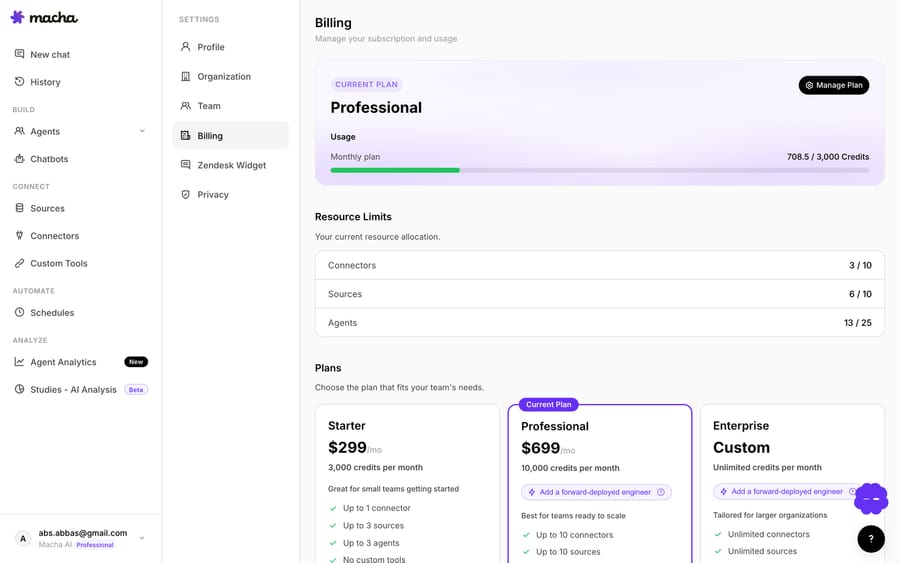
The billing page makes the two balances legible instead of mashing them into one number:

When you do have a top-up balance, a green +N top-up chip appears right next to your monthly count, with a hover that explains the persist-and-spend-after rule — so the extra headroom is always visible, never a hidden line item.
Who can buy a top-up?
Top-ups appear on the billing page for any active paid subscription. That covers the teams the feature is built for — paying customers on a fixed monthly allowance who occasionally run hot.
One group sees something different on purpose:
- Trial users don't get top-ups. If you're on a free trial ($50 of usage, about 125 tickets, no credit card required) and you're already pushing the limits, the right move is to start a paid plan, not to bolt extra onto a trial — so the flow nudges you to move onto a plan first.
There's also some unglamorous-but-important plumbing worth a sentence: top-up purchases are recorded against the Chargebee invoice ID as a unique key, so if a payment webhook gets delivered twice — which happens — your account can't be double-credited or double-charged off the back of it. It's the kind of detail you only notice when it's missing.
When does a top-up beat moving up a tier?
Say you're on the 3,000-ticket tier ($1,199 a month) and a Black Friday push triples your inbound for ten days. You're going to blow through the month's tickets with two weeks still on the clock. Your options:
- Move up a tier. Now you pay the higher monthly fee every month, forever, to cover one spike. For a genuinely one-off event, that's overkill.
- Buy a top-up. One purchase, the agents keep resolving tickets through the rush, and next month you're back to your normal allowance with whatever's left of the top-up still banked for the next spike.
For episodic demand — launches, sales, seasonal peaks, a one-time Studies batch run over your back-catalogue of tickets — option 2 is almost always the cheaper, lower-commitment call. The deep link makes this concrete: from the Studies Review screen, a "Need more? Buy a top-up" link sits right next to the remaining-balance pill, so when an estimate is bigger than your remaining balance you can top up in two clicks without losing your place.
When should you change tier instead?
Top-ups are a convenience, not a loophole. Before buying, divide the pack price on your billing page by its ticket count and compare it with the roughly $0.40 a ticket every tier works out to. A recurring gap is cheaper to close with a tier than with repeated one-off purchases.
So the decision rule is simple and worth stating plainly:
- If your overage is occasional — a spike here, a one-off batch there — top up. You pay only for the tickets you actually needed, and you never raise your recurring bill.
- If you're consistently running out every single month, that premium starts to add up, and moving up a tier is the cleaner answer. Every feature is already on every tier, so the only thing that changes is the volume. Buying three top-ups a month, every month, is a signal you've outgrown your tier — and the billing page is telling you to move up, not to keep patching.
This is the opposite of how some of the market prices overage. Fin, the AI agent Intercom built and Salesforce acquired on 10 September 2026, charges $0.99 per outcome, with a 50-outcome monthly minimum when it runs on a help desk other than Intercom, and no published volume discount on that rate. It's a per-outcome meter that climbs with every success, so the vendor earns more as volume grows. A Macha top-up is a flat block of the same tickets you already buy, and never billed twice for the same invoice. We'd rather you buy exactly what you need and stop, than be metered on every win.
FAQ
Does a top-up expire? No. Unlike your monthly allowance, which resets each billing cycle, a top-up rolls over indefinitely until you spend it.
Which gets spent first, my monthly allowance or my top-up? Your monthly allowance always spends first. Macha only draws on your top-up balance after the month's tickets are used up, so a top-up is never burned prematurely.
Do I need to change my tier to buy a top-up? No — that's the whole point. A top-up sits on top of the plan you already have. Nothing about your subscription, billing date, or monthly fee changes.
Can trial users buy top-ups? No — the flow asks you to start a paid plan first.
How do I actually buy one? From the billing page, pick a size and click Buy. A Chargebee checkout opens in an in-page popup; once payment completes, it appears on your Usage card as a separate top-up balance.
Should I top up or move up a tier? Top up for occasional, episodic spikes — you only pay for the extra tickets you needed. Move up if you're running out every month, because a tier covers recurring volume without a purchase every few weeks. See the pricing page to compare.
What should you do when a busy month hits?
Top-ups close the gap between "my plan fits us 11 months a year" and "but this month is different." Buy a block once, keep your agents working through the spike, and let whatever's left wait for the next one. For everything else, the plans are right there. Start a free trial ($50 of usage, no credit card required), or read the billing docs for the full walkthrough, and browse more product updates on the blog.
Written by Abbas (Customer Support & AI, Macha) · Reviewed by Ankeet Guha (Co-founder & CTO) · Published 2026-06-24 · Last updated 2026-09-24.