Intercom
 Shopify
 Stripe
 Slack
Slack Notion
 Google Workspace
 Confluence

Who Are Freshdesk's Competitors in 2026? The Full Landscape by Category


Freshdesk competes with different tools on different fronts: Zendesk and Zoho Desk on general ticketing, Gorgias on ecommerce, ServiceNow at the enterprise end, Front and Hiver on shared email, and Intercom's Fin on AI resolution. This map sorts them by category, with ratings, prices and who picks each one over Freshdesk.
Key takeaways
- Freshdesk's closest head-to-head competitor is Zendesk, which offers more depth and ecosystem at a higher price and held a G2 rating of 4.3/5 across roughly 6,700 reviews.
- Zoho Desk undercuts Freshdesk with paid plans at $7, $14, $23 and $40 per agent per month on annual billing, plus a free plan for three users.
- Gorgias prices by ticket volume instead of seats, from $10 a month for 50 tickets on Starter, which makes it the Freshdesk rival for Shopify and DTC brands.
- Freshdesk held a G2 rating of 4.4/5 and a Capterra rating of 4.5/5 in mid-2026, but only 2.5/5 on Trustpilot, where billing complaints dominate.
- Salesforce completed its acquisition of Fin, formerly Intercom, on September 10, 2026, while Fin still adds $0.99 per outcome on top of Intercom seats.
Freshdesk's closest competitors in 2026 are Zendesk (more depth, higher price) and Zoho Desk (from $7 per agent per month), followed by Help Scout and HappyFox among general help desks, Gorgias and Gladly in ecommerce, ServiceNow at the enterprise end, Front and Hiver for email-first teams, and Intercom's Fin plus other AI agents on autonomous resolution. Which one matters depends on the axis where Freshdesk is failing you, so the table below sorts them by category rather than ranking them.
| Competitor | Category | Competes with Freshdesk on | Best for | Rating (approx., mid-2026) |
|---|---|---|---|---|
| Zendesk | SMB / mid-market help desk | Depth, ecosystem, reporting | Scaling teams | G2 4.3/5 (~6,700) |
| Zoho Desk | SMB / mid-market help desk | Price + Zoho ecosystem | Budget / Zoho shops | G2 4.4/5 (~6,500) |
| Help Scout | SMB / mid-market help desk | Simplicity, human feel | Small SaaS/services | G2 ~4.4/5 (~440) |
| HappyFox | SMB / mid-market help desk | Clean ticketing, automation | Mid-market simplicity | G2 4.5/5 |
| Gorgias | Ecommerce-focused | Order-aware retail support | Shopify / DTC brands | G2 4.6/5 (~547) |
| Gladly | Ecommerce-focused | People-centric, no tickets | Premium consumer brands | G2 ~4.7/5 * |
| ServiceNow | Enterprise / ITSM | Enterprise workflow platform | Large enterprise | G2 4.4/5 |
| Freshservice | Enterprise / ITSM (sibling) | ITSM, not customer support | Internal IT desks | G2 4.6/5 |
| Front | Email-first / shared inbox | Collaborative inbox | Email-heavy ops | G2 4.7/5 (~2,440) |
| Hiver | Email-first / shared inbox | Lives inside Gmail | Google Workspace teams | G2 4.6/5 (~1,000+, G2 + Capterra combined) |
| Intercom (Fin) | AI-native wave | AI resolution + messaging | Product-led SaaS | G2 4.5/5 (Fin's ~2,900 G2 reviews) |
| Freshdesk (the incumbent) | n/a | n/a | Affordable multichannel | G2 4.4/5 (~3,700) |
Update (September 2026): Salesforce completed its acquisition of Fin (the company that renamed itself from Intercom on May 12, 2026, before any deal was signed) on September 10, 2026, in a deal worth ~$3.6 billion. Worth weighing in any long-term Intercom/Fin decision.
* Gladly's ~4.7/5 is strong, but its review base and seat-minimum model differ from the volume help desks, so treat it as approximate. Ratings are mid-2026 readings; prices were re-checked on September 24, 2026 where noted.
A Shopify store weighing Freshdesk against Gorgias is asking a different question than an enterprise IT team weighing it against ServiceNow, or a five-person startup choosing between Freshdesk and a Gmail plugin. For each competitor below we give what it competes with Freshdesk on, who picks it over Freshdesk, its G2 or Capterra rating, and how it differs.
If you've already decided to leave and want a ranked shortlist with pricing and migration notes, use our best Freshdesk alternatives guide. This page is the landscape view, for understanding the terrain before you shortlist.
How did we map the landscape?
We grouped products by the job they're hired for, not by a single "best" score, because a tool that suits a Shopify brand is irrelevant to an internal IT desk. For each competitor we pulled its G2 or Capterra star rating (with the approximate review count, since a 4.7 on 60 reviews isn't comparable to a 4.4 on 7,000), read recent review sentiment for recurring praise and complaints, and noted vendor-set pricing where it's public. G2's review pages return a 403 to automated fetches, so verbatim quotes come from Capterra, which serves them publicly; competitor sentiment lines are labelled as aggregate G2 themes, not single attributed reviews. Ratings are mid-2026 readings. Prices for Zoho Desk, Gorgias, Hiver, HappyFox and Intercom were re-checked on September 24, 2026; confirm on each vendor's page before you buy.
Where does Freshdesk sit in the market?
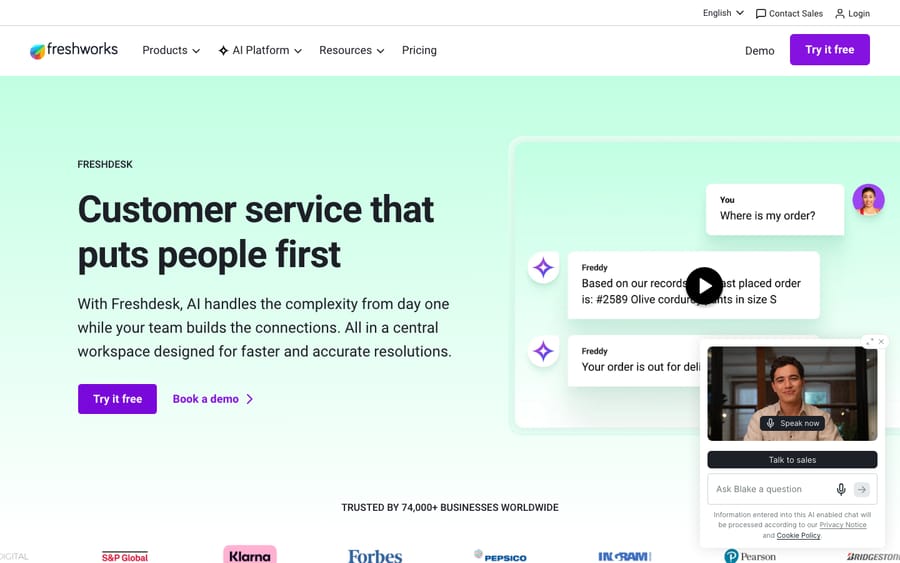
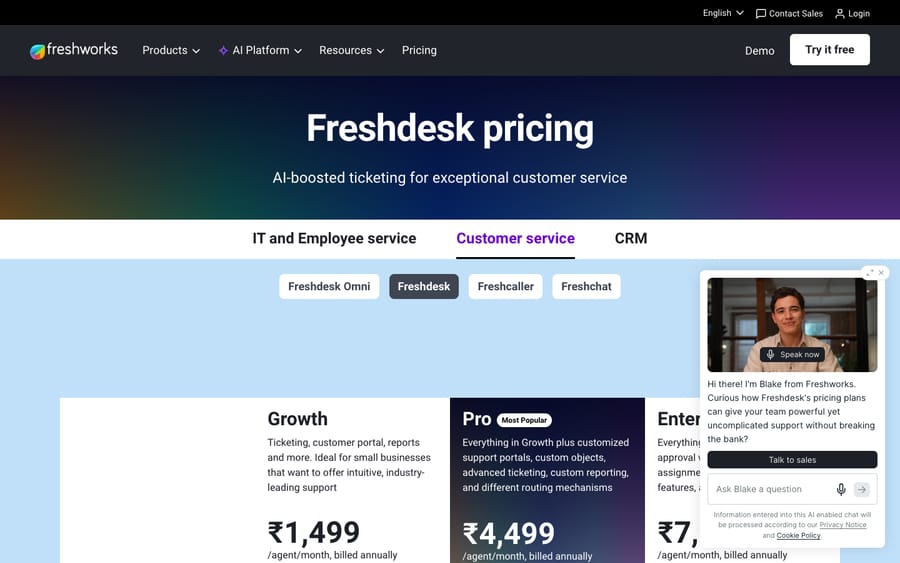
Freshdesk's pitch is accessible, multichannel ticketing at a friendly price: a free tier, cheap entry plans, fast setup, and the Freshworks ecosystem behind it. In mid-2026 it held a G2 rating of 4.4/5 (~3,700 reviews) and Capterra 4.5/5 (3,444 reviews), solidly mid-pack to upper-tier among general help desks. Its Trustpilot score was a much lower 2.5/5 across 367 reviews, where auto-renewal billing complaints dominate, a useful counterweight to the G2 average.
That positioning tells you who comes after it. Tools attack Freshdesk from below on simplicity, from the side on a specific channel (chat, email, ecommerce), from above on enterprise depth, and increasingly from a different direction: AI-native resolution.
Which help desks compete with Freshdesk head-to-head?
These are the most direct Freshdesk competitors: multichannel ticketing, knowledge bases, automations, and reporting. The fight is usually over price, depth, or how simple the tool feels.
Zendesk: the depth-and-ecosystem rival
Positioning: The category heavyweight, a deep, extensible support platform with a mature app marketplace, strong reporting, and native AI agents (built partly on the acquired Ultimate and Forethought tech). Who it wins: Teams that have outgrown Freshdesk and want more configurability, analytics, and a large ecosystem, and have the budget for it. Rating: G2 4.3/5 across ~6,700 reviews. What users say (aggregate G2): praised for power and integrations; the recurring knock is cost, and that "the AI and add-ons make the real bill hard to predict." How it differs from Freshdesk: More powerful and more extensible, generally pricier, and its AI carries usage cost much like Freshdesk's Freddy does. The closest head-to-head in the whole map; see our full Zendesk vs Freshdesk comparison.
Zoho Desk: the budget option with depth
Positioning: A feature-rich, omnichannel help desk that punches above its price, with strong automation, the Zia AI assistant, and tight integration into the broader Zoho suite. Who it wins: Cost-conscious teams that want a lot of capability per dollar, especially anyone already on Zoho CRM or Zoho One. Rating: G2 4.4/5 across ~6,500 reviews, one of the largest bases in the category. What users say (aggregate G2): strong value and depth; the common complaint is a busier interface and a learning curve outside the Zoho stack. How it differs from Freshdesk: Paid plans run $7 (Express), $14, $23 and $40 per agent per month on annual billing, plus a free plan for three users (zoho.com/desk/pricing). It's arguably deeper in raw features, but the UI feels busier and the pull is strongest if you're already in Zoho. A real like-for-like swap for many Freshdesk teams.
Help Scout: the simpler, human-first inbox
Positioning: A clean, conversation-style help desk built around a shared inbox, knowledge base, and live chat, which hides the "ticket" machinery so it feels more like email. Who it wins: Small-to-mid SaaS and services teams that find Freshdesk's interface heavy and want fast onboarding with a warm customer experience. Rating: G2 ~4.4/5 (~440 reviews), consistently praised for ease of use and quality of support. What users say (aggregate G2): loved for simplicity and a friendly UI; the recurring limit is depth: heavy routing, granular SLAs, and complex automation. How it differs from Freshdesk: Friendlier and faster to adopt, with less configuration; the trade-off is the feature ceiling, which is where Freshdesk and Zendesk pull ahead.
HappyFox: the clean mid-market workhorse
Positioning: A straightforward, well-organized help desk known for tidy ticketing, Smart Rules automation, and customizable forms without enterprise bloat. Who it wins: Mid-market teams that want orderly ticketing and reliable automation over a sprawling feature list. Rating: G2 4.5/5, with reviewers citing 12,000+ companies across education, IT, media, and retail. What users say (aggregate G2): praised for ease of use and customization; the most-cited weakness is a knowledge-base experience that "isn't as polished as Zendesk's." How it differs from Freshdesk: Cleaner and more opinionated, starting at $24 per agent per month on annual billing ($29 monthly). It has no free-tier on-ramp like Freshdesk's and a smaller ecosystem, but suits teams that value simplicity.
Which Freshdesk competitors are built for ecommerce?
Here the competition isn't general ticketing; it's retail conversations. These tools pull order, refund, and subscription data into the ticket and resolve the where-is-my-order questions Freshdesk handles only through integrations.
Gorgias: the Shopify specialist
Positioning: The dominant ecommerce help desk, built for Shopify and DTC, with order data in the ticket and an AI Agent that resolves WISMO, returns, and product questions. Who it wins: Shopify, BigCommerce, and DTC brands whose support is mostly order-related. Rating: G2 4.6/5 across ~547 reviews. What users say (aggregate G2): loved for deep Shopify integration and automation ROI; the common gripe is ticket-volume billing that can spike with seasonal volume. How it differs from Freshdesk: Far better for retail out of the box and priced on monthly ticket volume rather than seats: $10 a month for 50 tickets on Starter, $60 for 300 on Basic, $360 for 2,000 on Pro (gorgias.com/pricing, monthly billing). A poor fit outside ecommerce: a specialist, not a general Freshdesk replacement.
Gladly: the people-centric premium platform
Positioning: A customer-centric platform that drops tickets entirely and threads every channel into one lifelong conversation per person. Built for high-touch consumer brands. Who it wins: Premium retail, travel, and consumer brands where the relationship, not the ticket, is the unit of work. Rating: G2 ~4.7/5 (flagged approximate given a different review profile and seat-minimum model). What users say (aggregate G2): praised for the single-customer-thread model and onboarding; the recurring drawback is commitment: seat minimums and a large upfront investment. How it differs from Freshdesk: The opposite philosophy, people-centric rather than ticket-centric, aimed at the enterprise end of consumer brands. Far pricier, and overkill for a team that wants affordable ticketing.
Do enterprise and ITSM suites compete with Freshdesk?
These compete with Freshdesk from above (enterprise scale) or sideways (internal IT rather than customer support). Worth knowing even if most Freshdesk teams never shortlist them.
ServiceNow: the enterprise workflow platform
Positioning: A sprawling enterprise platform whose Customer Service Management module runs support as one workflow among many (IT, HR, operations), with heavy automation and AI. Who it wins: Large enterprises that need service tied into company-wide workflows and have the budget and admin capacity to run it. Rating: G2 4.4/5 for Customer Service Management. What users say (aggregate G2): praised for automation and centralization; the consistent criticisms are complex setup requiring technical expertise and pricing "among the highest in the market" (deals commonly reach six figures annually). How it differs from Freshdesk: A different weight class, far more powerful and far more expensive and complex. Teams choose Freshdesk precisely to avoid a ServiceNow-scale implementation.
Freshservice: the ITSM sibling (not really a competitor)
Positioning: Freshworks' own IT service management tool, same family as Freshdesk, built for internal IT (incidents, assets, change management) rather than external customer support. Who it wins: IT service desks that need ITIL-aligned workflows; often run alongside Freshdesk in the same company. Rating: G2 4.6/5. How it differs from Freshdesk: The one entry that's a sibling, not a rival: Freshdesk is for customers, Freshservice is for employees and IT. If you're unsure which Freshworks product you need, see Freshdesk vs Freshservice.
What about email-first and shared-inbox tools?
These treat support as collaborative email rather than a ticket queue, a structure email-heavy and high-touch teams often prefer over Freshdesk's classic ticketing.
Front: the collaborative shared inbox
Positioning: A shared-inbox platform blending email, chat, SMS, and social into one workspace with internal comments, assignments, and shared drafts, plus AI on top. Who it wins: Operations-heavy, high-touch teams (logistics, finance, B2B services) where conversations need real collaboration. Rating: G2 4.7/5 across ~2,440 reviews, among the highest-rated tools in this map. What users say (aggregate G2): loved for collaboration and the email-native feel; the recurring note is that it's "less of a traditional help desk," with lighter classic ticketing and reporting. How it differs from Freshdesk: A shared inbox rather than a ticketing system, which collaborative teams love and process-heavy shops may miss.
Hiver: the Gmail-native option
Positioning: A help desk that lives inside Gmail, turning Google Workspace into a shared support inbox with assignments, SLAs, analytics, and an AI Copilot, with no separate app to learn. Who it wins: Small and mid-sized teams on Google Workspace that want help-desk structure without leaving the inbox they use all day. Rating: G2 4.6/5 across ~1,000+ reviews (G2 + Capterra combined). What users say (aggregate G2): praised for ease of use and Gmail integration; the most-cited limit is that performance can lag at high email volume and customization is shallower than a full help desk. How it differs from Freshdesk: Lighter and quicker to adopt for Gmail shops, with Growth at $25 per user per month annual ($35 monthly), a two-seat minimum and no free plan (hiverhq.com/pricing). The ceiling is lower for complex, multichannel operations where Freshdesk has more room to grow.
How do AI-native tools compete with Freshdesk?
The newest front. Instead of competing on ticketing, these tools compete on autonomous resolution: answering and closing tickets with AI rather than routing them to a human. They're changing what buyers expect, and they're the reason Freshdesk built Freddy.
Intercom (with Fin AI) is the most established here: a messenger-first platform whose Fin agent is one of the most-cited outcome-priced products on the market (Fin's ~2,900 G2 reviews, 4.5/5). Seats run $29 (Essential), $85 (Advanced) and $132 (Expert) per seat per month, and Fin adds $0.99 per outcome on top (fin.ai/pricing, checked September 24, 2026). Strong AI and chat, with a bill that's harder to predict than a flat seat price. Alongside it sits a fast-growing class of pure AI agents (Decagon, Sierra, Ada, and others) that bolt onto an existing help desk to deflect tickets, plus Freshdesk's own Freddy and Zendesk's native agents. The common thread: these aren't help desks you migrate to; they're resolution engines you add on top of whatever ticketing you run.
Can you add AI to Freshdesk instead of switching?
Here's where we disclose our own hand. Macha isn't a Freshdesk competitor, and it isn't a help desk, so it doesn't belong in the map above. It's an AI agent layer that runs on top of Zendesk, Freshdesk, Gorgias, Front, HubSpot or Intercom. It reads the customer's actual question, pulls from your connected order and CRM data and your help center, drafts and resolves routine tickets inside your existing Freshdesk workflow, and hands off to a human with full context when it isn't confident. It's priced per ticket, not per seat: one plan from $299 a month for up to 750 tickets, with setup and monitoring by the Macha team included.
We mention it because of a pattern worth flagging before you shop this landscape: many teams who look at Freshdesk's "competitors" don't want a different help desk. They want better AI resolution, and they assume switching platforms is how to get it. If that's you, an AI layer on your current Freshdesk solves the real problem without a migration. If your frustration is Freshdesk's ticketing, reporting, or channel fit, one of the categories above is the right move and a layer won't fix it. See how the layer works on your help desk, or start with $50 of free usage, no credit card required.
What do real users say about Freshdesk?
Ratings give you the average; reviews give you the why behind the shopping. A few verbatim, attributed Capterra reviews (G2's pages block automated fetches, so quotes come from Capterra):
"Customer Support takes too many responses to get to resolution," and the "Jira integration is broken." (Marjana C., Sr. Manager, Technology Support (Computer Software), Capterra, May 2026)
"Creating highly customized or granular reports can still feel restrictive," and "the cost can escalate quickly once you start adding advanced features." (Tsvetelina B., Customer Support Manager (Banking), Capterra, May 2026)
"The customization in Freshdesk is very minimal when compared to Zendesk." (Verified Reviewer, Marketing Director (Computer Software), Capterra, December 2024)
Read against the landscape, the themes line up with where each category attacks: reporting and customization that feel capped (Zendesk, Zoho), costs that climb with AI add-ons (the AI-native wave), and support that lags on complex issues. Plenty of reviewers also praise Freshdesk's clean interface and entry-tier value, which is why the right rival depends on your specific friction.
Where does Freshdesk win and lose against the field?
Across the map, Freshdesk's position is consistent: the affordable, easy-to-start multichannel generalist. It rarely wins on raw depth (Zendesk, ServiceNow), on a single channel or segment (Gorgias for retail, Front and Hiver for email, Intercom for chat), or on best-in-class AI resolution (the AI-native wave). It wins on the combination: a capable multichannel help desk with a free tier and cheap entry plans that a small team can run without specialists.
That's why "who's the best Freshdesk competitor?" has no single answer. It depends on which axis Freshdesk is failing you on. Name that axis first, and the right category picks itself.
Frequently asked questions
Who are Freshdesk's main competitors in 2026? Across categories: Zendesk, Zoho Desk, Help Scout, and HappyFox among general SMB/mid-market help desks; Gorgias and Gladly in ecommerce; ServiceNow at the enterprise/ITSM end (with Freshservice as Freshworks' own ITSM sibling); Front and Hiver for email-first teams; and Intercom (Fin) plus AI-native agents like Decagon, Sierra, and Ada. Which matters depends on your segment and channel mix.
What is the closest competitor to Freshdesk? Zendesk is the most direct head-to-head: same job (multichannel ticketing), more depth and ecosystem, higher price. Zoho Desk is the closest on price and value. See our Zendesk vs Freshdesk comparison for the detail.
Is there a cheaper alternative to Freshdesk? Zoho Desk (paid plans from $7 per agent per month, plus a free plan for three users) is the closest cheaper like-for-like; Hiver can be cost-effective for Gmail teams at $25 per user per month. Model the total cost including AI add-ons, because the sticker price is rarely the final bill on any of these.
What's the difference between Freshdesk and Freshservice? They're siblings from Freshworks, not rivals: Freshdesk is for external customer support, Freshservice is for internal IT service management (incidents, assets, change). Many companies run both. Full breakdown in Freshdesk vs Freshservice.
Do I have to switch help desks to get better AI than Freddy? No. If your only frustration is AI resolution, you can add an AI agent layer on top of Freshdesk instead of migrating. Macha does that, resolving routine tickets inside your existing Freshdesk workflow and escalating with context. If your problem is the ticketing itself, one of the competitors above is the better move.
Which Freshdesk competitor is best for ecommerce? Gorgias for Shopify and DTC volume (order-aware, priced by ticket volume from $10 a month); Gladly for premium consumer brands that want a people-centric, no-ticket model. General help desks like Freshdesk and Zendesk handle retail only with added integrations.
Which Freshdesk competitor should you pick?
Freshdesk doesn't face one line of rivals; it sits in a landscape with several fronts. Zendesk, Zoho Desk, Help Scout, and HappyFox fight it on general ticketing; Gorgias and Gladly on ecommerce; ServiceNow on enterprise workflow (with Freshservice as its ITSM sibling); Front and Hiver on collaborative email; and Intercom, Decagon, Sierra, and the AI-native wave on autonomous resolution. Freshdesk's lasting edge is being the affordable, easy multichannel generalist, so the right competitor is whichever one beats it on the specific axis you care about.
Pin that axis down first. If it's depth, look enterprise; if it's a channel or segment, look specialist; if it's AI resolution, you may not need to switch at all: an AI layer on top of Freshdesk can solve that while you keep the tool your team knows. When you're ready to shortlist with pricing and migration notes, go to our best Freshdesk alternatives guide.
Ratings and positioning from web research, mid-2026; prices re-checked September 24, 2026. Help-desk and AI pricing in this category changes fast, so confirm current terms on each vendor's site before buying.
Add AI agents to your Freshdesk
Macha reads the ticket, drafts the reply and takes the action, inside the Freshdesk you already run.