
 Shopify
 Stripe
 Slack
Slack Notion
 Google Workspace
 Confluence

Gorgias vs Help Scout (2026): Which Help Desk Fits Your Shopify Store?


Gorgias suits Shopify stores that want an AI agent to resolve order requests, and Help Scout suits teams that want a simple shared inbox priced per seat. Both let agents refund, cancel and edit Shopify orders from the ticket, so the choice comes down to billing and automation.
Key takeaways
- Gorgias fits Shopify stores that want AI Agent and flows to resolve order requests, while Help Scout fits teams wanting a simple shared inbox priced per user.
- Gorgias bills by ticket volume, from $10 a month helpdesk only or $40 with AI Agent, and charges $1.50 per automated interaction past each plan's bundle.
- Help Scout offers a free plan for up to 5 users, then Standard $25, Plus $45 and Pro $75 per user a month, with AI Answers at $0.75 per resolution.
- Help Scout's Shopify integration is not view-only: agents can refund, cancel, edit or duplicate a customer's recent orders from the sidebar.
- Gorgias counts an interaction as automated only if the customer needs no human within 72 hours, and a resolved ticket incurs both a ticket fee and an automation fee.

Pick Gorgias if your Shopify store wants an AI agent and automation that resolve order questions on their own; pick Help Scout if you want a calm shared inbox priced per seat from $25 a user a month. Both now let agents refund, cancel and edit Shopify orders from the ticket sidebar, so the real split is billing and automation: Gorgias charges by ticket volume (from $10 a month for 50 tickets, helpdesk only), Help Scout charges by user and meters AI Answers at $0.75 per resolution (prices checked 24 September 2026).
How do Gorgias and Help Scout compare at a glance?
| Gorgias | Help Scout | |
|---|---|---|
| Best for | Shopify/ecommerce brands that want AI Agent and flows to resolve order requests | Small-to-mid teams that want a clean, fast shared inbox at a predictable cost |
| Pricing entry (24 Sept 2026) | Starter $10/mo helpdesk only, or $40/mo with AI Agent; 50 tickets; billed on ticket volume | Free for up to 5 users; Standard $25/user/mo, billed per seat |
| User seats | 3 on Starter, 500 on Basic, Pro and Advanced | Up to 25 on Standard, 50 on Plus, unlimited on Pro (10 minimum) |
| Shopify order actions | Refund, cancel, edit orders inside the ticket; AI Agent can act on orders too | Refund, cancel, edit or duplicate recent orders from the customer sidebar |
| AI & automation | AI Agent on every plan; $1.50 per automated interaction past the bundle | AI Assist and Summarize on paid plans; AI Answers $0.75 per resolution |
| Channels | Email, chat, social, help center; Voice and SMS add-ons | Email, live chat, SMS, Messenger, Instagram, WhatsApp; phone via integration |
How do Gorgias and Help Scout price differently?
The two tools price on opposite axes, and that difference matters more than the sticker numbers. Gorgias bills on ticket volume and says it is "never priced per agent", while Help Scout bills per user (seat). Gorgias suits a lean team fielding a high volume of ecommerce tickets; Help Scout suits a team where headcount, not ticket count, is the thing that grows.
On Gorgias's pricing page (24 September 2026), the plans with AI Agent cost Starter $40/mo, Basic $77/mo, Pro $471/mo and Advanced $1,227/mo billed annually ($90, $550 and $1,430 month to month; Starter is monthly only). They include 50, 300, 2,000 and 5,000 tickets a month. An "Add AI Agent" toggle also shows helpdesk-only prices: $10, $50, $300 and $750 a month on annual billing. Past your quota you pay $0.40 a ticket on Starter and Basic, $0.36 on Pro and Advanced. Seats are not unlimited: Starter allows 3 users and the other plans 500.
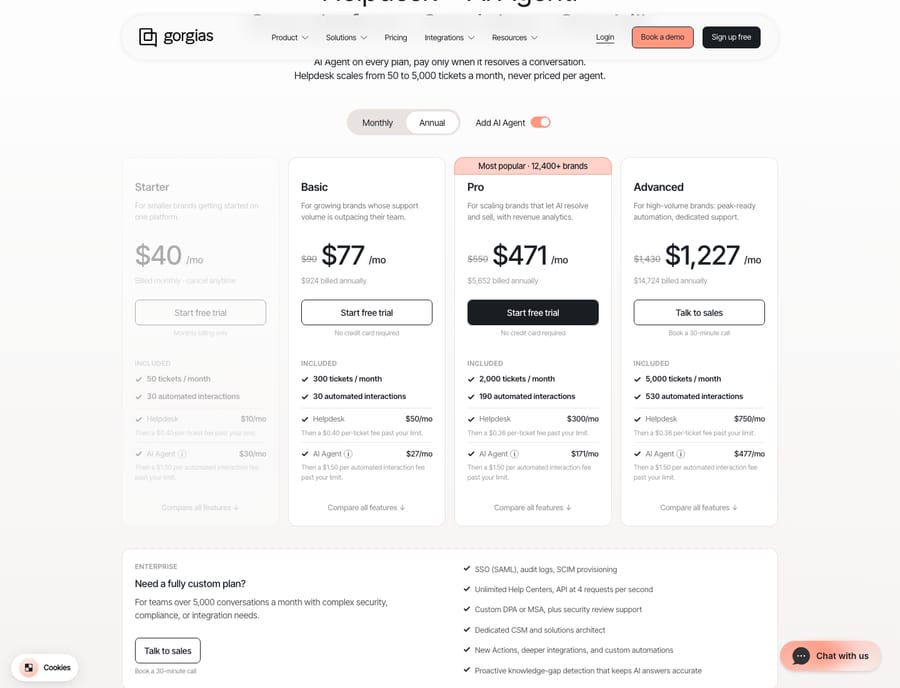
The AI Agent line is where budgets drift. Each plan includes a bundle of automated interactions (30 on Starter and Basic, 190 on Pro, 530 on Advanced), then charges $1.50 per automated interaction. Gorgias's billing doc sets a 72-hour rule: an interaction counts as automated if the customer does not need a human within 72 hours. When AI Agent resolves a ticket without a handover, you pay the ticket fee and the automation fee. When it hands over to a human, you pay only the ticket fee. At scale the AI bill can rival the plan bill. We break the mechanics down further in Gorgias pricing explained.
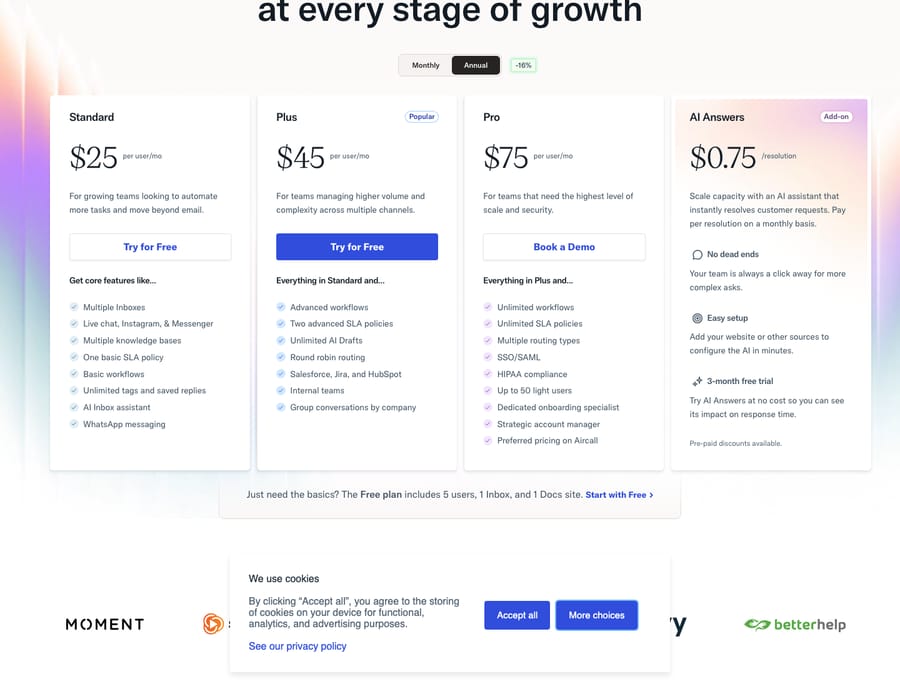
Help Scout keeps it simpler. Help Scout's pricing page lists a Free plan for up to 5 users, then Standard $25, Plus $45 and Pro $75 per user a month, with 16% off for annual billing. Standard caps at 25 users, Plus at 50, and Pro has a 10-user minimum. AI Answers costs $0.75 per resolution on every plan, and new accounts get a 3-month free trial with unlimited resolutions from the day the account is created. Because you pay per seat, a five-agent team's core bill stays the same when volume spikes during a sale.
The honest read: a small team with moderate volume usually pays less, and more predictably, on Help Scout. A lean team drowning in order tickets can come out ahead on Gorgias, because a 3-person team on Basic pays the same as a 10-person team. Model your own ticket volume against seat count before you decide; the crossover point is store-specific.
Which one goes deeper on Shopify?
Older comparisons called Help Scout's Shopify integration view-only. That is out of date. Help Scout's Shopify doc says agents can "refund, cancel, edit, or duplicate your customer's most recent orders right in the customer sidebar", next to lifetime value, average order value and full order details. For a store whose tickets are mostly "where's my order" and "can you refund this one", that covers the daily work.
Gorgias still goes further because Shopify sits at the center of the whole product. Agents can refund, cancel or edit an order and update a shipping address without leaving the ticket, and the same Shopify data feeds macros, rules and the AI Agent. Gorgias counts Order Management among the automation features that resolve requests without a human, so customers can check or change an order themselves. It also connects to WooCommerce, BigCommerce and Magento on some plans. If you want a person to click the refund button, both tools work. If you want the order request handled before a person sees it, Gorgias is built for that.
How do their AI features compare?
Both platforms have leaned hard into AI, but toward different jobs. Gorgias's AI Agent is included on every plan and aims at autonomous resolution of ecommerce requests: order tracking, shipping updates, cancellations and returns. It is strong on repetitive, structured questions and, like every LLM-driven agent, less reliable on nuanced edge cases, so most teams keep human review on anything complex. It is metered per automated interaction, as covered above. For a deeper look at how it behaves, see our Gorgias review and what is Gorgias.
Help Scout bundles agent-assist features into its paid plans: AI Assist (expand and edit text) and AI Summarize on every paid plan, basic AI Drafts on Standard and unlimited AI Drafts on Plus and Pro. AI Answers, the customer-facing layer, is metered at $0.75 per resolution. Help Scout's AI mostly makes a human agent faster, while Gorgias pitches its AI as a revenue-aware worker that closes tickets alone. If your goal is agent productivity on conversational support, Help Scout's included assist tools are real value. If your goal is deflecting transactional order tickets, Gorgias's AI Agent is built for that. Either way, read the category context in AI agents for customer service before you bank on any vendor's headline deflection rate.
Which channels does each cover?
Help Scout's pricing page lists email, live chat, SMS, Messenger, Instagram and WhatsApp on every plan, the Free plan included, with phone available only through an integration. Gorgias covers email, chat, social and a help center on its plans and sells Voice and SMS as add-ons priced by call and text volume. Neither is a true phone system, so if after-hours phone support is central to your operation, plan on a separate voice tool either way. For most ecommerce stores that field email, chat and DMs, both cover the essentials, and Help Scout includes SMS and WhatsApp without an add-on.
Which is easier to set up and use?
Help Scout's reputation is built here. Reviewers consistently praise its clean, uncluttered interface and fast onboarding, and nontechnical agents tend to be productive within days. The flip side of that simplicity is shallower reporting and fewer knobs for teams with advanced routing or analytics needs. Gorgias is also praised for ease of use given its depth, with the Shopify integration the most-cited reason people like it; complaints cluster around cost at scale and the add-on phone channel. It carries more ecommerce setup: macros with Shopify variables, rules, flows and AI Agent guidance. Help Scout wins on pure simplicity; Gorgias wins on ecommerce automation for a still-approachable setup.
What are the pros and cons of each?
Gorgias pros: Shopify at the center of tickets, macros and rules; in-ticket refunds, cancels and edits; AI Agent included on every plan; up to 500 seats on Basic and above at no per-seat cost; email, chat, social and help center in one inbox. Cons: ticket-based pricing plus the $1.50 automation fee gets expensive and harder to predict at scale; Starter allows only 3 users; voice and SMS cost extra; AI needs guardrails on nuanced tickets.
Help Scout pros: easy to use and fast to onboard; clean shared inbox; predictable per-seat pricing and a free plan for up to 5 users; AI Assist and Summarize included on paid plans; SMS and WhatsApp on every plan; Shopify refunds, cancels and edits from the sidebar. Cons: no built-in autonomous order handling beyond AI Answers; reporting is comparatively shallow; Pro needs 10 users; can feel limiting for teams with advanced automation or routing needs. Both are strong tools, and the choice is about fit.
Which should you choose?
- Shopify store, order-status and returns heavy, planning to automate: choose Gorgias. AI Agent, flows and Order Management are built to resolve transactional requests, and ticket-based pricing suits a small team fielding high volume. If you're weighing it against others first, our best Gorgias alternatives roundup is a useful sanity check.
- Small-to-mid team, mostly conversational support, dislikes billing surprises: choose Help Scout. Predictable per-seat pricing, a calm inbox and fast onboarding win when your tickets are questions, and the sidebar still handles the occasional refund.
- Multi-channel team leaning on SMS, WhatsApp and social DMs, any industry: Help Scout edges it, because those channels come with every plan rather than as add-ons.
- High-volume store planning aggressive AI deflection of order-status tickets: Gorgias, with eyes open on the $1.50 per-interaction fee and the 72-hour rule.
If you're on a simple inbox and your team spends its day answering the same order questions by hand, that is the signal to look at Gorgias-style automation. If your volume is manageable and your tickets are mostly conversations, staying simple is the cheaper call.
Can you add an AI agent on top of either help desk?
Yes. The help desk you choose is the system of record, but it isn't the whole answer stack. Whichever inbox you land on, an AI agent layer can sit on top of it, reading and writing the same tickets, drafting grounded replies, and calling your order system to fetch a status or start a return. That's the seam Macha fills: it runs on Zendesk, Freshdesk, Gorgias, Front, HubSpot or Intercom (including through a native Macha–Gorgias integration) rather than replacing your desk, so you keep your inbox, your data and your workflows, and add automation through a custom tool that turns your REST APIs into something an agent can call. Macha bills per ticket, from $299 a month for up to 750 tickets: one conversation, charged once however many messages it takes, never per resolution.
FAQ
Is Gorgias or Help Scout better for a Shopify store? Gorgias, for stores that want order requests resolved automatically, because its AI Agent, flows and Order Management act on Shopify data without an agent. Help Scout's Shopify integration lets agents refund, cancel, edit or duplicate recent orders from the sidebar, so stores with conversational, human-handled tickets are well served by it too.
How do Gorgias and Help Scout price differently? Gorgias bills on ticket volume and never per agent, with 3 seats on Starter and 500 on higher plans. Help Scout bills per user. On 24 September 2026, Gorgias started at $10/mo helpdesk only ($40 with AI Agent), and Help Scout had a free plan for up to 5 users and paid plans from $25/user/mo. Gorgias charges $1.50 per automated interaction past its bundle; Help Scout charges $0.75 per AI Answers resolution.
Which is easier to use? Help Scout is widely regarded as the easier tool, with a clean shared inbox and fast onboarding. Gorgias is also praised for ease of use given its depth, but it carries more ecommerce-specific configuration: macros with Shopify variables, rules, flows and AI Agent setup.
Do I have to pick one to get AI automation? No. Both include native AI, but you can also layer an independent AI agent platform like Macha on top of whichever help desk you choose. It runs on top of your existing inbox rather than replacing it, so you keep your tooling and add automation.
When should I graduate from Help Scout to Gorgias? Since Help Scout agents can already refund, cancel and edit Shopify orders, the switch rarely pays off for manual order handling alone. The stronger signal is wanting those order requests resolved without an agent, through an AI agent and flows that act on Shopify. Compare that against adding an AI layer on top of Help Scout before you migrate.
Want to add an AI agent layer on top of the help desk you choose? Start a free trial of Macha and connect it in minutes.