Shopify
 Stripe
 Slack
Slack Notion
 Google Workspace
 Confluence

Gorgias vs Kustomer (2026): Which Help Desk Fits an Ecommerce Brand?


Gorgias is built ticket-first for Shopify stores and prices by ticket volume, while Kustomer is a CRM-style platform that quotes each deal after a demo. Here is how they compare on pricing, Shopify depth, AI, channels and setup for an ecommerce team in 2026.
Key takeaways
- Gorgias suits Shopify-first brands with public pricing from $40 a month, while Kustomer suits larger CX teams and publishes no prices on its pricing page.
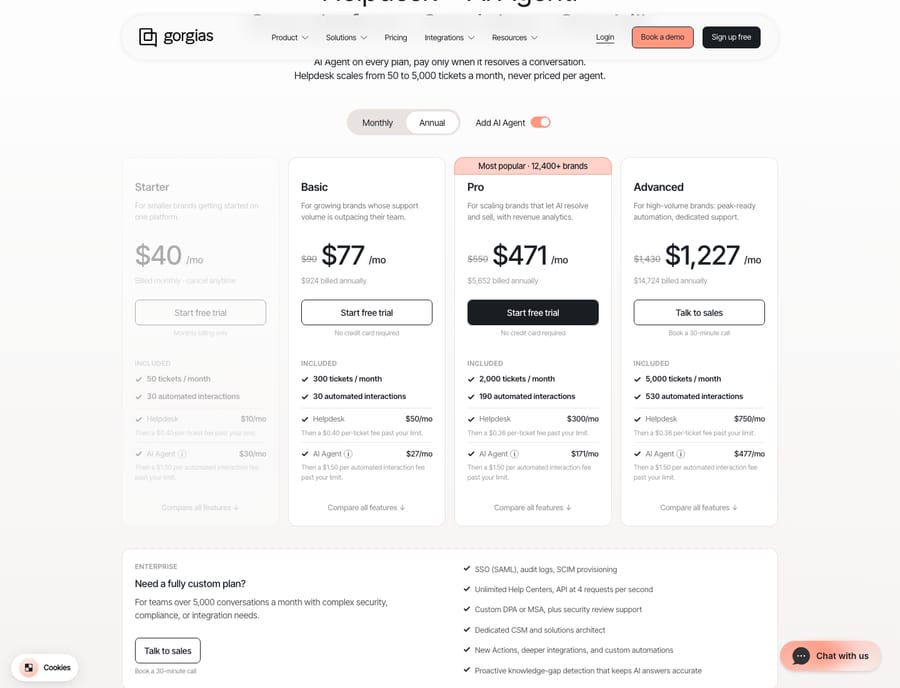
- Gorgias lists Starter at $40, Basic at $77, Pro at $471 and Advanced at $1,227 a month with the AI Agent included, Basic and above billed annually.
- Gorgias bills $1.50 per automated interaction past each plan's AI bundle, and each AI Agent interaction also counts as a helpdesk ticket.
- Older third-party trackers put Kustomer's Enterprise plan around $89 a seat a month with an 8-seat minimum, while Kustomer itself lists only pay-as-you-go voice and WhatsApp.
- Macha runs as an AI agent layer on Gorgias from $299 a month for up to 750 tickets, but does not connect to Kustomer.

Gorgias is the better fit for Shopify-first ecommerce brands, with public pricing from $40 a month and refunds, edits and cancellations handled inside the ticket, while Kustomer fits larger CX teams that want a CRM-style customer timeline and will buy through a sales call. Gorgias prices by ticket volume and says it is "never priced per agent" (gorgias.com/pricing, checked 24 September 2026). Kustomer publishes no prices at all.
How do Gorgias and Kustomer compare at a glance?
| Gorgias | Kustomer | |
|---|---|---|
| Best for | Shopify-native DTC brands that want ecommerce-specific automation | Larger CX orgs wanting a CRM-style unified customer timeline |
| Pricing entry | Starter $40/mo with AI Agent, or $10/mo helpdesk only; scales by ticket volume | No public price; quote after a demo |
| Ecommerce / Shopify depth | Deep: native order view, refunds, edits, cancellations in the ticket | Broad omnichannel CRM; ecommerce via integrations, less Shopify-native |
| AI & automation | AI Agent resolves tickets and takes Shopify actions; bundles of automated interactions, then $1.50 each | Concierge and Envoy AI plus workflow rules; AI billed separately |
| Channels | Email, chat, SMS, social, voice, WhatsApp | Email, chat, SMS, voice, social, WhatsApp (voice and WhatsApp pay-as-you-go) |
| Standout strength | Ecommerce-native speed and Shopify actions out of the box | Single customer timeline across every channel and touchpoint |
How much do Gorgias and Kustomer cost?
The pricing philosophies are the clearest fork in the road, and they reward opposite business shapes.
Gorgias prices around ticket volume. Its pricing page on 24 September 2026 shows four plans with the AI Agent included: Starter at $40/mo (monthly only, 50 tickets), Basic at $77/mo billed annually or $90 monthly (300 tickets), Pro at $471/mo annually or $550 monthly (2,000 tickets), and Advanced at $1,227/mo annually or $1,430 monthly (5,000 tickets). Without the AI Agent, the helpdesk alone is $10, $60, $360 and $900 a month. Past the ticket allowance you pay $0.40 a ticket ($0.36 on Pro and Advanced). Each plan's AI bundle covers a set number of automated interactions (30 on Starter and Basic, 190 on Pro, 530 on Advanced), then $1.50 per automated interaction. Pro's $171 annual bundle for 190 interactions works out to $0.90 each. Gorgias's own FAQ adds that each AI Agent interaction also counts as a helpdesk ticket, so an automated conversation is billed twice. That's worth modeling before you commit, because a high-automation month is also a higher-bill month. We break the tiers down further in Gorgias pricing explained.
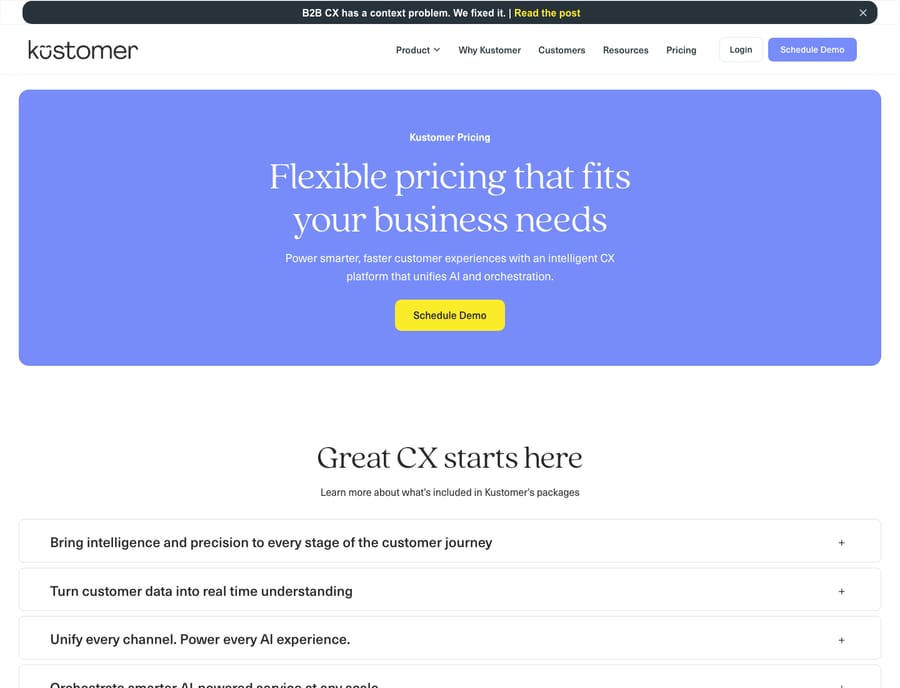
Kustomer does not publish any numbers. Its pricing page says "Every CX team's setup is different, so we don't post one-size-fits-all pricing" and routes you to an ROI calculator and a demo. It does list what's billed on top: Kustomer Voice (talk, SMS and transcription) and WhatsApp are pay-as-you-go, and a HIPAA-enabled subscription and implementation are separate lines. For a public reference point you have to lean on third parties. Older analyses of Kustomer's pricing put Enterprise around $89/seat/mo and Ultimate near $139/seat/mo, annual-only, with an 8-seat minimum. eesel's May 2026 breakdown says the base price is no longer disclosed and lists AI at about $0.60 per engaged conversation. Treat all of these as a starting point for the sales call.
The incentives explain the difference. Gorgias earns more as your ticket count and automation grow, which suits a store whose volume swings with sales. Kustomer quotes per deal because implementation and a CRM data model come with it. A small-to-mid DTC brand with a handful of agents will usually find Gorgias cheaper to start and easier to reason about. A larger org with many agents may find a negotiated Kustomer contract predictable at scale, but annual commitments and any seat minimum make it a poor fit for tiny teams.
Which has deeper Shopify and ecommerce features?
This is where Gorgias's ticket-first, ecommerce-native design earns its reputation. The moment a ticket opens, agents see the full customer picture (order history, lifetime spend, average order value and VIP status) and can handle refunds, order edits, cancellations and reshipping right inside the ticket without leaving the help desk. That native Shopify action set is Gorgias's signature, and it's why so many Shopify stores standardize on it. Its pricing page tags the Pro plan "most popular" with 12,400+ brands. For the fuller picture, see what Gorgias is.
Kustomer approaches the same problem from the CRM side. Its strength is the unified customer timeline: every email, chat, SMS and social touch a shopper has made, stitched into one view alongside custom objects and orchestration rules. Ecommerce data reaches Kustomer through integrations rather than being the native center of gravity, and Kustomer AI historically hasn't offered the same out-of-the-box native Shopify actions that Gorgias ships by default. If your CX spans multiple storefronts, marketplaces, or a mix of DTC and B2B, Kustomer's object model is more flexible; if you're a pure Shopify DTC shop, Gorgias's depth is hard to beat.
Which has better AI and automation?
Both platforms lead with AI, but package it differently.
Gorgias's AI Agent can resolve tickets on its own with the context of the customer thread and take native Shopify actions (refunds, cancellations, edits, reshipping) across email, chat, SMS, social and voice, with replies in 80+ languages and pre-sale shopping assistance, set up without developer resources. Gorgias's setup guide requires a connected Shopify store for the AI Agent. It's billed per automated interaction, so cost scales with automation. We go deeper in the Gorgias AI Agent explained.
Kustomer's current AI products are Concierge (customer-facing) and Envoy (agent assist), alongside AI profiles that pull in external data, suggested responses and two-way translation, layered over its business-rules and workflow engine. AI is billed separately from the platform rather than bundled. The difference is emphasis: Gorgias tunes AI for ecommerce actions and deflection, Kustomer for routing, agent assist and orchestration across a rich customer record. The broader landscape of AI agents for customer service is worth reading if AI capability is your deciding factor.
Which channels does each support?
Both cover the main channels. Gorgias handles email, live chat, SMS, social (Instagram, Facebook, TikTok), WhatsApp and voice, with SMS and voice billed as usage add-ons. Kustomer covers the same core set (email, chat, text, voice and social including WhatsApp), with voice and WhatsApp on pay-as-you-go pricing, and treats omnichannel as its founding premise, with conversation routing across queues and teams. Neither will leave an ecommerce team short on channels. The difference is that Kustomer's timeline collapses all of them into one customer thread by design, whereas Gorgias keeps a ticket-centric structure that most support agents find faster to triage.
Which is faster to set up?
Gorgias is known for fast, no-code setup: Shopify stores can connect and be automating in days, and Basic, Pro and Advanced start with a free trial and no credit card. Kustomer does more and weighs more: its CRM-grade flexibility (custom objects, workflows, business rules) means implementation is a real project, and its pricing page lists implementation as a separate line item. That's appropriate for an enterprise rollout and overkill for a lean DTC team. The gap in time-to-value is one of the clearest deciders between the two.
What are the pros and cons of each?
Gorgias, pros: ecommerce-native with deep Shopify actions in the ticket; transparent, volume-based pricing that's cheap to start and never per agent; fast no-code onboarding; an AI Agent tuned for ecommerce; strong G2 standing (4.6/5 across roughly 550 reviews on G2 when we last read it). Gorgias, cons: AI interactions past the bundle cost $1.50 each and also count as tickets; the ticket-first model is less of a full CRM; overages need watching at high volume; best value is Shopify-centric.
Kustomer, pros: the unified customer timeline gives a full 360° view; a flexible CRM object model suits complex, multi-channel orgs; strong orchestration and routing; solid reviews (4.4/5 across roughly 555 reviews on G2 when we last read it). Kustomer, cons: no public pricing; annual contracts and reported seat minimums price out small teams; heavier implementation billed separately; less native Shopify depth than Gorgias.
Which should you choose?
- Shopify-native DTC brand, small-to-mid team, want automation fast: choose Gorgias. The native order actions, no-code setup and volume pricing map directly to how a store operates.
- Larger CX org, many agents, complex multi-channel or multi-brand customer data: choose Kustomer. The unified timeline and CRM object model reward scale and complexity, and a negotiated contract becomes predictable.
- Budget-sensitive or tiny team (under about 8 agents): Gorgias, comfortably. The 8-seat minimum older trackers report for Kustomer, plus annual terms, make it an awkward fit below that size.
- You need a true customer CRM as the system of record, not just a help desk: lean Kustomer.
If you're still weighing the field beyond these two, our best Gorgias alternatives roundup covers the wider ecommerce help-desk market.
Can you add an AI agent layer on top of either one?
The help desk you choose is where tickets live and get measured, but the AI that reads a shopper's message, checks the order and drafts or sends the grounded reply can be a separate layer. Macha isn't a help desk and isn't in this bake-off; it runs on top of Zendesk, Freshdesk, Gorgias, Front, HubSpot or Intercom. Gorgias is on that list, through a native Macha–Gorgias integration that reads and writes the same tickets your team works. Kustomer isn't, so a Kustomer team would use Kustomer's own AI. On Gorgias, Macha looks up live order or account status through a custom tool that turns your REST API into something the agent can call, and drafts or posts grounded replies without replacing your help desk. Macha bills per ticket, one conversation charged once however many messages it takes, from $299 a month for up to 750 tickets, with setup and monitoring by the Macha team included.
FAQ
Is Gorgias or Kustomer better for ecommerce? For a Shopify-native DTC brand, Gorgias is usually the better fit. It's built ticket-first for ecommerce with native order actions (refunds, edits, cancellations) inside the ticket. Kustomer suits larger CX orgs that need a CRM-style unified customer timeline across many channels and complex data.
How much does Gorgias cost vs Kustomer? On 24 September 2026, Gorgias lists Starter $40/mo, Basic $77/mo, Pro $471/mo and Advanced $1,227/mo with the AI Agent included (Basic and above billed annually), or $10 to $900 a month for the helpdesk alone, plus $1.50 per automated interaction past each bundle. Kustomer publishes no prices; older third-party trackers put Enterprise around $89/seat/mo, annual-only, with an 8-seat minimum. Confirm Kustomer's number with its sales team.
Does Kustomer integrate with Shopify like Gorgias does? Kustomer connects to Shopify via integration, but it doesn't ship the same native, in-ticket Shopify actions (refunds, edits, cancellations) that Gorgias offers out of the box. Gorgias is more Shopify-native; Kustomer is a broader omnichannel CRM.
Which has better AI for support? They're tuned differently. Gorgias's AI Agent is built for ecommerce deflection and native Shopify actions, billed per automated interaction. Kustomer's Concierge and Envoy emphasize routing, agent assist and orchestration over a rich customer record. Your channel mix and how much you value native order actions should decide it.
Can I add AI on top without replacing my help desk? On Gorgias, yes. An AI agent layer like Macha connects to Gorgias as a native integration and runs on top of it: it drafts or sends grounded replies and looks up live order status, while Gorgias stays the system of record for tickets. Macha doesn't connect to Kustomer, so Kustomer teams would use Kustomer's built-in AI.
Ready to add an AI agent layer to your help desk? Start a free trial of Macha and connect it to the desk you already run.