
 Shopify
 Stripe
 Slack
Slack Notion
 Google Workspace
 Confluence

Gorgias vs Tidio (2026): Which Is Better for an Ecommerce Store?


Gorgias is an ecommerce help desk built around the ticket and the Shopify order behind it, while Tidio is a live-chat tool with a free plan and the Lyro AI agent. Pick by the shape of your store: order-heavy volume favours Gorgias, small stores wanting cheap chat favour Tidio.
Key takeaways
- Gorgias suits established Shopify stores with real ticket volume, while Tidio suits small stores that want cheap live chat and a genuine free plan.
- Gorgias bills by ticket volume with unlimited seats: Starter $10, Basic $60, Pro $360 and Advanced $900 a month for the help desk alone.
- Tidio lists a free plan, Starter at $24.17 a month billed annually, Growth from $49.17, Plus from $300 plus usage, and a custom Premium tier.
- Gorgias AI Agent costs $0.90 per automated interaction on most plans and $1 on Starter, while Tidio's Lyro runs on Claude from $32.50 a month for 50 conversations.
- Macha runs AI agents on top of an existing help desk and bills per ticket from $299 a month for up to 750 tickets, never per resolution.

Gorgias is the better pick for an established Shopify store with real ticket volume, and Tidio is the better pick for a small store that wants cheap live chat: Tidio has a free plan and a Starter plan at $24.17 a month billed annually, while Gorgias starts at $10 a month for the help desk alone and $40 with its AI Agent. Gorgias bills by ticket volume with unlimited seats and can refund or edit a Shopify order inside the ticket; Tidio starts at the chat widget and treats order data as context.
How do Gorgias and Tidio compare at a glance?
| Gorgias | Tidio | |
|---|---|---|
| Best for | Established Shopify stores with real ticket volume | Small stores wanting cheap, fast chat and a free tier |
| Pricing entry (24 Sept 2026) | Starter $10/mo help desk only, $40/mo with AI Agent | Free plan; Starter $24.17/mo billed annually |
| Top published tier | Advanced $900/mo help desk only (5,000 tickets) | Plus from $300/mo plus usage; Premium custom |
| Ecommerce / Shopify depth | Deep: native order actions inside the ticket | Lighter: chat-first, order context rather than order actions |
| AI and automation | AI Agent at $0.90 per automated interaction on most plans, $1 on Starter | Lyro AI agent (on Claude) from $32.50/mo for 50 conversations |
| Channels | Email, chat, social, SMS, voice in one inbox | Live chat first, plus Messenger, Instagram, WhatsApp, email |
| Standout strength | Shopify order management inside the ticket | Friendliest onboarding and a genuine free plan |
How much do Gorgias and Tidio cost?
Prices below were read from each vendor's pricing page on 24 September 2026. Pricing changes, so confirm against the live pages before you buy.
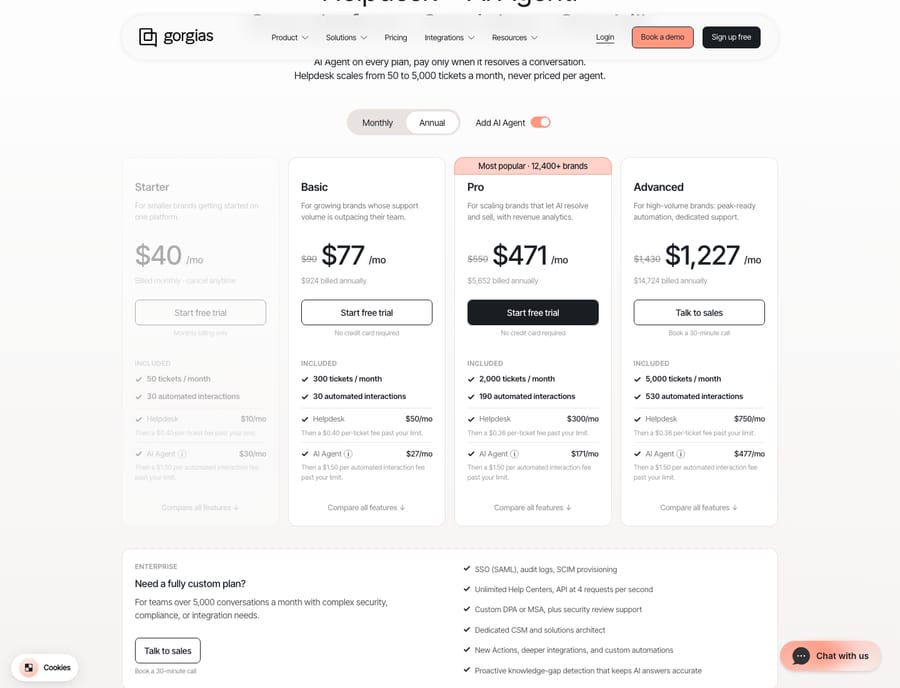
Gorgias publishes four core tiers on its pricing page, each with a monthly ticket allowance and unlimited agent seats, because Gorgias bills by ticket volume rather than per user. The page now has an AI Agent toggle. For the help desk alone, monthly billing runs Starter $10 (50 tickets), Basic $60 (300 tickets), Pro $360 (2,000 tickets) and Advanced $900 (5,000 tickets), with Basic, Pro and Advanced at $50, $300 and $750 billed annually. Switch AI Agent on and the bundles read Starter $40, Basic $77, Pro $471 and Advanced $1,227 a month on annual billing ($90, $550 and $1,430 monthly for the top three), with an Enterprise tier on request. Gorgias's own AI pricing post puts AI Agent at $0.90 per automated interaction on most plans and $1 on Starter, with $1.50 per interaction once you pass the allowance. That per-interaction fee stacks on top of the help desk, so estimate your automated volume before you commit.
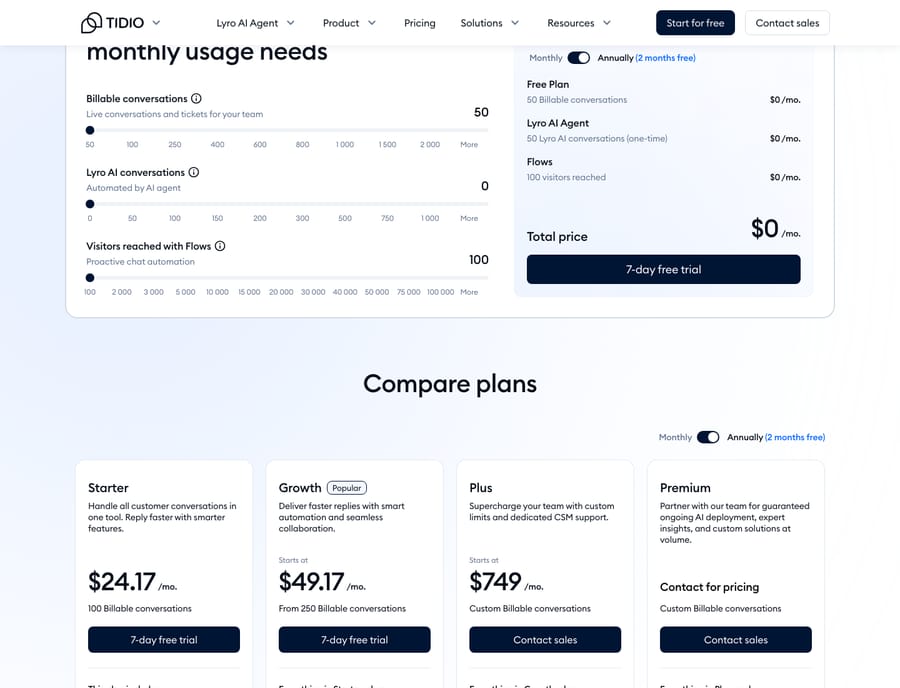
Tidio comes in cheaper at the door. Its pricing page lists a free plan, then Starter at $24.17 a month billed annually ($290 a year, 100 billable conversations), Growth from $49.17 (from 250 conversations), Plus from $300 a month plus usage, and a custom Premium tier. Paid plans come with a 7-day free trial and no card. The nuance is the meter structure: Lyro AI agent and Flows automation are separate add-ons, Lyro from $32.50 a month for 50 conversations and Flows from $24.17 a month for 2,000 visitors reached. A store that wants real automation can stack Starter, a Lyro pack and Flows and land well above the entry price. There is also a jump from Growth to Plus with little in between.
The honest summary: Tidio wins on entry price and has a genuine free plan, which makes it the more forgiving first purchase for a small store. Gorgias's help desk-only Starter is cheap too, but its useful tiers cost more, and because seats are unlimited it scales without a per-agent tax. For a deeper breakdown of the Gorgias side, see Gorgias pricing explained.
Which handles Shopify orders better?
This is where the two diverge most, and it is the single most important axis for an online store. Gorgias is an ecommerce help desk first: its Shopify integration lets an agent see order history, edit an order, issue a refund, or cancel a subscription from inside the ticket without switching tabs. That order-action layer is the reason Shopify Plus brands gravitate to it, because the support workflow and the commerce data sit on the same surface. If you want the full picture of the platform, what is Gorgias covers it.
Tidio integrates with Shopify too, and shows customer and order context in the chat panel, but it treats commerce as context rather than actions. It is closer to a chat widget that knows who the shopper is than a help desk that manages the order. For a store whose support is mostly pre-sale questions and FAQ deflection, that is often enough. For a store drowning in "where is my order" and refund requests, the difference is material.
Which has the better AI agent?
Both platforms have leaned hard into AI, and both are credible. Tidio's Lyro is its headline AI agent. Tidio's Lyro FAQ says it runs on Anthropic's Claude plus Tidio's in-house models, and it resolves common questions conversationally and stands up quickly. Tidio's own product page claims Lyro reaches a 67% resolution rate on average; that is the vendor's figure, so test it on your own tickets before you plan around it.
Gorgias's AI Agent is tuned for ecommerce and is Shopify-aware, so its automations can use order data to act, not just answer. The tradeoff is the per-interaction billing covered above. If you want the mechanics, the Gorgias AI Agent explained goes deep, and the broader category context lives in our primer on AI agents for customer service. The short version: Tidio's AI is easier to switch on; Gorgias's AI is more tightly wired into the commerce actions an ecommerce team needs.
Which channels does each cover?
Gorgias unifies email, chat, social, SMS and voice into one agent inbox, which suits a brand consolidating everything into a single support surface. Tidio is chat-first by heritage, and its strongest surface is the on-site widget, but it also covers Messenger, Instagram, WhatsApp and email, which is plenty for a small store whose customers mostly arrive through chat and social. If voice or heavy multichannel routing is on your roadmap, Gorgias has the broader native spread today.
Which is easier to set up?
Tidio's clearest win is approachability. Reviewers consistently call it one of the most user-friendly tools in the category, with a fast install and an intuitive interface: the kind of tool a founder can set up over a weekend. Gorgias is more of a system, with more to configure, and it rewards a store that has enough volume to justify the setup. Neither is hard, but Tidio is the gentler on-ramp and Gorgias is the deeper platform.
What are the pros and cons of each?
Gorgias pros: Shopify order management inside the ticket; unlimited agent seats (billed by volume, not per user); an AI Agent that can take commerce actions, not just reply; a multichannel inbox including voice; frequent product updates. Cons: the useful tiers cost more than Tidio's; per-interaction AI fees add to the bill as automation grows; much of the standout functionality is Shopify-first, so non-Shopify stores get less; a few rough edges in ticket management (for example, merged tickets can't be unmerged).
Tidio pros: a genuine free plan and a low entry price; among the easiest tools to set up in the category; strong live chat and proactive-sales features; Lyro stands up fast and runs on Claude; coverage of chat, Messenger, Instagram, WhatsApp and email. Cons: multi-meter add-on pricing (Lyro and Flows billed separately); a steep jump from Growth to Plus with no mid-tier; lighter on ecommerce order actions versus context; advanced reporting reserved for higher tiers.
Neither is the weaker product. The choice between them is about fit, not quality.
Which should you choose?
Pick Gorgias if you run an established Shopify (or Shopify Plus) store doing real ticket volume, hundreds a month or more, and your support is heavy on order lookups, refunds and returns. The native order actions and seat-unlimited, volume-based pricing pay off when a store is scaling, and the ecommerce-tuned AI Agent earns its per-interaction fee when it automates genuine order work. If you're weighing it against the wider market, the best Gorgias alternatives and our full Gorgias review are good next reads.
Pick Tidio if you're a small or early store that wants cheap, fast, friendly chat with a real free tier to start: front-of-house FAQ deflection and proactive sales chat more than deep order management. If your volume is modest and your budget is tight, Tidio's on-ramp is hard to beat, provided you model the add-on meters before you scale.
The dividing line is roughly this: Tidio for the storefront conversation, Gorgias for the operations behind the order. Most stores know which side of that line they live on.
Can you add an AI agent to whichever help desk you pick?
Yes. This is a help desk versus help desk decision, and the winner is whichever fits your store. Macha isn't a third help desk in this race. It's the AI agent layer that sits on top of the one you use, and it runs on Zendesk, Freshdesk, Gorgias, Front, HubSpot or Intercom. It resolves routine questions against the same tickets and calls your own systems through a custom tool when an answer needs live order or account data. Macha bills per ticket, from $299 a month for up to 750 tickets: one conversation is charged once however many messages it takes, never per resolution, and setup and monitoring by the Macha team are included.
FAQ
Is Tidio cheaper than Gorgias? At the entry level, usually. Tidio has a free plan and a $24.17/mo Starter billed annually, while Gorgias starts at $10/mo for 50 tickets on the help desk alone and $40/mo with AI Agent. Tidio's Lyro and Flows are billed as separate meters, and Gorgias charges its AI Agent per automated interaction, so the real cost depends on your automation volume. Model both against your ticket load before deciding.
Which is better for a Shopify store? For deep Shopify support (order edits, refunds and returns handled inside the ticket), Gorgias is the stronger fit. Tidio integrates with Shopify for context but is chat-first rather than an order-management help desk, which suits smaller stores focused on FAQ and pre-sale chat.
Does Tidio have an AI agent like Gorgias? Yes. Tidio's Lyro is an AI agent that runs on Anthropic's Claude and resolves common customer questions, priced from $32.50 a month for 50 conversations. Gorgias's AI Agent is more tightly wired into Shopify order actions. Tidio's is easier to switch on; Gorgias's is more ecommerce-operational.
Do I have to replace my help desk to add AI? No. An AI agent layer such as Macha runs on top of your existing help desk rather than replacing it: you keep your help desk as the system of record and add AI agents that read and resolve the same tickets.
Which has the better free/entry option? Tidio, for getting started cheaply: it has a genuine free plan, a $24.17/mo Starter and a 7-day free trial of paid plans. Gorgias has no free tier, but its $10 help desk-only Starter is a cheap way in, and its paid tiers bundle unlimited seats, which favours stores with real volume.
Want an AI agent working on top of your help desk? Start a free trial of Macha with $50 of free usage and no credit card.