Shopify
 Stripe
 Slack
Slack Notion
 Google Workspace
 Confluence

Jira Zendesk Integration: Connect Them for Your AI Agent (2026)


Support and engineering live in two systems, and your agents feel it every day: a bug report lands in Zendesk, but the fix — its status, its priority, whether it shipped — lives in Jira, one tab over. A customer asks "any update on that crash you logged?" and the agent has to leave the ticket, hunt through Jira, and translate the answer back by hand. Connecting the two is one of the most-requested integrations in customer support, and there's more than one way to do it depending on what you actually need.

This guide covers both: the native Jira Zendesk integration (and where it stops), and how to give your AI agent live Jira lookups and issue-creation right inside a ticket using a Custom Tool.
Framing first. Macha runs on top of the Zendesk you already use — it's an AI-agent layer, not a Zendesk or Jira replacement. Your agents keep working in Zendesk; Macha reads the ticket, reasons, and reaches into Jira to answer or act.
Prefer the classic step-by-step setup? See our guide on how to integrate Zendesk with Jira — this piece focuses on giving your AI agent live access instead.
The native option — and where it stops
Zendesk does offer a native Zendesk Support for Jira app, and it's free in the Zendesk Marketplace. Once installed, it adds a Jira panel to the ticket so an agent can link an existing issue, create a new one, and see basic status passed back. If all you need is a human agent manually linking tickets to issues, that may be enough.
Note: Atlassian is retiring the legacy Zendesk Support for Jira app after April 2026 (a v2.0 rebuild is replacing it) — one more reason an API-backed Custom Tool is a more durable path than a marketplace app whose roadmap you don't control.
Where it stops:
- It's collaboration, not autonomy. It's built for a human to click "link issue" or "create issue." It doesn't let an AI agent decide to check an issue's status mid-conversation, pull the fix version, and answer the customer without anyone leaving the ticket.
- Field and sync mapping is limited. The native app is widely described as basic — restricted field mapping, limited true bidirectional status sync, limited comment sync. Teams that need real two-way sync often reach for third-party apps.
- It's fixed. You get the link/create flow the app exposes — not the specific JQL query or the exact issue-creation payload your workflow needs (e.g. "how many open P1s reference this account?" or "file a bug pre-filled with this customer's plan and env").
For a lot of teams, manual linking is fine. For anyone who wants their AI agent to actually use Jira, there's a lighter, more flexible path.
What you actually want: the agent using Jira live
The high-value version of this integration isn't a link button — it's the agent doing the work. A customer writes into Zendesk asking about a bug; the agent recognizes it, queries the matching Jira issue by key or summary, and answers "that's fixed in the release going out Thursday" — grounded in live Jira, not a stale synced field. Or the agent files a fresh bug straight from the ticket, pre-filled with the customer's plan, browser, and steps to reproduce. That's what a Custom Tool enables.
How to connect them with a Custom Tool
A Custom Tool is a single action you define once and point at Jira's REST API. No marketplace app, no code.
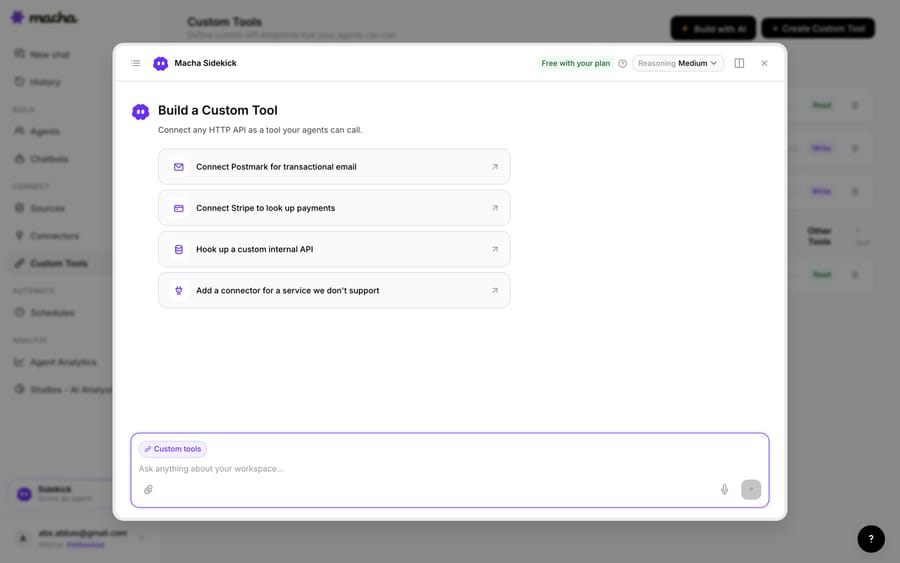
1. Point it at the Jira API. Jira exposes a REST API (with an API token or OAuth 2.0); you give Macha the endpoint and credentials. The built-in Sidekick can scaffold the request from a plain-English description if you'd rather not fill in the form.
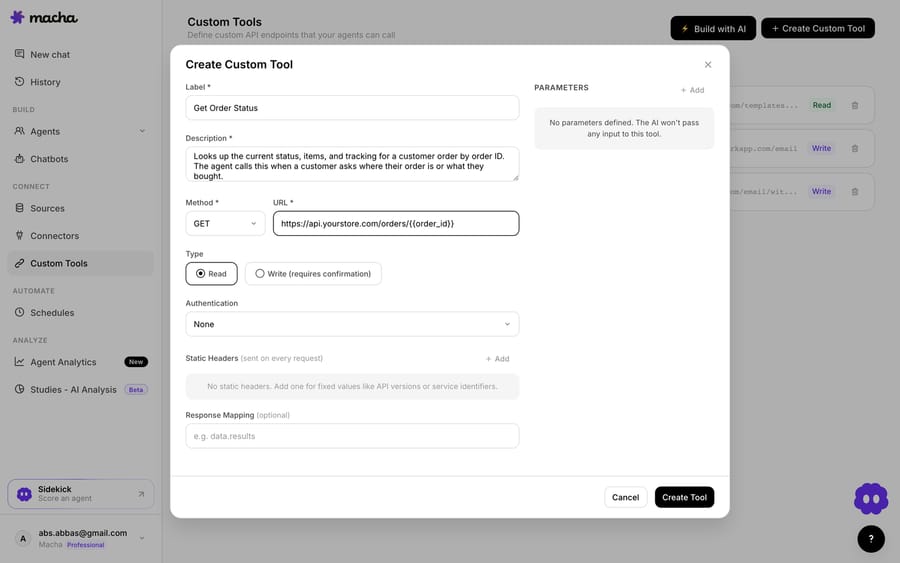
2. Define the action. Give it a label and a description the AI uses to decide when to call it — e.g. "Get the status, priority, and fix version of a Jira issue by key" — set the method and URL (a GET against the Jira issue endpoint, with an {{issue_key}} placeholder), and choose Read or Write. Reading an issue's status is a Read; creating a bug or posting a comment to an issue is a Write, which requires confirmation before it runs.
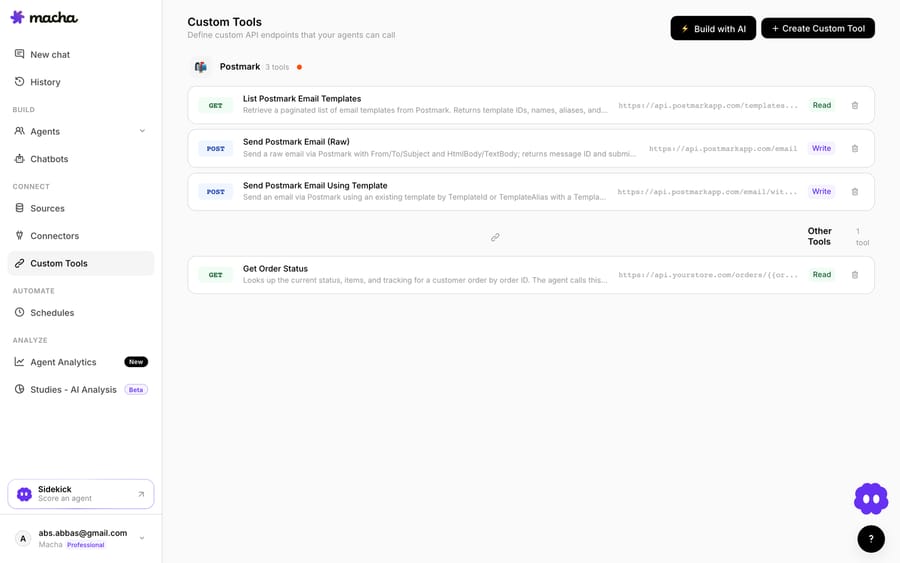
3. The agent uses it live. Once the tool exists, the agent calls it mid-ticket, passes the issue key (or the details for a new bug), and reasons over what Jira returns — answering the status question or filing the escalation.
Read vs Write, and staying safe
Because a Custom Tool can reach into Jira, the guardrails matter: Read tools (issue lookups) are free to call; Write tools (create an issue, add a comment, transition a status) require confirmation. Each tool is scoped to one action, permissioned per agent, and every call is audited. Jira's API token or OAuth handles credentials, so secrets never live in the conversation.
Teams usually build a few Jira tools and group them — a "get issue status" lookup, a "file a bug" writer, a "comment on an issue" writer — alongside tools for their other systems.
Native app vs Custom Tool — which to use
- Use the native Zendesk Support for Jira app if you just want human agents to manually link and create issues from the ticket panel, and basic status passthrough is enough.
- Use a Custom Tool when you want your AI agent to read live Jira status or file an issue from the ticket on its own, you need a specific JQL query or a pre-filled create payload the native app doesn't expose, or you'd rather not be limited to the app's fixed fields. The two can coexist.
Beyond the lookup
Once the agent can reach Jira, the same pattern covers more: check whether a reported bug is already fixed before replying, count open issues linked to an account to gauge risk, file a bug pre-filled with the customer's environment, post the customer's repro steps as a comment on the existing issue, or read the sprint/fix version to give an honest ETA. And because Custom Tools aren't Jira-specific, the same approach connects your CRM, billing system, or internal API — see the Custom Tools integration directory for 200+ tools, or the full pillar on building custom Zendesk integrations.
The bottom line
Zendesk's native Jira app puts a link/create panel on the screen for humans. A Custom Tool puts Jira in your AI agent's hands — live status lookups and issue-creation, decided in context, on any plan, no code. You describe the action, point it at the Jira API, and your Zendesk agents can use it inside a ticket with Read/Write guardrails and a full audit trail.
Ready to try it? See how Custom Tools work, browse the integration directory, or start a free trial and wire up your first Jira tool today.
Frequently asked questions
Does Zendesk have a native Jira integration? Yes — the free Zendesk Support for Jira app lets human agents link and create Jira issues from a ticket, with basic status passthrough. Field mapping and true two-way sync are limited. A Custom Tool adds live, agent-driven issue lookups and creation on any plan.
Do I need an engineer to connect Jira to Zendesk this way? No. You describe the action in plain English and Macha's Sidekick scaffolds the Jira request, auth, and parameters. Technical teams can go deeper with full control over the JQL, the create payload, headers, and response mapping.
Can the agent create or update Jira issues, or only read them? Both. Reads (issue lookups) run freely; writes — creating a bug, commenting, transitioning a status — require a confirmation step, and you control which agents can use them.
Is it secure? Yes. The tool is scoped to a single action, permissioned per agent, authenticated via Jira's API token or OAuth, and every call is audited.
Add AI agents to your Zendesk
Macha reads the ticket, drafts the reply and takes the action, inside the Zendesk you already run.