Shopify
 Stripe
 Slack
Slack Notion
 Google Workspace
 Confluence

Maven AGI: The Complete Guide (2026)


Maven AGI is an enterprise AI agent platform built to sit across the entire customer journey, from support to sales to onboarding to retention, by reasoning over a company's existing systems instead of requiring a fresh data migration. This guide covers what Maven actually does, how its "Graph of Record" architecture works, what it costs (the short answer: nobody outside a sales call knows), and how it compares to narrower tools built specifically for a support team already running Zendesk or Freshdesk.

We build AI agents for customer service ourselves, so we read Maven's claims the way a buyer evaluating both products would: what's a real mechanism, what's a case-study number, and what's marketing.
What is Maven AGI?
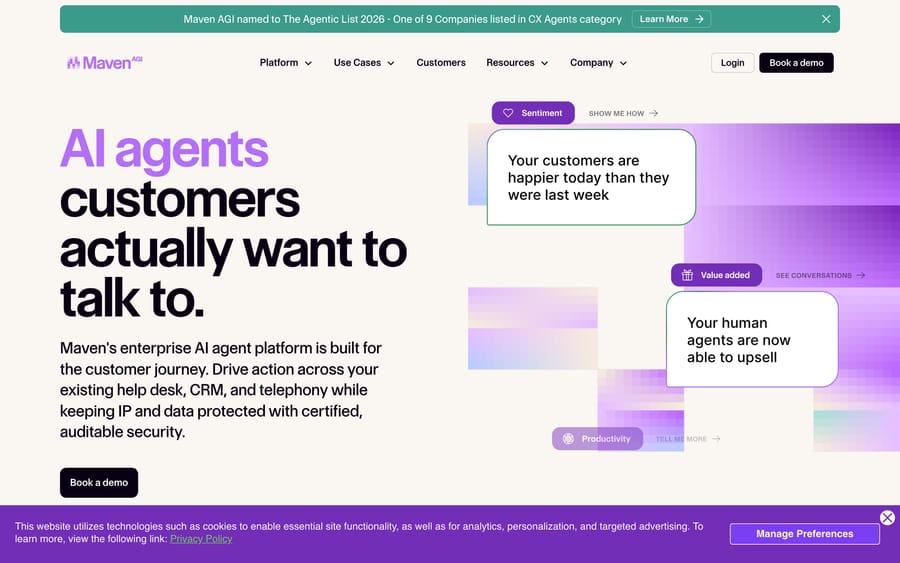
Maven AGI is a Boston-based company founded in early 2023 by CEO Jonathan Corbin (formerly global VP of customer success and strategy at HubSpot), CTO Sami Shalabi (a former Google engineering leader), and CPO Eugene Mann (formerly an applied ML leader at Stripe). It has raised $78 million total, including a $50 million Series B in June 2025 led by Dell Technologies Capital, with Cisco Investments, SE Ventures, and returning investors Lux Capital, M13, and E14 also participating. Press coverage of that round put the company's valuation around $236 million.
The company's own framing is "Business AGI": AI that reasons across a company's existing systems of record instead of requiring support content to be re-authored inside the vendor's tool. That distinction matters for how Maven sells itself. Instead of "train a bot on your help center," the pitch is "point the agent at Salesforce, Zendesk, your product database, and your knowledge base as they already exist, and it reasons over what's current." Named customers on Maven's site include Dell Technologies, Hard Rock Digital, Thumbtack, Clio, Qualia, and TripAdvisor, and the company says the platform runs at more than 90 companies, including several publicly traded ones.
Maven positions itself against the enterprise CX platforms: Decagon, Ada, Netomi. Smaller help-desk add-ons simply aren't its comparison set. If your team is a handful of agents inside a single help desk, Maven's sales process and platform scope are built for a different buyer than you. That's a fit question worth answering honestly before a demo, because a sales-led enterprise platform's incentive is the size of the contract it signs, and a multi-system, multi-quarter deployment is how that contract gets bigger.
How Maven AGI's AI works
Maven's technical pitch centers on three named, separate pieces that work together.
Graph of Record is Maven's term for connecting live to a company's existing systems: CRM, help desk, product database, internal wikis. The stated benefit is that the agent reasons over data as it changes: a return policy updated in Zendesk this morning, an account status that changed in Salesforce five minutes ago. Most competing platforms also support live integrations. What Maven emphasizes is treating the connection as the primary knowledge source, so a support agent doesn't drift out of sync with a separately maintained, uploaded knowledge base.
Charters define what an agent knows and is allowed to do in a given conversational context, closer to a scoped policy document than a single system prompt. A charter can say, in effect: "When the conversation is about billing, use these three data sources and these two actions, and hand off to a human when the account is flagged high-risk." This is Maven's answer to the governance question every enterprise buyer asks: how do you stop the agent from improvising outside its lane.
Intelligent Fields turn unstructured conversation into structured data on the way out, extracting a reason code, a sentiment score, or a churn signal from a chat transcript automatically. A human doesn't have to tag it afterward. Agent Designer is the no-code workspace where a CX team tunes charters and behavior without engineering support, and Voice Agent extends the same reasoning to real-time phone calls.
What the case studies actually claim
Maven's public case studies report specific autonomous-resolution numbers. TripAdvisor is cited as autonomously handling 90% of incoming queries, Mastermind reports 93% autonomous resolution within six weeks of launch, and K1X says it went live in one week and reached 80% autonomous resolution in six weeks. These are vendor-published, customer-attributed figures, not independently audited numbers. Treat them as directionally credible evidence of fast time-to-value on Maven's own telling, not as a benchmark you should expect to replicate without qualification.
Key features
- Graph of Record: live connections into CRM, help desk, and internal knowledge systems, positioned as the primary data source instead of a static upload.
- Charters: scoped policy definitions that control what an agent knows and can do per conversation type.
- Intelligent Fields: automatic extraction of structured data (reason codes, sentiment, churn signals) from conversations.
- Agent Designer: a no-code workspace for CX teams to configure and tune agent behavior.
- Voice Agent: real-time voice AI for phone-based support, extending the same reasoning beyond chat and email.
- Integrations with Zendesk, Salesforce, Freshdesk, and Slack, plus a listed Salesforce AppExchange app (Maven AGI Co-Pilot).
- Compliance certifications including SOC 2 Type 2, ISO 27001/27017/27018/27701/42001, HIPAA, PCI DSS, GDPR, and CCPA: the checklist an enterprise security review asks for.
Maven AGI pricing (researched)
Maven AGI does not publish pricing anywhere on its site. There is no pricing page with numbers, no calculator, and no self-serve signup: mavenagi.com/pricing is a demo-booking page.
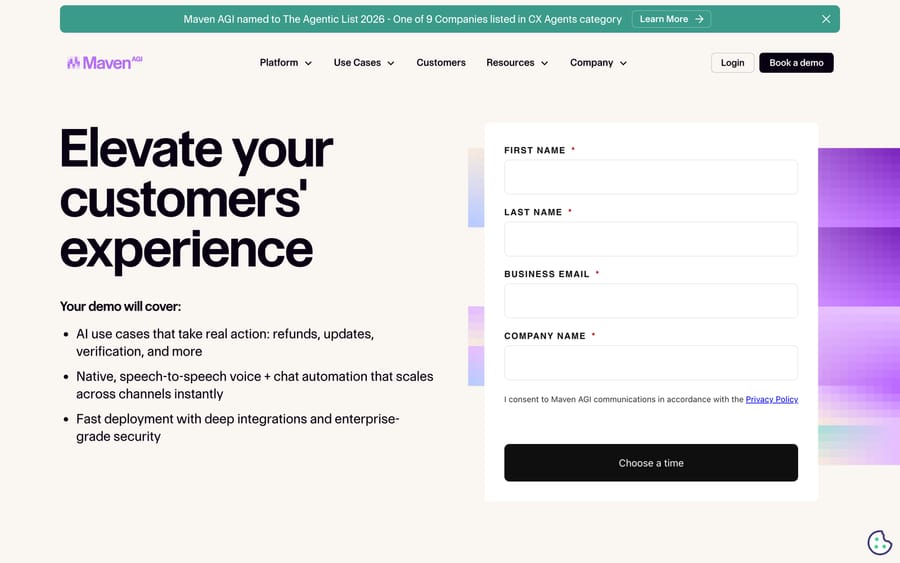
The URL mavenagi.com/pricing renders a demo-booking form, not a price list. G2's pricing page for Maven returned an access error when we checked it, and we found no credible third-party contract-value estimate (Vendr, Capterra) with real numbers behind it, unlike some enterprise peers where procurement data is available. Rather than publish an unverifiable estimate, the honest statement is that Maven's pricing is fully quote-based, and you will not know your number until you talk to sales.
There's a business reason opaque, sales-led pricing is standard at this end of the market: it lets the vendor price to what a specific enterprise account can pay and to how many systems it's connecting, rather than publishing one number that undersells a large deal or scares off a small one. That serves the vendor's margin, not your ability to compare options quickly. What we can say with confidence, based on the company's positioning and funding stage: Maven sells to enterprises with multiple systems of record and a security review process, which is the segment where six- and seven-figure annual contracts are normal for this category.
Pros and cons
Pros
- Reasons over live data in existing systems instead of requiring a fresh knowledge-base migration.
- Charters give a concrete, auditable mechanism for scoping what an agent can do, useful in a security review.
- Fast-cited time-to-value in its own case studies (K1X live in one week).
- Broad channel coverage: chat, email, and real-time voice under one platform.
- Deep compliance certification list for regulated buyers.
Cons
- No published pricing anywhere; every deal requires a sales conversation.
- No self-serve trial, so you cannot test the product before committing to a sales process.
- Built for the full customer journey (sales, onboarding, retention, support), which is more platform than a team that only wants to automate support tickets needs.
- Case-study resolution numbers are vendor-reported and specific to each customer's setup, not a number you can bank on for your own volume.
Who Maven AGI is best for
Maven AGI fits an enterprise that already runs several systems of record (a CRM, a help desk, a product database) and wants one AI layer reasoning across all of them for support, onboarding, and retention at once, with a security team that needs to see SOC 2 and ISO paperwork before signing. Its customer list (Dell, Hard Rock Digital, TripAdvisor) is the tell: large, established brands with a procurement process.
It's a poor fit if you already know your actual problem is narrower: a support team on Zendesk or Freshdesk that wants agents answering tickets inside the tool it already uses, without a multi-quarter platform rollout or an opaque contract negotiation. The scope Maven sells (sales, onboarding, retention, support, voice) is capacity most single-help-desk teams will pay for and never use.
Maven AGI vs alternatives
| Maven AGI | Decagon | Macha | |
|---|---|---|---|
| Model | Enterprise AI agent platform across the full customer journey | Enterprise conversational AI agent platform | AI agent layer on your existing help desk |
| Best for | Large enterprises with multiple systems of record | Enterprise support, high-volume chat | Teams on Zendesk, Freshdesk, Gorgias, or Front |
| Governance | Charters (scoped policy per conversation type) | Enterprise guardrails and workflows | Standard controls, scoped per agent |
| Pricing | Unpublished; sales-quoted only | Unpublished; sales-quoted only | From $299/month for 750 tickets (about $0.40 per ticket), published |
| Self-serve trial | No | No | Yes, $50 of free usage (about 125 tickets), no credit card, no time limit |
| Setup | Multi-system rollout, services-involved | Enterprise onboarding, services-involved | setup and monitoring by the Macha team, included on every plan |
| Replaces your help desk? | No, but is a broad standalone platform | No, but is a broad standalone platform | No, built to run on top of it |
If Maven's scope is more than your support team needs, or if a sales-quoted, opaque contract isn't how you want to evaluate a tool, Macha is the narrower alternative built for teams that already know which help desk they're keeping. It runs as an AI agent layer on top of the help desk you already have, with published pricing you can see before you talk to anyone. You build agents in plain English, and the price is set by ticket volume rather than by a negotiation. See Macha pricing for the current tiers.
To be fair to Maven: if you're a large enterprise that genuinely needs one AI reasoning across sales, onboarding, retention, and support simultaneously, and you have a security team that wants a SOC 2 report before anything else, Maven's breadth and certifications are a legitimate reason to pick it over a lighter tool. Pick by the shape of your problem.
FAQ
What is Maven AGI? Maven AGI is an enterprise AI agent platform, founded in 2023, that automates customer support, sales, onboarding, and retention conversations by reasoning over a company's existing CRM, help desk, and knowledge systems.
How much does Maven AGI cost? Maven AGI does not publish pricing. There's no pricing page with numbers and no self-serve trial. Every deal is quoted through a sales conversation.
Does Maven AGI have a free trial? No. Evaluating Maven requires booking a demo and going through its sales process.
What is Maven AGI's "Graph of Record"? It's Maven's term for connecting live to a company's existing systems of record (CRM, help desk, product database) so agents reason over current data instead of a static, separately maintained knowledge base.
What are Charters in Maven AGI? Charters are scoped policy definitions that control what an agent is allowed to know and do within a specific conversation context, such as restricting a billing conversation to certain data sources and actions.
Who uses Maven AGI? Publicly named customers include Dell Technologies, Hard Rock Digital, Thumbtack, Clio, Qualia, and TripAdvisor. The company says the platform runs at more than 90 companies.
How much funding has Maven AGI raised? $78 million total, including a $50 million Series B in June 2025 led by Dell Technologies Capital, with press coverage citing a roughly $236 million valuation.
What are good alternatives to Maven AGI? For similar enterprise-platform breadth, Decagon and Netomi are common comparisons. A team that wants to automate support inside a help desk it already runs, with transparent published pricing, fits Macha better.
Does Maven AGI integrate with Zendesk and Salesforce? Yes. Maven lists integrations with Zendesk, Salesforce, Freshdesk, and Slack, and publishes a Maven AGI Co-Pilot app on the Salesforce AppExchange.
Sources: Maven AGI homepage, Maven AGI about, Maven AGI Series B announcement, PR Newswire — Maven AGI raises $50M, Maven AGI pricing page.
Resolve tickets automatically with AI agents
Macha's AI agents work on top of the help desk you already use — no code.