Shopify
 Stripe
 Slack
Slack Notion
 Google Workspace
 Confluence

How to Build Custom Zendesk Integrations With No Native App (2026)


You open the Zendesk Marketplace, search for the tool your team actually lives in — an internal orders database, a niche billing platform, a homegrown admin panel — and it isn't there. Or it is there, but the app is read-only, hasn't been updated in two years, or is gated behind a plan you don't have. This is the quiet gap in every help desk: the marketplace covers the popular 5%, and your workflow depends on the other 95%.

The good news: a missing native app is no longer a dead end. If the tool you need has an API, you can connect it to Zendesk yourself — without shipping a marketplace app, and without writing integration code. This guide explains how, using AI-agent Custom Tools, and where this approach beats waiting for a native connector.
First, the framing. Macha isn't a Zendesk replacement — it runs on top of the Zendesk you already use. Your agents keep working in the Zendesk Agent Workspace; Macha adds an AI layer that can read tickets, reason, and — through Custom Tools — reach into any other system to answer or act.
What "custom integration" actually means now
For years, "integrating X with Zendesk" meant one of two things: find a pre-built Marketplace app, or pay a developer to build one against the Zendesk Apps framework and the target tool's API. Both are heavy. A Marketplace app is someone else's idea of the integration; a bespoke one is a project with a maintenance tail.
A Custom Tool is a third path. Instead of building an app, you define an action — "look up an order," "create a Jira issue," "check a subscription in our billing system" — and point it at the relevant API endpoint. Your Macha AI agent then calls that action while it works a ticket, passes the right parameters, and reasons over what comes back. No marketplace listing, no app review, no glue code.
The difference in practice is control. A native app does what its author decided it should do. A Custom Tool does exactly what you describe — scoped to the one job you need, in the language your team uses.
The model in three steps
Every Custom Tool follows the same shape, whether it's wrapping Salesforce, a Postgres database, or an internal microservice.
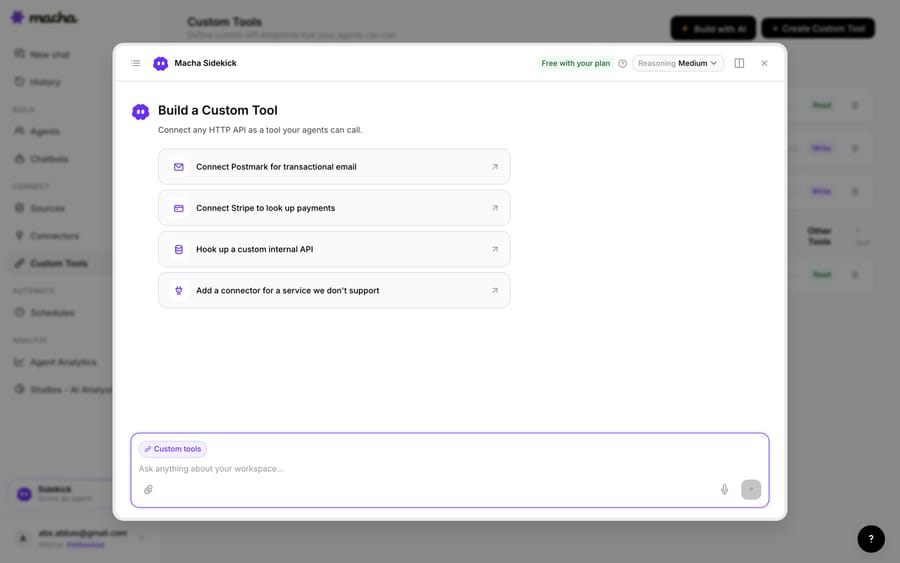
1. Point it at the API. You give Macha the endpoint, method, and credentials. If you'd rather not fill in a form, the built-in Sidekick will scaffold the whole thing from a plain-English description — "connect Stripe to look up payments," "hook up our internal orders API."
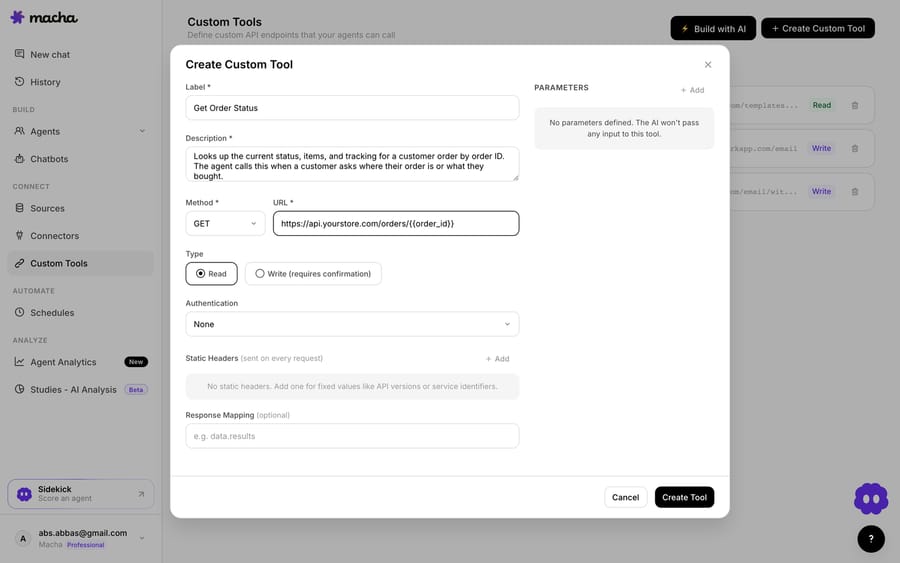
2. Define the action. Give the tool a label and a description the AI uses to decide when to call it, set the method and URL (with placeholders like {{order_id}} for the parameters the agent will fill), and choose whether it's a Read or a Write. Reads are safe lookups; Writes — refunds, status changes, record updates — require confirmation before they run. Authentication, static headers, and response mapping are all here too, so a real production endpoint drops straight in.
3. The agent uses it live. Once the tool exists, your agent calls it mid-ticket. A customer asks "where's my order?" in a Zendesk ticket; the agent recognizes the intent, calls Get Order Status with the order ID it pulled from the conversation, and answers with the real status and tracking — grounded in your system of record, not a guess.
That's the entire loop: define once, and the AI decides when to use it on every relevant ticket thereafter.
What it looks like once you've built a few
Custom Tools aren't a one-off escape hatch — teams build a small library of them, grouped by the service they wrap. Here's a Macha workspace with tools for Postmark (list templates, send email) and a store's order-lookup endpoint, each tagged Read or Write with its API URL.
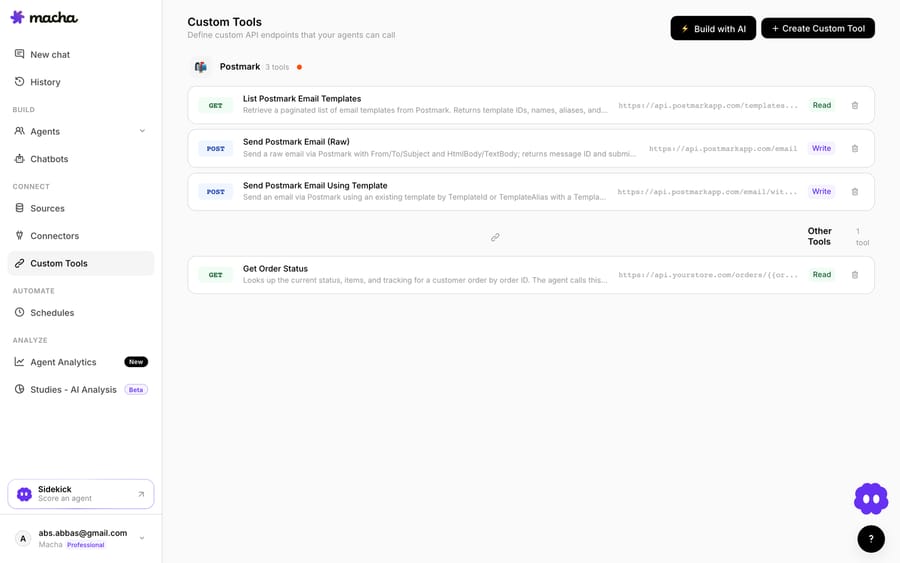
Notice the mix of GET/Read and POST/Write. A support agent can be allowed to look up anything but only act — send, refund, update — with a confirmation step. That boundary is enforced per tool and per agent.
Read vs Write, auth, and staying safe
Because a Custom Tool can reach into real systems, the guardrails matter as much as the capability:
- Read vs Write. Read tools are free to call. Write tools (anything that changes state) require confirmation, so an agent can't silently issue a refund or delete a record.
- Scoped by design. A tool exposes exactly one action against one endpoint. It can't wander — it does the job you defined and nothing else.
- Permissioned per agent. You decide which agents get which tools. Your triage agent might only read; a senior-support agent might be allowed to write.
- Audited. Every call is logged, so you can see exactly what ran, with what inputs, and when.
For authentication, the builder supports the common patterns (API keys, bearer tokens, custom headers), so tools that need credentials — most of them — work without exposing secrets in the conversation.
When to use a native app vs a Custom Tool
Custom Tools don't make the Marketplace obsolete; they cover what it can't.
- Reach for a native app when a well-maintained one already exists for a mainstream tool and does what you need out of the box — Slack notifications, a Jira sidebar, a Shopify order card. If Macha has a native connector for it, use that (it's deeper and zero-setup).
- Reach for a Custom Tool when there's no app, the app is limited or read-only, the tool is internal or industry-specific, or you need a specific action the app doesn't expose. This is most real workflows.
Zendesk also ships a no-code Integration Builder for connecting its own AI agents to APIs, which is worth knowing if you're all-in on Zendesk. A Custom Tool differs by being portable — the same action works across every help desk you run, not just Zendesk's agent framework — and by letting you describe it in plain English without living inside one vendor's builder.
The honest rule of thumb: if you've ever said "I wish Zendesk could just check X for me," and X has an API, that's a Custom Tool.
Examples worth building
The pattern generalizes across every category of tool a support team touches:
- CRM — pull a customer's account, plan, and owner from Salesforce or HubSpot into the ticket.
- Databases & warehouses — query orders, subscriptions, or usage from Postgres, Snowflake, or BigQuery to answer from source of truth.
- Billing & payments — check a subscription or issue a refund in Chargebee, Recurly, or Stripe.
- Engineering — open a Jira, Linear, or GitHub issue from a bug report and read its status back.
- Internal systems — hit your own admin API to look up an account, reset a flag, or trigger a job.
For a browsable list of tools you can connect this way — 200+ across CRM, databases, e-commerce, ITSM, and more — see the Custom Tools integration directory. If it has an API, it belongs on that list.
Running more than one help desk? The same approach works on Freshdesk, Front, Intercom, and Gorgias — Custom Tools are portable across all of them.
The bottom line
A missing Marketplace app used to mean "not supported." With Custom Tools, it means "not yet — give me ten minutes." You describe the action, point it at the API, and your Zendesk AI agents can read and write it live inside a ticket, with Read/Write guardrails, per-agent permissions, and a full audit trail. The integration you need stops being something you wait for and becomes something you build.
Ready to try it? See how Custom Tools work, browse the integration directory, or start a free trial and wire up your first tool today.
Frequently asked questions
Do I need an engineer to build a Custom Tool for Zendesk? No. You can describe the integration in plain English and Macha's Sidekick scaffolds the request, authentication, and parameters. Technical teams can go deeper with full control over methods, headers, bodies, and response mapping.
Is this a Zendesk Marketplace app? No — and that's the point. A Custom Tool doesn't need a Marketplace listing or app review. It's an action your AI agent calls against any API, so you can connect tools that will never have a native app, including internal and industry-specific systems.
Which help desks does this work with? Zendesk, Freshdesk, Front, Intercom, and Gorgias. Macha sits on top of the help desk you already use, and Custom Tools work the same way across all of them.
Can it change data, or only read it? Both. Read tools are safe lookups; Write tools (refunds, updates, status changes) require a confirmation step before they run, and you control which agents can use them.
Is it secure? Yes. Custom Tools are scoped to a single action, permissioned per agent, and every call is audited — so you always know what ran, with what inputs, and when.
Add AI agents to your Zendesk
Macha reads the ticket, drafts the reply and takes the action, inside the Zendesk you already run.