Shopify
 Stripe
 Slack
Slack Notion
 Google Workspace
 Confluence

Inkeep: The Complete Guide (2026)


Inkeep builds AI agents that answer product and support questions using a company's own docs, and it has become a common name on developer-tool support pages because companies like Anthropic, Postman, and Pinecone use it themselves. This guide covers what Inkeep actually does, how its agents work, what it costs, where it fits, and how it compares to the alternatives worth putting next to it.

We build AI agents for customer service ourselves, on top of the help desk a team already runs. We checked Inkeep's own site, docs, and pricing FAQ before writing this, so the claims below trace back to what Inkeep itself publishes.
What is Inkeep?
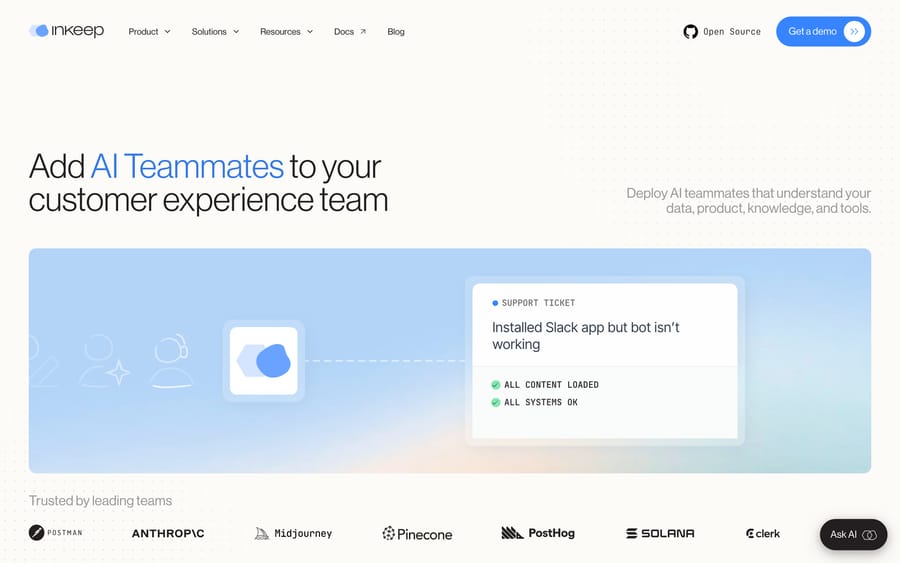
Inkeep is a platform for building AI agents that answer questions using a company's product docs, help center, source code, and support history, then take action through connected tools. On its site, Inkeep describes the product as giving "AI Teammates to your customer experience team": agents that read a company's knowledge and act inside the tools that team already uses instead of a single hosted chat widget.
The company came out of Y Combinator's Winter 2023 batch, founded by Nick Gomez (previously leading developer experience at Microsoft) and Robert Tran (previously Head of Engineering at illumis, later acquired by ComplySci). It has raised $13 million from Khosla Ventures, Y Combinator, and Great Point Ventures, according to its YC company profile, and runs with a small team of around 18 people. That founding story matters for fit: Inkeep was built by people who had shipped developer tools, and its earliest and most visible customers are developer-tool companies. Postman, Anthropic, Midjourney, Pinecone, PostHog, Solana, and Clerk all appear as logos on inkeep.com. If your support questions are mostly "how do I call this API" and "why is this SDK method failing," Inkeep suits your team well.
Inkeep ships two products under one roof. Inkeep Open Source is a self-hosted agent framework: a visual builder plus a TypeScript SDK with what the docs call "full 2-way sync," so a non-technical teammate can edit an agent in the UI and a developer can edit the same agent in code without the two drifting apart. Inkeep Enterprise is the managed, hosted version of the same product, sold through a sales conversation instead of self-serve signup.
How Inkeep's AI works
Inkeep's agents are built around three components, and the split matters more than the marketing language around any one of them:
- Customer-facing assistants: the chat or search widget end users see, backed by unified search across a company's docs, help center, and other connected sources.
- Inkeep Coworker: an internal assistant for the support team itself, triggered from Slack or from inside a help desk, that pulls context from a ticket and suggests a next step for a human to approve.
- Automation agents: background agents that keep the knowledge base current, running on event triggers (a doc changes, a ticket resolves in a new way) instead of waiting for someone to remember to update an article.
The platform is deliberately provider-agnostic: Inkeep's own documentation states "you can use the LLM provider of your choice" rather than locking a deployment to one model vendor. Agents can be composed into what the docs call a "multi-agent architecture," where a router agent hands a question to a narrower specialist. They are exposed through MCP, webhooks, or a direct API, so one Inkeep agent can be called from a chat widget, a Slack bot, or another internal tool without rebuilding the underlying agent three times.
The practical effect: Inkeep sits closer to a developer framework than a hosted bot. A team with an engineer willing to configure the SDK gets more out of it than a team that just wants to point it at a knowledge base and walk away, even though the no-code builder exists to lower that bar.
Key features
- Unified search across docs, help center articles, source code repositories, and past support conversations, used to ground both the customer-facing assistant and internal search.
- Inkeep Coworker for the support team itself, triggered from Slack or the help desk, with human approval before anything reaches a customer.
- Automation agents that update documentation and knowledge sources on a trigger instead of a fixed schedule.
- No-code visual builder and a TypeScript SDK, kept in sync so technical and non-technical teammates can both edit the same agent.
- MCP, webhook, and API deployment, so the same agent can be wired into a chat widget, an internal tool, or a third-party integration.
- White-label option on the enterprise plan, plus authentication and CAPTCHA controls for public-facing deployments.
Inkeep pricing
Inkeep does not publish prices for its managed Enterprise platform. Its own pricing FAQ, on docs.inkeep.com, says the company quotes based on expected usage after a sales conversation: "we aim to account for your expected usage in the pricing we quote you." Unlimited search is included on any quoted plan, with organization-level throttling used to catch abuse instead of metering normal use.
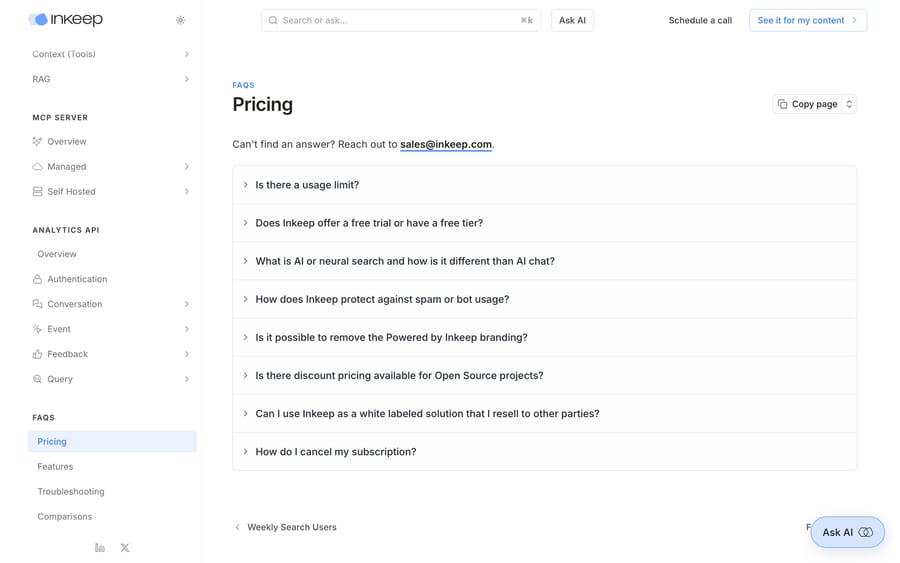
Quoting per deal instead of publishing a list price is a business model choice, not an oversight: it lets Inkeep price closer to what each customer is willing to pay, which earns the vendor more from a large enterprise account than a flat published rate would, at the cost of every prospect needing a call before they see a number.
What Inkeep does offer without a contract: a live demo built on your own content, followed by a 30-day sandbox to try the chat widget and UI components against your real docs, no credit card required.
Because nothing is published on inkeep.com itself, the only concrete numbers available come from third-party SaaS-pricing listicles rather than Inkeep. Treat the following as an estimate, not a quote: sites tracking Inkeep's pricing have reported a Starter tier around $200/month and a Scale tier around $500/month, with Enterprise custom above that. We could not verify these against Inkeep's own materials, and a company that quotes per expected usage will land most real deals at a different number depending on traffic and seat count. If pricing certainty matters to your evaluation, get the number from a call before you build an internal case around it.
Pros and cons
Pros
- Real technical customers (Anthropic, Postman, Pinecone) who chose it for developer-facing support, not just marketing logos.
- Open-source path lets an engineering team self-host and inspect the agent framework before committing to the managed version.
- Provider-agnostic model choice avoids lock-in to one LLM vendor.
- Coworker's human-approval step is a sane default for a support team nervous about autonomous replies.
Cons
- No published pricing anywhere, including the FAQ page dedicated to the topic. Every real number requires a sales call.
- The framework's flexibility (SDK, multi-agent routing, MCP) rewards a team with engineering time to spend on it; a lean support team without that gets a narrower slice of the product through the no-code builder alone.
- Built and marketed around developer-tool support. The case for a retail or e-commerce support team is thinner than for a company shipping an API.
Who Inkeep is best for
Inkeep suits teams at a developer-tool or platform company whose support volume is dominated by product and API questions, that have docs and a help center worth indexing, and that are comfortable quoting per usage on a sales call instead of seeing a price upfront. The customer list backs this up: Postman, Pinecone, and Clerk are the shape of company Inkeep is built for. If you already have an engineer willing to own the SDK, the platform's flexibility pays off faster.
It is a weaker fit if you are not selling a technical product, or if your tickets are mostly order status, refunds, and account changes that a doc cannot answer on its own. That is a different problem, one a help-desk-native AI agent solves better than a docs-search platform does.
Inkeep vs alternatives
| Inkeep | Kapa.ai | Macha | |
|---|---|---|---|
| Model | AI agents (chat, coworker, automation) over docs and product knowledge | AI chatbot trained on technical docs, for support and internal use | AI agent layer on top of your existing help desk |
| Best for | Developer-tool companies with API/product support volume | Developer-facing docs Q&A, similar niche to Inkeep | Teams on Zendesk, Freshdesk, Gorgias, or Front handling day-to-day ticket volume |
| Deployment | No-code builder or TypeScript SDK, self-hosted or managed | Hosted widget, embeds in docs and Slack/Discord | Configured inside the help desk you already run |
| Pricing | Unpublished; quoted per usage | Unpublished; quoted per deal | From $299/month for 750 tickets (~$0.40/ticket), published |
| Setup | Self-serve open source, or sales-led enterprise onboarding | Sales-led onboarding | Built, tested and monitored by the Macha team |
| Trial | 30-day sandbox demo, no card | Demo on request | $50 free usage |
| Replaces your help desk? | No, sits alongside docs and support tools | No | No, deliberately augments it |
Inkeep and Kapa.ai compete for the same buyer: a technical company that wants its documentation to answer questions before a human sees a ticket. Both are largely a knowledge layer that sits in front of or beside your help desk. Macha runs inside the help desk itself, working the tickets that already land in Zendesk, Freshdesk, Gorgias, or Front. If your problem is "our docs don't answer the question," Inkeep is squarely in scope. If your problem is "we have 3,000 tickets a month already sitting in Zendesk and nobody has time to triage them," that is the case Macha is built for. See Macha's pricing for what it costs at your volume.
FAQ
What is Inkeep? Inkeep is a platform for building AI agents that answer customer and product questions from a company's docs, help center, and support history, and that also assist the internal support team through a Slack- or help-desk-triggered "Coworker."
How much does Inkeep cost? Inkeep does not publish prices. Its Enterprise plan is quoted per expected usage after a sales conversation. Third-party listicles report Starter around $200/month and Scale around $500/month, but we could not confirm these against Inkeep's own site, so treat them as estimates only.
Does Inkeep have a free trial? There is no self-serve free tier, but Inkeep offers a live demo built on your own content and a 30-day sandbox afterward, with no credit card required.
Who founded Inkeep, and when? Inkeep came out of Y Combinator's Winter 2023 batch, founded by Nick Gomez and Robert Tran. It has raised $13 million from Khosla Ventures, Y Combinator, and Great Point Ventures.
What is Inkeep Coworker? Coworker is Inkeep's internal assistant for the support team, triggered from Slack or a help desk. It gathers context from a ticket and suggests a next step, with a human approving before anything reaches a customer.
Is Inkeep open source? Yes. Inkeep Open Source is a self-hosted agent framework under a fair-code license, with the same visual builder and SDK as the managed Enterprise product.
Which companies use Inkeep? Publicly shown customers include Postman, Anthropic, Midjourney, Pinecone, PostHog, Solana, and Clerk, concentrated in developer tools and technical products.
What are good alternatives to Inkeep? Kapa.ai targets the same niche: AI answers over technical documentation. For a support team that wants an AI agent working inside the help desk on the tickets it already receives instead of a docs-search layer, Macha is a different shape of tool worth comparing.
Sources: Inkeep homepage, Inkeep product overview docs, Inkeep Cloud pricing FAQ, Inkeep on Y Combinator.
Resolve tickets automatically with AI agents
Macha's AI agents work on top of the help desk you already use — no code.