Intercom
 Shopify
 Stripe
 Slack
Slack Notion
 Google Workspace
 Confluence

Duckie: The Complete Guide (2026)


Duckie is a Y Combinator-backed startup that builds AI agents for technical support teams: the kind that field bug reports and infrastructure questions instead of "where is my order." This guide covers what Duckie actually does, how its agents work, what it costs (unpublished, sales-led), where it's strong, where it's thin, and how it compares to the alternatives worth putting next to it. One note up front on the name: this is duckie.ai, distinct from any other product sharing the name.

We build AI agents for customer service ourselves, on top of the help desk a team already runs. We checked duckie.ai and its customer case studies directly before writing this, since Duckie publishes no pricing page and its real capabilities live mostly in vendor-reported case-study numbers.
What is Duckie?
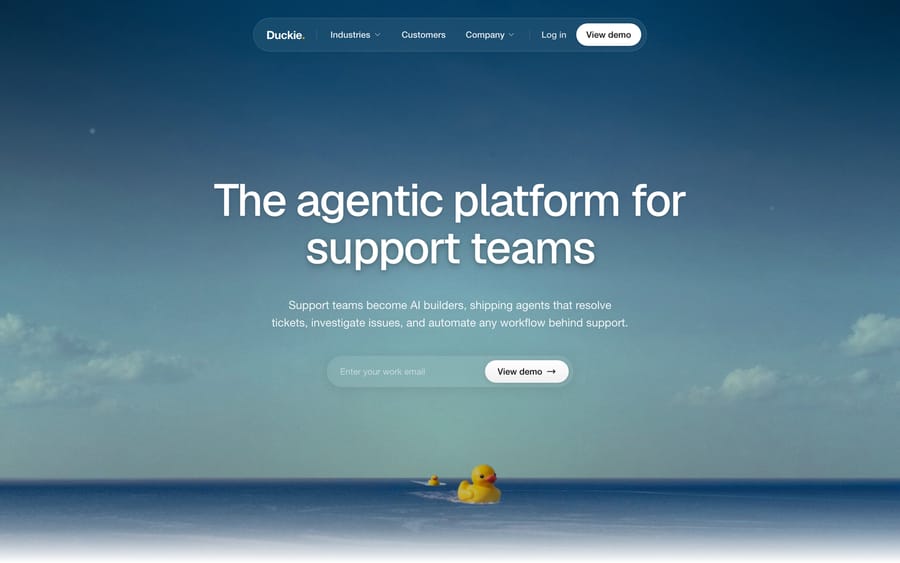
Duckie's homepage: "the agentic platform for support teams."
Duckie was founded in 2023 by Valerie Li and Joel Ritossa, and went through Y Combinator's Winter 2024 batch. Li previously spent three years as a senior engineer at Netflix, where she worked on the project that ended password sharing and added 8 million subscribers, according to her YC company profile; Ritossa was previously an AI software engineer at C3 AI. Duckie has raised $500,000 in seed funding as of April 2024 per third-party trackers, a figure not disclosed directly on Duckie's own site, and runs with a small team.
On its site, Duckie describes itself as a platform for building AI agents that resolve customer issues by connecting to a team's actual engineering knowledge sources: Slack, Jira, and Confluence, beyond just a public help center. That's a specific bet: most support AI vendors are built for FAQ-shaped consumer questions, while Duckie is built for support tickets that require pulling context out of an engineering team's internal tools. Case studies on duckie.ai claim results like a 90% ticket automation rate at Grid, a 95% resolution rate at Vanquish Trader, a 92% ticket deflection rate at Automox, and a 66% support cost reduction at Abbiamo. These are vendor-reported, case-by-case figures instead of an audited average; treat any single number as what one customer achieved, not a guarantee for every deployment.
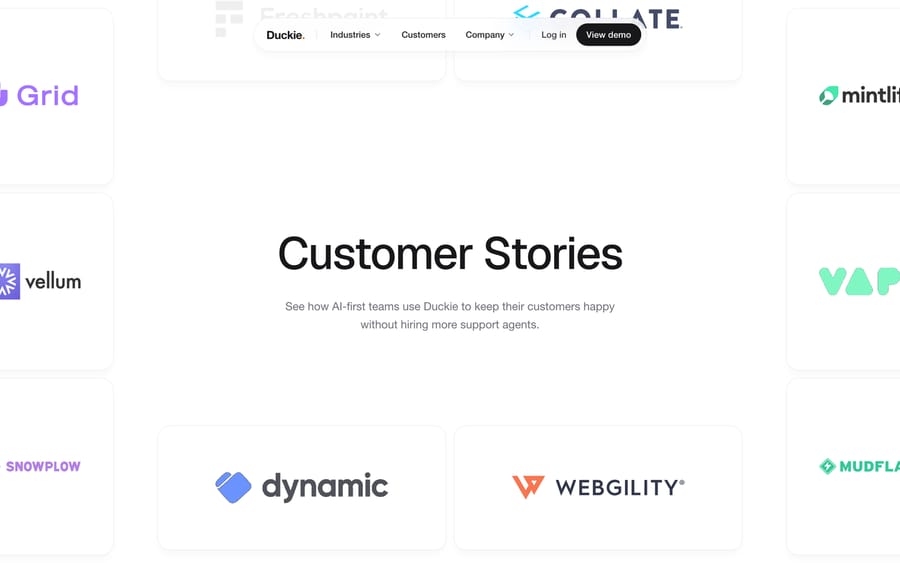
Duckie's customer stories page: real named logos backing the case-study figures.
How Duckie's AI works
Duckie's agents are defined in plain English instead of a flowchart builder, which the company positions as removing the engineering overhead of building an agent from scratch. Underneath that, a few named mechanisms do the actual work:
- Multi-model support, with switchable frontier LLMs instead of a single model locked into the platform.
- Tool connectivity via MCP, APIs, and native connectors, specifically naming Zendesk, Stripe, Slack, and Intercom, so an agent can read and act across the systems a support team already has open.
- Policy enforcement and PII redaction, built in instead of left to the customer to configure from scratch.
- Sandboxed execution with a kill switch, so an agent's actions can be contained and stopped if something goes wrong.
- Test, shadow, and live deployment modes, letting a team watch an agent run against real tickets without it actually responding before promoting it to production.
That staged rollout (test, then shadow, then live) is worth calling out specifically. It's a direct answer to the most common fear about giving an AI agent write access to a support system: that it does something wrong before anyone notices. Shadow mode gives a team a way to see what an agent would have done against live traffic before it's allowed to actually do it.
Key features
- Plain-English agent definition, no separate flowchart or scripting layer required to configure behavior.
- Multi-model, switchable frontier LLMs, with no lock-in to one AI provider.
- Native connectors and MCP/API access to Zendesk, Stripe, Slack, Intercom, and similar tools.
- Policy enforcement and PII redaction built into the platform.
- Sandboxed execution with a kill switch for contained, reversible agent actions.
- Test, shadow, and live modes for staged rollout against real ticket traffic.
Duckie pricing
Duckie does not publish pricing. The pricing URL a visitor would guess for it returns a 404, and every path on duckie.ai leads to booking a demo instead of a self-serve signup or a rate card.
That's consistent with how Duckie sells: a technical, engineering-facing product aimed at teams that need connectors, policy configuration, and a staged rollout, priced through a scoping conversation instead of a plan a team picks off a page. A sales-led motion like this earns the vendor more per account, since it prices to what a scoped deployment is actually worth instead of a flat number every buyer pays alike, at the cost of a buyer being able to compare numbers in five minutes the way Duckie's competitors with published pricing let you. We found no third-party contract-value estimate reliable enough to cite here. Budget for a sales conversation and a proof-of-concept against your own ticket queue before you'll see a number.
Pros and cons
Pros
- Built specifically for technical support, pulling context from Slack, Jira, and Confluence beyond a public help center.
- Staged test/shadow/live rollout is a genuinely useful answer to the "what if it does something wrong" question.
- Multi-model support avoids lock-in to a single AI provider.
- Named connectors to Zendesk, Stripe, Slack, and Intercom cover a real technical support stack, well beyond a chat widget.
Cons
- No published pricing anywhere; every evaluation starts with a sales call.
- Small, early-stage team (four people as of its YC profile), which is worth weighing for a team that wants a vendor with deep bench strength for support and reliability.
- Case-study results are vendor-selected and vendor-reported; there's no independently audited average across all customers.
Who Duckie is best for
Duckie suits teams doing technical or DevOps-adjacent support whose tickets require pulling context out of Slack threads, Jira issues, and internal documentation, beyond answering from a public FAQ. If your support queue looks more like triaging bug reports and infrastructure questions than answering "where is my order," Duckie's specific focus on engineering knowledge sources is the differentiator worth evaluating.
It's a weaker fit if your questions are simple and FAQ-shaped, or if you want to see a price before booking a call. That's a real friction point for a fast evaluation process, and it's worth going in expecting a sales-led cycle instead of a self-serve trial.
Duckie vs alternatives
| Duckie | Decagon | Macha | |
|---|---|---|---|
| Model | AI agents for technical support, built on Slack/Jira/Confluence context | Enterprise AI agent platform for customer support | AI agent layer on top of your existing help desk |
| Best for | Technical/DevOps-adjacent support teams | Large enterprise support operations | Teams on Zendesk, Freshdesk, Gorgias, or Front handling day-to-day tickets |
| Deployment | Test, shadow, and live modes for staged rollout | Sales-led enterprise onboarding | Built, tested and monitored by the Macha team |
| Pricing | Unpublished; sales-led | Unpublished; enterprise sales cycle | From $299/month for 750 tickets (~$0.40/ticket), published |
| Trial | Demo only | None published | $50 free usage |
| Replaces your help desk? | No, connects to it | No | No, deliberately augments it |
Duckie and Decagon both build standalone AI agents that sit apart from a help desk's own ticket queue, though Duckie's specific angle (engineering knowledge sources, staged rollout) targets a narrower, more technical buyer than Decagon's enterprise-wide pitch. Macha is a different shape again: an agent layer that lives inside Zendesk, Freshdesk, Gorgias, or Front, working the tickets already sitting there instead of a separate agent platform layered beside it. If your support queue is genuinely technical and your team wants an engineering-facing tool with real staged rollout controls, Duckie is worth the sales conversation. If the tickets that concern you already sit in a help desk and the question is getting AI to work them well, see Macha's pricing for a published number instead of a demo request.
FAQ
What is Duckie? Duckie is a Y Combinator-backed (W24) startup, founded in 2023 by Valerie Li and Joel Ritossa, that builds AI agents for technical support, connecting to Slack, Jira, and Confluence to resolve issues beyond what a public help center covers.
How much does Duckie cost? Duckie does not publish pricing. Its pricing URL 404s, and every evaluation path leads to booking a demo.
Does Duckie offer a free trial? No published self-serve trial exists. Evaluation runs through a demo and, typically, a proof-of-concept.
What are Duckie's test, shadow, and live modes? They're staged deployment options: test an agent privately, run it in shadow mode against real tickets to see what it would have done without actually responding, then promote it to live once it's trustworthy.
Which companies use Duckie? Case studies on duckie.ai name Grid, Vanquish Trader, Automox, and Abbiamo, along with logos including Snowplow, Mintlify, Vapi, Mudflap, Collate, and Dynamic.
What results does Duckie report? Vendor-reported, customer-specific figures include a 90% ticket automation rate at Grid, a 95% resolution rate at Vanquish Trader, a 92% deflection rate at Automox, and a 66% support cost reduction at Abbiamo. Treat these as individual case studies, not an audited average.
What tools does Duckie connect to? Named connectors and MCP/API access cover Zendesk, Stripe, Slack, and Intercom, alongside Duckie's core Slack/Jira/Confluence knowledge sources.
What are good alternatives to Duckie? Decagon is a common enterprise-scale comparison for standalone AI support agents. For a team that wants an AI agent working inside a help desk it already runs instead of a separate agent platform, Macha is a different shape of tool worth comparing.
Sources: Duckie homepage, Duckie customers, Duckie on Y Combinator.
Resolve tickets automatically with AI agents
Macha's AI agents work on top of the help desk you already use — no code.