Intercom
 Shopify
 Stripe
 Slack
Slack Notion
 Google Workspace
 Confluence

Parahelp: The Complete Guide (2026)


Parahelp is a YC-backed AI support platform built around a two-agent system: one agent resolves customer tickets end-to-end, and a second agent, configured entirely in natural language, builds and tunes the first one. This guide covers what Parahelp actually does, how the two-agent setup works, its real published credit pricing, and how it compares to alternatives built for teams already running a help desk.

We build AI agents for customer service ourselves, so we read Parahelp's claims the way a buyer evaluating both products would: what's a real mechanism, what's a case-study number, and what's marketing.
What is Parahelp?
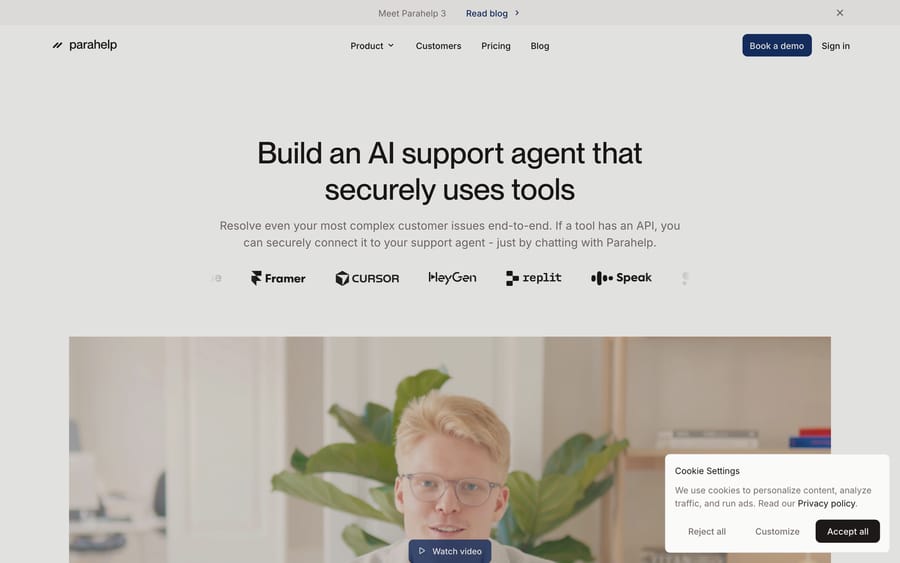
Parahelp was founded in 2024 by CEO Anker Ryhl and Mads Liechti, and went through Y Combinator's Summer 2024 batch. The company is based in San Francisco with a small team (around 11 people as of this writing) and pitches itself specifically at software companies that want an AI agent handling complex tickets end-to-end, not just answering FAQs. The company hasn't disclosed total funding raised.
Named customers include Kit, Bolt, and Fyxer, and Parahelp's own case study with the video-editing company Captions reports 46% of support tickets resolved within a week of implementation. That figure is a vendor-published, single-customer result rather than an average across Parahelp's book, and a week-one number tends to reflect the easiest tickets first. AI note-taking company Perplexity is also mentioned as a customer.
How Parahelp's AI works
Parahelp's structure is built around two named, separate agents:
Customer Agent is the one your customers actually talk to. It resolves tickets across email, live chat, and Slack, and it can take real actions through any tool with an API: process a refund through Stripe, look up an account, pull an order status. Parahelp says it does not train its models on customer data, which is one of the security claims enterprise buyers usually ask about first.
Internal Agent is the more distinctive piece: instead of an engineer writing prompts and wiring up integrations by hand, a support or ops person describes what they want in plain language, and the Internal Agent configures the Customer Agent's tools and context sources accordingly. You refine the setup through conversation, the same way you'd brief a new hire, rather than editing a config file. This is the mechanism behind Parahelp's speed claim: the company says a new deployment can resolve its first tickets within hours, because building the agent doesn't require a separate engineering sprint.
On the compliance side, Parahelp is SOC 2 Type II certified and GDPR compliant, and it offers role-based access with Admin and Operator roles, which is the baseline checklist a security review usually asks for before an AI agent gets write access to a support tool.
Key features
- Customer Agent: resolves tickets end-to-end across email, live chat, and Slack.
- Internal Agent: builds, tests, and refines the Customer Agent through natural-language instructions instead of manual configuration.
- Tool connections: any API-accessible tool, with Stripe, Intercom, and Zendesk named as examples.
- Security: SOC 2 Type II certified, GDPR compliant, no model training on customer data.
- Access control: Admin and Operator roles.
- Fast setup: vendor-stated first resolutions within hours of deployment.
Parahelp pricing (published)
Parahelp is one of the more transparent vendors in this category: it publishes real, structured pricing rather than requiring a sales call for a starting number. We checked parahelp.com/pricing directly. The plans:
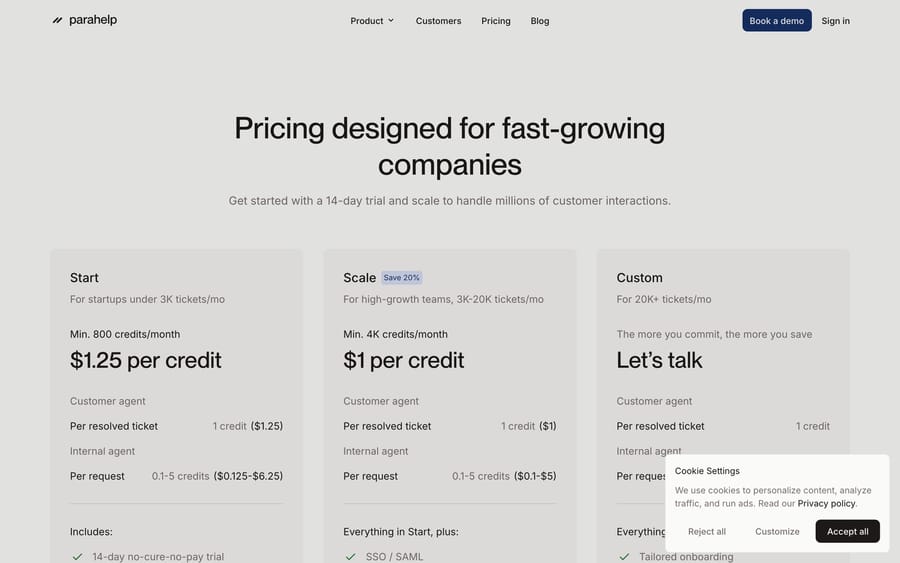
- Start: $1.25 per credit, with an 800-credit monthly minimum (about $1,000/month), aimed at startups under 3,000 tickets a month. Includes a 14-day no-cure-no-pay trial.
- Scale: $1 per credit, with a 4,000-credit monthly minimum (about $4,000/month), aimed at teams handling 3,000 to 20,000 tickets a month. Parahelp markets this as a 20% discount over the Start rate. Adds SSO/SAML, role-based access controls, and priority support.
- Custom: for operations above 20,000 tickets a month, quoted directly with tailored onboarding and SLAs.
Credit consumption is metered separately by agent: the Customer Agent spends 1 credit per resolved ticket, while the Internal Agent spends 0.1 to 5 credits per request, depending on how much configuration work that request involves. That means your actual monthly ticket capacity on the Start plan is somewhat below 800, since building and refining the agent also draws down the same credit pool.
The per-credit discount at higher volume is a fairly standard incentive: Parahelp earns a lower margin per resolved ticket from a bigger customer, in exchange for locking in a much larger monthly minimum. If you're near the 3,000-ticket boundary between Start and Scale, it's worth modeling both minimums against your real volume before committing to either.
Pros and cons
Pros
- Publishes real, structured pricing instead of gating every number behind a sales call.
- The Internal Agent's natural-language configuration is a genuinely different build experience from writing prompts or config files by hand.
- SOC 2 Type II and GDPR compliance, plus a no-training policy, cover the standard enterprise security checklist.
- A 14-day no-cure-no-pay trial on the Start plan gives you a real off-ramp if it doesn't work out.
- Vendor-stated fast time-to-first-resolution, on the order of hours.
Cons
- Credit minimums mean you pay for capacity you might not use in a slow month; there's no pure pay-as-you-go tier below Start.
- Internal Agent credit consumption for configuration work eats into the same pool as ticket resolution, so effective ticket capacity is a bit lower than the headline credit count suggests.
- Small team and company (founded 2024) compared to more established enterprise CX platforms; less of a public track record to evaluate.
- The 46% resolution figure is a single customer's week-one result, not a benchmark to plan around.
Who Parahelp is best for
Parahelp fits teams at a software company, roughly startup to mid-market in size, that want an AI agent taking real actions across its existing tools (Stripe, Zendesk, Intercom) without hiring an engineer to build and maintain it. The Internal Agent's plain-language configuration is the standout feature for a support lead who wants to iterate on the agent's behavior directly, rather than filing a ticket with an engineering team every time something needs to change.
It's a weaker fit for a large enterprise that needs a long compliance and procurement process with a vendor that has a longer track record, or for a team with very low or highly seasonal ticket volume that would rather not commit to a monthly credit minimum.
Parahelp vs alternatives
| Parahelp | Decagon | Macha | |
|---|---|---|---|
| Model | Two-agent system: Customer Agent resolves, Internal Agent builds it | Enterprise conversational AI agent platform | AI agent layer on your existing help desk |
| Best for | Startups to mid-market software companies | Enterprise support, high-volume chat | Teams on Zendesk, Freshdesk, Gorgias, or Front |
| Configuration | Natural-language, via the Internal Agent | Enterprise onboarding, services-involved | Plain-English agent building, setup and monitoring by the Macha team, included on every plan |
| Pricing | $1.25/credit (Start) to $1/credit (Scale), published, monthly minimums | Unpublished; sales-quoted only | From $299/month for 750 tickets (about $0.40 per ticket), published |
| Self-serve trial | Yes, 14-day no-cure-no-pay on Start | No | Yes, $50 of free usage (about 125 tickets), no credit card, no time limit |
| Replaces your help desk? | No, connects to Zendesk/Intercom via API | No, but is a broad standalone platform | No, built to run on top of it |
Parahelp and Macha are structurally the closest comparison in this guide: both publish real pricing, both let a non-engineer configure the agent in plain language, and neither pretends to replace the help desk itself. The difference is scope and channel model. Parahelp's Customer Agent runs its own inbox-style resolution across email, chat, and Slack; Macha runs as an agent layer directly inside the help desk your support team already lives in day to day, which matters if your team's workflow, macros, and reporting are already built around Zendesk or Front. Compare the credit minimums against Macha's ticket-based tiers at your real monthly volume before deciding.
FAQ
What is Parahelp? Parahelp is a YC-backed (Summer 2024) AI support platform with a two-agent system: a Customer Agent that resolves tickets across email, chat, and Slack, and an Internal Agent that builds and tunes the Customer Agent from natural-language instructions.
How much does Parahelp cost? Parahelp publishes credit-based pricing: Start is $1.25/credit with an 800-credit monthly minimum (about $1,000/month), Scale is $1/credit with a 4,000-credit minimum (about $4,000/month), and Custom pricing applies above 20,000 tickets a month.
Does Parahelp have a free trial? There's no traditional free tier, but the Start plan includes a 14-day no-cure-no-pay trial.
What is Parahelp's Internal Agent? It's the agent that builds and configures your customer-facing Customer Agent. You describe what you want in natural language, and it sets up the relevant tools and context sources, using 0.1 to 5 credits per request depending on complexity.
How many credits does a resolved ticket cost? The Customer Agent uses 1 credit per resolved ticket. Internal Agent configuration work draws from the same credit pool separately.
Is Parahelp secure enough for enterprise use? It's SOC 2 Type II certified and GDPR compliant, offers role-based access control (Admin and Operator roles), and states it does not train models on customer data.
Who uses Parahelp? Publicly named customers include Kit, Bolt, Fyxer, Captions, and Perplexity. Parahelp's case study with Captions reports 46% of tickets resolved within the first week.
What are good alternatives to Parahelp? For an established enterprise conversational AI platform, Decagon is a common comparison. For a team that wants agents working inside the help desk it already runs, with published per-ticket pricing, Macha is a comparable alternative.
Does Parahelp integrate with Zendesk and Intercom? Yes. Parahelp connects to any tool with an API, and names Stripe, Intercom, and Zendesk specifically as examples of tools its Customer Agent can act on.
Sources: Parahelp homepage, Parahelp pricing, Parahelp on Y Combinator.
Resolve tickets automatically with AI agents
Macha's AI agents work on top of the help desk you already use — no code.