Intercom
 Shopify
 Stripe
 Slack
Slack Notion
 Google Workspace
 Confluence

Plain: The Complete Guide (2026)


Plain is a support platform built specifically for B2B software companies, by two people who scaled Deliveroo's own support operation from a handful of employees to thousands, and it shows: the product reads like it was built for engineers who hate ticket queues instead of a call-center supervisor. This guide covers what Plain actually is, how its AI agent works, what it costs in full published detail, where it's strong, where it's thin, and how it compares to the alternatives worth putting next to it.

We build AI agents for customer service ourselves, on top of the help desk a team already runs. We checked plain.com and its pricing page directly before writing this, since a company with the generic name "Plain" is genuinely easy to research wrong.
What is Plain?
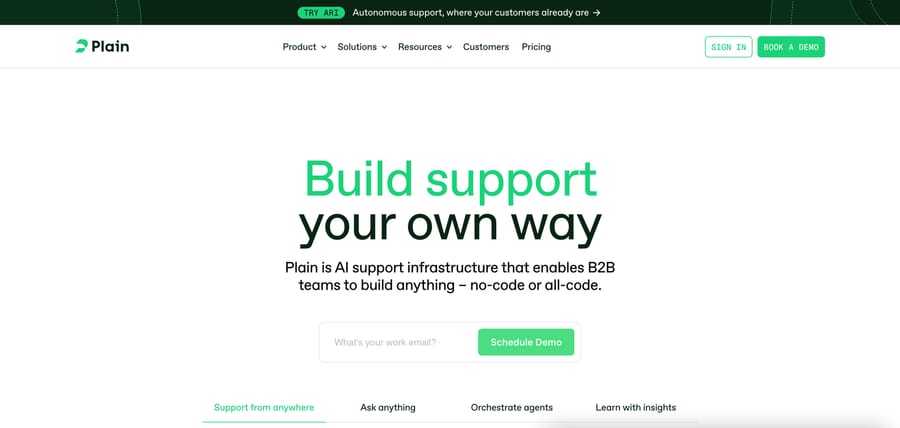
Plain's homepage: "the AI support stack built for B2B teams."
Plain was founded in 2020 by Simon Rohrbach and Matt Vagni, who previously helped scale Deliveroo's operations from around 10 employees to 2,000. On its site, Plain describes itself as "the AI support stack built for B2B teams," consolidating Slack, Microsoft Teams, Discord, email, chat, and a customer portal into one place, with AI woven through the workflow instead of bolted on as a separate chatbot.
The company raised a $15 million Series A led by Battery Ventures, with continued participation from Index Ventures and Connect Ventures, according to Plain's own announcement. Third-party trackers report total funding around $21.3 million across three rounds; treat that total as an aggregate estimate instead of a number Plain has stated directly. Customers referenced on plain.com include Granola, and Plain draws an explicit comparison to how a company like Raycast runs support, which tells you the target customer: a product-led software company whose support load comes from technical users, not a call center fielding phone volume.
That B2B-specific focus is the whole pitch. Plain isn't trying to be a general-purpose help desk for every industry. It's built around the shape of support at a software company: threaded Slack-style conversations, engineers pulled in when a bug report needs one, and a knowledge base that looks like documentation instead of a canned-response library.
How Plain's AI works
Plain's AI layer centers on two named components:
- Ari, Plain's own AI agent, handles conversations directly: answering from a knowledge base, following configured workflows, and escalating to a human when it's out of scope.
- Sidekick, an AI assistant for the human side of the team, surfaces customer context and drafts responses for a support engineer to review and send, rather than sending on its own.
Underneath both, Plain's Workflows feature automates routing, triage, and integration with external systems, and Insights applies AI to detect trends across conversations automatically rather than requiring someone to build a report by hand. The platform is API-first by design, which matters for the buyer Plain is chasing: an engineering-led team that wants to script or extend its support tooling instead of clicking through a settings UI for every customization.
Key features
- Multi-channel consolidation: Slack, Microsoft Teams, Discord, email, chat, and a customer portal in one place.
- Ari, an AI agent that answers from a knowledge base and follows configured workflows.
- Sidekick, an AI assistant that drafts responses and surfaces context for human agents.
- Workflows for automated routing, triage, and external system integration.
- Insights for automated trend detection across support conversations.
- API-first architecture, built for teams that want to extend or script their support stack.
Plain pricing
Plain publishes its full pricing, and it's worth reading closely because the model mixes a seat price with a credit allowance.
| Plan | Price | Seats | Credits/mo |
|---|---|---|---|
| Foundation | $35/month | 1 (+$35/additional seat) | 2,000 |
| Horizon | $299/month | 3 (+$99/additional seat), up to 10 | 15,000 |
| Frontier | Custom | Custom | Custom |
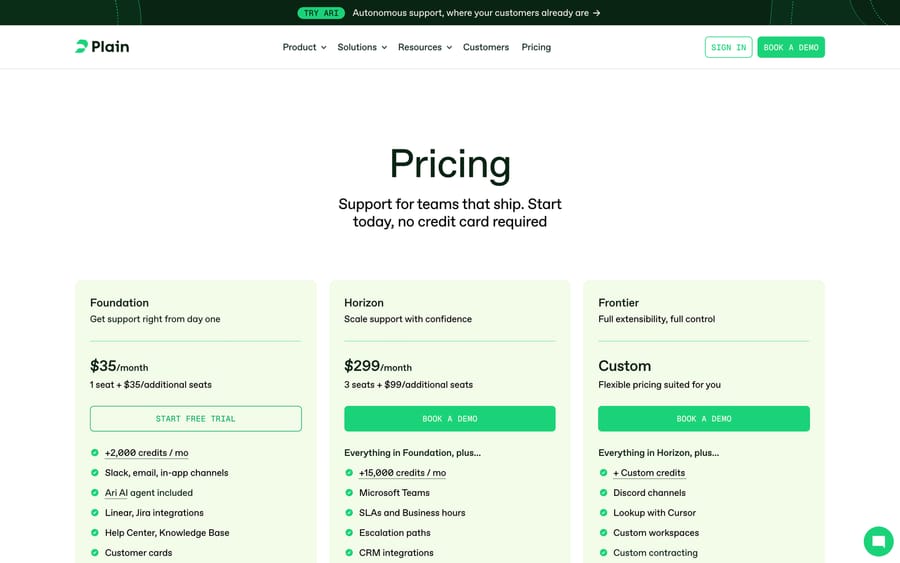
Plain's pricing page: a real published table, not a "contact us" wall.
Foundation includes Slack, email, and in-app channels, Ari, one knowledge base, one Ask AI instance, and Linear/Jira integrations. Horizon adds Microsoft Teams, SLAs and business hours, escalation paths, CRM connections, and unlimited knowledge bases. Frontier adds Discord, custom workspaces, SSO/SCIM, and a dedicated CSM with white-glove onboarding. A 7-day free trial is available with no credit card required, and Plain offers a startup discount of 50% off eligible plans.
The credit allowance is the number worth watching. Foundation's 2,000 credits a month cover a limited amount of AI-driven work before a team needs to either upgrade or buy more, and Plain doesn't publish an overage rate on the pricing page itself. Selling a seat price plus a metered credit pool gives Plain a built-in upsell as usage grows, the same lever most AI vendors pull, so a team running near that ceiling should get a direct answer on what happens next before committing.
Pros and cons
Pros
- Genuinely built for B2B software support, not a generic help desk with an AI feature added on.
- Full published pricing with a self-serve trial, no sales call required to see a number.
- API-first design suits an engineering-led team that wants to extend its support stack.
- Sidekick's draft-and-review model is a sane default for a team not ready to let AI reply unsupervised.
Cons
- The credit-based AI allowance is easy to outgrow at Foundation, and the overage cost isn't published.
- Discord support and SSO/SCIM sit behind Frontier's custom pricing, which pushes any team needing them into a sales conversation anyway.
- Built specifically for B2B software companies; a retail or consumer support team is a poor match for the whole product philosophy.
Who Plain is best for
Plain suits a B2B software company whose support tickets mostly come from technical customers already living in Slack or a similar tool, and whose engineering team wants to be pulled into support directly instead of working around a separate ticketing system. If your reference point for good support is how Raycast or a similar product-led company runs it, Plain built the product with you in mind.
It's a weaker fit if your support volume is phone- or retail-heavy, or if you need Discord support or enterprise security features without jumping straight to custom Frontier pricing. That's a narrower question of which tier actually covers your requirements, worth checking before you commit to Foundation or Horizon.
Plain vs alternatives
| Plain | Pylon | Macha | |
|---|---|---|---|
| Model | B2B support platform with Ari (AI agent) and Sidekick (AI assist) | B2B support platform for Slack-based customer channels | AI agent layer on top of your existing help desk |
| Best for | Product-led software companies with technical customers | B2B teams running support through shared Slack channels | Teams on Zendesk, Freshdesk, Gorgias, or Front handling day-to-day ticket volume |
| Pricing | Published: $35-$299/mo by tier plus credits, Frontier custom | Published tiers, seat-based | From $299/month for 750 tickets (~$0.40/ticket), published |
| Setup | Self-serve, 7-day trial | Self-serve | Built, tested and monitored by the Macha team |
| Replaces your help desk? | Yes, it's a full support platform | Yes, it's a full support platform | No, deliberately augments your existing help desk |
Plain and Pylon are direct competitors: both are B2B-focused support platforms built around how software companies actually talk to customers, and see our Zendesk vs Pylon comparison for more on that shape of tool. Macha is a different kind of decision. It doesn't ask a team to move off Zendesk, Freshdesk, Gorgias, or Front; it adds an agent layer inside whichever one you already run. If you're choosing your support platform from scratch, Plain is a serious, well-built option for a B2B software company. If you already have a help desk and the actual problem is getting AI to work its tickets well, Macha's pricing is the more direct comparison.
FAQ
What is Plain? Plain is a B2B support platform, founded in 2020, that consolidates Slack, Microsoft Teams, Discord, email, chat, and a customer portal into one tool, with an AI agent (Ari) and AI assistant (Sidekick) built into the workflow.
How much does Plain cost? Foundation is $35/month for one seat with 2,000 AI credits, Horizon is $299/month for three seats with 15,000 credits, and Frontier is custom. A 7-day free trial is available with no credit card.
Who founded Plain, and when? Plain was founded in 2020 by Simon Rohrbach and Matt Vagni, who previously scaled Deliveroo's operations. It raised a $15 million Series A led by Battery Ventures.
What is Ari? Ari is Plain's AI agent. It answers customer questions from a knowledge base and follows configured workflows, escalating to a human when a question is out of scope.
What is Sidekick? Sidekick is Plain's AI assistant for human agents. It surfaces customer context and drafts responses for a person to review, rather than replying on its own.
Is Plain only for software companies? Plain is built specifically around B2B software support: technical customers, engineering escalations, and Slack-based conversation patterns. It's a weaker fit outside that shape of business.
Which companies use Plain? Granola is referenced as a customer on plain.com, and Plain draws an explicit comparison to how a company like Raycast runs its support operation.
What are good alternatives to Plain? Pylon is the closest direct comparison: another B2B support platform built around Slack-based customer conversations. For a team that wants an AI agent layered onto a help desk it's already running instead of replacing it, Macha is a different shape of tool worth comparing.
Sources: Plain homepage, Plain pricing, Plain: We've raised a $15m Series A.
Resolve tickets automatically with AI agents
Macha's AI agents work on top of the help desk you already use — no code.