Intercom
 Shopify
 Stripe
 Slack
Slack Notion
 Google Workspace
 Confluence

Pylon AI: The Complete Guide (2026)


Pylon is a support platform built specifically for B2B and SaaS companies, where AI agents investigate and route tickets before a human ever opens them, and every conversation carries the account context (CRM data, product usage, logs) that a B2B support rep actually needs. This guide covers what Pylon does, how its agentic layer works, researched pricing, and how it compares to alternatives for teams supporting other businesses rather than consumers.

We build AI agents for customer service ourselves, so we read Pylon's claims the way a buyer evaluating both products would: what's a real mechanism, what's a case-study number, and what's marketing.
What is Pylon?
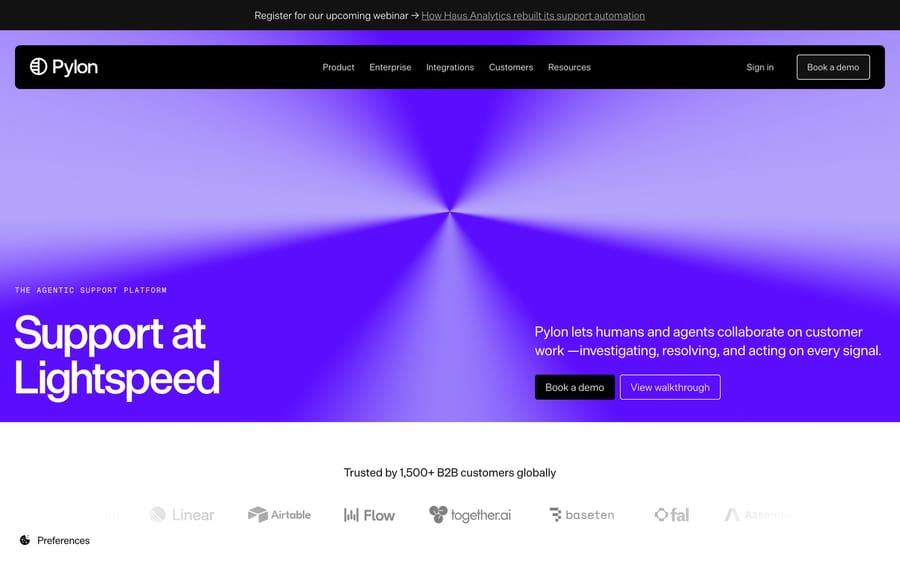
Pylon's homepage, positioned as "the agentic support platform," citing 1,500+ B2B customers globally.
Pylon was founded in 2022 by Marty Kausas (CEO), Advith Chelikani, and Robert Eng, and went through Y Combinator's Winter 2023 batch. The company has raised $51 million total, including a $31 million Series B in August 2025 led by a16z and Bain Capital Ventures, with General Catalyst and Y Combinator also participating.
Pylon's positioning is deliberately narrow: it builds for B2B and SaaS companies, the kind that support other businesses through shared Slack channels and Microsoft Teams as much as email and chat. Its own homepage cites 1,500+ B2B companies using the platform, and named customers include Cognition AI, Retool, Hightouch, and Deel. That's a different customer profile than the ecommerce or consumer-facing vendors elsewhere in this category, and it shows up directly in the product's feature set.
How Pylon's AI works
Pylon organizes its AI around several named, purpose-specific agents:
- Assist Agent acts as a personal AI operator for an individual support rep, handling repetitive parts of their workflow.
- Background Agent runs specialized, automated tasks without a rep initiating them directly.
- Slack Agent operates inside Slack, where a lot of B2B support already happens for teams running shared channels with customers.
- Support Agent handles multi-channel resolution across email, chat, and the other surfaces Pylon supports.
- Skills are reusable instruction sets an agent can apply across conversations, similar in spirit to a saved macro, except the AI executes it on its own.
The mechanism that differentiates Pylon from a general-purpose support AI is Account Intelligence: it aggregates signals from conversations, CRM records, product usage data, logs, and even code, and ties all of it to the account. In a B2B context, a support rep often needs to know that this specific account is a top-20 customer three weeks from renewal with an open Jira bug before responding; the ticket text alone won't tell them that. Pylon's stated goal is to "investigate every issue before your team opens it," meaning the AI does the fact-finding across those systems automatically, and a rep opens a ticket that already has the relevant context attached.
Where it connects
Pylon supports Slack, Microsoft Teams, email, chat, SMS, WhatsApp, phone, Telegram, and Discord as customer channels, which is unusually broad for a platform this size. On the integration side, it connects to CRMs (Salesforce, HubSpot), knowledge bases (Notion, Confluence), issue trackers (Linear, Jira), data warehouses (Snowflake, BigQuery), analytics tools (PostHog, Mixpanel), and LLM providers directly (Claude, ChatGPT). The Linear and Jira integrations in particular are a tell for who Pylon is built for: a B2B support team that routes bugs to engineering constantly needs that connection in a way a DTC ecommerce brand rarely does.
Key features
- Multiple purpose-built agents: Assist, Background, Slack, and Support agents, plus reusable Skills.
- Account Intelligence: unifies CRM, product usage, logs, and code context around the whole account.
- Broad channel support: Slack, Microsoft Teams, email, chat, SMS, WhatsApp, phone, Telegram, and Discord.
- Deep B2B tool integrations: Salesforce, HubSpot, Linear, Jira, Snowflake, BigQuery, PostHog, Mixpanel.
- Account as a first-class object: routing and SLAs can attach to the account tier automatically, a structural choice most consumer-support tools don't make.
Pylon pricing (researched)
We checked usepylon.com/pricing directly and it didn't render visible numbers, which suggests either a JavaScript-heavy page our tooling couldn't parse or a shift toward a sales-gated quote.
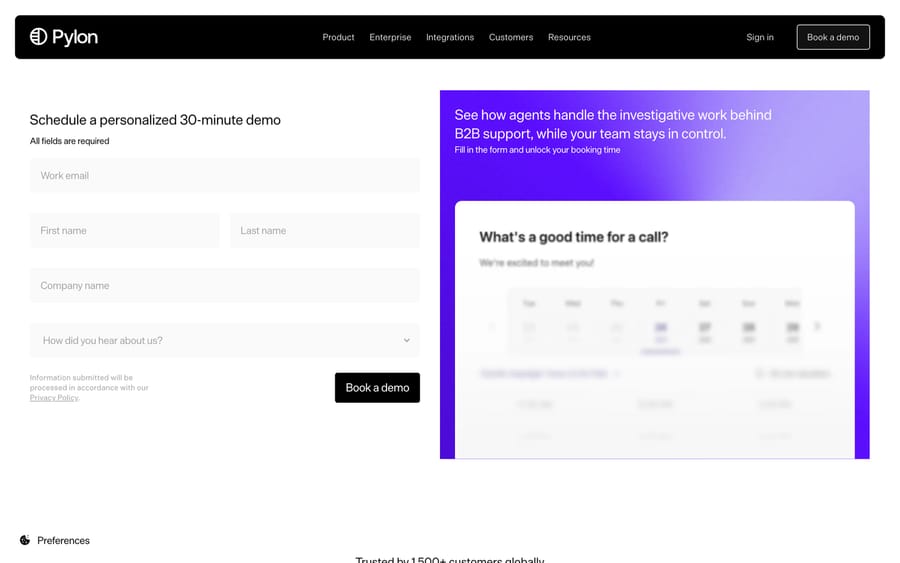
The URL usepylon.com/pricing currently renders a demo-booking form, not a price list. What we found instead, cross-checked against Macha's own earlier Pylon research: a third-party review (saleshive.com) reports a three-tier, per-seat structure.
- Starter: about $59/seat/month billed annually (around $70/month billed monthly), minimum 3 seats. Covers the core support inbox, email and chat widget channels, ticket forms, and a knowledge base.
- Professional: about $89/seat/month annually (around $118/month monthly), minimum 3 seats. Adds the Slack connector, broadcasts, CRM integrations, and API access.
- Enterprise: about $139/seat/month annually, minimum 7 seats. Adds Microsoft Teams, a customer portal, and custom reporting.
A 14-day free trial is reported, with no permanent free plan. AI capability itself is metered separately from the seat price, with add-ons cited in Macha's earlier research at roughly $50/seat for AI Assistants and from $100/month for AI Agents, though we could not re-verify those specific add-on figures live and treat them as dated. Charging for seats and AI usage separately gives Pylon a built-in upsell path on the same account: more seats, more AI-handled volume, or both, and it's worth knowing that before a sales conversation nudges you toward turning AI on for every seat instead of only the ones that need it. Since none of this comes from Pylon's own current pricing page directly, treat the seat prices as a well-sourced third-party estimate, and confirm the current number with Pylon before budgeting.
Pros and cons
Pros
- Purpose-built for B2B support: account-level context, Slack-native workflows, and Linear/Jira integration match how B2B teams actually work.
- Account Intelligence pulls CRM, product, and code context into the conversation automatically, cutting the manual lookup a rep would otherwise do.
- Genuinely broad channel coverage, including SMS, WhatsApp, and Discord alongside the usual email and chat.
- Backed by well-known investors (a16z, Bain Capital Ventures) at a meaningful funding stage for a 2022-founded company.
Cons
- Seat-based pricing with AI capability metered as a separate add-on makes the real monthly cost harder to estimate upfront than a single all-in number.
- Minimum seat counts (3 for Starter/Professional, 7 for Enterprise) rule out very small teams.
- Current pricing page did not show numbers directly to us, so anyone evaluating Pylon today should confirm the current figures rather than relying on third-party reports.
- Purpose-built for B2B; a consumer or ecommerce support team gets less value from account-tier routing and Linear integration.
Who Pylon is best for
Pylon fits teams supporting other businesses, especially SaaS companies whose customers already live in shared Slack channels and whose support reps need CRM, product usage, and engineering-ticket context to answer a question well. If your support org already argues with engineering over which bugs came from which account, Account Intelligence and the Linear/Jira integration solve a real, specific problem.
It's a weaker fit for consumer or ecommerce support, where account-tier routing and Slack-channel support add little, and where a per-seat-plus-AI-add-on pricing model is harder to budget than the ticket-based pricing common among consumer-focused tools.
Pylon vs alternatives
| Pylon | Intercom | Macha | |
|---|---|---|---|
| Model | Agentic B2B support platform | General-purpose support + AI platform | AI agent layer on your existing help desk |
| Best for | B2B/SaaS teams supporting via Slack, Teams, and email | B2C and B2B support broadly | Teams on Zendesk, Freshdesk, Gorgias, or Front |
| Account context | Account Intelligence: CRM, product usage, logs, code, tied to the account | Standard CRM-style contact and company records | Standard controls, scoped per agent |
| Pricing | Per-seat tiers ($59-$139/seat/mo, researched) plus separate AI add-ons | Per-seat plus AI add-on pricing | From $299/month for 750 tickets (about $0.40 per ticket), published |
| Self-serve trial | 14-day free trial (reported) | Yes | Yes, $50 of free usage (about 125 tickets), no credit card, no time limit |
| Replaces your help desk? | Yes, it is the help desk | Yes, it is the help desk | No, built to run on top of it |
Pylon and Intercom are both full help desks Pylon competes to replace; Macha isn't in that race. Macha runs as an AI agent layer on top of the help desk your team already uses, Zendesk and Front included, rather than asking you to migrate your support inbox to a new platform. If your team is happy with its current help desk and mainly wants AI handling more of the ticket volume inside it, that's a smaller, cheaper decision than switching platforms. If you're already evaluating a help-desk migration and B2B account context is the deciding factor, Pylon is a legitimate, purpose-built option. We have a full breakdown in our Zendesk vs Pylon comparison.
FAQ
What is Pylon? Pylon is a support platform built for B2B and SaaS companies, founded in 2022, that combines AI agents with account-level context (CRM, product usage, logs, code) to investigate and route tickets before a human opens them.
How much does Pylon cost? Pylon's own pricing page didn't show numbers directly to us. Third-party review sources report per-seat tiers of roughly $59 to $139/seat/month billed annually, with AI capability metered as a separate add-on.
Does Pylon have a free trial? A 14-day free trial is reported by third-party sources; there's no permanent free plan.
What is Pylon's Account Intelligence? It's Pylon's system for aggregating CRM records, product usage data, logs, and code context around a customer account, so a support rep sees relevant account context automatically instead of looking it up manually.
What channels does Pylon support? Slack, Microsoft Teams, email, chat, SMS, WhatsApp, phone, Telegram, and Discord.
Who uses Pylon? Pylon's homepage cites 1,500+ B2B companies, with named customers including Cognition AI, Retool, Hightouch, and Deel.
How much funding has Pylon raised? $51 million total, including a $31 million Series B in August 2025 led by a16z and Bain Capital Ventures, with General Catalyst and Y Combinator also participating.
What are good alternatives to Pylon? For a broader B2C-and-B2B help desk with its own AI layer, Intercom is a common comparison. For a team that wants to keep its current help desk and add AI agents on top rather than migrate, Macha is the lighter-weight alternative. See our Zendesk vs Pylon comparison for a deeper look at migrating away from Zendesk specifically.
Does Pylon replace my existing help desk? Yes. Pylon is a full support platform, not an add-on, so adopting it means migrating your support workflows to it rather than layering AI onto your current tool.
Sources: Pylon homepage, Pylon on Y Combinator, Pulse2: Pylon $31M Series B, Pylon pricing review, SalesHive, Macha: Zendesk vs Pylon.
Resolve tickets automatically with AI agents
Macha's AI agents work on top of the help desk you already use — no code.