Intercom
 Shopify
 Stripe
 Slack
Slack Notion
 Google Workspace
 Confluence

Thena AI: The Complete Guide (2026)


Thena AI is a B2B support platform that turns Slack, Microsoft Teams, email, and web chat into a single ticket queue, with AI agents handling triage, tagging, drafting, and some resolutions directly inside those channels. This guide covers what Thena actually does, its real published pricing, where it holds up and where it doesn't, and how it compares to the alternatives worth putting next to it.

We build AI agents for customer service ourselves, so this is written by people who have to evaluate platforms like Thena in practice. We checked Thena's own site directly for every claim below instead of working from a review aggregator.
What is Thena AI?
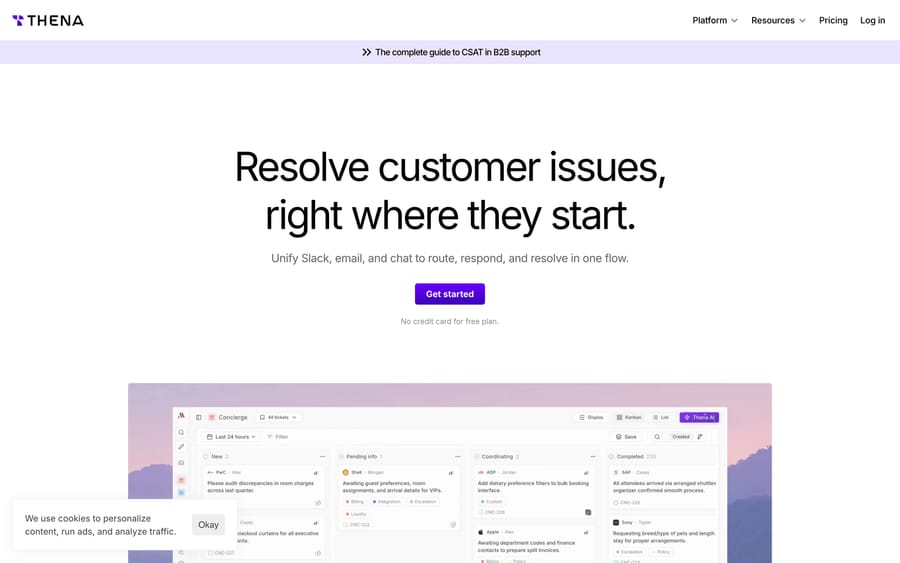
Thena's homepage: a Kanban-style support queue pulling in tickets from named accounts like PwC, Shell, ADP, and Sony.
Thena is a support platform built specifically for B2B teams, most often SaaS companies whose customers already live in shared Slack channels rather than emailing a support address. Founded in April 2022 by Ankit Saxena, Govind Kavaturi, Mike Molinet, and Unmukt Raizada, the company raised a $2.2 million pre-seed round from Pear VC and Tenacity Venture Capital, followed by a $5 million seed round from Lightspeed and First Round Capital, per its own press release, bringing disclosed funding to roughly $7.2 million. One third-party tracker lists a slightly higher total; we're using the figure the press release itself supports.
Thena's pricing page names Braze, Embrace, Tropic, Amplitude, Redpanda, and Oligo under a "Trusted by the best of B2B companies" banner, though it doesn't attach a case study or usage figure to any of them.
How Thena's AI works
The core mechanic is converting a Slack or Teams message into a trackable ticket without forcing the customer to leave the channel they're already in. A message in a shared Slack Connect channel, a Teams thread, an email, or a web chat form all land in the same underlying queue, tagged, routed, and (per Thena's own framing) handled by "purpose-built AI agents" that can "respond to customers, apply fields, create tickets, and escalate issues instantly."
That's the mechanism worth understanding: Thena isn't asking a B2B customer to adopt a new support portal. It's asking the vendor's support team to manage Slack-based conversations with the same triage, routing, and reporting discipline as a traditional help desk, using AI to close the gap between "a customer pinged us in Slack" and "someone tracked, tagged, and resolved that."
Agent Studio and MCP
On the Standard plan and above, Thena includes an Agent Studio for building and customizing AI agents, plus MCP (Model Context Protocol) support for connecting Thena's support data to external AI tools, including Claude, Cursor, Windsurf, and Raycast, per its own site. That MCP integration is a genuinely current mechanism: instead of only running Thena's own agents, a team can expose its support data to whatever AI tooling its engineers already use for other work.
Smart routing and account context
Thena centralizes account data across every channel a customer uses, so a Slack message and a follow-up email from the same company land against one account record rather than two disconnected threads. Auto-triage and role-based assignment route incoming messages to the right person or team, with customizable boards for tracking status. For a B2B support team managing dozens of Slack Connect channels simultaneously, that consolidation is the actual product, more than any single AI feature layered on top.
Key features
- Omnichannel ticketing across Slack, Microsoft Teams, email, and web chat, unified into one queue.
- AI ticket detection, summaries, and tagging, included on every plan including Starter.
- AI assistant and AI co-pilot for drafting responses (co-pilot ships from the Standard plan up).
- Agent Studio, for building custom AI agents (Standard plan and above).
- MCP support, connecting Thena's support data to external AI tools like Claude and Cursor.
- Account-level context, unifying a customer's messages across channels into one record.
- Knowledge management, private or public branded help centers.
- Broadcasting, multi-channel announcements with account-level targeting.
Thena AI pricing
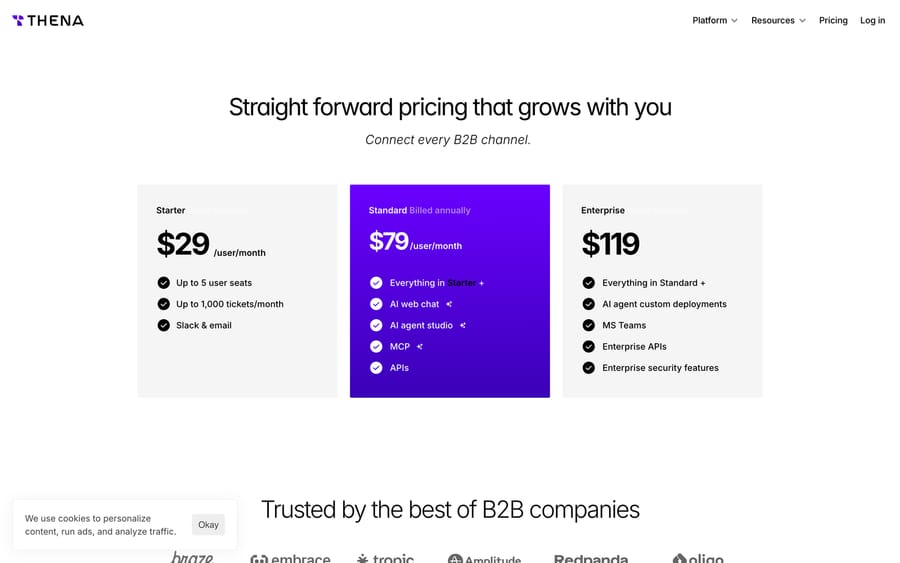
Thena's pricing page: Starter, Standard, and Enterprise, all billed annually per user.
Thena publishes real, checkable pricing on its own site, billed annually:
| Plan | Price | Seats / tickets | Channels | Notable AI features |
|---|---|---|---|---|
| Starter | $29/user/month | Up to 5 seats, 1,000 tickets/mo | Slack, email | AI ticket detection, summaries, tagging, AI assistant |
| Standard | $79/user/month | Same limits as Starter | Adds AI web chat | Adds AI auto-responses, AI co-pilot, AI-powered workflows, MCP |
| Enterprise | $119/user/month | Not specified | Adds Microsoft Teams | Adds custom AI agent deployments, enterprise APIs, unlimited MCP, Agent Studio |
Thena's own pricing page states plainly that "AI is the baseline in all plans," meaning the AI ticket detection and tagging aren't an add-on tier, they ship even on Starter. A free plan is available with no credit card required, per Thena's site, though the specifics of what that tier includes weren't detailed on the pricing page itself.
The jump worth noticing is Starter's 5-seat, 1,000-ticket cap staying identical through the Standard tier: a team paying $79/user instead of $29/user isn't buying more headroom, it's buying AI web chat, AI auto-responses, and MCP access on the same volume ceiling. Holding the ticket cap flat while the feature list grows optimizes for upselling on capability instead of volume: a team that just needs more ticket headroom has no mid-tier option and has to jump straight to an Enterprise conversation regardless of which features it actually wants.
Pros and cons
Pros
- Real, published, per-seat pricing with a free plan and no credit card required to start.
- Genuine Slack- and Teams-native workflow, matching how B2B SaaS customers actually communicate with vendors today.
- MCP support lets a team plug Thena's data into AI tools it already uses elsewhere.
- AI ticket detection and tagging included on every paid tier, not gated to the top plan.
Cons
- Named customers (Braze, Amplitude, Redpanda, and others) appear as logos only, with no case study or usage figure attached to any of them.
- The 1,000-ticket cap doesn't increase between Starter and Standard, so growing ticket volume forces an Enterprise conversation regardless of which features a team wants.
- Narrowly built for B2B/SaaS support conducted primarily through Slack and Teams; a consumer support team gets little benefit from the core mechanism.
- Enterprise pricing lists a per-seat number but no stated ticket ceiling, so the actual cost at scale needs a sales conversation to pin down.
Who Thena AI is best for
Thena fits a B2B SaaS company whose customers already reach out through shared Slack Connect channels or Teams threads instead of a support portal, and whose support team needs those conversations tracked and routed with the same discipline as email tickets. The AI ticket detection and tagging, included even on Starter, mean a small team can get real triage automation without buying into the top tier.
It's a weaker fit for a consumer-facing support team, since the entire mechanism is built around Slack- and Teams-based B2B relationships rather than a customer-facing chat widget or a traditional email queue. It's also a mismatch for a team already committed to Zendesk, Freshdesk, or another established help desk that mainly wants AI layered on top of tickets already flowing through that system, rather than a new platform to manage Slack-based support separately.
Thena AI vs alternatives
| Thena AI | Pylon | Macha | |
|---|---|---|---|
| Model | Slack/Teams-native B2B support platform with AI agents | B2B support platform (Slack, email, tickets) | AI agent layer on your existing help desk |
| Best for | B2B SaaS teams supporting customers primarily via Slack/Teams | B2B support teams wanting a Slack-first help desk | Teams on Zendesk, Freshdesk, Gorgias, or Front |
| Pricing | $29-$119/user/mo billed annually, published | Published tiers on its site | From $299/mo for 750 tickets (~$0.40/ticket), published |
| Setup | Self-serve; connect Slack/Teams workspace | Self-serve | Built, tested, and monitored by the Macha team |
| Trial | Free plan, no credit card | Free trial available | $50 free usage |
| Replaces your help desk? | Yes, for teams centering support on Slack/Teams | Yes, similarly Slack-centric | No, deliberately augments it |
Thena and Macha aren't really solving the same problem. Thena is a full support platform built around Slack- and Teams-native conversations; Macha is an AI agent layer that runs on top of a help desk a team already has, like Zendesk, Freshdesk, Gorgias, or Front. Macha fits teams that have already standardized on one of those help desks and want the tickets flowing through it automated, instead of adopting a new platform to manage support separately. Thena fits a B2B team whose actual support conversation happens in Slack and needs that turned into trackable, AI-assisted tickets in the first place. For a closer comparison within the Slack-native category, Pylon covers similar ground with its own take on B2B, channel-based support.
FAQ
What is Thena AI? Thena AI is a B2B support platform that unifies Slack, Microsoft Teams, email, and web chat into one ticket queue, with AI agents handling triage, tagging, drafting, and some direct resolutions.
How much does Thena AI cost? Starter is $29/user/month billed annually for up to 5 seats and 1,000 tickets a month. Standard is $79/user/month with the same limits plus AI web chat, co-pilot, and MCP. Enterprise is $119/user/month with Microsoft Teams support and custom AI agent deployments.
Does Thena AI offer a free trial or free plan? Yes. Thena offers a free plan with no credit card required, though its specific limits aren't detailed on the public pricing page.
Who founded Thena AI and is it funded? Thena was founded in April 2022 by Ankit Saxena, Govind Kavaturi, Mike Molinet, and Unmukt Raizada. It raised a $2.2 million pre-seed round from Pear VC and Tenacity Venture Capital, followed by a $5 million seed round from Lightspeed and First Round Capital.
What channels does Thena AI support? Slack and email on every plan, with AI web chat added from Standard and Microsoft Teams added on Enterprise.
What is MCP support in Thena AI? MCP (Model Context Protocol) lets a team connect Thena's support data to external AI tools it already uses, including Claude, Cursor, Windsurf, and Raycast, available from the Standard plan up.
Is Thena AI good for consumer support teams? Not particularly. Thena's core mechanism is built around B2B customers who reach out through shared Slack or Teams channels, which doesn't map onto a consumer-facing chat widget or email queue.
What's a good alternative to Thena AI for a team already using a help desk? Macha runs as an agent layer on top of the help desk (Zendesk, Freshdesk, Gorgias, or Front) a team already uses, instead of adopting a new Slack-centric platform, and Pylon is a closer comparison within the Slack-native B2B support category.
Sources: Thena homepage, Thena pricing, Thena — $5M seed funding press release.
Resolve tickets automatically with AI agents
Macha's AI agents work on top of the help desk you already use — no code.