Shopify
 Stripe
 Slack
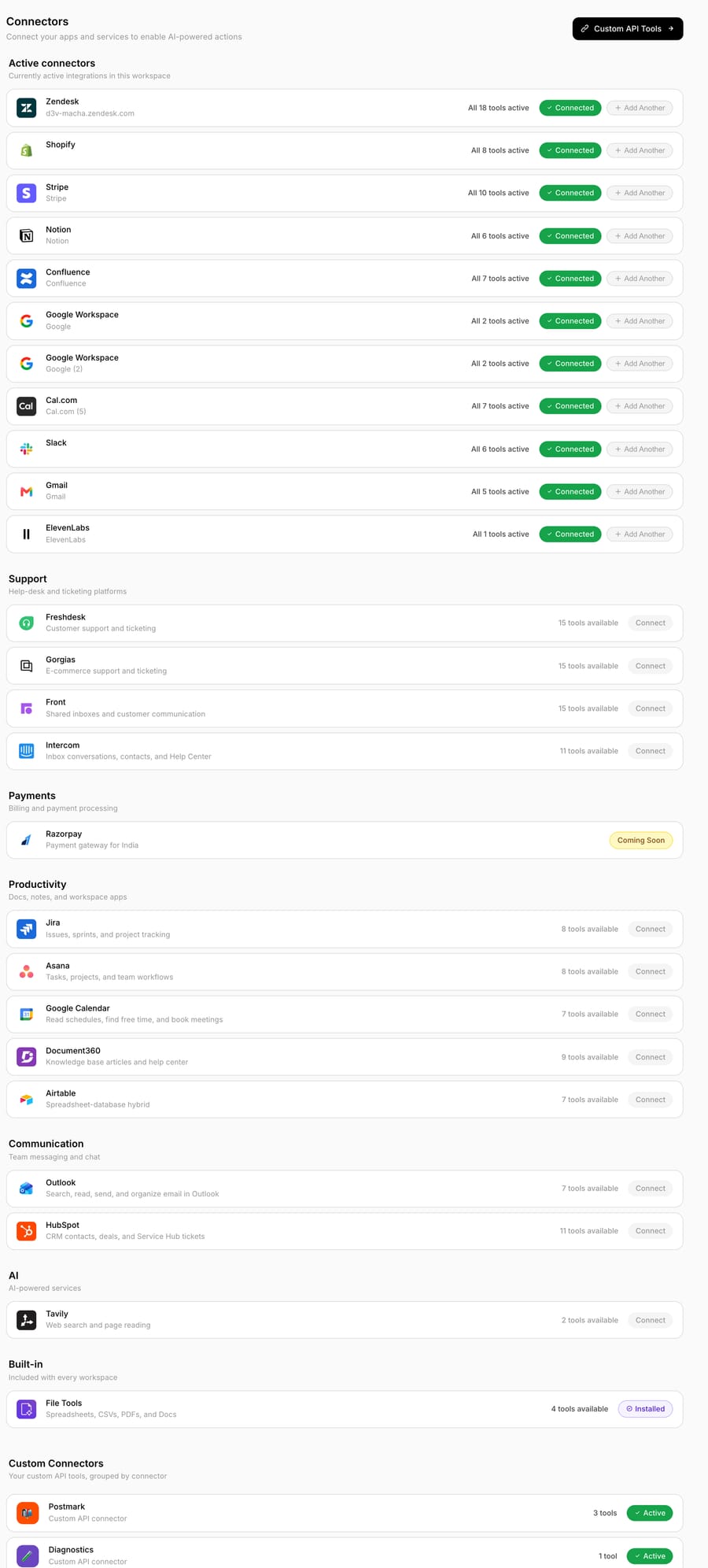
Slack Notion
 Google Workspace
 Confluence

What Does the Macha Razorpay Integration Do for Support Teams?


Macha's Razorpay connector lets an AI agent look up payments, orders and customers from inside a support ticket, so refund and double-charge questions get answered with the real transaction status. It is read-only: the agent explains and routes, and a human still issues refunds in the Razorpay dashboard.
Key takeaways
- The Macha Razorpay connector exposes four read-only tools, Get Payment, List Payments, List Orders and Get Customer, and cannot create refunds or charges.
- Razorpay normal refunds take 7 to 10 working days overall, with cards at 5 to 10 days and UPI at 2 to 7, while Instant Refunds usually arrive within minutes.
- Macha's Stripe connector supports Create Refund, while the Razorpay connector leaves refund issuance to a human in the Razorpay dashboard.
- Razorpay says the issuing bank returns a chargeback verdict within 15 to 30 days after the merchant submits evidence, so the Macha agent escalates dispute tickets to a human.
- Macha bills a Razorpay lookup-and-reply as one ticket, from $299 a month for up to 750 tickets, however many Razorpay tools the agent calls.

The Macha × Razorpay integration gives an AI agent four read-only Razorpay tools (Get Payment, List Payments, List Orders and Get Customer), so a "was I charged twice?" or "where's my refund?" ticket gets the real payment status inside the ticket instead of three clicks away in the Razorpay dashboard. Macha is an AI agent layer that sits on top of the help desk you already run (Zendesk, Freshdesk, Gorgias, Front, HubSpot or Intercom) and connects out to the tools that hold the answers. The connector reads; it doesn't refund or charge, and that boundary shapes everything below.
Quick framing: Macha doesn't replace Razorpay or your help desk. It sits between them: reading from both, acting in your help desk, and looking up payment facts in Razorpay so a reply can be drafted or sent with the real numbers attached.
What can the Razorpay connector do?
The connector is a read access layer over your Razorpay account, authenticated with an API key. Once connected, an agent can call four tools:
| Tool | What it returns |
|---|---|
| Get Payment | Full details of a specific payment: status, amount, currency and payment method. |
| List Payments | A list of payments filtered by status, date range or customer, for "show me everything on this customer." |
| List Orders | Razorpay orders with their payment status and amounts, useful for tying a charge back to a checkout. |
| Get Customer | A Razorpay customer profile, including contact details and transaction history. |
That's the whole surface, and it's deliberately tight. These four tools answer the questions a support team fields most about payments: did the payment go through, what was it for, how much, on which method, and what's the refund doing. The agent decides which tool to call based on what the ticket asks. You don't script the calls; you describe the job.
How does the connector fit into an agent?
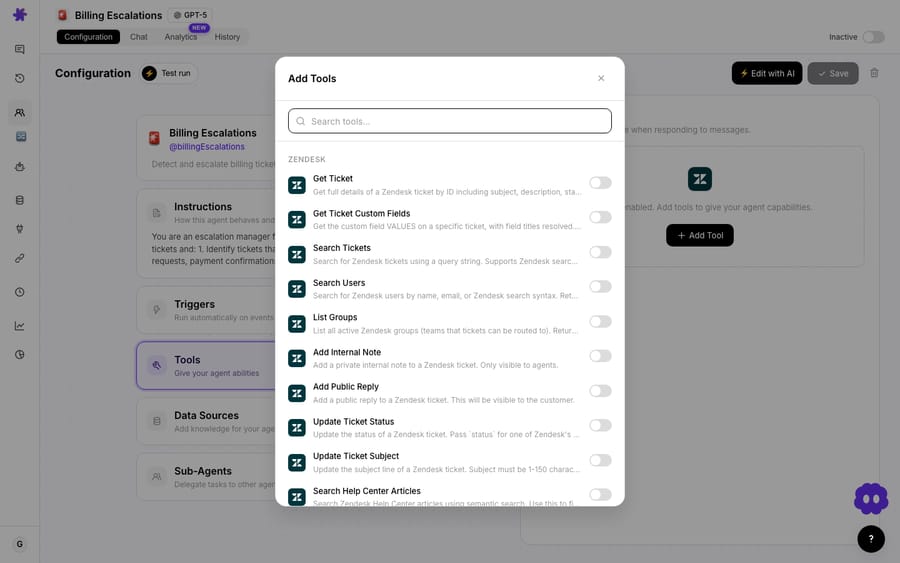
In Macha, a connector does nothing until an agent is allowed to use it. You build an agent, give it instructions ("help customers with payment and billing questions"), and check the Razorpay tools you want it to have in the tool picker. From there the agent draws on Razorpay the same way it draws on your help desk or knowledge base.
What triggers a payment lookup?
Razorpay doesn't push events into Macha; the connector has no Razorpay-side triggers. The trigger comes from your help desk, which is where you want it. A typical setup:
- A new ticket (or customer reply) lands in Zendesk on the Billing brand or with a payment tag, and Macha's Zendesk connector fires the trigger.
- The agent reads the ticket, extracts the order ID or customer email, and calls Get Customer → List Payments on Razorpay to find the transaction.
- It checks the payment status (captured, failed, refunded, pending) and, if a refund is in flight, reads when it was initiated.
- It drafts (or, if you've allowed it, posts) a reply on the ticket with the real status, and tags or routes the ticket.
Because the trigger lives on the help desk side, you get all the targeting the help desk already gives you: brand, tag, channel, form, SLA. Macha's Zendesk connector alone offers triggers for new tickets, customer replies, status and priority changes, assignment, closed tickets, messaging and a custom webhook, so you can scope payment automation as tightly or as broadly as you like. See Macha on Zendesk for the full trigger model.
How does an agent answer "Where's my refund?"
Here's the most common Razorpay ticket, end to end. The customer writes:
"I cancelled order #RP-48213 two days ago and was told I'd be refunded. I don't see anything in my account yet."
An agent with the Razorpay tools and your refund policy in its knowledge base would:
- Call List Orders / List Payments to find the payment behind order #RP-48213.
- Read the payment object and see the refund was initiated to the original method (say, a Visa card).
- Pull your refund-timeline policy from knowledge and combine it with Razorpay's published timings. Razorpay's normal-refund documentation gives 7–10 working days overall, and breaks it down by method: cards 5–10 days, netbanking 2–10, UPI 2–7, wallets 0–3. Then it drafts a grounded, specific reply:
"Your refund for order #RP-48213 was initiated on 22 June to your Visa card ending 4242. Card refunds through Razorpay return to the original card and usually take 5–10 working days to show, so please allow until early next week. I'll keep this ticket open until then."
No tab-switch, no guesswork, and the customer gets the actual date and method rather than a copy-pasted "please allow 7–10 days." For UPI and netbanking payments, merchants can issue Instant Refunds, which Razorpay says reach the customer "within minutes (or an hour, sometimes)" for a small fee, per Razorpay's instant-refund docs. The agent can surface that distinction when the payment method warrants it.
What can't the Razorpay connector do?
The Razorpay connector is read-only. It can look up payments, orders and customers. It cannot create a refund or create a charge through Razorpay. There is no "Create Refund" tool on Razorpay the way there is on our Stripe connector.
That's a deliberate boundary, and for refunds it's a sensible one. Refunds are irreversible money movements. For Razorpay we expose the read surface that lets an agent diagnose and explain a payment accurately, and leave issuing the refund to a human in the Razorpay dashboard. So the realistic division of labor is:
- Macha does: find the payment, confirm status, explain the refund timeline, draft the reply, tag and route the ticket, escalate with the transaction already attached as an internal note.
- A human does: click "refund" in Razorpay when a refund is warranted.
If your team wants agents to issue refunds programmatically today, Stripe is the connector that supports it (Create Refund, for a full or partial amount). For Razorpay, automate the lookup and the reply and keep the payout a human action. A few other limits worth knowing up front:
- Razorpay covers the gateway, not the order. Cancellation, shipping and return questions depend on your store, not the gateway. Pair Razorpay with the Shopify connector or your order system so the agent has both the payment and the fulfillment picture.
- Region. Razorpay is the common gateway for India-based commerce; if your payments run through Stripe in other markets, use the Stripe connector instead (or both, on different brands).
- Read scope = API-key scope. The agent can only see what the connected key is permitted to see. Scope the key to what support needs.
How does the agent handle partial refunds, disputes and chargebacks?
Two edge cases come up constantly in payment queues, and the read-only boundary shapes how an agent handles them.
Partial refunds. Razorpay supports refunding part of a captured payment, and the Get Payment response carries an amount_refunded field alongside the original amount. An agent can read that, say, ₹1,200 of a ₹3,000 payment has been returned and explain the remainder ("₹1,200 was refunded to your card on 21 June; the balance reflects the items you kept"). It can't issue that partial refund. Like a full refund, the payout stays a human action in the Razorpay dashboard.
Disputes and chargebacks. When a customer disputes a charge with their bank, the bank opens a chargeback and Razorpay routes it through its Disputes flow, where the merchant submits evidence to contest it. After representment, the issuing bank returns a verdict within 15 to 30 days, per Razorpay's dispute documentation. Win, and nothing is deducted; lose, and the chargeback amount is deducted from your account and credited back to the customer. The connector exposes no dispute tools, so the agent's job here is narrow: recognize a "my bank reversed this" or "I raised a chargeback" ticket, attach the matching payment as an internal note, and escalate it to the team that contests disputes rather than attempting to resolve it. Disputes are a money-and-deadline workflow that belongs with a human; the agent's value is catching them early and routing them with context attached.
How much does a Razorpay lookup cost on Macha?
Macha bills per ticket: one conversation, charged once, not per resolution or per tool call. A Razorpay lookup-and-reply is one ticket whether the agent calls one Razorpay tool or three, so the cost is flat and predictable. Macha is one plan priced by monthly volume: from $299 a month for up to 750 tickets, about $0.40 a ticket, rising to $1,199 for 3,000 and $3,999 for 10,000, with setup and monitoring by the Macha team included. You can start on a free trial ($50 of usage, no credit card required) and see what your real ticket mix costs before committing. Full tiers are on the pricing page.
How do you set up the Razorpay integration?
The flow is short:
- Connect Razorpay. In Macha, open Connectors, pick Razorpay, and paste an API key scoped to read payments and customers.
- Build (or pick) an agent. Give it clear instructions for payment and billing tickets, and attach your refund-policy knowledge source so replies follow your policy, not just gateway defaults.
- Grant the Razorpay tools. Check Get Payment, List Payments, List Orders and Get Customer in the tool picker.
- Set the help desk trigger. Fire the agent on payment-tagged tickets or your billing brand in your help desk.
- Start in draft mode. Let the agent draft replies for a human to approve for the first week. Once you trust the payment lookups, switch the ones you're comfortable with to auto-send.
The Macha docs cover connectors, agents and triggers in full if you want the step-by-step.
When should you use the Razorpay connector?
Reach for it when: a meaningful slice of your tickets are "where's my payment / refund / charge" questions, your payments run through Razorpay, and your agents are losing time hopping into the Razorpay dashboard to answer them.
Skip it when: you need agents to issue refunds autonomously (that's Stripe today, not Razorpay), or when your payment volume is low enough that a manual dashboard check a few times a day is fine. The connector earns its place on volume and repetition.
FAQ
Does Macha replace Razorpay or my helpdesk? No. Macha is an AI agent layer that sits on top of your help desk (Zendesk, Freshdesk, Gorgias, Front, HubSpot or Intercom) and reads from connected tools like Razorpay. It coordinates the two; it doesn't replace either system.
Can a Macha agent issue a Razorpay refund automatically? No. The Razorpay connector is read-only: Get Payment, List Payments, List Orders, Get Customer. An agent can find the payment and explain the refund status and timeline, but a human issues the refund in the Razorpay dashboard. For programmatic refunds, the Stripe connector supports Create Refund.
What triggers the agent to look up a payment? Your help desk does, for example a new Zendesk ticket with a payment tag, or a customer reply. Razorpay doesn't push events into Macha; the trigger logic lives on the help desk connector.
How long do Razorpay refunds take, so the agent can set expectations? Razorpay's normal refunds take 7–10 working days overall: cards 5–10, netbanking 2–10, UPI 2–7 and wallets 0–3, per Razorpay's documentation. Instant Refunds on UPI and netbanking usually arrive within minutes. The agent can quote the specific method from the payment record.
What does a Razorpay lookup cost? Nothing on its own. Macha bills per ticket, one conversation charged once however many Razorpay tools the agent calls, from $299 a month for up to 750 tickets, about $0.40 each. See pricing.
Which helpdesks does this work with? All of Macha's supported help desks: Zendesk, Freshdesk, Gorgias, Front, HubSpot or Intercom. The Razorpay tools attach to an agent regardless of which help desk fires the trigger.
Where should you start?
You don't have to automate every payment ticket on day one. Connect Razorpay, point one agent at your refund-status queue in draft mode, and watch how often "where's my refund?" resolves itself with the real transaction attached. Start a free trial ($50 of usage, no credit card required), or read the Razorpay integration page for the connector details.
Written by Abbas (Customer Support & AI, Macha) · Reviewed by Ankeet Guha (Co-founder & CTO) · Published 2026-06-24 · Last updated 2026-09-24.