Shopify
 Stripe
 Slack
Slack Notion
 Google Workspace
 Confluence

What Can Macha's Stripe Integration Do for Support? Refunds, Payments and Disputes (2026)


Billing tickets cost handle time because the agent has to leave the help desk, search Stripe, and copy amounts back into the reply. Macha's Stripe connector lets an AI agent do that lookup and the refund inside the ticket, within the limits you set.
Key takeaways
- Macha's Stripe connector gives AI agents ten actions: Get Customer, Get Payment, List Payments, Get Charge, Get Subscription, List Subscriptions, List Invoices, Cancel Subscription, Create Refund and Create Payment Link, authenticated with a Stripe API key.
- Macha's Stripe connector has no dispute action, so it never submits chargeback evidence; Stripe says businesses usually get 7-21 days to respond after a chargeback is created.
- Stripe's dispute documentation says the issuer usually takes 60-75 days to decide and the full dispute lifecycle can take 2-3 months, which is why filing stays with a person in Stripe.
- Failed-payment alerts in Macha run through a custom webhook trigger that Stripe calls, because the Stripe connector lists no native trigger; the agent then posts the failure reason to Slack.
- Macha bills per ticket rather than per resolution, starting at $299 a month for 750 tickets, about $0.40 each, with a $50 free trial and no credit card.

Macha's Stripe integration gives your AI agents ten Stripe actions (Get Customer, Get Payment, List Payments, Get Charge, Get Subscription, List Subscriptions, List Invoices, Cancel Subscription, Create Refund and Create Payment Link), so an agent can look up a payment, refund a duplicate charge and confirm it on the ticket without anyone opening Stripe. Macha isn't a payment processor and it isn't a help desk. It's the agent layer that sits on top of the help desk you already use (Zendesk, Freshdesk, Gorgias, Front, HubSpot or Intercom) and reaches into Stripe to take real actions. The agent does the legwork; your people keep the judgment calls. The one thing it doesn't do is file chargeback evidence, which the dispute section below covers.
What can Macha's Stripe connector do?
You connect Stripe to Macha with a Stripe API key (use a restricted key, the model Stripe recommends for third-party tools), and from that point your agents can call ten Stripe actions as tools:
| Action | What the agent can do |
|---|---|
| Get Customer | Look up a customer by ID or email and pull their profile |
| Get Payment | Retrieve one payment's full detail: status, amount, metadata |
| List Payments | List a customer's payments |
| Get Charge | Retrieve one charge's detail |
| Get Subscription | Retrieve one subscription's plan and status |
| List Subscriptions | List a customer's subscriptions |
| List Invoices | List a customer's invoices |
| Cancel Subscription | Cancel a customer's subscription |
| Create Refund | Issue a full or partial refund on a completed payment, with a reason |
| Create Payment Link | Create a Stripe payment link to send to the customer |
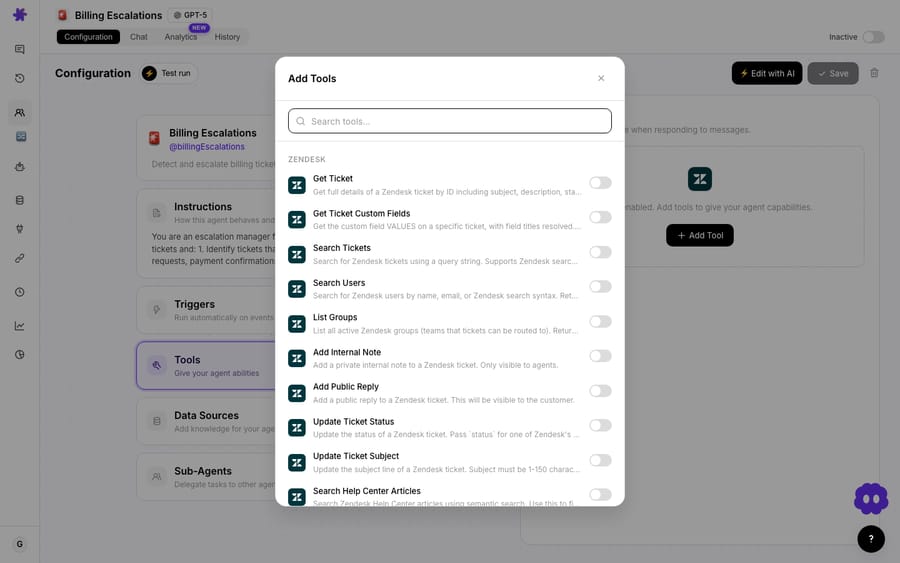
The mental model that matters: these aren't buttons a human clicks. They're tools an agent decides to use when an instruction and a ticket call for them. You tell an agent, in plain language, "When a customer asks about a charge, look up their payment history and process a refund if the charge is duplicated", and Macha works out which Stripe calls to make, in what order, and what to write back on the ticket.
Notice what's missing from the list: there's no "update customer" action and no dispute action. An agent can read a Stripe customer, but it can't create or edit a customer record or touch a Dispute object. That shapes several of the workflows below.
Stripe sits in Macha's connector gallery alongside the rest of the stack: commerce (Shopify), comms (Slack, Google Workspace), and knowledge (Notion, Confluence). That matters, because the best billing workflows don't use Stripe alone. They combine Stripe data with the order and the conversation.

Which billing tickets can a Stripe-connected agent handle?
A capability list is abstract. Here's what it looks like as the jobs your queue throws at you every day.
1. Payment lookups, with zero tab-switching
The most common billing ticket isn't a request. It's a question: "What did I pay last month?" "Which card is on file?" "Did my payment go through?" With Get Customer and List Payments, an agent pulls the customer's billing history into a clean summary (amounts, dates, statuses, methods) right inside the conversation. No Stripe tab, no copy-paste.
This is the look-up-a-customer's-payment-history pattern, and it's the starting point for everything below: once the agent can see Stripe, it can act on Stripe.
2. Refunds, handled end to end (with the guardrails you set)
This is the one that saves real time. For a straightforward refund, a Macha agent runs the whole flow: read the ticket, Get Customer, List Payments to find the charge, Create Refund, then post a confirmation comment and update the ticket status. Nobody on your team touches the clean cases.

The guardrails are the point. You write the policy into the agent's instructions (only refund charges under $X, only within the return window, only when the reason is duplicate or cancelled), and anything outside those bounds gets drafted for a human instead of sent. That's the process-refund-requests-automatically flow, and it pairs with Create Refund's support for partial amounts when you only want to give back shipping or a prorated slice.
A close cousin is the duplicate-charge complaint, a high-frustration, high-trust moment. The agent checks Stripe for two payments of the same amount in a short window, confirms the duplicate, refunds the extra one, and explains what happened. Resolving that in one touch instead of three is often the difference between a churned customer and a relieved one.
3. Subscription and billing questions, with plan context
Subscription questions are rarely only about Stripe. They're about the plan, and the plan rules live in your docs. Macha handles the subscription-billing-questions pattern by pulling the customer's billing record from Stripe and the relevant plan details from Notion (or Confluence), then writing one answer grounded in both. The customer asks "why was I charged this much?" and the agent answers with the charge and the policy that produced it.
4. Failed payments, caught before they churn
Not every Stripe event starts as a ticket. Macha's Stripe connector doesn't list a native trigger today, so the setup runs through Macha's custom webhook trigger: point a Stripe webhook for failed invoice payments at it, and when a payment fails an agent grabs the customer and payment detail with Get Customer and Get Payment and posts an alert to the right Slack channel with the failure reason and a suggested next step. Involuntary churn stops being something you find at month-end and becomes something you act on the same day.

A scheduled trigger (included on every Macha plan) powers the weekly version: every Monday, list the week's refunds from Stripe, total them, surface the top reasons, and post the summary to Slack. You get visibility into refund patterns without a spreadsheet.
5. New customers and account changes
When a ticket arrives from someone with no billing profile yet, Get Customer (by email) confirms they're new; the connector has no create-customer action, so a person creates the Stripe record. For routine account updates such as an email change or a name correction, the connector has no edit action, so the agent verifies the request, pulls the current Stripe record, and hands a ready-to-apply change to a person (or to a custom API tool you've built against Stripe's customer update endpoint).
How does Stripe data help agents that aren't about billing?
Stripe's biggest value in Macha often isn't a standalone workflow. It's the context it adds to everything else. When a ticket gets escalated, Macha can bundle the conversation history, the Shopify order, and the Stripe customer record into one summary so the senior agent starts with the full picture (escalate-tickets-with-full-context-bundle). When a previously solved ticket reopens, payment history is part of the context Macha rebuilds. When an order cancellation comes in, the agent checks Shopify for eligibility and Stripe for the payment before it drafts a response.
Does Macha handle Stripe disputes and chargebacks?
No, not the filing. The original title of this post says "disputes," so here's the precise answer, because this is where a lot of vendors oversell.
Macha's Stripe connector does not manage Stripe Dispute objects. There is no tool that submits chargeback evidence, and you should be wary of any "AI agent" that claims it auto-wins chargebacks. Disputes are a card-network process with hard deadlines. After a chargeback is created you usually have 7-21 days to respond depending on the network, the issuer then usually takes 60-75 days to decide, and the full lifecycle can take 2-3 months (Stripe Docs: How disputes work). Stripe also debits the disputed amount plus a dispute fee the moment a dispute opens, and you can't refund outside the dispute process while it's open. That's not a place for an agent to act unsupervised.
What Macha does do is the support-side work around a dispute:
- Arm the person who responds. An agent gathers the payment detail, the customer's history, the order, and the original conversation into one evidence-ready summary: the raw material your team (or your finance lead) needs to build a strong response in Stripe.
- Catch the precursors. Many chargebacks start as "I don't recognize this charge" tickets. Stripe's own guidance is that proactive customer service and clarifying the transaction can avoid a dispute entirely, and that a full refund during an inquiry resolves it without a dispute fee. Answering those tickets fast is the cheapest dispute prevention there is.
- Route, don't gamble. Anything that looks like a dispute or a flagged payment goes to a person, every time.
For the filing itself, stay in Stripe. Stripe's Smart Disputes compiles and submits evidence on eligible disputes; Stripe says it's trained on $1.9 trillion in annual payment volume and reports an 18% average increase in payment volume recovered. Macha's job is everything around the dispute: the context, the prevention, and the clean handoff.
What should you watch out for before turning it on?
- Refunds are real money, so set the policy before you switch on autonomy. Start every refund agent in draft-for-review mode, watch it on real tickets, and only let it auto-send once its judgment matches yours within tight rules (amount caps, time windows, allowed reasons). The refund flow keeps a person in the loop until you decide otherwise.
- No dispute filing. As above, Macha won't submit chargeback evidence. If that's your core need, pair it with Stripe Smart Disputes.
- API-key scope is on you. Use a Stripe restricted key with only the permissions your agents need. Don't hand a full secret key to an automation.
- Stripe is the billing system of record, not the policy engine. Macha reads and acts on Stripe data, but your refund and return policy lives in the agent instructions (and ideally your Notion or Confluence docs). Keep them in sync.
- Identity verification still matters. For account changes and refunds on sensitive accounts, build a verification step into the instruction rather than trusting the sender's email alone.
How much does it cost to run Stripe workflows in Macha?
Macha bills per ticket: one conversation, charged once, however many steps the agent takes to finish it, and never per resolution. A simple "what did I pay?" lookup and a refund-and-confirm flow that hits Stripe three times cost the same: one ticket. Pricing is one plan set by volume, starting at $299 a month for 750 tickets (about $0.40 each) and running to $3,999 for 10,000, with every tier on the pricing page. Every connector, scheduled triggers, and setup and monitoring by the Macha team are included. The free trial is $50 of usage with no credit card and no time limit.
Per-resolution pricing earns a vendor more for every ticket its bot closes, so it has little reason to help you prevent billing tickets in the first place. Per-ticket pricing is flatter: each conversation costs the same whether the agent resolves it or escalates it. The payback math depends on how much of your volume is genuinely billing. For a reference point, Stripe's case study on Decagon reports a 65% reduction in support costs for one Decagon business running agents against Stripe billing data (Stripe: Decagon). That's one company, not a benchmark. Count your billing tickets for a month before you build anything; more billing and refund walkthroughs are on the Macha blog.
FAQ
How do I connect Stripe to Macha? Add the Stripe connector from the gallery and authenticate with a Stripe API key (use a restricted key scoped to what your agents need). Once connected, the ten Stripe actions become available as tools to any agent. See the integrations directory and the docs for the full setup.
Can Macha process refunds automatically? Yes. An agent can run the full refund flow: look up the customer, find the payment, issue a full or partial refund, and confirm on the ticket. You set the policy in the instructions, and anything outside those bounds is drafted for a person instead of sent.
Does Macha handle Stripe chargebacks and disputes? Not the filing itself. The connector has no dispute tool, so it won't submit evidence to the card issuer. It does assemble the payment-and-customer context your team needs to respond, and it helps prevent disputes by resolving "unrecognized charge" tickets quickly. Use Stripe Smart Disputes for the network-side filing.
Which help desks does this work with? Macha is the agent layer on top of your existing help desk: Zendesk, Freshdesk, Gorgias, Front, HubSpot or Intercom. The Stripe workflows above are most often started by a help desk event (a new ticket), a custom webhook (a failed payment), or a schedule (a weekly report). See Macha on Zendesk for the deepest integration.
Can agents combine Stripe with other tools? Yes, and the strongest workflows do. They pair Stripe with Shopify (order and payment), Notion or Confluence (plan rules), and Slack (alerts and reports). An agent can use several connectors in one run.
What does it cost to run a Stripe workflow? It's billed per ticket (one conversation, charged once, whether the agent makes one Stripe call or five), not per resolution. From $299 a month for 750 tickets, about $0.40 each. Start with the free trial and see pricing for every tier.
How do you get started?
If billing is eating your queue, the Stripe connector is the quickest place to see Macha earn its keep. Start a free trial ($50 of usage, no credit card), connect Stripe and your help desk, and stand up one refund or payment-lookup agent in draft mode. Watch it work real tickets before you give it the keys. Browse the full integrations directory for everything else it plugs into.
Written by Abbas (Customer Support & AI, Macha) · Reviewed by Ankeet Guha (Co-founder & CTO) · Published 2026-06-24 · Last updated 2026-09-24.