Shopify
 Stripe
 Slack
Slack Notion
 Google Workspace
 Confluence

How Do You Automate Shopify Support Tickets? Macha's Shopify Connector Reads Orders, Customers and Refunds


Where is my order tickets make up 20 to 40 percent of ecommerce support volume according to LateShipment, and each one means switching to Shopify, finding the order and pasting back a tracking link. Macha's Shopify connector lets an AI agent do that lookup and reply inside the help desk you already run.
Key takeaways
- Macha's Shopify connector, shipped in the March 22, 2026 release, gives AI agents tools to search products, look up orders and customers, view discounts, issue refunds and, since then, cancel orders.
- WISMO tickets, meaning where is my order, make up 20 to 40 percent of ecommerce support tickets according to LateShipment research cited by serveretail, and 50 percent or more at peak.
- Macha's create_refund tool is gated behind a confirmation card, shown in one example proposing an $89.00 refund to a Visa card ending in 4242 before a human approves it.
- Scheduled triggers, which shipped in the same March 22 release, are now included on every Macha plan and can sweep Shopify for stuck orders at a minimum one-hour interval.
- Macha bills about $0.40 per ticket rather than per Shopify lookup, from $299 a month for 750 tickets, with setup by the Macha team and a dedicated success manager included and no separate fee for the Shopify connector.

Macha automates Shopify support tickets by giving its AI agents seven Shopify tools, shipped in the March 22, 2026 release: they look up orders, check fulfillment and inventory, pull customer history and propose refunds behind a confirmation gate, all from inside the help desk ticket. The agent reads a "Where is my order?" ticket, calls get_order, replies with the tracking details and marks it solved, while your team keeps the help desk and ticketing workflow it already runs. WISMO tickets are the obvious first target: serveretail, citing LateShipment, puts them at 20 to 40 percent of ecommerce support tickets, climbing to 50 percent or more at peak.
| Question | Answer |
|---|---|
| What it reads | Orders, customers, order history, products and inventory, discounts |
| What it writes | Refunds, only after a confirmation |
| Where tickets live | Your existing help desk (Zendesk, Freshdesk, Gorgias, Front, HubSpot or Intercom) |
| How it connects | OAuth to your Shopify store |
| Price | Per ticket, from $299 a month for 750 tickets; Shopify has no separate fee |
| Trial | $50 of usage, no credit card |
One thing to be clear about up front, because it's the whole point of how Macha works: Macha is not a Shopify helpdesk, and it doesn't replace one. It's an AI agent layer that sits on top of the helpdesk you already run (Zendesk, Freshdesk, Gorgias, Front, HubSpot or Intercom) and connects your commerce stack to it. Shopify is a connector: it gives your agents live commerce context and a set of real actions. The ticket still lives in your helpdesk. Macha just makes the agent working that ticket genuinely useful.
What can the Macha Shopify connector do?
The Shopify connector ships as a standard Macha integration. You connect your store via OAuth, and the changelog lists seven tools your agents can call:
| Tool | What the agent can do |
|---|---|
search_products | Find products by title, SKU, vendor, or type |
get_order | Pull one order's line items, fulfillment, and payment status |
search_orders | Search orders by email, fulfillment/financial status, or date range |
lookup_customer | Retrieve a customer profile and contact details |
get_customer_orders | List a customer's full order history |
get_discounts | View active discount codes and rules |
create_refund | Issue a refund: behind a confirmation gate |
A quick note on naming, so the live claim is accurate: those are the seven internal tool names from the release. The connector has since added an eighth tool, Cancel Order, and the tool picker and the public Shopify integration page show all eight by display name: Search Products, Get Discounts, Get Order, Search Orders, Lookup Customer, Customer Orders, Create Refund and Cancel Order. Net effect: your agent gets product, order, customer, and discount reads, plus gated refund and cancel writes. Same capability, different names depending on where you read it.
The refund tool matters most: refunds touch money, so create_refund doesn't fire silently. The agent proposes the refund and waits for an explicit confirmation before anything moves. More on that below.
To make it easy to try before you wire it to your own store, the same release ships a pre-configured Shopify demo support agent: a working agent against a sample store so you can see the tools in action without connecting production data first.
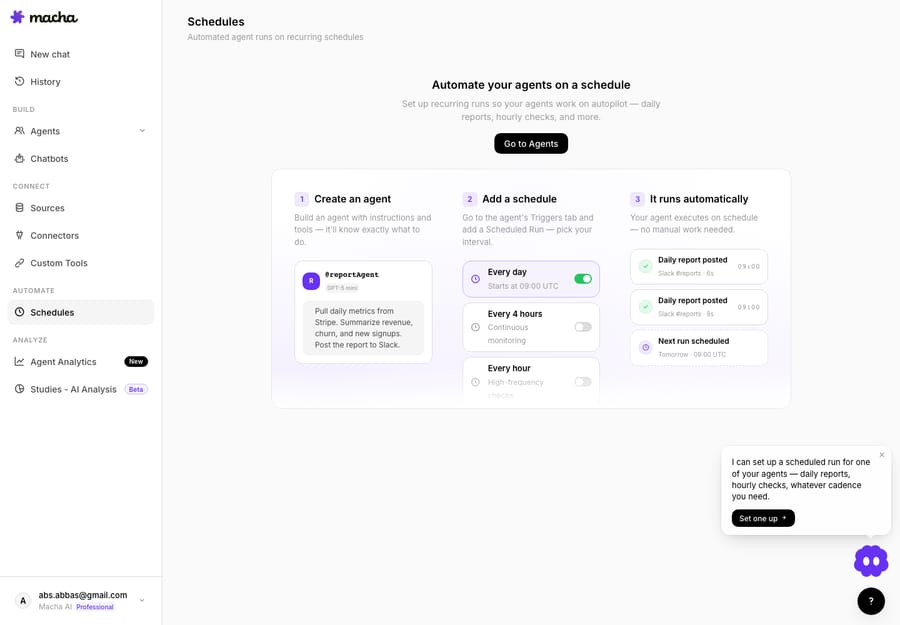
The March 22 release also added scheduled (cron) triggers: agents that run on a recurring interval (minimum one hour) with daily caps, concurrency limits, and auto-disable after five consecutive failures (scheduled triggers are now included on every Macha plan). Pair them with Shopify and you can, say, sweep for orders stuck unfulfilled past their SLA every morning. That's a separate feature, but it landed the same day and composes neatly with commerce data.
How does Macha resolve "Where is my order?" tickets?
Here's the workflow that pays for the connector on day one. A customer opens a ticket in your helpdesk. A Macha agent, triggered on ticket creation, reads it, recognizes an order-status question, calls get_order (or search_orders if the customer didn't give a number), reads the fulfillment and tracking details straight off Shopify, and replies on the ticket. No human in the loop for the easy ones.
A real exchange looks like this:
Customer: "Hi, I placed an order 3 days ago and haven't received any updates. Order #1847." Macha agent: looks up order #1847 in Shopify → order shipped via FedEx, tracking #7829401, est. delivery tomorrow Macha agent: "Hi! Your order #1847 shipped on March 2nd via FedEx. Your tracking number is 7829401 and it's estimated to arrive tomorrow. Let me know if you need anything else!" → ticket status set to Solved
The same primitive covers the rest of the WISMO family. Macha publishes worked use cases for auto-resolving order status inquiries and looking up an order mid-conversation (where the agent surfaces order context for a human rep instead of replying autonomously), plus answering product availability questions by checking live inventory before it tells a customer something is in stock. The tools are the same; the agent's instructions decide whether it replies on its own or hands a draft to a human.
How does Macha handle Shopify cancellations and refunds?
Order lookups are low-stakes: worst case the agent reads the wrong order and a human corrects it. Refunds are not. Macha treats the two differently on purpose.
Take a cancellation request. The customer wants to cancel order #2205 before it ships. A Macha agent can run the whole investigation: get_order to confirm the order is still unfulfilled, then: because Macha agents aren't limited to one connector: a Stripe lookup to confirm the payment is refundable, then draft the reply with the exact amount and card. But it stops before pulling the trigger:
Macha agent: "I've confirmed order #2205 hasn't shipped and is eligible for cancellation. I'll process a full refund of $89.00 to the Visa ending 4242. You should see it within 5–7 business days. Shall I send this and process the refund?"
That confirmation card is the safety model. create_refund is gated; the agent does all the legwork (eligibility checks, payment verification, drafting), but a human (or an explicitly configured approval step) confirms the action that moves money.
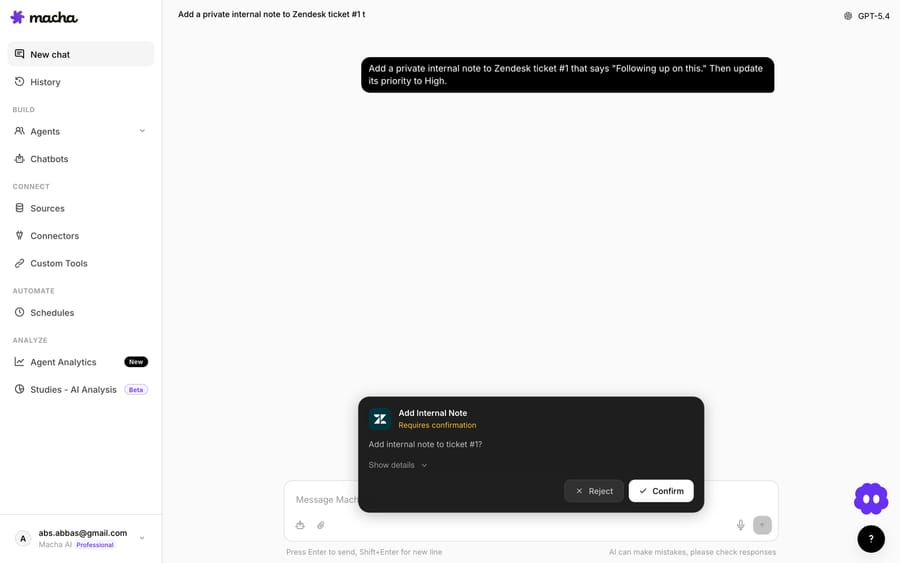
This is the line we draw across every Macha action, not just Shopify: read freely, write carefully. You can tune how much autonomy an agent has, but financial actions default to asking first.
How does Macha compare with Gorgias, Richpanel, Ada and Tidio?
The Shopify App Store is full of AI support apps, and most of them are good at order lookups and refunds. The honest difference is architecture: almost all of them want to be your support tool, while Macha is a layer that keeps the one you have. Here's a side-by-side on the dimensions that actually decide the purchase.
| Macha | Gorgias | Richpanel | Ada | Tidio (Lyro) | |
|---|---|---|---|---|---|
| Product model | AI agent layer on your existing helpdesk | Full ecommerce helpdesk (replacement) | Helpdesk + AI (replacement) | Standalone AI automation platform | Chat widget + AI |
| Keep your current helpdesk? | Yes: Zendesk, Freshdesk, Gorgias, Front, HubSpot or Intercom | No, you move to Gorgias | No, you move to Richpanel | Layers on, but is its own automation tier | Mostly its own widget |
| Native Shopify actions | Read orders/customers/products/discounts + gated refund | Edit orders, refunds, discount codes in-ticket | Order/refund actions | Via integrations | Order lookup, tracking |
| Refund safety | Gated behind a confirmation card by default | In-ticket, agent-driven | Agent-driven | Configurable | Limited |
| Spans Shopify + Stripe + helpdesk in one run | Yes, multiple connectors per agent | Within Gorgias | Within Richpanel | Limited | No |
| Setup | Done for you by the Macha team, with a dedicated success manager, included | Configured in Gorgias; a dedicated CSM depends on your Shopify GMV | Helpdesk migration handled for you | Through sales (demo call) | Self-serve; Dedicated Success Manager from the Plus plan ($300/mo+) |
| Pricing model (approx.; verify) | Per ticket (from $299/mo for 750, about $0.40 each, setup and a dedicated success manager included); see pricing | Ticket-based plans + per AI-resolved ticket (~$0.90–1.00, third-party roundups) | Per-conversation; one-click Gorgias import | Per-conversation (charges even on escalation) | 50 free Lyro conversations (one-off), then Lyro from $32.50/mo (tidio.com/pricing) |
| Best for | Teams keeping their helpdesk who want commerce-aware agents | Shopify-native teams wanting one all-in-one platform | Teams migrating off Gorgias on flat economics | Large global enterprises, heavy multilingual | Small stores wanting a low-cost widget |
Competitor pricing and capability figures are from third-party 2026 roundups (Richpanel buyer's guide, Stormy AI: Tidio vs Gorgias, Fin AI) and may not be official, so confirm current terms with each vendor before you buy. Gorgias publicly claims roughly 60% automation coverage for most ecommerce brands; what any tool actually resolves depends on your data and configuration.
A nuance worth calling out: Gorgias is also a Macha connector. If your team already lives in Gorgias and likes it, you don't have to choose: Macha can run agents on top of Gorgias the same way it does on Zendesk or Freshdesk, then add Shopify and Stripe context to those agents. The "vs" above is really "do you want to replace your helpdesk to get commerce-aware AI, or add a layer to the one you have?"
Where Macha is genuinely different. Most of these tools either are the helpdesk (Gorgias, Richpanel) or want to be the front door (a standalone widget). Macha is neither: it keeps your existing helpdesk and, because a single agent can hold multiple connectors, one run can span Shopify + Stripe + your helpdesk: look up the order, verify the charge, reply on the ticket. The same builder that handles Shopify also handles your Notion knowledge base, Slack escalations, and custom API tools. And you don't build it yourself: the Macha team analyzes your past tickets, builds the knowledge base and the agent on your existing helpdesk, and runs it in safe mode, with drafts as internal notes, until the drafts are right. That's included on the trial and every plan.
Where it isn't. If you run Shopify with no separate helpdesk and just want a chat widget on your storefront, a native Shopify-first app (or Tidio Lyro at the low end) may be a more direct fit. Macha shines when there's a ticketing workflow to plug into. And Macha won't market a headline automation percentage; what an agent resolves depends entirely on how you configure it and how clean your catalog and order data are. We'd rather you measure it on your own queue than trust a number from a landing page.
If your helpdesk is Zendesk specifically, the Macha on Zendesk page walks through how agents attach to tickets, triggers, and your existing macros, and the Shopify connector simply gives those agents commerce context.
Where should you not point the Shopify connector?
A few honest caveats before you turn it loose:
- Don't auto-send refunds. Keep
create_refundbehind its confirmation gate (it is, by default). Autonomy is great for reads; for money, let a human or a tightly-scoped approval flow confirm. - Garbage catalog in, garbage answers out. Product-availability answers are only as good as your Shopify inventory hygiene. If your stock counts lag reality, the agent will confidently quote the wrong number.
- Ambiguous lookups need guardrails. If a customer gives a name but no order number and has six orders, tell the agent how to disambiguate (ask, or use the most recent) rather than guessing.
- It's not an OMS or a fulfillment engine. The connector reads order/customer/discount data and issues refunds; it doesn't edit line items, split shipments, or rewrite fulfillment. For deep order edits, a human still works in Shopify admin.
- Billing is per ticket, not per step. A chatty multi-lookup agent and a single
get_ordercall cost the same: one conversation, charged once (from $299/mo for 750 tickets). What to estimate before you scale a trigger across your whole queue is ticket volume, not how many actions each run takes.
How much does Macha cost for Shopify support?
Macha bills per ticket: one conversation with one person, charged once however many messages, model turns or tool calls it takes: not per resolution or per "deflection." A clean WISMO answer and a cancellation that checks Shopify, verifies a Stripe charge, and drafts a reply cost the same: one ticket. Pricing starts at $299 a month for 750 tickets, about $0.40 each, rising to $599 for 1,500 and $1,199 for 3,000, and that price includes setup and a dedicated success manager who handles your changes, such as a new ticket category or a new tool. There are no per-store or per-connector add-on fees for Shopify: it's a standard connector on every plan. That's a different shape from the per-resolved-ticket or per-conversation models above: the bill tracks the volume you handle, and never hangs on an outcome definition you don't control. See the pricing page for current plans and tiers.
FAQ
Can Macha fully automate Shopify support tickets? For the repetitive ones, yes. A Macha agent triggered on ticket creation can read the ticket, look up the order in Shopify, and reply with tracking, autonomously, then mark it solved. Higher-stakes tickets (refunds, cancellations) run the same investigation but pause for a human confirmation before any money moves.
Does Macha replace my Shopify helpdesk? No. Macha is an AI agent layer that sits on top of your existing helpdesk (Zendesk, Freshdesk, Gorgias, Front, HubSpot or Intercom). Shopify is a connector that gives those agents live commerce data and actions: your tickets stay where they are. It can even run on top of Gorgias.
What can the Shopify connector actually do? Eight tools: search products, get an order, search orders, look up a customer, list a customer's orders, view discounts, create a refund and cancel an order, with the two write tools gated behind a confirmation. Together that covers order status, product availability, customer history, and cancellation/refund workflows.
Will it issue refunds automatically? Only if you explicitly allow it. By default create_refund requires a confirmation: the agent proposes the refund and a human approves before it fires.
Can one agent use Shopify and Stripe together? Yes. Macha agents can hold multiple connectors, so a single run can check the order in Shopify, verify the payment in Stripe, and reply on the helpdesk ticket.
How do I try it without connecting my real store? The March 22 release ships a pre-configured Shopify demo support agent against a sample store, so you can test the tools before connecting production data.
How much does it cost? Macha bills per ticket (one conversation, charged once, however many steps the agent takes) from $299 a month for 750 tickets, about $0.40 each. That includes the Macha team setting up your first agent and a dedicated success manager who handles your changes. Shopify is a standard connector with no separate fee. See pricing.
How do you try it?
If WISMO is eating a fifth to two-fifths of your queue, this is the fastest way to claw that time back, and to automate Shopify support tickets without ripping out the helpdesk your team already knows. Start a free trial ($50 of usage, no credit card required), connect your helpdesk and your Shopify store, and let an agent handle the next "where's my order?" Read the Shopify integration page for the full tool list, or the docs for the connector walkthrough.
Written by Abbas (Customer Support & AI, Macha) · Reviewed by Ankeet Guha (Co-founder & CTO) · Published 2026-06-24 · Last updated 2026-09-24.