Shopify
 Stripe
 Slack
Slack Notion
 Google Workspace
 Confluence

Richpanel AI Explained: What It Automates and Where It Stops (2026)


Richpanel is a customer support helpdesk built for ecommerce brands, and its AI agent is sold as the core reason to switch off Zendesk or Gorgias in the first place, not as a bolt-on chatbot. This guide covers what Richpanel's AI actually does inside the helpdesk, how you turn it on, what it costs per conversation, where it stops working without a human, and where a separate AI agent layer fits if you are not ready to migrate your whole support stack to get AI.

We checked Richpanel's own pricing page and its Shopify App Store listing directly before writing this, rather than relying on secondhand roundups.
What Richpanel's AI does inside the helpdesk
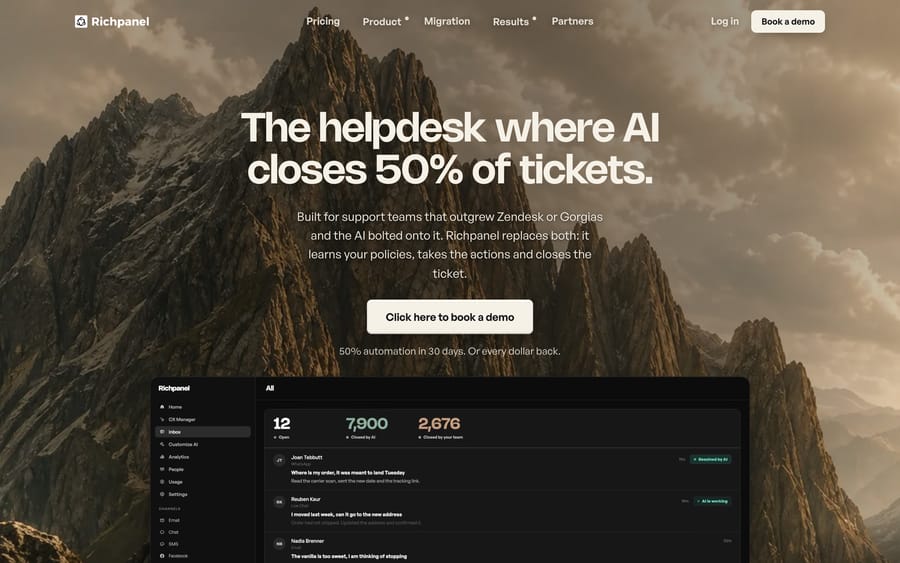
Richpanel calls itself "the AI-native helpdesk," which is a specific claim: the AI agent is not an add-on marketplace app sitting next to the inbox, it is the thing the inbox is built around. The AI Agent reads a store's policies and order data, mostly through its Shopify integration, and resolves conversations end to end: answering "where is my order," processing a return, adjusting a subscription, or closing out a simple refund without a human touching the ticket.
Three components sit around that core agent:
- Copilot mode: the same AI drafts a reply, but a human approves it before it sends. Richpanel positions this as the on-ramp; teams run Copilot first, watch what the AI gets right, then flip conversations over to full automation once they trust it.
- QA Agent: a second AI reviews every closed conversation after the fact, checking tone and accuracy after the reply already went out.
- Self-service portal: a customer-facing page for order tracking and return initiation that deflects tickets before they reach the inbox at all.
Richpanel also runs a social media agent that answers comments and DMs on the same policies, and it publishes a specific pre-send guardrail: a reply that touches money or that the AI can't complete gets held for a human instead of sent on a guess.
How to set it up
Richpanel is a full helpdesk migration. Setup starts with connecting your channels (email, chat, WhatsApp, Instagram, Facebook, TikTok, SMS, and phone all land in one inbox) and connecting Shopify, plus commerce tools like Recharge, Loop, Yotpo, and AfterShip if you use them, so the AI can see orders, shipping status, and subscriptions, not just message text.
From there, you train the agent on your policies instead of coding rules by hand: you give it your return window, shipping exceptions, and refund rules, and it applies them to real conversations. Richpanel's own recommended path is to run new automation in Copilot mode first, reviewing AI-drafted replies before they go out, and only flip a topic to full autopilot once a few weeks of drafts have been accurate. That staged rollout is also how the 50%-automation guarantee gets measured: Richpanel commits to 50% of conversations resolved by AI within 30 days, and refunds the difference if it misses.
What it costs
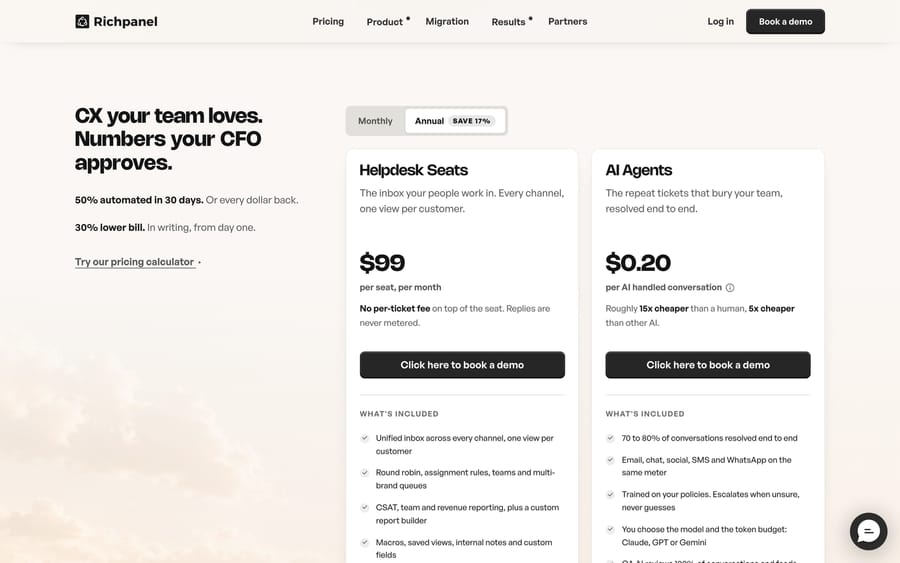
Richpanel prices the helpdesk seat and the AI separately, which matters if you are used to seat-based pricing that includes automation for free:
| Component | Price |
|---|---|
| Helpdesk seat | $99/seat/month, no per-ticket fee on manual replies |
| AI Agent | $0.20 per conversation resolved end to end |
| QA Agent, Social Media Agent, Self-Service Portal | Included at no extra cost |
| Returns & Exchanges | Paid add-on, starting at $99/month |
Annual billing takes 17% off the total, per Richpanel's pricing page. The company backs the AI pricing with two guarantees, refundable if it misses either: 50% of conversations automated within 30 days, and a written commitment that the total bill runs 30% lower than a comparable Zendesk-plus-AI-app setup. Richpanel frames $0.20 a conversation as cheap against a human agent's fully loaded cost and against "other AI," though it does not name which competitors it's comparing against; treat that specific multiple as a vendor claim, unaudited.
The per-conversation price is also a business-model choice. Charging by resolved conversation instead of by seat means Richpanel earns more only when the AI actually closes a ticket, which is why the public guarantee is framed as an automation rate instead of a feature list. That's a cleaner incentive than a flat AI add-on fee that gets charged whether the bot resolves anything or not.
Where it stops
The AI Agent is built for the ecommerce questions a Shopify store gets on repeat: order status, shipping delays, returns, exchanges, subscription changes. That's also its ceiling. A brand with complex account-level issues, B2B contracts, or support questions that don't map to order data is asking Richpanel's AI to do something it wasn't trained for. The guardrail response, holding money-related or incomplete replies for a human, means those tickets fall back to a person anyway, just after the AI has already looked at them.
The bigger limit is structural: Richpanel's AI only knows what's inside Richpanel. If your team also runs a knowledge base in Notion, deal data in HubSpot, or engineering tickets in Jira, none of that context reaches the AI agent unless Richpanel builds a direct integration for it. And because the AI is inseparable from the helpdesk it runs in, adopting it means migrating your whole support operation (inbox, macros, reporting, agent seats) off whatever you're on now. That's a bigger commitment than turning on an AI feature inside a helpdesk you already run.
Who it suits
Richpanel suits Shopify-first ecommerce brands that are willing to migrate their whole helpdesk to get AI automation as a first-class feature rather than an app-store add-on, and that mostly deal in order-status, shipping, and returns tickets an AI can resolve against commerce data. It's a strong fit for a team currently paying separately for a helpdesk and a bolted-on AI app, since Richpanel is explicitly built to undercut that combined bill.
It's a weaker fit if your support volume is dominated by account, billing, or technical questions that don't map neatly to an order record, or if switching helpdesks is off the table this year because of existing workflows, integrations, or headcount trained on your current tool. In that case, the more realistic move is adding an AI layer to the helpdesk you already have rather than replacing it.
Where an AI agent layer fits on top
If you're not ready to move off Zendesk, Freshdesk, Gorgias, or Front to get AI automation, that's the gap Macha is built for. Macha runs as an AI agent layer on top of the help desk you already use, and it never asks you to migrate the inbox, seats, or reporting you've already built. You configure agents in plain English, they act inside your existing tickets with confirmation gates on customer-facing steps, and pricing is one plan set by monthly ticket volume, from $299/month for 750 tickets, about $0.40 a ticket at every tier. See Macha pricing for the full table. Setup and monitoring by the Macha team is included, and the trial is $50 of free usage with no credit card.
To be clear about the comparison: Macha isn't a Richpanel alternative, because it doesn't compete with the helpdesk layer at all. If you like Richpanel's inbox and want its AI, that's a Richpanel decision. If you like the help desk you already run, or you run one Richpanel doesn't serve, like Help Scout, and want AI without switching, that's where a layer like Macha or Macha on your existing help desk fits better than a full migration.
FAQ
Is Richpanel's AI agent included in the base price? No. The helpdesk seat ($99/month) and the AI Agent ($0.20 per conversation resolved) are billed separately. The QA Agent, Social Media Agent, and self-service portal are included once you're on the AI Agent, but Returns & Exchanges is a separate paid add-on.
Does Richpanel's AI work without Shopify? Richpanel connects to several ecommerce platforms and tools (Shopify, Recharge, Loop, Yotpo, AfterShip), but its AI is built around commerce data: order status, shipping, returns. A store outside that ecosystem gets far less value from the automation.
What happens when Richpanel's AI can't resolve a ticket? Richpanel's guardrails hold replies that touch money or that the AI can't complete, routing them to a human instead of sending an uncertain answer.
Do I have to replace my current helpdesk to use Richpanel's AI? Yes. The AI agent isn't sold separately from the Richpanel inbox, so adopting it means moving your support operation onto Richpanel.
Is Richpanel's 50%-automation guarantee real, or marketing? It's a stated, refund-backed commitment on Richpanel's own pricing page: 50% of conversations automated within 30 days, or money back. It's worth confirming the exact terms with sales before you sign, since guarantees like this typically carry conditions on ticket type and setup.
What do Richpanel users say about the AI in reviews? On the Shopify App Store, Richpanel holds a 4.9-star rating across 139 reviews, with reviewers praising automation and support responsiveness; a smaller number mention occasional AI accuracy issues that support resolved.
What's a good alternative if I don't want to switch helpdesks for AI? An AI agent layer that runs on top of your current help desk, such as Macha on Zendesk, Freshdesk, Gorgias, or Front, gets you automation without a migration project.
Who are Richpanel's typical customers? Ecommerce brands, mostly on Shopify. Richpanel names Ridge, Jones Road Beauty, Aloha, Pique, Aeons, Haus, Pela, and Paleovalley among 3,000-plus brands on its site.
Sources: Richpanel homepage, Richpanel pricing, Richpanel on the Shopify App Store.
Automate your support workflows
Macha's agents run multi-step workflows across the tools you already connect.