Intercom
 Shopify
 Stripe
 Slack
Slack Notion
 Google Workspace
 Confluence

What Are Zendesk's G2 and Capterra Ratings in 2026, and What Do They Mean?


Zendesk rates about 4.3 out of 5 on G2 and 4.4 on Capterra, and close to nine in ten reviewers on both sites give it four or five stars. The sub-scores show where the reservations sit: features rate highest, while value for money and ease of setup rate lowest.
Key takeaways
- Zendesk holds about 4.3 out of 5 on G2 from roughly 6,700 reviews and 4.4 out of 5 on Capterra from 4,092 reviews.
- On Capterra, 89% of Zendesk's reviewers give four or five stars, and only about 3% give one or two stars.
- Zendesk's Capterra sub-scores put Features highest at 4.4 and Value for Money lowest at 4.2, with Ease of Use and Customer Service at 4.3.
- Zendesk's G2 sub-scores show Ease of Use at about 88% and Ease of Setup lowest at about 83%, so agents rate daily use above admin setup.
- GetApp and Software Advice share Capterra's review pool through Gartner Digital Markets, so their Zendesk scores are not independent confirmation.
Zendesk rates about 4.3 out of 5 on G2 (roughly 6,700 reviews of Zendesk for Customer Service) and 4.4 out of 5 on Capterra (4,092 reviews in September 2026), and on both sites close to nine in ten reviewers give it four or five stars. The star number hides the useful part: reviewers consistently score Zendesk's features highest and its value for money and setup lowest.
A note on method, because it matters for trust: G2's rating pages are bot-walled, so G2 figures below are its published scores as read in June 2026 and corroborated by third-party write-ups. Capterra's figures were re-read on 24 September 2026. We did not screenshot the rating pages and haven't fabricated any number. The one screenshot in this post is of the Zendesk product itself.
What are Zendesk's ratings on each review site?
Here is where Zendesk sits across the major review platforms. Treat the counts as approximate; they tick up every week.
| Platform | Score | Reviews (approx.) | What's being rated | Last read |
|---|---|---|---|---|
| G2 | 4.3 / 5 | ~6,700 | "Zendesk for Customer Service" (formerly Zendesk Support Suite) | June 2026 |
| Capterra | 4.4 / 5 | 4,092 | Zendesk Suite | Sept 2026 |
| TrustRadius | 8.7 / 10 | ~1,000+ reviews & ratings (~210 full written reviews) | Zendesk Suite | June 2026 |
| Gartner Peer Insights | 4.4 / 5 | ~930 | Zendesk (corroborating) | June 2026 |
| GetApp / Software Advice | ~4.4 / 5 | shared pool | Same reviews as Capterra (Gartner Digital Markets) | June 2026 |
Two things to flag. First, G2 and Capterra carry the most weight for a like-for-like comparison: they have the deepest review pools (thousands each) and the same 5-point scale. TrustRadius is a substantial pool but scores on a 10-point scale, so read its 8.7/10 alongside the 5-star numbers, not directly against them. Second, GetApp and Software Advice are not independent opinions. They share Capterra's review pool through Gartner Digital Markets, so "4.4 on three sites" is one dataset shown three times. Counting it as corroboration overstates the consensus.
The convergence still means something: a 4.3 to 4.4 band across two independent platforms with five-figure combined volume is a stable rating. Zendesk is not a product people quietly hate. The better question is why it lands at 4.3 to 4.4 rather than 4.6 or higher, and that's a distribution and sub-score story.
How are Zendesk's star ratings distributed?
An average rolls a 5-star rave and a 1-star meltdown into the same arithmetic. The distribution separates them. On G2 (June 2026), Zendesk's ~6,700 reviews broke down roughly as:
- 63%: 5 stars
- 29%: 4 stars
- 4%: 3 stars
- 1%: 2 stars
- 1%: 1 star
Capterra's September 2026 split tells the same story with a bigger four-star share: 2,263 five-star, 1,387 four-star, 323 three-star, 66 two-star and 53 one-star reviews. That's about 55% five-star and 34% four-star, so 89% of Capterra reviewers give four or five stars and about 3% give one or two.
That shape tells you more than the 4.3. Nine in ten reviewers rate Zendesk 4 or 5 stars, and detractors are a thin tail. This is not a polarized product with a loud unhappy camp. It's a broadly liked product where the 4-star bucket does the heavy lifting. The gap between 4.3 and a top-tier 4.7 is the large mass of "good, not great" reviews from people who would recommend Zendesk with a reservation. Read those four-star reviews and the reservation is almost always price or complexity.
What do Zendesk's G2 sub-scores show?
G2's real value is its category sub-ratings, scored as a percentage of reviewers who rate that dimension well. Zendesk's pattern as of June 2026:
- Ease of Use: ~88%. Its strongest dimension. Agents find the ticket workspace intuitive once it's set up.
- Quality of Support: ~86%. Strong, though it's one of the more contested numbers in the written reviews.
- Ease of Setup: ~83% (about 8.0/10). Consistently the lowest of Zendesk's core G2 metrics, and it shows up around 7.9 on head-to-head comparison pages too.
The pattern is simple: using Zendesk scores higher than setting it up. "Ease of use" in Zendesk reviews almost always means an agent working tickets after the system is configured, not an admin building routing, triggers, permissions and SLAs from scratch. That admin work is the documented friction, and "learning curve" appears in the text of well over a hundred G2 reviews. G2 also publishes a "Meets Requirements" sub-score, which we couldn't verify to an exact figure, so we haven't quoted one.
What do Zendesk's Capterra sub-scores show?
Capterra splits its rating into four categories scored out of 5. For Zendesk Suite (4,092 reviews, read 24 September 2026):
| Capterra category | Score /5 |
|---|---|
| Features | 4.4 |
| Ease of Use | 4.3 |
| Customer Service | 4.3 |
| Value for Money | 4.2 |
Read top to bottom and Capterra's reviewers are describing a feature-rich platform that costs more than buyers would like: Features leads at 4.4 and Value for Money trails at 4.2. In June 2026 we read Features at 4.5 and Ease of Use at 4.2 as the lowest; since then Ease of Use has edged up and Value for Money has slipped to the bottom. That shift fits the pricing complaints below, and value is the dimension where SMB and enterprise reviewers diverge most.
These sub-scores move by a tenth as reviews land, so treat the decimals as a snapshot. The durable signal is the spread: features at the top, cost at the bottom. Check the live values on Capterra if a tenth matters to your decision.
What do reviewers praise about Zendesk?
Strip the platforms down to what reviewers repeat, and a consistent set of strengths shows up across G2, Capterra and TrustRadius:
- Omnichannel ticketing that scales. Email, chat and messaging, voice and social in one ticket view. Reviewers on larger or growing teams cite this as the reason they stay.
- A reliable agent workspace. Once configured, ticket handling is described as intuitive, stable and productive. This is what the 88% ease-of-use score measures.
- Automation and workflow depth. Triggers, macros, automations, routing and SLA tooling let teams encode real process, and reviewers credit this for scaling support without scaling headcount at the same rate.
- A large integration marketplace. The Zendesk Marketplace and APIs mean most teams can connect their stack rather than replace it.
- Role-based control for bigger orgs. Granular permissions and admin controls come up repeatedly as a reason Zendesk suits larger, structured teams.
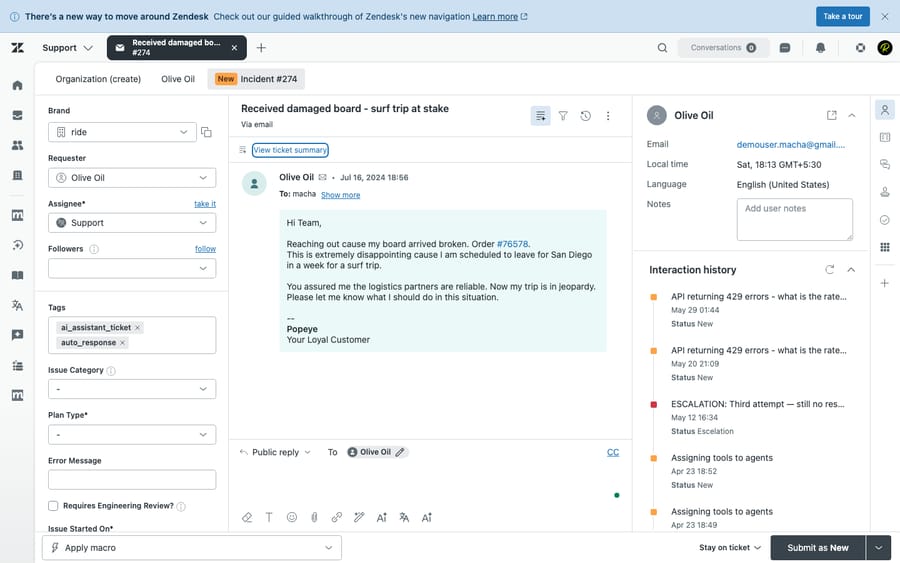
Below is the product the reviews are about: a ticket in the Zendesk Agent Workspace, the unified view the "reliable day-to-day" praise refers to.
What do reviewers complain about most?
The complaints are just as consistent, and they cluster tightly:
- Pricing, and the way it climbs. The most common reservation on every platform. Per-agent seats, paid add-ons and tiered features push the real bill above the headline plan price, and SMB reviewers feel it most. This is what pulls Capterra's Value for Money to 4.2. (We do the math in our full Zendesk review.)
- Setup and admin complexity. The flip side of the breadth. Standing up and governing Zendesk takes real time and often outside expertise, which is why Ease of Setup is G2's lowest sub-score.
- Support responsiveness, a genuine split. The score (86% on G2) and the written reviews disagree. Plenty of reviewers praise documentation and community; a recurring minority report slow responses and billing friction. The long tail of one-star reviews is disproportionately about support and billing.
- Reporting behind upgrades. Deeper analytics often need higher tiers or the Explore add-on, so out-of-the-box reporting feels limited.
- AI pricing opacity. A newer complaint: Zendesk's AI features are seen as capable but hard to price in advance or tie to a clear return.
Community sentiment, which is less filtered than vendor-solicited review sites, leans harder on cost and complexity. See our roundup of what Zendesk users say on Reddit for that version.
How much should you trust Zendesk's review scores?
Four caveats apply to all B2B review platforms, Zendesk included:
- Vendor-solicited reviews. G2 and Capterra both run programs where vendors solicit reviews, sometimes with a gift card. That doesn't make reviews fake, but it skews the pool toward recently onboarded, prompted users, who tend to rate higher than the silent long-term base. The incentive is plain: a vendor asks happy customers first. A small upward bias is baked in everywhere.
- Recency and version drift. A five-year-old 5-star review rated a different product. Zendesk's pricing, AI features and UI have all changed. The newest reviews, especially on AI and pricing, matter most for a 2026 decision.
- Segment skew. Zendesk's pool over-represents mid-market and enterprise, where the product shines and budgets absorb the cost. An SMB buyer reading a 4.3 should weight the value-for-money and setup sub-scores, where smaller teams' pain concentrates.
- Product fragmentation. Zendesk is listed several ways: "Zendesk for Customer Service," "Zendesk Suite," plus separate listings for Chat, Talk, Guide and Explore. G2's seller page tallies about 7,142 reviews across all Zendesk products, versus ~6,700 on the main customer-service listing. Compare the same listing when you cite a number.
None of this invalidates a 4.3 to 4.4. It means the honest read is "broadly well-regarded, with a known and consistent set of trade-offs," not "near-perfect."
Where does an AI layer fit in the rating story?
One pattern in the 2026 reviews deserves its own line: the AI pricing opacity complaint, sitting next to the older "reporting and resolution depth cost extra" theme. Teams like the platform but want more resolution out of it without an unpredictable bill.
That's the gap an AI agent layer like Macha (our product) addresses. To be clear on positioning, Macha is not a Zendesk alternative or a help desk. It runs on top of your existing Zendesk, reads the customer's question, pulls from your connected knowledge and past tickets, and resolves routine issues inside the ticket while escalating the rest with context. It's another integration to configure and only as good as the knowledge you connect. On cost, Macha bills per ticket, one charge per conversation however many steps it takes, on one plan priced by volume that starts at $299 a month for up to 750 tickets with setup and monitoring by the Macha team included. The spend tracks a number your help desk already reports, rather than a resolution definition you don't control. If the reviews above describe your situation, you can see how it works on Zendesk or try it free: $50 of free usage, no credit card required.
Frequently asked questions
What is Zendesk's rating on G2? Zendesk for Customer Service (formerly Zendesk Support Suite) held about 4.3/5 on G2 from roughly 6,700 reviews in June 2026. The distribution is strongly positive: about 63% five-star and 29% four-star, with about 2% at one or two stars.
What is Zendesk's rating on Capterra? Zendesk Suite sits at 4.4/5 on Capterra from 4,092 reviews (September 2026). Its sub-scores: Features 4.4, Ease of Use 4.3, Customer Service 4.3 and Value for Money 4.2, so features rank highest and value lowest.
Is G2 or Capterra more reliable for Zendesk? Both are credible and they agree (4.3 vs 4.4). G2 leans toward larger and more technical reviewers and publishes percentage sub-scores; Capterra skews more SMB and gives four named out-of-5 categories. Use them together. GetApp and Software Advice share Capterra's review pool, so they aren't independent confirmation.
Why isn't Zendesk rated higher if reviews are mostly positive? Because the gap between 4.3 and 4.7 is filled by four-star reviews, not angry ones. Those reviewers like Zendesk but flag the same two reservations, price escalation and setup complexity, which also pull down Value for Money and Ease of Setup.
What's the most common Zendesk complaint in reviews? Pricing, specifically how the real cost climbs with per-agent seats, paid add-ons and tiered features beyond the headline plan. Setup complexity is a close second, with support responsiveness and AI pricing clarity behind them.
Does Zendesk have a TrustRadius score? Yes. Zendesk Suite scored about 8.7/10 on TrustRadius in June 2026, from roughly 1,000+ reviews and ratings (a few hundred are in-depth written reviews). It uses a 10-point scale, so weight it alongside, not directly against, the 5-star G2 and Capterra numbers.
Who should read Zendesk's ratings as a warning?
Every dimension points the same way: Zendesk is feature-rich and pleasant to use, but heavier to set up and prone to cost escalation. The four-star majority isn't unhappy; it's qualified. So the ratings are a verdict on fit more than quality. A mid-market or enterprise team that needs omnichannel depth and can absorb the cost and configuration should find the 4.3 to 4.4 reassuring. A small team with simple needs and a tight budget should read the same scores as a warning about exactly the sub-categories, value and ease of setup, where it will feel the pain. For the full cost picture, see our Zendesk review; if you're weighing options, our guide to the best Zendesk alternatives maps the field.
Capterra figures re-read 24 September 2026. G2, TrustRadius and Gartner figures are published scores read in June 2026; those pages block automated access, so they're attributed rather than screenshotted. Review counts move weekly, so confirm current numbers before relying on exact figures.
Add AI agents to your Zendesk
Macha reads the ticket, drafts the reply and takes the action, inside the Zendesk you already run.