Shopify
 Stripe
 Slack
Slack Notion
 Google Workspace
 Confluence

How to Build an AI Agent for Zendesk (2026)


If your support runs on Zendesk, an AI agent that reads a ticket, looks up the customer, answers from your help center, and either replies or escalates is the highest-leverage automation you can add. There are two ways to get there: build it against the Zendesk API yourself, or connect an agent platform that already speaks Zendesk. This guide covers both honestly — the real API path with code, the production work it takes, and the faster route — so you can pick the one that fits your team.

What a Zendesk AI agent does
The loop is the same as any support agent, wired to Zendesk: a new ticket arrives → the agent reads it and the requester's history → it calls tools (look up the order, search your help center, check a policy) → it posts a reply as a public comment or routes the ticket to a human. The trick is doing that reliably against real tickets. (New to agents generally? Start with AI agents for customer service.)
Option 1: Build it against the Zendesk API
Zendesk has a full REST API, so you can build the agent yourself. The pieces:
- Read tickets — the Tickets API and Search API to pull the ticket, its comments, and the requester.
- Reply / act — update the ticket or add a comment via the API.
- Trigger on new tickets — a Zendesk trigger or webhook fires your endpoint when a ticket is created.
A reply tool against the real Zendesk API looks like this:
import requests
ZD = "https://yourco.zendesk.com/api/v2"
AUTH = (f"{EMAIL}/token", API_TOKEN)

def reply_to_ticket(ticket_id: str, body: str):
    r = requests.put(f"{ZD}/tickets/{ticket_id}.json",
        json={"ticket": {"comment": {"body": body, "public": True}}},
        auth=AUTH, timeout=10)
    r.raise_for_status()          # handle 429 rate limits, token refresh
    return {"status": "sent"}
Wrap that (and a get_requester, a search_help_center) as tools in an agent loop on the model of your choice — see our from-scratch walkthrough in how to build an AI agent: from scratch vs. platform.
The production part
The API calls are the easy bit; making the agent run on real tickets is the work. You stand up a webhook to trigger the agent, and it has to verify Zendesk's signature and dedupe retries so one ticket never gets two replies:
from fastapi import FastAPI, Request, HTTPException
app = FastAPI()

@app.post("/zendesk-webhook")
async def on_ticket(req: Request):
    verify_zendesk_signature(req)            # HMAC over the raw body
    event = await req.json()
    if already_handled(event["detail"]["id"]):  # idempotency — Zendesk retries
        return {"ok": True}
    run_agent(event["detail"]["id"])
    return {"ok": True}
Then the rest: rate-limit handling (Zendesk throttles per-endpoint — roughly ~200–700 requests/min by plan — so you back off on 429s), grounding in your Help Center (embed the articles via the Help Center API and re-index when they change), guardrails (escalate refunds, redact PII, treat ticket text as untrusted input), hosting 24/7, observability, and an eval harness over real historical tickets. That's weeks of work plus permanent upkeep — the undifferentiated infrastructure every support agent needs.
Option 2: Connect a native Zendesk agent
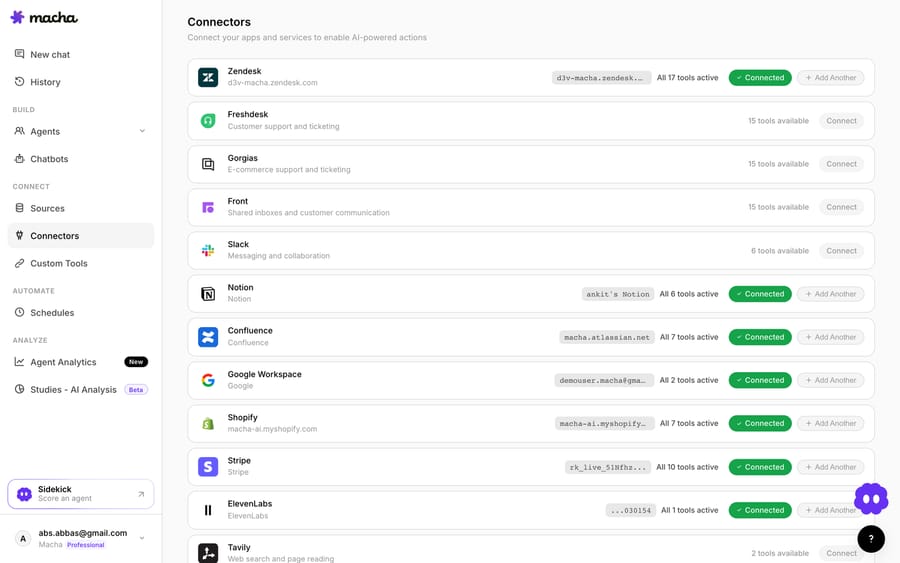
If the goal is a working agent on your Zendesk — not a project to maintain — a platform that connects natively is far faster. Macha layers on top of Zendesk (it's not a Zendesk replacement or a Support app you install — it connects via OAuth and works autonomously):
- One-click connect — authorize Zendesk and the agent can read tickets and post replies, with a full set of ticket tools ready to use.
- Ground on your Help Center — add your Zendesk Help Center as a Source so replies quote real articles.
- Any other system as a tool — Custom Tools turn your order/billing APIs into agent capabilities by describing them.
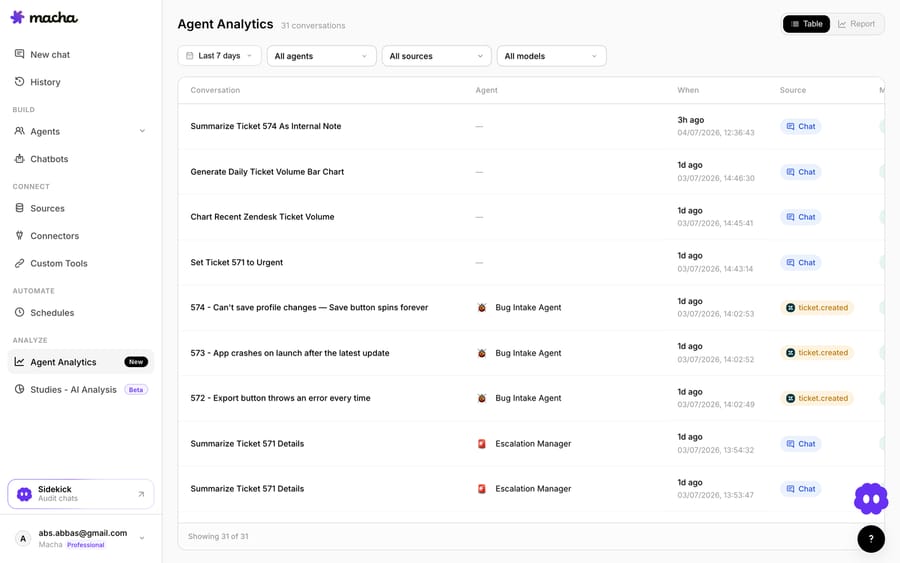
- Runs and grades — the agent runs in the cloud triggered by new tickets; Agent Analytics show every run (including
ticket.createdevents), and Studies grade it against real historical tickets before it goes live.
More on the Zendesk integration specifically on our Macha on Zendesk page.
What about Zendesk's own AI?
Zendesk sells built-in AI agents (the lineage of the old Answer Bot), configured no-code in the Admin Center and priced per automated resolution. It's a real option — here's a quick rule of thumb for the three routes:
- Zendesk's native AI — fastest no-code setup, you're happy on Zendesk's model, and per-resolution pricing works for your volume. Least control, least effort.
- Build on the Zendesk API yourself — you need a specific model, custom tools wired to your own systems (orders, billing), or full control of the runtime, and you have the engineering to own it. Most control; weeks to build plus permanent upkeep (hosting, evals, maintenance).
- Connect a model-agnostic platform (Macha) — the control and model choice of building, but live in days instead of weeks, with the hosting, observability, and eval harness handled for you.
The rest of this guide is about the second and third routes — where you want more than Zendesk's native automation gives you.
Build vs. connect — for Zendesk
| Build on the Zendesk API | Connect Macha | |
|---|---|---|
| Read/reply to tickets | You write the API client | Native connector (OAuth) |
| Trigger on new tickets | You build a webhook endpoint | Handled |
| Ground on Help Center | You embed + host a vector store | Add it as a Source |
| Hosting, retries, observability | Your infrastructure | Built in |
| Evaluate before go-live | You build a harness | Studies |
| Time to a live agent | Weeks + ongoing | Same day |
So which should you build?
Build on the API if you need a fully custom runtime, have strict data-residency needs, or the agent is your product. For most Zendesk teams who just want tickets resolved, a native connector gets you a measurable agent on your real tickets far faster — and you keep your model of choice. You can start free on Macha, connect Zendesk, and test an agent on your own tickets the same day.
FAQ
Is a Zendesk AI agent the same as Zendesk's own AI? Not necessarily. Zendesk offers built-in AI, but you can also run a model-agnostic agent on top of Zendesk (via its API or a platform like Macha) — useful if you want a specific model, custom tools, or to grade the agent your own way.
Do I need to install a Zendesk app? No — Macha connects to Zendesk via OAuth and works autonomously; it's an AI layer on top of Zendesk, not a Support marketplace app you install.
Can the agent take actions, not just answer? Yes — via the Zendesk API (update, tag, route) plus your own systems' APIs as tools (order lookups, refunds), with guardrails on what it can do unattended.
How do I make sure it's accurate before it replies to customers? Ground it in your Help Center and grade it against real historical tickets first (Macha's Studies do this), start in a draft/approve mode, and widen autonomy per ticket type as it earns trust.
Add AI agents to your Zendesk
Macha reads the ticket, drafts the reply and takes the action, inside the Zendesk you already run.