Shopify
 Stripe
 Slack
Slack Notion
 Google Workspace
 Confluence

How to Build an AI Customer Support Agent with Claude (and Claude Code)


You want an AI agent that reads an incoming support ticket, looks up the customer, checks their order or account, drafts an accurate reply grounded in your own docs, and either sends it or escalates to a human — without a brittle rule tree you have to babysit. Claude is a genuinely strong model to build that on. But if you've only seen the weekend-demo tutorials, you're seeing about 20% of the job: the model call and a couple of tools. The other 80% — grounding it in your data, wiring it to your help desk, running it 24/7, and actually knowing whether it's any good — is the part that decides whether this touches a real customer or dies in a branch. This guide walks the whole build with Claude, in the order you'd actually hit it, and is honest about where a platform saves you months.

We'll do the from-scratch path in real detail first (so it's genuinely useful if you build it yourself), show where Claude Code and Codex speed it up, and then show the shortcut for the undifferentiated plumbing.
What a support agent actually has to do
Strip the hype and a support agent is a loop with four jobs: understand the ticket and its history; fetch real context (customer, orders, past tickets, the right help-center article) via tool use; act (draft a reply, tag/route, refund, escalate); and know when to stop — answer when confident, hand to a human when not. Every section below exists to make that loop safe and reliable in production. (If you're still weighing build-vs-buy at all, our overview of AI agents for customer service covers the landscape and use cases first.)
Option 1: Build it from scratch — the whole journey
Here's the honest map. None of these steps is optional if real customers are on the other end, and only the first two are "Claude." Budget this as weeks, not a weekend — a competent team lands a solid v1 in roughly 4–8 weeks and keeps paying maintenance after (directional, but plan for it).
1. The model and the agent loop
Anthropic's Claude Agent SDK is the official framework for production agents. Under the hood it's a well-tuned loop: call Claude, execute any tools it asks for, feed the results back, repeat until it stops asking. You define each capability as a tool — a function plus a JSON schema for its inputs:
tools = [{
  "name": "get_customer",
  "description": "Look up a customer by email. Returns plan, status, LTV.",
  "input_schema": {"type": "object",
    "properties": {"email": {"type": "string"}}, "required": ["email"]},
}, {
  "name": "reply_to_ticket",
  "description": "Post a reply. Use only when confident; else call escalate.",
  "input_schema": {"type": "object",
    "properties": {"ticket_id": {"type": "string"}, "body": {"type": "string"}},
    "required": ["ticket_id", "body"]},
}]
Then you own the loop around it — call Claude, run whatever tools it asks for, feed the results back, repeat until it stops asking:
while True:
    resp = client.messages.create(model=MODEL, system=SYSTEM_PROMPT,
                                   messages=messages, tools=tools)
    if resp.stop_reason != "tool_use":
        break                                  # Claude has a final answer
    messages.append({"role": "assistant", "content": resp.content})
    results = []
    for block in resp.content:
        if block.type == "tool_use":
            output = dispatch(block.name, block.input)   # your functions
            results.append({"type": "tool_result",
                            "tool_use_id": block.id, "content": output})
    messages.append({"role": "user", "content": results})   # hand results back
That's the whole agent in fifteen lines — but production is the part not shown: parallel tool calls, managing the conversation state and context window as histories grow, retries and backoff for rate limits, and streaming for responsiveness. Anthropic's customer-support use-case guide walks the core pattern; production-hardening it is on you. Decide here too whether you use the Agent SDK, raw Messages API, or something like LangChain — and accept you now own that dependency.
2. Grounding it in your knowledge (RAG)
An agent that answers policy questions from memory will confidently invent policy. So you build retrieval: chunk your help-center articles and macros, embed them, store the vectors (pgvector, Pinecone, etc.), and give the agent a search_knowledge_base tool that returns the top passages for the model to quote. Then you own the un-glamorous half: re-embedding when docs change, tuning chunk size and top-k, and evaluating retrieval quality so the agent isn't grounded on the wrong passage.
3. Connecting your help desk
The agent is useless until it can read tickets and post replies where your team already works. That means an API client for Zendesk / Freshdesk / Intercom / your platform — OAuth and token refresh, pagination, rate-limit handling, and webhooks to trigger the agent on each new ticket (with signature verification and idempotency so a retried webhook doesn't double-reply). Every one of your internal systems the agent needs — orders, billing, subscriptions — is another API client you write and maintain.
4. Guardrails, safety and escalation
This is what stands between you and an incident. You need grounding checks (don't answer beyond retrieved context), action limits (an agent that can refund must not refund $10,000 unattended), PII handling and redaction, prompt-injection defenses (tickets are untrusted user input), and clear human-in-the-loop escalation — confidence thresholds, and a clean handoff with context so an agent gets a person, not a dead end.
5. Deploy and run it 24/7
A demo runs on your laptop; a support agent runs always. You need hosting (a cloud platform and a long-running service or queue workers), secrets management for keys, a job queue for incoming tickets with retries and a dead-letter queue, and autoscaling so a Monday-morning ticket spike doesn't drop conversations. This is real DevOps, ongoing.
6. Observability
When it sends a bad reply at 2am, "the AI messed up" is not a debuggable statement. You need per-run logging of the full trace — every tool call, the context it had, the decision it made — plus latency and cost metrics and alerting on failures and escalation spikes. Most teams end up building a little internal dashboard just to see what their agent is doing.
7. Evaluation — the step everyone skips
The hardest question isn't "does it reply," it's "is it right." You need an eval harness: a labeled set of real historical tickets with known-good outcomes, automated scoring (resolution, factual accuracy, tone, correct escalation), and a regression run before every prompt or model change so an "improvement" doesn't quietly break 15% of cases. Without this you're shipping on vibes.
8. Ongoing maintenance
It's never done. Models get deprecated and you re-test prompts on the new one; your help desk changes its API; the KB drifts and needs re-embedding; prompts need tuning as edge cases surface; and someone owns the on-call pager. Budget for it permanently.
Where Claude Code and Codex genuinely help
You don't hand-write all of that from a blank file. Claude Code (Anthropic's terminal coding agent) and Codex (OpenAI's) are excellent at the scaffolding: generating the tool schemas and loop wiring (step 1), a first-pass help-desk API client (step 3), the RAG plumbing (step 2), and the eval-harness skeleton (step 7). A realistic flow is to tell Claude Code "scaffold a Claude Agent SDK support agent with Zendesk ticket tools and a pgvector KB search," let it write the first pass, and refine. It compresses the coding. It does not make the design decisions — which tools, what guardrails, when to escalate — and it does not run, host, monitor, or evaluate the thing in production. Steps 4–8 are still yours.
Option 2: Bring Claude, skip the plumbing
Look back at that list. Exactly one and a half of the eight steps are your actual product; the rest is undifferentiated infrastructure every support agent needs. That's the case for a platform. Macha is the layer for the plumbing — you bring the agent design (and Claude as the model), it handles connect → deploy → monitor → grade. Mapped to the eight steps:
- The loop, hosting, secrets, queue, autoscaling (1, 5) — built in. Agents run on Macha's cloud, triggered by new tickets; nothing to host.
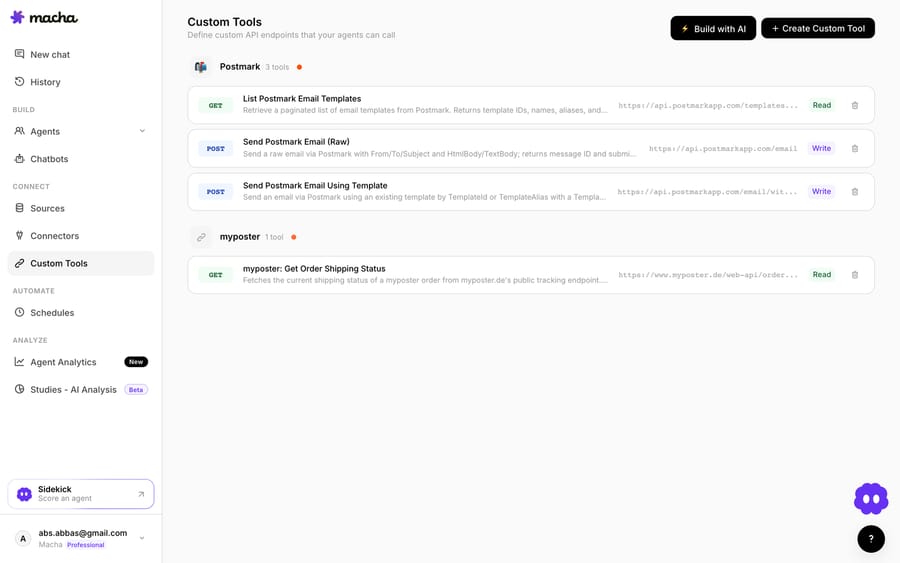
- Connecting your help desk and any API (3) — Macha's Custom Tools turn any REST API into a tool your agent can call: define the endpoint and auth, or describe it in a sentence ("connect our orders API and add a tool to look up an order by ID") and the AI tool builder discovers, tests, and creates the tools. Your help desk is a native connector (Zendesk, Freshdesk, Front, Intercom, HubSpot, Help Scout, Salesforce, Jira Service Management, Pylon); your internal systems plug in the same way. No client library to maintain, no webhook plumbing.
- Grounding (2) — attach your knowledge sources; retrieval is handled, so you're not running a vector store.
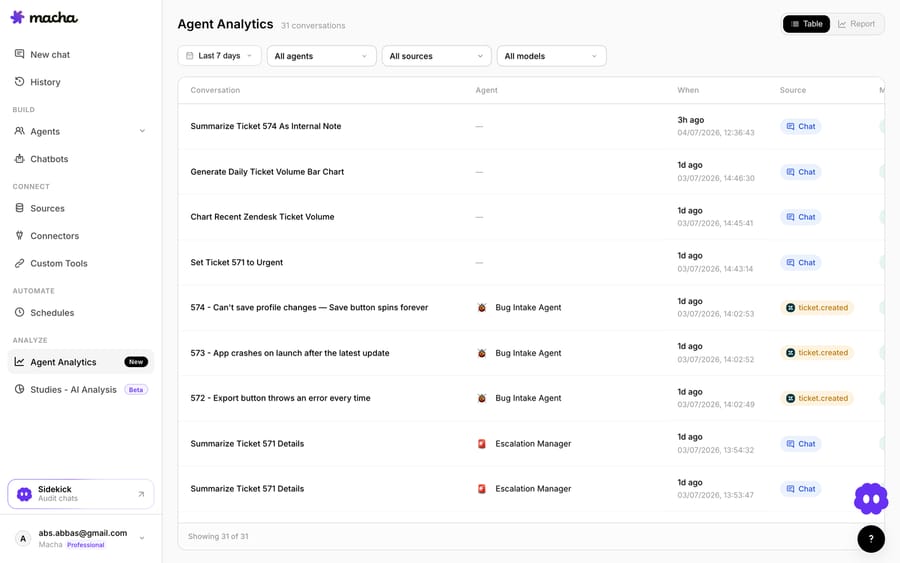
- Observability (6) — agent analytics show every run, tool call, and handoff out of the box.
- Evaluation (7) — Studies run the agent against a batch of real historical tickets and score the outcomes, so a prompt change is a measured decision, not a guess.
- Guardrails and escalation (4) — you still design these (they're product decisions), but you configure them instead of building the enforcement machinery.
The trade is control for time-to-ship: from-scratch is weeks-to-production plus permanent maintenance; a platform is live this week with the infra owned for you.
From scratch vs. on a platform — mapped to the eight steps
| Step | Claude Agent SDK from scratch | Claude + Macha |
|---|---|---|
| Model | Claude (your choice) | Claude (your choice) |
| Agent loop | You write & maintain it | Built in |
| RAG / grounding | You build + run a vector store | Attach sources; handled |
| Help-desk + API tools | You build every client + webhooks | Native connector or Custom Tools |
| Guardrails / escalation | You build enforcement | You configure it |
| Hosting 24/7 | Your infra + queue + autoscale | Runs in the cloud |
| Observability | You build a dashboard | Agent analytics |
| Evaluation | You build an eval harness | Studies (batch grading) |
| Time to production | ~4–8 weeks + ongoing | Days |
So which should you build?
Build from scratch if the agent runtime is your product, or you have hard constraints (on-prem, a custom orchestration model, strict data-residency) a SaaS can't meet — you'll own eight moving parts, but you'll own them exactly how you want. (For a fuller side-by-side, see our from-scratch vs. platform breakdown.) Use a platform if resolving support well is the goal and the agent is the means: you want it live this week, grounded in your data and your help desk, measurable from day one, and you'd rather spend engineering time on the tools and prompts that make it good than on hosting and dashboards you'll maintain forever. Claude is the same strong foundation either way; the only question is how much of the surrounding stack you want to own. You can start free on Macha and wire your first tool in a few minutes to feel where that line is for you.
FAQ
Can Claude Code or Codex build the whole agent for me? They're excellent for the code — tool schemas, the loop, a first-pass API client, the eval-harness skeleton. They won't make the product decisions (tools, guardrails, escalation) or run, host, monitor, and evaluate the agent in production. That's either your infrastructure or a platform's.
How long does a from-scratch build really take? Directionally, 4–8 weeks to a solid v1 for a competent team — most of it in steps 3–8 (integration, hosting, observability, evals), not the Claude call — plus ongoing maintenance as models and APIs change.
Do I need RAG? If the agent should answer from your help center or policies, yes — give it retrieval over your docs so replies are grounded and quotable. For pure "look up this order and reply," tool use alone is enough.
Which Claude model should I use? Use the strongest model for the reasoning/decision step and a faster, cheaper one for high-volume classification; most support agents mix models by task to balance quality and cost.
How do I know it's good before it touches customers? Grade it against real historical tickets with automated scoring, and re-run that before every prompt or model change. Whether you build the harness or use something like Macha's Studies, never ship a change you haven't measured on real cases.
Resolve tickets automatically with AI agents
Macha's AI agents work on top of the help desk you already use — no code.