Shopify
 Stripe
 Slack
Slack Notion
 Google Workspace
 Confluence

How to Build an AI Support Agent with Copilot (Studio & GitHub)


"Build an agent in Copilot" means two different things, and picking the right one matters. Microsoft Copilot Studio is a low-code builder for enterprise agents — including customer-support agents that live in Teams, Dynamics, and on your website. GitHub Copilot is a developer tool that can run custom coding agents. For a support agent, Copilot Studio is almost always what you want; this guide walks it honestly — how to build one, the Microsoft-ecosystem tradeoffs that come with it, and the case where a help-desk-native platform is the better home.

Build a support agent in Copilot Studio
Copilot Studio is genuinely capable for support, especially if you're already a Microsoft shop. The build is low-code, in a visual canvas. Walking our Acme support agent through it:
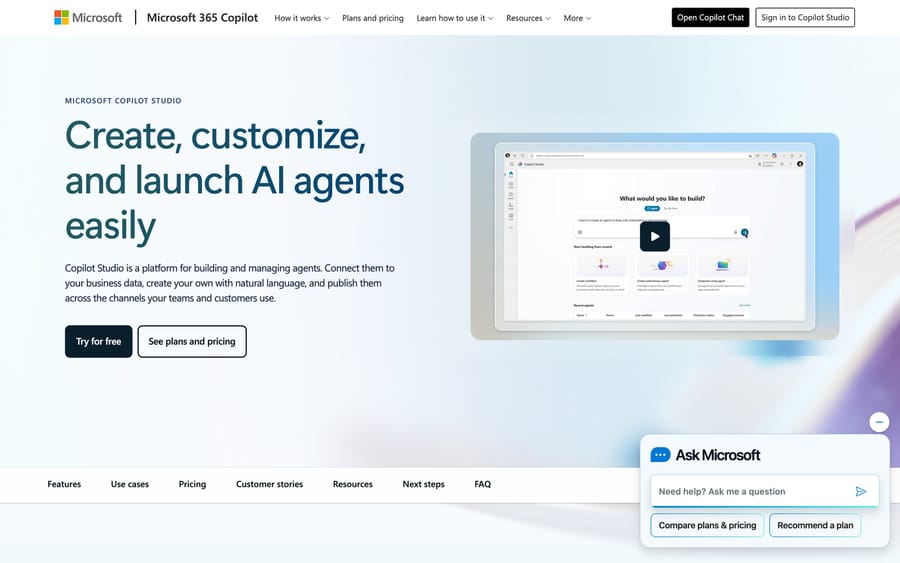
- Create and describe the agent. From the Copilot Studio home you create an agent and describe it in natural language — Acme's role, tone, and rules ("answer from the help center; escalate refunds over $100"). Copilot Studio drafts a first version you refine.
- Add knowledge for generative answers. Point it at SharePoint, public websites, or uploaded files. Copilot Studio's generative answers feature then responds from that content rather than only from scripted topics (its dialog-tree units) — so Acme's agent quotes the help center instead of following a rigid flow. You can mix: topics for deterministic paths (a refund workflow), generative answers for the long tail.
- Add actions. Give it the ability to do things by adding actions — a Power Platform connector, a Power Automate flow, or a REST API — so it can look up an order or update a ticket. This is where the Acme agent gets its
get_orderandescalatecapabilities. - Test in the test pane. Copilot Studio's side-by-side test pane lets you chat with the draft agent as you build — send "where's my order #4471?", watch which topic or knowledge source fires, and fix it before anyone sees it.
- Publish to channels. Publish to Teams, a website widget, Microsoft 365 Copilot, or — via Dynamics 365 Contact Center — real-time voice agents that identify callers and hand off to humans with context preserved.
- Govern with Agent 365. Microsoft Agent 365 gives a central control plane for agent inventory, permissions, and activity across your estate; Microsoft cites go-live in "a few weeks."
Microsoft's own Copilot Studio updates show where it's strong: agent-to-agent (A2A) orchestration, voice, and enterprise governance. If your world is M365, Dynamics, and Power Platform, that integration is a real advantage.
The GitHub Copilot angle (for developers)
If you meant GitHub Copilot, that's the developer path: custom agents defined as .agent.md files in your repo, with function calling, your preferred model, and MCP connections to external knowledge:
---
name: support-triage
description: Triages support tickets and drafts replies from our docs.
tools: ["get_customer", "search_kb", "reply_to_ticket"]
model: claude-sonnet-4-6
---
You are Acme's support agent. Answer from the help center.
Escalate refunds over $100 to a human.
That's great for scaffolding an agent you then run yourself — but it's a coding tool, not a support-agent runtime. It won't sit on your help desk and handle tickets unattended; that's Copilot Studio's job, or a platform's.
The honest tradeoff with Copilot Studio
Copilot Studio is strong — with a catch that matters for support teams:
- It's a Microsoft-ecosystem bet. The value is highest when your stack is Teams, Dynamics 365, SharePoint, and Power Platform. If your support actually runs on Zendesk, Freshdesk, Gorgias, Front, or Intercom — not Dynamics — you're bridging Copilot Studio into a world it wasn't built for, via connectors you maintain.
- Licensing and governance are enterprise-shaped. Copilot Studio pricing, Power Platform connectors, and Agent 365 governance are powerful but come with real licensing complexity and cost.
- It's not help-desk-native. A support agent's home is your help desk. Copilot Studio's home is Microsoft's cloud.
None of that makes it wrong — for a Microsoft-first enterprise it's often the right call. It's just worth naming before you commit.
When a help-desk-native platform fits better
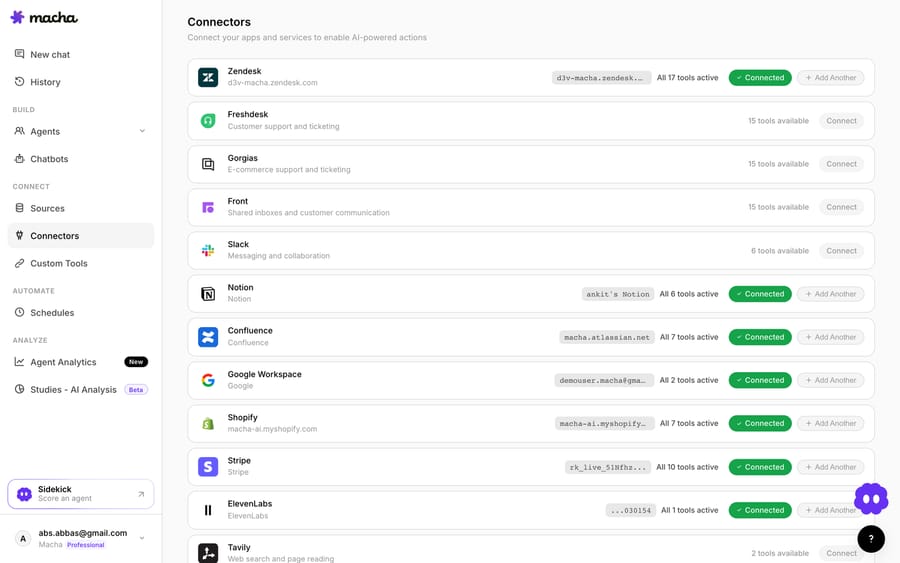
If your support doesn't live in Dynamics, Macha is the more natural home for a support agent — it sits on top of the help desk you already use and is model-agnostic (Claude, GPT, or others), not tied to one vendor's cloud:
- Native to your help desk — connect Zendesk, Freshdesk, Front, Intercom, HubSpot, Help Scout, Salesforce, Jira Service Management, or Pylon so the agent reads and replies to tickets where your team works.
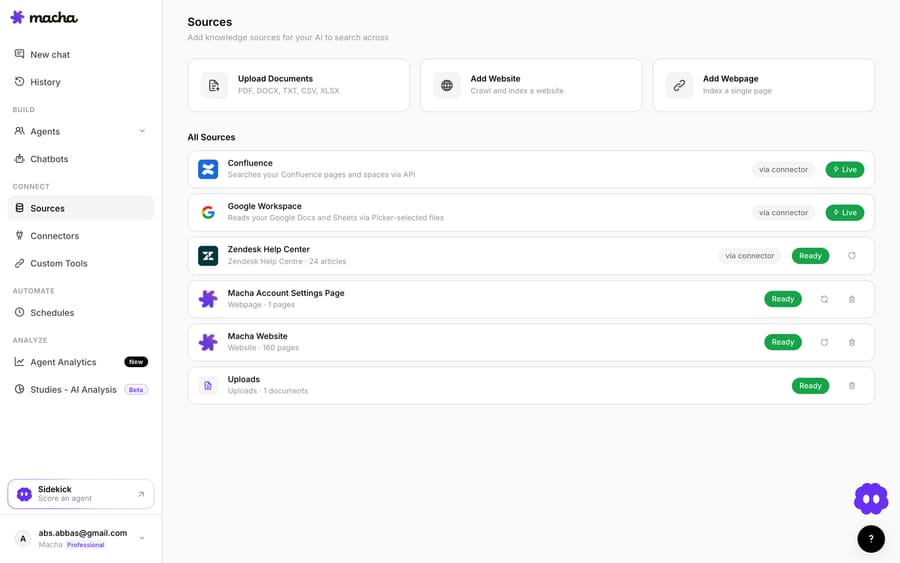
- Any API as a tool — Custom Tools turn any REST API into a capability by describing it in a sentence; ground the agent on your help center via Sources.
- Test and run — grade the agent against real historical tickets with Studies, then run it in the cloud with every run visible in analytics.
Copilot Studio vs. a help-desk-native platform
| Copilot Studio | Macha | |
|---|---|---|
| Best fit | Microsoft/Dynamics/M365 shops | Teams on Zendesk/Freshdesk/etc. |
| Help-desk home | Bridged via connectors | Native connector |
| Model | Microsoft-hosted | Model-agnostic (Claude/GPT/…) |
| Channels | Teams, web, Dynamics voice | Your help desk + chat |
| Governance | Agent 365 (enterprise) | Built-in analytics + Studies |
| Setup | A few weeks | Same afternoon |
So which should you build?
Build in Copilot Studio if you're a Microsoft-first enterprise — Dynamics, Teams, Power Platform — and want agents governed alongside the rest of your Microsoft estate; the ecosystem integration is worth it there. (For the broader build-vs-buy view, see our from-scratch vs. platform breakdown and the AI agents for customer service overview.) Choose a help-desk-native platform if your support runs on a dedicated help desk and you want an agent that lives there, on the model you prefer, live this week. You can start free on Macha and connect your help desk in minutes.
FAQ
Is "Copilot" for support the same as ChatGPT/Claude? No — Copilot Studio is Microsoft's builder for agents (it can use various models under the hood); ChatGPT and Claude are models you'd build an agent on. This post is about the builder.
Do I need Dynamics 365 to use Copilot Studio for support? Not strictly, but the biggest advantages (voice via Contact Center, deep CRM actions) assume Dynamics. Without it, you're using a Microsoft agent builder to reach a non-Microsoft help desk — workable, but not its sweet spot.
Can GitHub Copilot build the whole support agent? It'll scaffold one (.agent.md, tools, MCP wiring) fast, but it's a coding assistant, not a runtime — it won't host, monitor, or run the agent against live tickets.
What if I'm on Zendesk or Freshdesk, not Microsoft? Then a help-desk-native platform is the more natural fit — the agent lives on your help desk instead of being bridged into Microsoft's cloud.
Resolve tickets automatically with AI agents
Macha's AI agents work on top of the help desk you already use — no code.