Shopify
 Stripe
 Slack
Slack Notion
 Google Workspace
 Confluence

How to Build an AI Support Agent with Cursor


Cursor is the AI code editor a lot of developers now live in, and its Agent mode is very good at building things — including a customer support agent. Point it at your codebase, describe the agent, and it will scaffold the whole thing: the tool-calling loop, the help-desk client, the tests. The catch — and it's the important part — is that Cursor writes the agent; it doesn't run it. This guide shows how to build a support agent with Cursor fast, and is honest about the gap between the code Cursor generates and a system live on your help desk.

What you're building
A support agent is a loop: read the ticket, call tools to fetch context (customer, orders, the right help-center article), act (reply, tag, escalate), and hand off when unsure. Cursor's job is to write that loop and its tools well; running it in production is a separate job. (Weighing build-vs-buy first? See our AI agents for customer service overview.)
Option 1: Scaffold it with Cursor's Agent mode
Cursor's real advantage over a plain chatbot is that it's codebase-aware. Using Agent mode (its autonomous, multi-file editor), you can prompt:
"Build a customer support agent in this repo. Use the Anthropic SDK with a tool-use loop. Add toolsget_customer,search_kb, andreply_to_ticketthat call our existing Zendesk client inlib/zendesk.py. Escalate refunds over $100. Write tests."
Because Cursor reads your repo, it wires the agent into your code — reusing your existing Zendesk client and conventions instead of generating a generic stub. It produces the loop:
def run_agent(ticket_text):
    messages = [{"role": "user", "content": ticket_text}]
    while True:
        resp = client.messages.create(model=MODEL, system=SYSTEM,
                                      tools=TOOLS, messages=messages)
        if resp.stop_reason != "tool_use":
            return resp.content[0].text
        messages.append({"role": "assistant", "content": resp.content})
        results = [handle_tool(b) for b in resp.content if b.type == "tool_use"]
        messages.append({"role": "user", "content": results})
Three Cursor features make this better for agent work specifically:
- Rules — a
.cursor/rules/file pins your conventions so the generated agent matches your codebase, e.g.:
# .cursor/rules/agent.mdc
- All external calls go through lib/http.py with retry + backoff.
- Never let the agent issue a refund > $100 without an escalate() call.
- Log every tool call with the ticket_id.- MCP — connect Model Context Protocol servers so Cursor pulls in external context (your API schemas, your help-desk docs) while building, producing more accurate tool definitions than guessing from names.
- Background Agents — kick off longer builds (the full agent + tests) to run asynchronously while you keep working, then review the diff.
In an afternoon, Cursor can take you from empty file to a working, tested agent that fits your codebase. That's real leverage — and it's exactly where its job ends.
The catch: Cursor writes the agent, it doesn't run it
Everything Cursor gives you is code in your repo. To put that agent on real tickets, you still own the whole runtime:
- Host it 24/7 — a cloud host, secrets, a queue with retries, autoscaling. Cursor writes the handler; you run it.
- Trigger it — a webhook endpoint your help desk calls per new ticket, with signature verification and idempotency.
- Observe it — logging of every run (tools called, decisions), metrics, alerting. Cursor can write a logger; it can't watch production for you.
- Evaluate it — a harness over real historical tickets to know it's actually resolving them, run before every change.
- Maintain it — model and API changes, KB re-indexing, on-call. Cursor speeds up edits; it doesn't remove the ownership.
Cursor is a phenomenal accelerator for the building. The running is a different problem — undifferentiated infrastructure every support agent needs.
Option 2: Let Cursor build, let a platform run it
The clean division of labor: use Cursor to design and prototype the agent's logic, and a platform to run it without owning the infrastructure. Macha is model-agnostic, so you keep whatever model you built against:
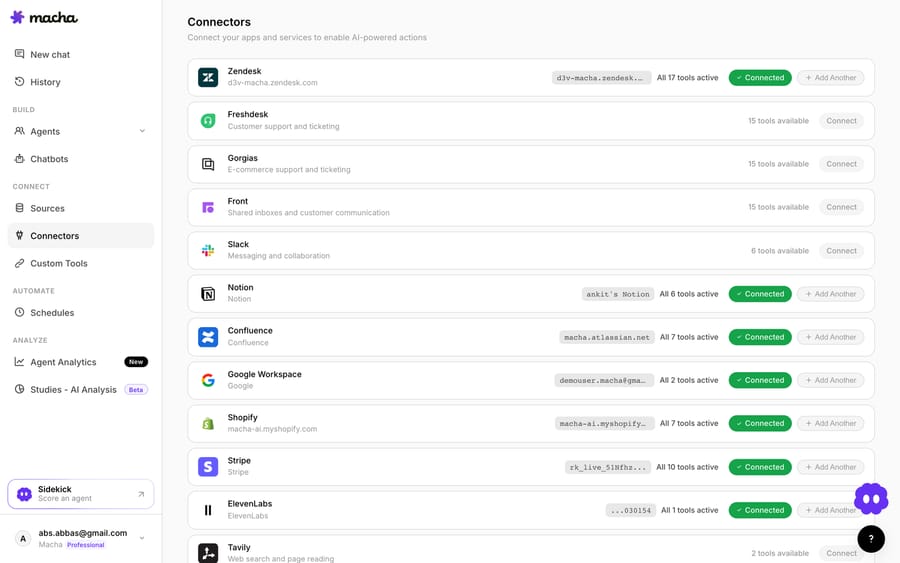
- Help-desk-native + any API — connect your help desk as a native connector (Zendesk, Freshdesk, Front, Intercom, HubSpot, Help Scout, Salesforce, Jira Service Management, Pylon); Custom Tools turn any REST API into a capability from a sentence — the same tools Cursor would hand-code, minus the hosting.
- Run + observe — the agent runs in the cloud triggered by tickets, with every run visible in analytics.
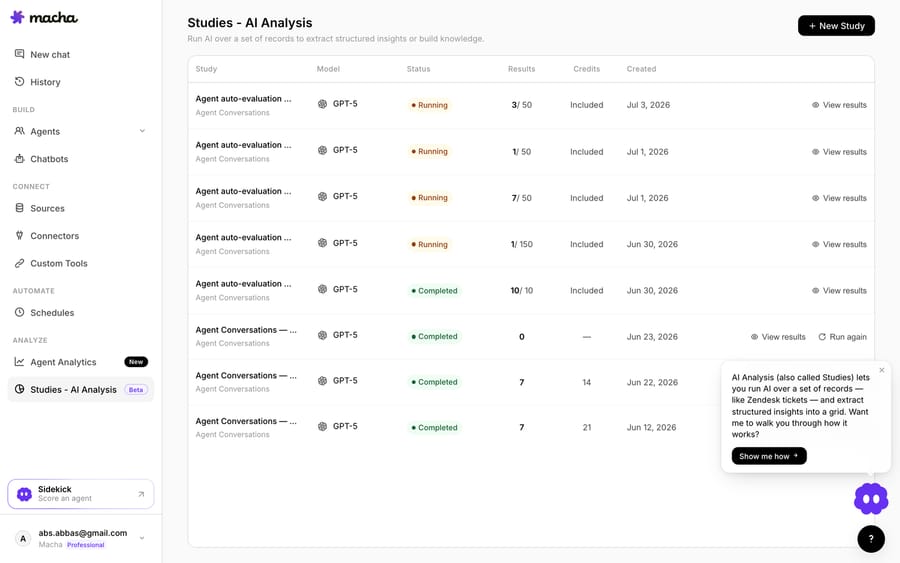
- Grade it — Studies run it against a batch of real historical tickets and score outcomes.
Cursor + a platform vs. Cursor alone
| Concern | Cursor alone | Cursor + Macha |
|---|---|---|
| Write the agent code | Cursor (fast, codebase-aware) | Cursor |
| Tools / help-desk client | Cursor generates; you host | Native connector or Custom Tools |
| Hosting 24/7 | You build and run it | Runs in the cloud |
| Observability + eval | You build both | Agent Analytics + Studies |
| Time to production | Days of code + ongoing infra | Hours |
So which should you build?
Use Cursor to build the whole thing if you want to own the runtime and the code — it's the fastest way to a well-structured, codebase-native agent, and you keep total control. (Our from-scratch vs. platform breakdown covers owning the runtime in full.) Use Cursor to prototype and a platform to run it when resolving support is the goal and you'd rather not own hosting, observability, and evals. Either way Cursor makes the building faster; the question is who runs it after. You can start free on Macha and bring the agent you prototyped.
FAQ
Is Cursor different from Claude Code or Codex for this? Same idea — an AI coding tool — but Cursor is a full IDE with deep codebase awareness (Agent mode, Rules, @-context), so it's especially good at fitting the agent into an existing repo. Like the others, it writes code; it doesn't run the agent.
Can Cursor deploy the agent too? It can write your deploy config and CI, but it doesn't host or operate the running agent — that's your infrastructure or a platform's.
Do I need to know how to code to use Cursor for this? Yes — Cursor is a developer tool. If you want to build a support agent without code, a no-code platform is the better path.
How do I know it's good before it touches customers? Grade it against real historical tickets and re-run before every change — build that harness (Cursor can help write it), or use a platform's batch grading like Macha's Studies.
Resolve tickets automatically with AI agents
Macha's AI agents work on top of the help desk you already use — no code.