Shopify
 Stripe
 Slack
Slack Notion
 Google Workspace
 Confluence

How to Build an AI Support Agent with n8n


n8n is a favorite of the technical automation crowd — open-source, self-hostable, and genuinely powerful for wiring systems together. With its AI Agent node you can build a support agent that reads a ticket, calls tools to look things up, and drafts a reply, all inside a visual workflow. If you already run n8n (especially self-hosted for privacy), this is an appealing path. This guide shows how to build it, and is honest about where n8n's workflow-first design is a great fit — and where a dedicated support platform will serve you better.

What a support agent needs
The loop: understand the ticket, fetch context (customer, orders, the right help-center article) via tools, act (reply, tag, escalate), and hand off when unsure. In n8n, that loop lives inside the AI Agent node, and the tools are other nodes wired to it. (Weighing build-vs-buy first? See our AI agents for customer service overview.)
Option 1: Build it as an n8n workflow
The AI Agent node (built on LangChain) is the heart of it — you wire sub-nodes into it for the model, memory, and tools.
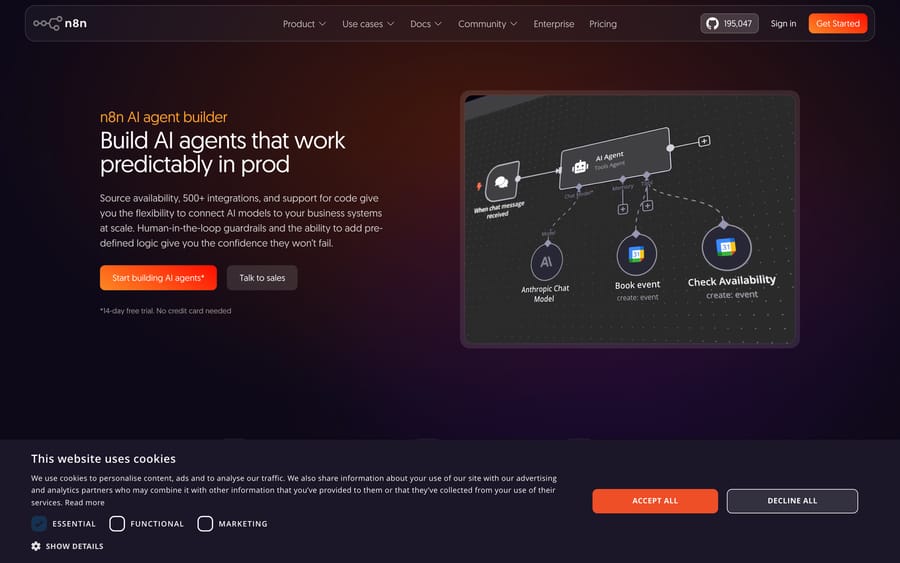
A support workflow for our Acme agent looks like this:
- Trigger — for a support agent you want a Webhook node (fired by your help desk when a ticket is created), not the Chat Trigger node (which is for interactive chat UIs). The webhook passes the ticket text and ID into the flow.
- AI Agent node — wire in a Chat Model sub-node (Claude, GPT, or Gemini) and set the system prompt: "You are Acme's support agent. Answer from the help center; escalate refunds over $100."
- Tools — attach tool sub-nodes the agent can call: an HTTP Request Tool to look up an order, a Vector Store Tool (e.g. the Postgres PGVector or Pinecone node) over your embedded help center, and another HTTP Request Tool to post the reply. The agent picks which to call per ticket.
- Memory — attach a memory sub-node so multi-turn threads keep context. Simple Memory (window buffer) works for a single execution; use Postgres Chat Memory (keyed by the ticket ID) so context survives across separate webhook calls on the same ticket — the detail most tutorials skip.
- Output — route the agent's reply to a node that posts it back to the ticket, with an IF node sending the over-$100 refunds to a human queue instead.
Because it's n8n, the whole thing is visual, version-controllable as JSON, and you can self-host it — a real advantage if data residency or privacy matters. The n8n advanced-AI docs are the reference, and Claude Code or Codex can help you draft the workflow JSON and the HTTP tool configs.
What n8n leaves you to own
n8n gives you the loop, the tools, and the triggers. The honest remainder for a support agent:
- You build and maintain the workflow. The agent is a graph of nodes you assemble and keep working as APIs and needs change — powerful, but it's yours to own, node by node.
- Grounding is DIY. There's no turnkey "connect your help center"; you stand up a vector store node, embed your docs, and keep it fresh.
- Hosting is on you (or n8n Cloud). Self-hosting n8n means running and scaling it; n8n Cloud means a bill and their limits. Either way the agent's uptime is your concern.
- No support-specific evals. n8n won't tell you whether the agent is resolving tickets. You build your own way to grade it against real cases.
- Not help-desk-native. n8n connects to your help desk via generic nodes; it doesn't live inside it the way a support tool does.
None of that is a knock — n8n is excellent when the agent is one step in a bigger automation you're already running there. It's just more assembly than a purpose-built support agent needs.
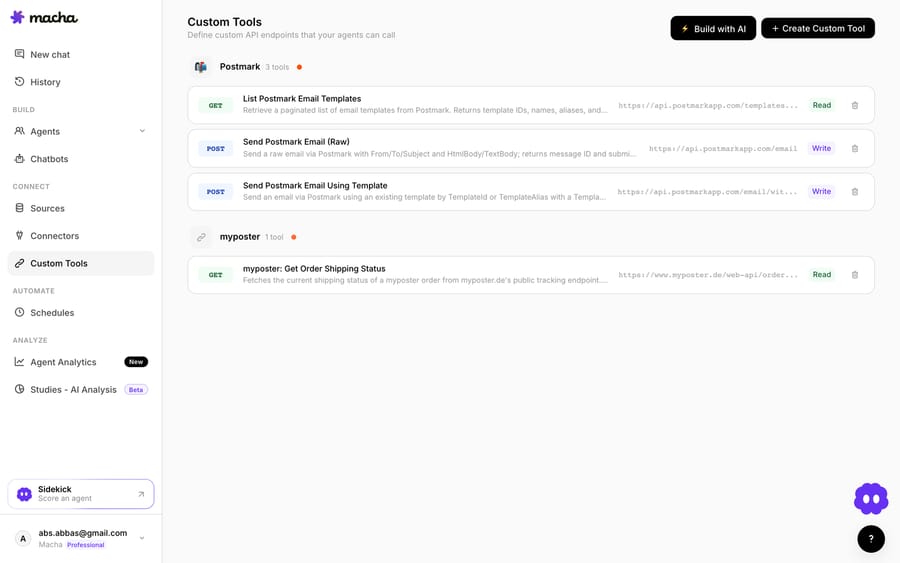
Option 2: When a dedicated support platform fits better
If the goal is specifically a support agent — not a general automation — Macha is purpose-built for it, and it's model-agnostic so you keep your choice of model:
- Help-desk-native — connect Zendesk, Freshdesk, Front, Intercom, HubSpot, Help Scout, Salesforce, Jira Service Management, or Pylon; the agent reads and replies to tickets where your team already works, no webhook workflow to build.
- Grounding + tools without assembly — attach your help center as a Source; turn any REST API into a tool with Custom Tools by describing it — no vector-store node to maintain.
- Run + grade — it runs in the cloud with every run visible in analytics, and Studies grade it against a batch of real tickets so you know it's ready.
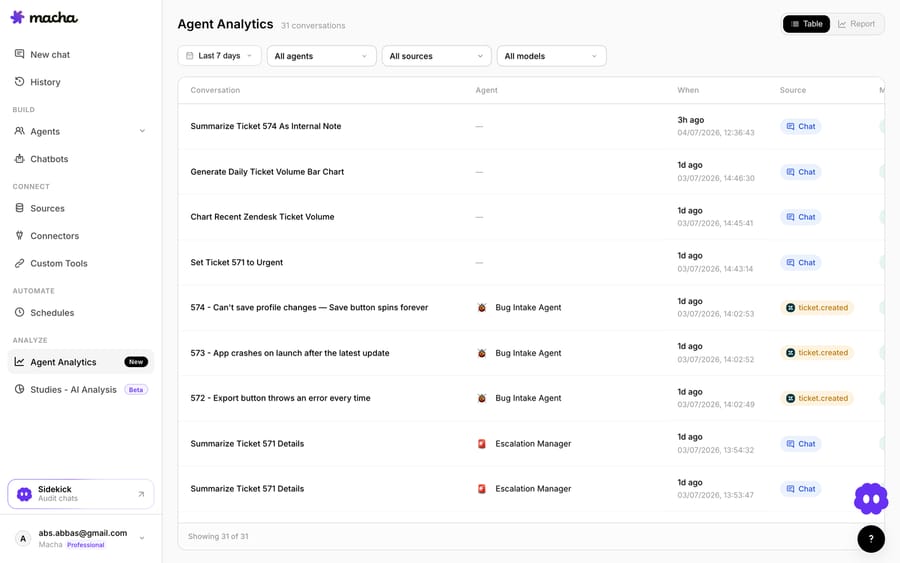
n8n vs. a dedicated platform
| Concern | n8n | Macha |
|---|---|---|
| Best fit | Agent as a step in a bigger automation; self-hosted/private | A help-desk-native support agent |
| Help-desk connection | Generic nodes you wire | Native connector |
| Grounding | DIY vector-store node | Attach a Source |
| Tools | HTTP Request nodes | Custom Tools (describe an API) |
| Hosting | Self-host or n8n Cloud | Runs in the cloud |
| Support evals | Build your own | Studies (batch grading) |
So which should you build?
Use n8n if you're already living in it, you want to self-host for privacy, or the support agent is one node in a larger automation you run there — its flexibility and openness are real strengths. (Our from-scratch vs. platform breakdown covers the broader trade.) Choose a dedicated platform when you want a support agent that's native to your help desk, grounded, and measurable without assembling and hosting a workflow. You can start free on Macha, keep your model, and connect your help desk in minutes.
FAQ
Is n8n's AI Agent node enough for support? Mechanically yes — it runs the tool-calling loop. The gaps for support are grounding, help-desk-native connection, and evals, which you assemble yourself in n8n and get out of the box on a dedicated platform.
Can I self-host the whole thing? Yes — that's n8n's big draw. If self-hosting for privacy or data residency is a hard requirement, n8n is a strong fit; weigh it against the assembly and upkeep.
Does Claude Code or Codex help build the workflow? They can draft the workflow JSON and HTTP tool configs and explain node wiring, but you still design the agent and own the running instance.
How do I know it's good before it goes live? Grade it against real historical tickets. In n8n you build that harness; on a platform like Macha, Studies does the batch grading for you.
Resolve tickets automatically with AI agents
Macha's AI agents work on top of the help desk you already use — no code.