Intercom
 Shopify
 Stripe
 Slack
Slack Notion
 Google Workspace
 Confluence

What Are the Cheaper and Free Intercom Alternatives in 2026?


Intercom has no free plan: seats run $29 to $132 a month, and Fin adds $0.99 every time it resolves a conversation. Crisp, Chatwoot, Help Scout, Freshdesk, Zoho Desk, HubSpot, Tidio and Gorgias all cost less at 750 conversations a month, and four of them have a free tier.
Key takeaways
- Crisp is the cheapest real Intercom alternative at 750 conversations a month with 40% AI resolution, costing $95 flat because its per-workspace price does not move with volume.
- Intercom's Essential plan showed $29 a seat on annual billing on September 24, 2026, after serving $19 on September 20, while Advanced costs $85 and Expert $132.
- Fin, Intercom's AI agent, charges $0.99 per outcome and at most one outcome per conversation, with a 50-outcome monthly minimum when it runs on another help desk.
- Freshdesk no longer offers a free plan: Growth costs $19 an agent a month billed annually, Pro $55 and Enterprise $89, and the old free-plan URL returns a 404.
- Chatwoot Cloud's Hacker plan is free for up to 2 agents and 500 conversations a month, and self-hosted Chatwoot removes the seat count entirely.

The cheapest real Intercom alternative in 2026 is Crisp, at $95 a month flat for a whole workspace in our 750-conversation model, and the best free options are Zoho Desk for three users, HubSpot Service Hub for two, and Crisp or Chatwoot Cloud for two. Every price below comes from the vendor's own pricing page, first read on September 20, 2026, with Intercom, Fin, Crisp, Help Scout and Freshdesk re-checked on September 24. Freshdesk no longer has a free plan at all, which many 2026 roundups still get wrong.
| Tool | Free tier | Paid from | AI meter |
|---|---|---|---|
| Intercom (for reference) | None, 14-day trial | $29 a seat (Essential, annual) | $0.99 per Fin outcome |
| Crisp | 2 seats | $45 a month per workspace | AI credit included in the plan |
| Chatwoot | 2 agents, 500 conversations | $19 an agent | Captain AI credits |
| Help Scout | 5 users, 1 Inbox | $25 a user | $0.75 per resolution |
| Freshdesk | None | $19 an agent | $49 per 100 Freddy sessions |
| Zoho Desk | 3 users | Local currency only | None on the free edition |
| HubSpot Service Hub | 2 users | $7 a seat (Starter) | 50 credits per resolution |
| Tidio | 50 conversations a month | $24.17 a month | Lyro from $32.50 a month |
| Gorgias | None | $40 a month for 50 tickets | $1.50 per automated interaction past the allowance |
Does Intercom have a free plan?
No. There is a 14-day free trial that needs no credit card, and after that every plan is paid. Intercom's pricing page, read on September 20, 2026, lists Advanced at $85 and Expert at $132 per seat a month paid annually. Essential, the entry plan, showed $29 a seat on September 24, 2026, after serving $19 on annual billing on September 20, so check what your own account is shown. Every plan needs at least one full seat. Fin, the AI agent, is available on all three at $0.99 per outcome.
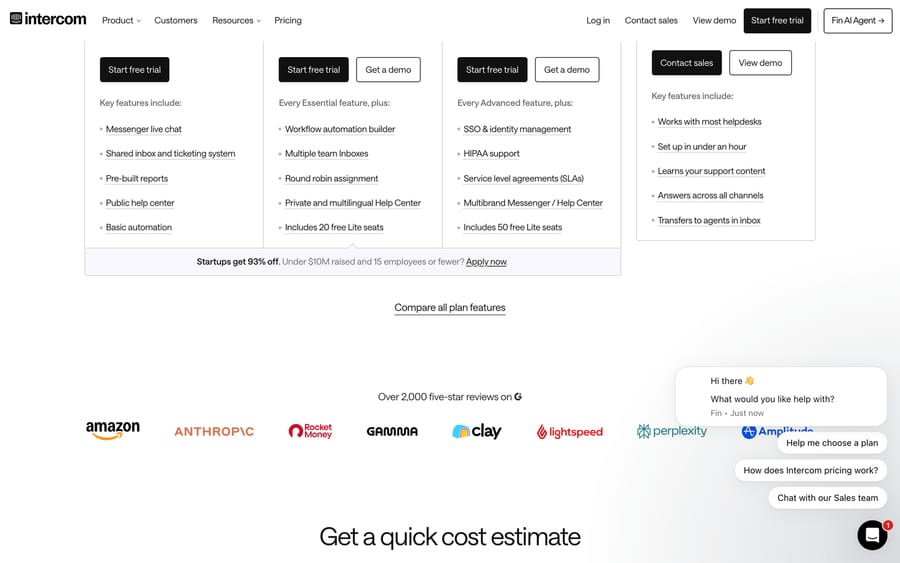
Two discounts do exist and are easy to miss. Advanced includes 20 free Lite seats and Expert includes 50, which covers colleagues who only need to read and comment. And the Early Stage program offers up to 93% off plus a year of Fin free to eligible startups. Neither is a free plan, and both end.
Why does an Intercom bill grow faster than the headcount?
The seat price is the part people budget for. The per-outcome meter is the part that surprises them, and it is the subject of the r/SaaS thread titled "My Intercom billing shot up by 120%, it was because of AI".
Fin's own pricing page states the unit plainly: $0.99 per outcome, and only one outcome is charged per conversation even if Fin takes several actions. A 50-outcome monthly minimum applies when Fin runs on a help desk other than Intercom. Qualifications, where Fin qualifies a lead rather than resolving a ticket, are $9.99 each.
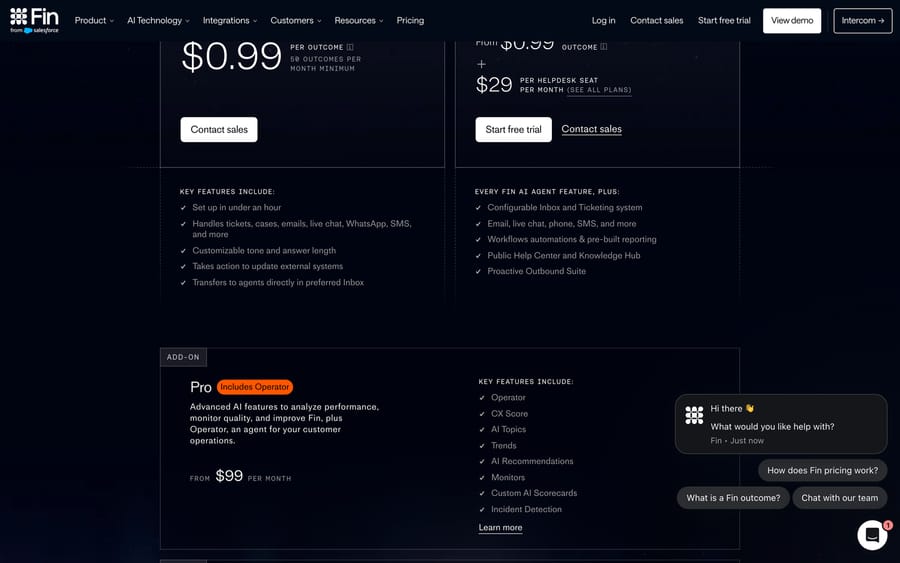
Name the incentive and the model reads differently. Per-outcome billing means the vendor earns more the more questions your customers have to ask, and nothing in the price rewards a help center good enough that they never open the chat. Intercom is straightforward about the trade: you pay only when Fin works. It is still a meter that grows with your support volume while your team stays the same size, which is exactly the shape of bill that arrives after a good launch. Our Intercom pricing explainer works through the tiers in detail.
What counts as cheaper or free here?
Three different things, and mixing them up is how people end up disappointed.
- Free forever, with a seat cap. Zoho Desk (3 users), HubSpot Service Hub (2 users), Crisp (2 seats), Chatwoot Cloud (2 agents, 500 conversations a month), Tidio (10 seats, 50 billable conversations a month).
- Free to self-host. Chatwoot under the MIT Expat license outside its enterprise directory, plus Zammad, FreeScout and osTicket. No license fee, and a server bill instead.
- Cheaper, not free. Crisp's flat per-workspace plans, Help Scout at $25 a user, Freshdesk at $19 an agent, Gorgias priced per ticket. These beat Intercom on total cost at most volumes while still being a real invoice.
What does 750 conversations a month cost on each tool?
Here is the model, so you can redo it with your own numbers: 750 conversations a month, 3 people answering, AI resolving 40% of them (300 conversations). Every rate comes from the vendor's own published page, checked September 20, 2026, with Intercom's Essential seat updated on September 24. Rows marked as a model are arithmetic, not quotes.
| Tool | Seats | AI meter | Seat cost | AI cost at 300 resolutions | Monthly total |
|---|---|---|---|---|---|
| Intercom Essential (annual) | $29 a seat | $0.99 per outcome | $87 | $297 | $384 |
| Intercom Advanced (annual) | $85 a seat | $0.99 per outcome | $255 | $297 | $552 |
| Help Scout Standard | $25 a user | $0.75 per resolution | $75 | $225 | $300 |
| Freshdesk Growth | $19 an agent | $49 per 100 Freddy sessions | $57 | $147 | $204 |
| Crisp Essentials | Flat, 10 seats included | About 450 automated conversations of credit included | $95 | $0 extra | $95 |
| Chatwoot Startups | $19 an agent | Captain AI credits, 300 on this plan | $57 | Metered, not published per conversation | From $57 |
| Gorgias Basic (annual) | Not priced per agent | $1.50 per automated interaction past 30 | $77 | $180 ticket overage plus $405 AI overage | $662 |
| Gorgias Pro (annual) | Not priced per agent | $1.50 past 190 | $471 | $165 | $636 |
| Zoho Desk Free Edition | 3 users, free | None included | $0 | No AI on the free edition | $0 |
| Self-hosted Chatwoot | Unlimited | Your own model keys | $0 license | Model usage only | A VPS, $10 to $40 |
Three things fall out of that table.
Crisp is the cheapest real product at this volume by a wide margin, because it is the only one here whose price does not move with conversation volume at all. Gorgias is the most expensive, and the reason is instructive: its Basic plan includes only 30 automated interactions, so 300 resolutions costs $405 in overage, and its Pro plan at $471 a month with 190 included is actually cheaper than Basic at the same workload. That is worth checking before you pick a Gorgias tier.
And Intercom Essential at $384 is not the outlier people expect. Intercom gets expensive when the seat plan moves up, or when resolution volume doubles. At 750 conversations and three seats, the gap to Help Scout is $84 a month.
Which eight alternatives cost less than Intercom?
Crisp: flat per workspace, which is the cheapest shape at volume
Free forever gives you 2 seats, a website chat widget, a shared inbox, mobile apps and, in the plan card's own words, "No AI credits included". The Free workspace is capped at 100 customer profiles. Above that, Mini is $45 a month, Essentials $95 and Plus $295, per workspace, with 4, 10 and 20-plus seats included and $5, $25 and $75 of AI credit.
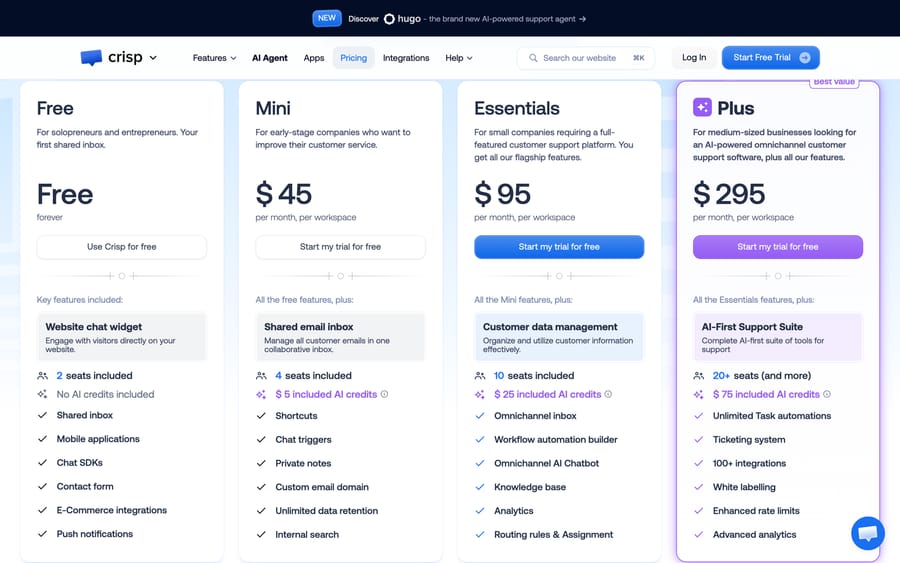
Crisp is the right answer if your conversation volume grows faster than your headcount, which is the usual shape for a self-serve SaaS product. It is the wrong fit if you need deep ticketing, routing rules or reporting, where Intercom is materially better.
Chatwoot: the open-source one, with a free cloud tier
Chatwoot Cloud's Hacker plan is $0 an agent a month for up to 2 agents, 500 conversations a month, live chat only, and 30 days of data retention. The help center, Captain AI, teams and automation rules start at Startups, $19 an agent a month, then Business $39 and Enterprise $99.
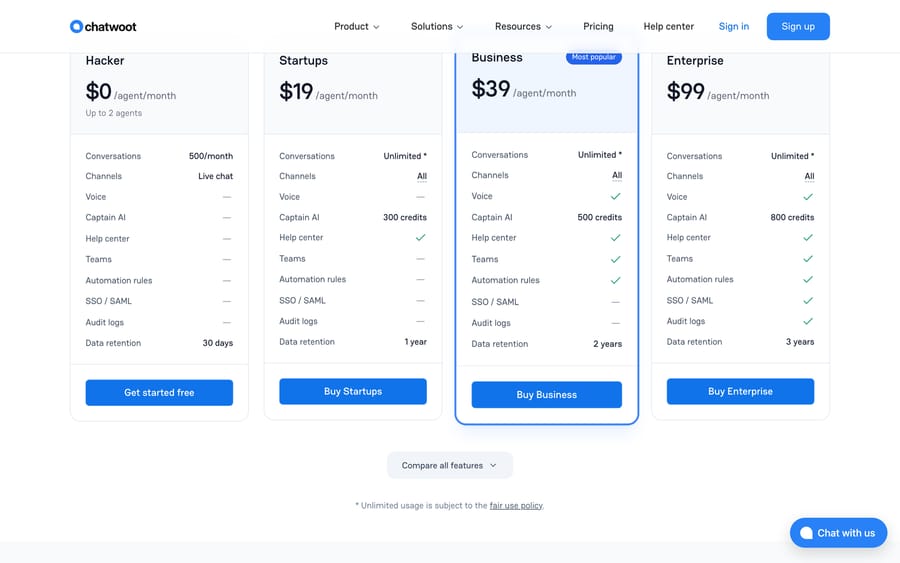
The reason it appears in every "open source Intercom alternative" thread is the license: everything outside the repository's enterprise/ directory is MIT Expat, so self-hosting removes the seat count entirely. It is the most active project in this category by a distance, at 37,002 GitHub stars with commits the week we checked. Our Chatwoot explainer covers the cloud and self-hosted split.
Help Scout: the closest thing to Intercom's shape, on a cheaper meter
Free for 5 users, 1 Inbox, 1 Docs site and 100 contacts a month. Standard is $25 a user, Plus $45 and Pro $75. AI Answers is an add-on at $0.75 a resolution with a three-month free trial.
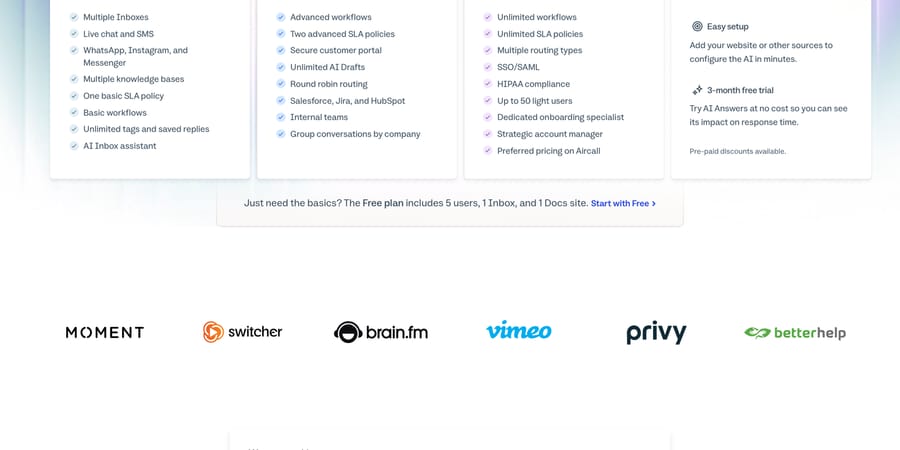
The comparison is direct: Help Scout charges 24% less per AI resolution than Fin and about the same per seat as Intercom Advanced. It suits teams whose support is email-led with chat attached, and whose growth shows up as volume on one channel.
Freshdesk: cheapest paid total in the model, and no free plan any more
Growth is $19 an agent a month billed annually, Pro $55 and Enterprise $89. Freddy AI Agent includes 500 sessions once per account and then bills $49 per 100 sessions, and Freddy AI Copilot is $29 an agent a month.
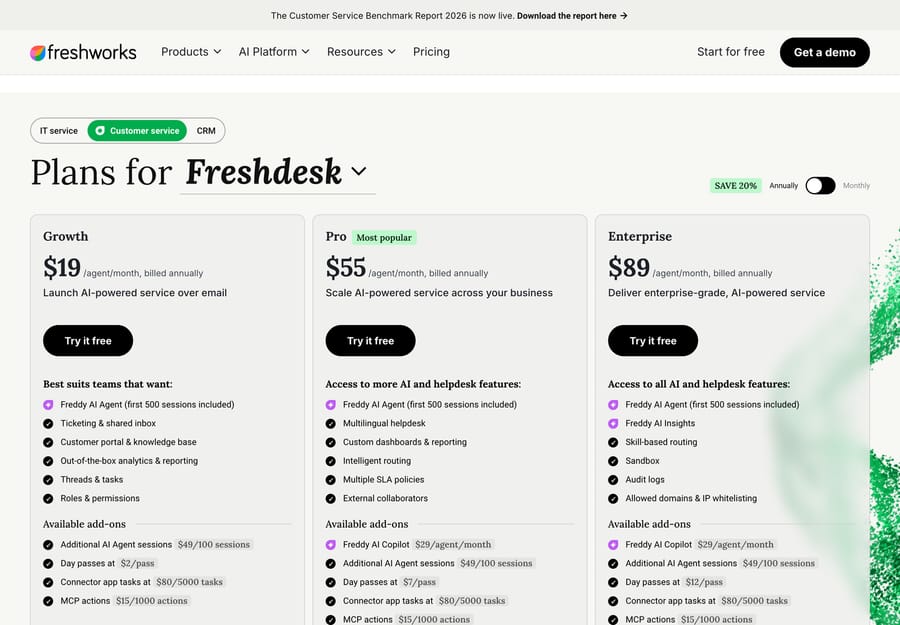
An earlier version of this page said Freshdesk's free program had shrunk to one or two agents for six months. That program is gone: the pricing page carries three paid tiers and a 14-day trial, and the old free-plan URL returns a 404. If you came here looking for it, our free Freshdesk alternatives page is the replacement shortlist.
Zoho Desk: free for three, cheap after that
Free Edition, three user licenses, free forever, with email ticketing, a help center and a knowledge base. It is the largest genuinely free ticketing product on this list.
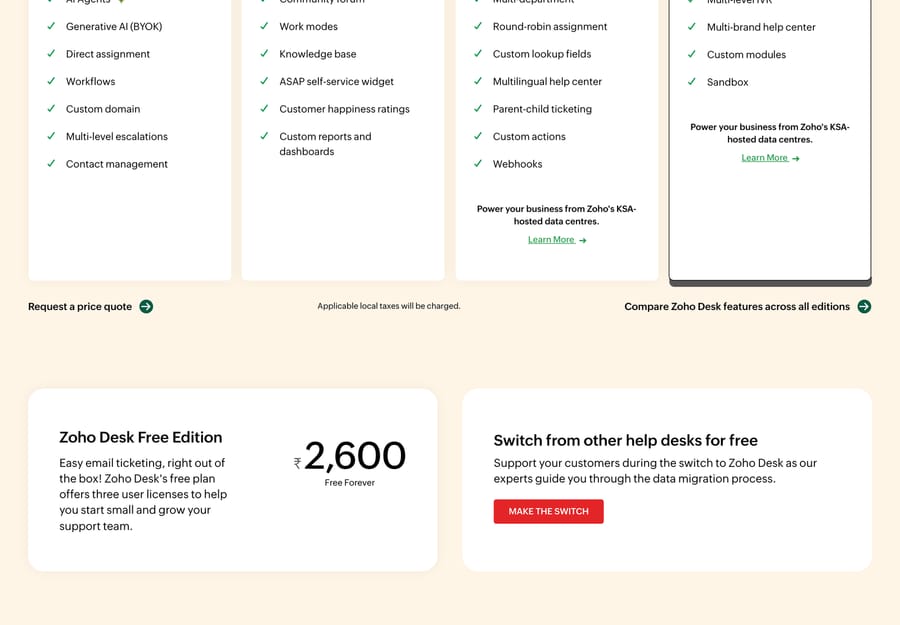
One caveat we hit and will not paper over: Zoho's pricing page geolocates and served us local currency in both a scripted fetch and a real browser, so no USD figure for the paid tiers appears here. The three-user free limit is the same everywhere.
HubSpot Service Hub: free for two, with a CRM attached
Free tools include ticketing, a shared inbox and live chat with HubSpot branding, "Free for up to 2 users. No credit card required." Starter is advertised from $7 a seat a month against a struck-through $20, Professional $90 and Enterprise $150.
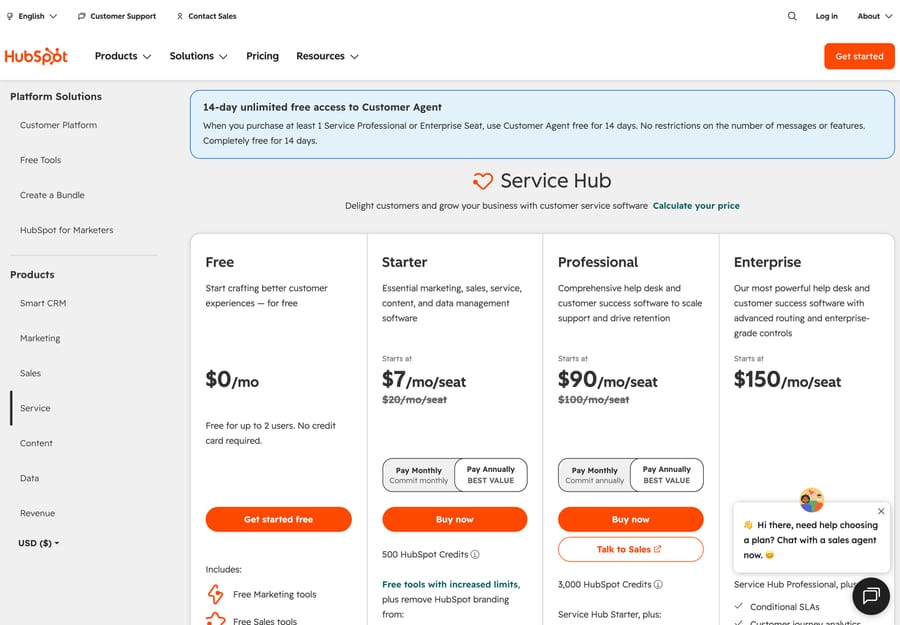
Before treating Professional as the AI answer: it carries a required one-time onboarding fee of $1,500, and the Customer Agent costs 50 HubSpot Credits per resolved conversation with credits at $9.00 per 1,000 paid annually, or roughly $0.45 a conversation. That is cheaper per resolution than Fin and more expensive per seat.
Tidio: cheap chat, with three different limits on one plan
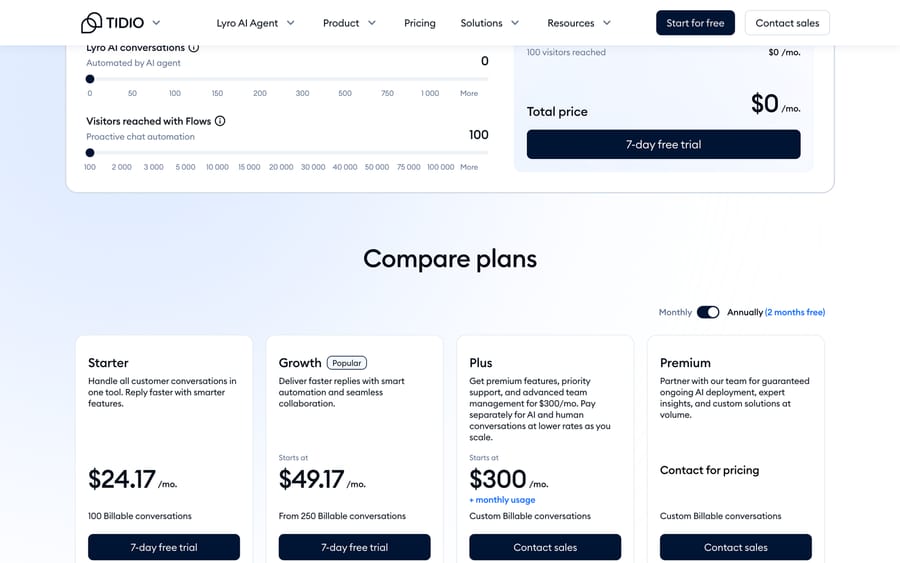
Tidio's Free plan card states "50 Billable conversations / mo." with 10 seats included, covering live chat, ticketing and email. Two other figures get confused with that one: a separate 100-unique-visitors-a-month cap applies only to Flows, Tidio's automation builder, and Lyro, Tidio's AI agent, gives a one-time lifetime allowance of its first 50 conversations rather than a monthly one. Paid starts at Starter $24.17 a month for 100 billable conversations, Growth from $49.17 at 250, and Plus at $300 plus usage. Lyro beyond the lifetime 50 is sold separately from $32.50 a month for 50 Lyro conversations.
Gorgias: per ticket, not per seat, if you sell on Shopify
Gorgias is the clearest contrast to Intercom's model, and its pricing page says so: "Helpdesk scales from 50 to 5,000 tickets a month, never priced per agent." The unit is the ticket. Starter is $40 a month with 50 tickets and 30 automated interactions, Basic $90 monthly or $77 billed annually with 300 tickets, Pro $550 or $471 with 2,000, Advanced $1,430 or $1,227 with 5,000. Ticket overage is $0.40 on the lower plans and $0.36 above. Automated interactions past the allowance are $1.50 each.
It fits ecommerce teams with a few hundred to a few thousand tickets a month and more agents than seat-priced tools make affordable. Watch the automated-interaction allowance, which is the meter that made Basic more expensive than Pro in the model above.
Does moving to Zendesk, Freshdesk, Gorgias or Front cut the AI bill?
If the AI meter is your reason for leaving Intercom, changing desks does not by itself fix it. Zendesk bills automated resolutions at $1.50 on a committed plan, or $2.00 pay-as-you-go (its own free options are a separate shortlist, in our free Zendesk alternatives guide), Freshdesk charges $49 per 100 Freddy sessions, Gorgias $1.50 per automated interaction past the allowance, and Help Scout $0.75 a resolution. Everyone meters AI. The question worth asking is which unit the meter counts.
Macha is our product and it is not on the list above, because it is not free and it is not a help desk. It is an AI agent layer that runs on top of Zendesk, Freshdesk, Gorgias, Front, HubSpot or Intercom, so it is only relevant if you land on one of those. What it changes is the unit: one plan priced on monthly ticket volume, from $299 a month for 750 tickets, about $0.40 a ticket at every tier, where a ticket is one thread with one person and costs the same however many replies it takes. At the 750-conversation volume modeled above, that is $299 against $384 on Intercom Essential and $300 on Help Scout, with setup and monitoring by the Macha team included. The trial is $50 of free usage, no credit card. Details on Macha on Gorgias and pricing.
If you are staying on Intercom, Macha still connects and runs agents on your Intercom inbox rather than replacing it, but none of the switching math above applies to you.
How we researched this
We opened each vendor's pricing page in a scripted browser on September 20, 2026, captured the plan tables, and read the free column instead of the marketing above it. Freshdesk and HubSpot rewrite their prices by IP address, so we read Freshdesk's server-rendered page with JavaScript disabled and switched HubSpot's own currency control to USD; Zoho refused both, which is why no Zoho USD figure appears. The 750-conversation model is our own arithmetic on published rates. No vendor quoted us a number. We did not create a test account on any of these products for this page.
Which alternative should you choose?
- Volume grows faster than your team. Crisp. Flat per workspace is the only pricing shape here that ignores conversation count.
- You want to keep the Intercom shape for less. Help Scout, at $25 a user and $0.75 a resolution.
- You need real ticketing, SLAs and routing. Freshdesk Growth at $19 an agent, cheapest paid total in the model.
- You sell on Shopify. Gorgias, and pick the tier by automated-interaction allowance rather than by ticket count.
- Three people and an email queue. Zoho Desk Free Edition, $0.
- Two people and a chat widget. Crisp Free or Chatwoot Hacker, $0.
- You have a server and a preference for owning things. Self-hosted Chatwoot, and see our open-source ticketing roundup for the rest.
- You should stay on Intercom if you use its product tours, outbound messages and Series campaigns. Nothing on this list replaces those, and rebuilding them elsewhere costs more than the seats you save.
Frequently asked questions
Does Intercom have a free plan? No. Intercom offers a 14-day free trial with no credit card, then charges $29 a seat a month paid annually on Essential (it showed $19 on September 20, 2026), with Advanced at $85 and Expert at $132 on the same basis. Fin, its AI agent, is $0.99 per outcome on every plan.
What is the cheapest alternative to Intercom? Free: Zoho Desk for three users, Crisp or Chatwoot for two, HubSpot Service Hub for two. Paid: Crisp Mini at $45 a month for a whole workspace, or Freshdesk Growth at $19 an agent. At 750 conversations a month with 40% AI resolution, Crisp Essentials at $95 was the cheapest real product in our model.
Is there an open-source Intercom alternative? Chatwoot is the direct one: an omnichannel inbox with a chat widget, MIT Expat licensed outside its enterprise directory, 37,002 GitHub stars and commits the week we checked. Zammad and FreeScout cover the ticketing and shared-inbox halves if you do not need the widget.
How much does Fin cost? $0.99 per outcome, with a 50-outcome monthly minimum when Fin runs on a help desk other than Intercom. You are charged at most once per conversation even if Fin takes several actions. Qualifications are $9.99 each. At 300 resolutions a month that is $297 on top of your seats.
Why did my Intercom bill go up? Almost always the Fin meter rather than the seats. Resolution volume tracks your customer count and your launch calendar while your headcount sits still, so a bill that was stable for a year moves when traffic does. Check the outcomes line on the invoice before you change plan.
Is Freshdesk free? No, not any more. Its pricing page lists Growth $19, Pro $55 and Enterprise $89 per agent a month billed annually, plus a 14-day trial, and the old free-plan URL returns a 404. Any comparison still crediting Freshdesk with a free tier is out of date.
Is Tidio free up to 50 conversations a month? Yes. Tidio's Free plan card states "50 Billable conversations / mo." with 10 seats included. A separate 100-unique-visitors-a-month cap exists too, but it belongs to Flows, Tidio's automation builder, not the plan's overall conversation allowance.
Which alternative is closest to Intercom's product? Help Scout for the inbox, docs and AI resolution model; Crisp for the chat widget and campaign side; Gorgias if your customers arrive from a Shopify store. None of them replaces Intercom's product tours or Series campaigns.
What does a cheaper tool cost me? Usually three things: outbound messaging and product tours, the depth of reporting, and the size of the integration catalog. If you only use Intercom as a shared inbox with a chat widget and an AI agent, you are paying for a lot of product you are not touching, and switching is cheap. If you run campaigns out of it, it is not.
Sources:
- Intercom pricing and Fin pricing, both checked September 20 and 24, 2026
- Crisp pricing, Chatwoot pricing, Help Scout pricing, Tidio pricing
- Freshdesk pricing, Zoho Desk pricing, HubSpot Service Hub pricing, Gorgias pricing
- Chatwoot on GitHub, checked September 20, 2026
- Community threads reached through search: r/SaaS on an Intercom bill rising because of AI, r/SaaS on better options than Intercom and Fin, r/iOSProgramming on affordable Intercom alternatives
Add AI agents to your Intercom
Macha reads the conversation, drafts the reply and takes the action, inside the Intercom you already run.