Intercom
 Shopify
 Stripe
 Slack
Slack Notion
 Google Workspace
 Confluence

What Is DigitalGenius? Ecommerce AI Agent, Pricing and Alternatives (2026)


DigitalGenius is an AI agent built only for ecommerce and retail that resolves order, return, refund and warranty tickets inside your existing help desk. It has no public pricing and no free trial, and third-party estimates start around $1,000 a month plus an implementation fee.
Key takeaways
- DigitalGenius is an AI agent built only for ecommerce and retail, founded in 2013 in London, that resolves order, return, refund and warranty tickets inside an existing help desk.
- DigitalGenius publishes no pricing and offers no free trial, and third-party estimates put its license at about $1,000 to $2,000 a month plus an implementation fee.
- DigitalGenius integrates with help desks including Zendesk, Salesforce, Gorgias, Kustomer and Freshdesk, and says it builds new integrations free of charge.
- DigitalGenius reports that On cut customer wait times by 93%, air up saw 600% ROI, and Beauty Pie automated 40% of contacts at over 90% resolution.
- DigitalGenius suits mid-market and enterprise ecommerce brands with heavy WISMO, returns and warranty volume and the staff to run a sales-led, multi-week implementation.

DigitalGenius is a London-based AI agent built only for ecommerce and retail: it resolves "where is my order?", returns, refunds, order changes and warranty claims inside your existing help desk, and it sells through demos and custom quotes with no public price or free trial. Third-party estimates put it at about $1,000 to $2,000 a month plus an implementation fee, which makes it a mid-market and enterprise tool. We build an AI support product ourselves, so we say where that bias applies, and where we couldn't verify something we say so.
| Question | DigitalGenius, as of 24 September 2026 |
|---|---|
| What it is | AI agent for ecommerce and retail, pre- and post-purchase; founded 2013, London |
| Product range | Customer Care, Agentic Commerce (Purchase AI), Proactive, Voice, Voice of Customer, Warranty |
| Architecture | Generative AI plus proprietary orchestration; pre-built "Genius Flows" (50 to 60+ use cases, per directories) |
| Help desks | Zendesk, Salesforce, Gorgias, Kustomer, Freshdesk, Gladly, Dixa, eDesk, Genesys, NICE, Sprinklr and others |
| Ecommerce / backend | Shopify, BigCommerce, WooCommerce, Magento, commercetools, Salesforce Commerce Cloud, Scayle, Centra; carriers such as DHL, UPS, FedEx; ERPs and warehouses |
| Pricing | Not published; third-party estimates ~$1,000 to $2,000 a month plus implementation |
| Free trial | None; demo and custom quote only |
| Deployment | Sales-led; reviewers describe ~2 to 4 weeks with vendor support |
| G2 rating | 4.7 / 5 from ~46 reviews at our last successful check (G2) |
What is DigitalGenius?
DigitalGenius is an AI agent built for ecommerce and retail, spanning both pre- and post-purchase. Founded in 2013 and headquartered in London, it's one of the older companies in the space. It predates the current LLM wave by nearly a decade. On funding, the reported figures don't fully agree: Tracxn lists ~$38.5M across 8 rounds from 31 investors (Tracxn), while PitchBook puts the total closer to ~$34.5M (PitchBook), anchored by a $14.75M Series A in 2017 (TechCrunch). Call it ~$35–38.5M raised: well-funded, but not mega-funded. It still markets itself as "the AI Agent built for ecommerce" (digitalgenius.com).
The core idea is resolution, not deflection. Where a basic bot points a shopper at a help-center article, DigitalGenius reads the incoming message, works out what the customer actually wants, pulls the relevant data from your backend systems (order management, shipping carriers, payment processors), and then either resolves the ticket end to end or hands it to a human agent with full context (digitalgenius.com). The pitch is that it does the things shoppers care about, "Where is my order?", "I need to return this", "this arrived damaged", and, increasingly, the pre-sale ones too ("which size should I get?"), without a person in the loop.
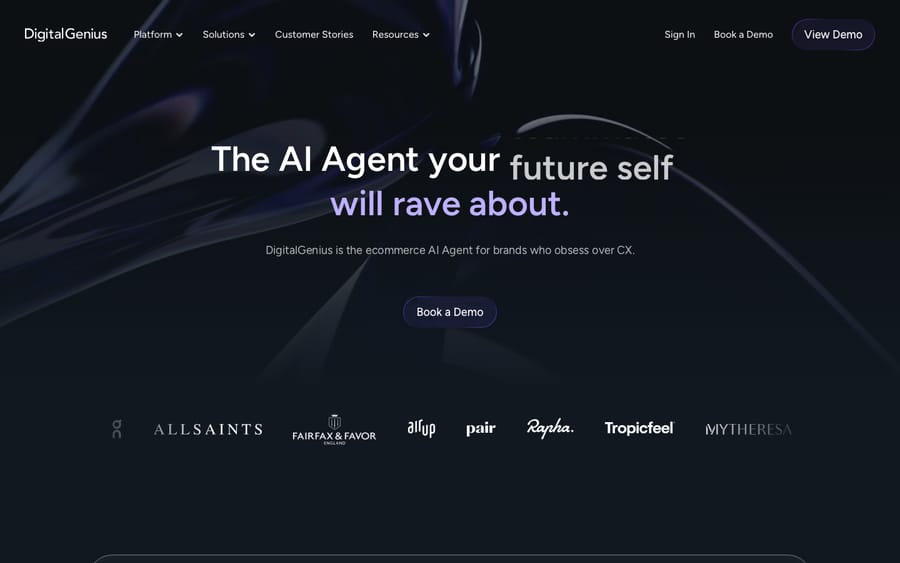
What sets it apart from horizontal AI agents (Intercom Fin, Decagon, Ada) is the ecommerce specialization: a decade of retail-specific training data, pre-built flows for common store scenarios, and direct connections to carriers and warehouses. That focus is both its biggest strength and its biggest limitation, as we'll get into.
What products does DigitalGenius sell, and how do they work?
DigitalGenius has outgrown the "single chatbot" description. The live platform is now a range of AI products covering the whole shopper journey, all sharing one orchestration engine (digitalgenius.com). Older write-ups describe it as "three layers: conversational, visual, and generative AI", which is dated. The site navigation on 24 September 2026 lists Customer Care, Agentic Commerce, Voice of Customer, Proactive and Warranty as solutions, plus Voice as a channel. We use the product names below (Care AI, Purchase AI and so on) because Purchase AI is still the name on the Agentic Commerce page and most buyer guides use the rest.
Care AI, post-purchase service (the core)
This is the original product and still the centre of gravity: the agent that reads an incoming message, works out intent, pulls order and carrier data, and resolves WISMO, returns, refunds, order changes, and warranty claims end to end. Care AI is also where DigitalGenius's standout visual AI lives, a computer-vision model that reads customer-submitted photos to detect product defects and damage and triggers the right workflow automatically (Software Finder). Upload a picture of a cracked item and it can verify the damage and kick off a replacement without a human eyeballing it first , an uncommon capability for warranty- and defect-heavy categories (apparel, electronics, homeware). DigitalGenius now also lists Warranty as a solution of its own.
Purchase AI, pre-purchase (the part older guides miss)
DigitalGenius isn't only post-purchase support anymore, and that's the most important correction to make. Purchase AI syncs with your product catalog and handles pre-sale conversations in chat, asking clarifying questions, then surfacing personalized product recommendations, advice, and upsells, each with a short explanation for the pick (digitalgenius.com/agentic-commerce). The pitch is turning browsers into buyers and reducing returns through better fit. If you only think of DigitalGenius as a deflection tool for "where's my order," you're missing half the current product.
Proactive AI, getting ahead of the ticket
Rather than wait for a complaint, Proactive AI detects late or stuck orders and reaches out first, offering expedited shipping, a replacement, or a refund before the customer has to chase (digitalgenius.com). It's the same resolution machinery pointed at problems the customer hasn't raised yet.
Voice AI and Insights AI
Voice AI puts the same engine on the phone, answering calls, looking up and editing orders, escalating to a human when needed, and loading full transcripts back into the platform for analysis (digitalgenius.com/voice). Insights AI mines the conversations the other products handle to surface voice-of-customer trends and recurring issues.
The Orchestrator, how it decides what to do
Tying the range together is what DigitalGenius positions as a hybrid orchestration architecture: "balancing best-in-class generative AI models with our proprietary orchestration tools to ensure your customers get the right outcome - every time" (digitalgenius.com). In practice, LLMs handle understanding and phrasing, while deterministic, pre-built workflows (branded "Genius Flows") control the steps that touch money and orders. The bet: a pure-LLM agent is too unpredictable to be trusted with refunds and address changes alone, so the model is wrapped in guardrailed workflows. (DigitalGenius describes this as "orchestration tools" and lists an "AI OS" page in its platform menu rather than a separately branded "Orchestrator" product, so treat it as architecture, not a SKU.)
Deep integrations (the part that does the work)
None of the above matters if the agent can't act. DigitalGenius's resolutions depend on live connections into your stack, pulling tracking from carriers, processing returns, issuing refunds through your payment processor, checking stock in an ERP, and syncing the product catalog Purchase AI recommends from. Concretely, the integrations page lists help desks (Zendesk, Salesforce, Gorgias, Kustomer, Freshdesk, Gladly, Dixa, eDesk, Genesys, NICE, Sprinklr, Zoho), ecommerce platforms (Shopify, BigCommerce, WooCommerce, Magento, commercetools, Salesforce Commerce Cloud, Scayle, Centra, eBay), and well over a hundred carriers, returns tools, warehouses and ERPs behind them (DHL, UPS, FedEx, Loop Returns, Recharge, NetSuite, SAP). DigitalGenius says it builds any integration, including custom ones, "absolutely free of charge". This is where "resolution rather than deflection" actually lives, and, as we'll see, also where setup gets heavy.
Which ecommerce tickets can DigitalGenius automate?
DigitalGenius ships with 50–60+ pre-built ecommerce use cases (SoftwareWorld). The headline flows:
- WISMO / order status: package tracking, delivery estimates, and reshipment of lost or delayed orders. For most retailers this is the biggest single bucket of volume.
- Returns & exchanges: initiating returns, generating labels, and processing exchanges automatically.
- Refunds: issuing refunds through the connected payment processor once policy conditions are met.
- Order modifications: real-time address changes, item swaps, and cancellations before fulfillment.
- Warranty & defect claims: using visual AI to verify damage from a photo and trigger a replacement.
- Subscriptions: managing, pausing, and preventing cancellations (save flows).
- FAQs & policy questions: knowledge-base-grounded answers for sizing, shipping, and policy queries.
- Pre-purchase recommendations: via Purchase AI: catalog-aware product advice, recommendations, and upsells that answer shopping questions and nudge a sale before checkout.
On channels, DigitalGenius works across email, live chat, social media, messaging apps, and voice (digitalgenius.com). It's designed to run through your existing help desk (Zendesk, Gorgias, Salesforce, Kustomer, Freshdesk and others) rather than replace it. It's an automation layer on top of the helpdesk you already use, not a new ticketing system.
How much does DigitalGenius cost in 2026?
DigitalGenius doesn't publish pricing. On 24 September 2026 its /pricing address opened the Book a Demo page. There's no rate card, no self-serve tier, and no free trial: you go through a demo and get a custom quote (G2 pricing). Everything below is assembled from third-party teardowns and software directories, and should be treated as approximate and possibly outdated, so confirm directly with DigitalGenius before budgeting.
What's reported across third-party teardowns and directories (no single one of which is authoritative; we flag where a figure leans on one source):
- License fees: ~$1,000–$2,000/month as a starting band. This recurs across third-party guides and aggregators (e.g. myAskAI; others peg it as "starting at approximately $1,000/month"), consistent, but still estimates, not a published price.
- Implementation fees: ~$1,000–$50,000, scaling with size, roughly $1,000–$5,000 for smaller companies, $10,000–$50,000 for larger enterprises. This specific spread comes mainly from one teardown (myAskAI), so treat it as indicative, not quoted; a directory separately cites a ~$2,500 one-time implementation fee (ITQlick), inside the lower end of that range.
- Usage / automation-based model. Multiple sources say pricing is tied to how much DigitalGenius automates: that is, the volume of tickets the AI resolves, rather than flat per-seat (G2 pricing).
A caution on the numbers: some directories also float per-seat figures: roughly $50/month for one user, $400/month for ten, $3,500/month for a hundred (itqlick / saasworthy listings). These contradict the usage-based descriptions and read like auto-generated directory estimates rather than confirmed quotes, so treat them with extra skepticism.
Bottom line on pricing: the defensible takeaway is simple: plan for four figures a month minimum plus an implementation fee, on a custom, sales-led contract. DigitalGenius is priced and sold like enterprise software; if you're a small store hoping to swipe a card and switch it on this afternoon, that's not how this one works, and that's by design.
What do DigitalGenius users say?
DigitalGenius holds a strong 4.7 / 5 on G2 across roughly 46 reviews (G2). (G2 and Gartner block automated access, and G2 refused our request again on 24 September 2026, so the themes below are drawn from G2 review text surfaced in search and from software directories, paraphrased and attributed by reviewer segment, not invented names or dates.)
The most consistent praise is for the customer-success team. As one verified G2 reviewer (retail/CX) put it, the "most helpful aspect is its continued collaborative approach to daily operations and projects… with a human element to cooperating with people who may not be tech-minded" (G2 reviews). Reviewers repeatedly mention weekly working sessions and a team that's "responsive and quick to understand what we needed."
On capability, a verified G2 user highlighted the automation payoff: DigitalGenius "has helped automate tasks in the CX department which has allowed employees to focus on other tasks that require human attention," and praised it for "giving a personalised response… and helping find creative solutions to complicated issues" (G2 reviews).
The criticism is just as consistent. The same reviewers flag that "the analytics section could be a little more user-friendly," and another noted the partnership can be resource-constrained, "challenging matching expectations on project progress, due to the resources allocated to our brand," while being careful to add it "is not a reflection on the employees themselves" (G2 reviews). Across directories, the recurring cons are a steep learning curve, advertised integrations that aren't as plug-and-play as the marketing implies, and the custom-quote pricing being a barrier for teams that want predictability (myAskAI).
DigitalGenius also publishes customer outcomes, re-checked on its site on 24 September 2026: On cutting wait times by 93%, air up reporting 600% ROI since deployment, and Beauty Pie automating 40% of contacts at a resolution rate of over 90% and 95% CSAT (digitalgenius.com customers). Treat these as vendor-reported marketing figures: real brands, plausible results, but self-selected best cases, not independently audited. Your numbers will hinge on ticket mix and how much you invest in configuration.
Where is DigitalGenius strong?
- Genuinely ecommerce-native. Pre-built retail flows, retail-trained intent models, and carrier/warehouse integrations mean less from-scratch configuration for store-specific scenarios than a horizontal agent.
- Visual AI is a real differentiator. Photo-based defect and damage detection is uncommon and genuinely valuable for warranty-heavy categories.
- Resolution, not just deflection. Deep backend integrations let it take real actions (refunds, returns, order changes) end to end.
- Strong, hands-on customer success. The single most repeated theme in reviews is a responsive, collaborative team. The 4.7/5 G2 score reflects high satisfaction where it lands.
- Runs on your existing helpdesk. It layers onto Zendesk, Gorgias, Salesforce, Kustomer, Freshdesk and several other help desks rather than forcing a migration.
What are DigitalGenius's limitations?
- No pricing, no trial, sales-led. You can't evaluate it without a demo and a quote, which is real friction for teams that like to test before they buy.
- Enterprise/mid-market only. With a four-figure monthly floor plus implementation, it's impractical for small stores. In our judgment it makes most sense for brands doing 10,000+ tickets a month.
- Heavy implementation. Reviewers describe a ~2–4 week setup with a steep learning curve; without dedicated technical resources, projects can stall.
- Integrations aren't always plug-and-play. A recurring complaint is that advertised "partner" integrations need more work than expected. One third-party teardown specifically cites Gorgias knowledge-base sync as needing manual workarounds (myAskAI). We couldn't independently confirm that exact limitation, so take it as a single-source data point illustrating the broader theme rather than a settled fact.
- Edge cases and analytics. The AI handles common ecommerce queries well but can go off-target on unusual situations, and multiple reviewers want a friendlier analytics interface with more self-serve tuning.
Who is DigitalGenius best for, and who should skip it?
Best for: mid-market-to-enterprise ecommerce brands with high ticket volume (think 10,000+/month), a meaningful share of WISMO, returns, and warranty/defect contacts, the budget for a four-figure-plus monthly contract with an implementation fee, and the internal resources to run a multi-week setup. If you sell physical products at scale and want photo-based defect handling and deep carrier integrations, DigitalGenius is a legitimately strong fit.
Not for: small stores and early-stage DTC brands, teams that want to try before they buy or need transparent pricing, anyone without technical resources to own the rollout, or support that's mostly simple FAQ deflection that doesn't justify enterprise machinery.
What are the best DigitalGenius alternatives?
DigitalGenius sits in a competitive ecommerce-AI field. The honest shortlist:
- Yuma AI: Shopify-native ecommerce AI agent; connects to Gorgias, Zendesk, Kustomer, and Front; markets high automation rates (Yuma).
- Gorgias Automate: the AI layer inside the ecommerce-native Gorgias helpdesk; lowest friction if you already run Gorgias.
- Siena: ecommerce AI agent that optimizes for human-feeling tone; integrates with Gorgias, Zendesk, and others.
- My AskAI: multi-helpdesk agent with notably transparent public pricing and fast setup.
- Intercom Fin / Decagon / Ada: horizontal AI agents that aren't ecommerce-specific but scale across industries; worth a look if your needs go beyond retail.
Update (September 2026): Salesforce completed its acquisition of Fin (the company renamed itself from Intercom on May 12, 2026) on September 10, 2026, in a deal worth about $3.6 billion. Worth weighing in any long-term Fin decision.
A note on where we fit, since we'd rather be upfront than pretend we're neutral. Macha is an AI agent layer that runs on top of Zendesk, Freshdesk, Gorgias, Front, HubSpot or Intercom. It isn't a help desk and it isn't a rip-and-replace platform. Both products sit on the help desk you already run, so the differences are elsewhere. Macha is faster to start (you can begin with $50 of free usage, no credit card required rather than a sales-and-implementation cycle), setup and monitoring are done by the Macha team at no extra charge, and it bills per ticket on published prices: one charge per thread, from $299 a month for up to 750 tickets, rather than an unpublished usage quote. DigitalGenius is the deeper, ecommerce-specialized, enterprise-custom option (with visual AI and carrier integrations Macha doesn't try to replicate); Macha is the lighter-weight option with a published price. Which is right depends on your scale, your stack, and how product-defect-heavy your support is. If you're weighing AI options around Zendesk specifically, our roundup of the best AI Zendesk alternatives lays out the trade-offs, and our guide to Zendesk AI covers the native option.
How we researched this
We drew on DigitalGenius’s own product, pricing and case-study pages and on third-party teardowns by competing vendors, which we label wherever we lean on them; DigitalGenius does not publish a rate card, so the numbers in the pricing section are reported ranges rather than quotes. On September 21, 2026 we re-checked the internal links in this post and added the guide cross-references above, and we did not obtain new pricing on that pass. DigitalGenius is demo-gated, so nothing here comes from hands-on use, and G2 turned away every request we made that day. On September 24, 2026 we re-checked the product menu, the integrations page, the customer figures and the absence of public pricing on digitalgenius.com.
Frequently asked questions
What is DigitalGenius? DigitalGenius is an AI agent built specifically for ecommerce and retail, spanning both pre- and post-purchase. Founded in 2013 and based in London, it ships as a product range: customer care (post-purchase service), Purchase AI (pre-sale recommendations and upsells), proactive outreach, voice, warranty, and voice-of-customer analytics, all running on one orchestration engine connected to your backend systems and help desk.
How does DigitalGenius's AI work? It pairs LLMs with deterministic, pre-built workflows ("Genius Flows") in a hybrid orchestration architecture: the model handles understanding and phrasing, while guardrailed workflows control the steps that touch orders and money. Deep integrations pull order/carrier data and take action; a visual-AI model (part of Care AI) reads customer photos to detect defects and damage; and Purchase AI handles catalog-aware pre-purchase recommendations. Pre-built flows cover 50–60+ ecommerce scenarios.
How much does DigitalGenius cost? DigitalGenius doesn't publish pricing and offers no free trial; it's custom and sales-led. Third-party estimates put license fees around $1,000–$2,000/month plus an implementation fee of roughly $1,000–$50,000 depending on size, with pricing generally tied to how much the AI automates. These are third-party estimates and may be outdated, so confirm directly with DigitalGenius.
What integrations does DigitalGenius support? Help desks include Zendesk, Salesforce, Gorgias, Kustomer, Freshdesk, Gladly, Dixa, eDesk, Genesys, NICE and Sprinklr. Ecommerce platforms include Shopify, BigCommerce, WooCommerce, Magento and commercetools, plus shipping carriers (DHL, UPS, FedEx), returns tools, ERPs and warehouses. DigitalGenius says it builds new integrations free of charge, and it runs on top of your existing help desk rather than replacing it.
Is DigitalGenius good for small businesses? Generally no. With a four-figure monthly floor, an implementation fee, a multi-week setup, no trial, and no public pricing, it's built for mid-market and enterprise brands, typically those doing 10,000+ tickets a month. Smaller stores are usually better served by self-serve tools that layer onto an existing helpdesk.
What are the main alternatives to DigitalGenius? Ecommerce-specific peers include Yuma AI, Siena, and Gorgias Automate; My AskAI is a transparent-pricing multi-helpdesk option; and Intercom Fin, Decagon, and Ada are horizontal agents. For teams that want an AI agent with published per-ticket pricing on top of their existing help desk, Macha is a lighter-weight option.
Should DigitalGenius be on your shortlist?
DigitalGenius is one of the strongest ecommerce-specialized AI agents in 2026, and its retail-trained models, visual AI, deep carrier integrations, and customer-success reputation back that up. If you're a mid-market or enterprise brand with serious ticket volume, a lot of WISMO, returns, and warranty contacts, real budget, and a team to run the rollout, DigitalGenius belongs on your shortlist and may well win the evaluation.
The caveats are equally real: it's opaque on pricing, trial-free, enterprise-oriented, and demanding to implement, with integrations that need more hands-on work than the marketing suggests. If you can't get past a sales gate, can't staff the setup, or your support is simpler than full ecommerce resolution, a lighter, self-serve AI layer on your existing helpdesk will get you a lot of the value for a fraction of the cost and effort. Match the tool to your scale and your stack.
Researched June 2026 and re-checked 24 September 2026 against DigitalGenius's site and customer pages, the Shopify and Gorgias app listings, G2, and independent pricing teardowns. Pricing is custom and unpublished; all figures are third-party estimates and may be outdated, so confirm directly with DigitalGenius. We'll re-check this guide within six months.
Simple per-ticket AI pricing
One thread with one person is one charge, however many replies it takes.