Shopify
 Stripe
 Slack
Slack Notion
 Google Workspace
 Confluence

eDesk AI Explained: What It Automates and Where It Stops (2026)


If you sell across Amazon, eBay, Walmart, TikTok Shop and your own Shopify store, eDesk is one of the few helpdesks built specifically for that mess, and its AI Agent is now bundled into every plan instead of sold as a separate add-on. This guide covers exactly what that AI does, how eDesk prices it, the limits real sellers hit, and where a dedicated AI agent layer fits if you outgrow it.

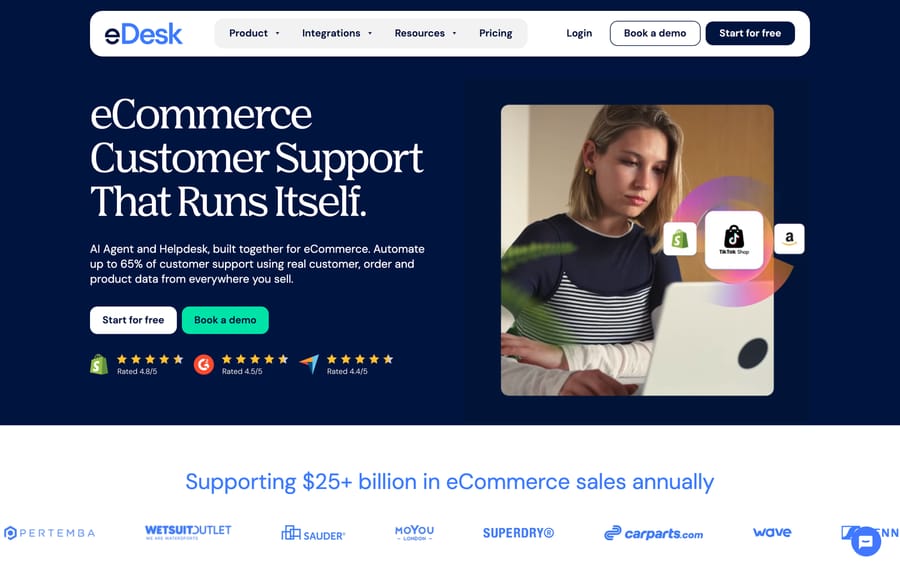
eDesk started life in 2012 as xSellco, a set of marketplace repricing and feedback tools, and rebranded to eDesk in 2021 once the product had grown into a full ecommerce helpdesk. It now claims 5,000+ sellers and connects to 300+ sales channels, and its pitch is direct: one AI Agent that reads order, policy and product data from wherever you sell, and answers customers in the voice and policy of whichever channel they bought from. That last part is the detail worth understanding before you evaluate anything else, because it is also where the AI's limits show up. We checked eDesk's own site directly rather than relying on secondary write-ups, and captured the screenshots below first-hand.
What eDesk's AI actually does
eDesk's AI ships as two connected pieces. The AI Agent works inside the helpdesk itself, reading and replying to tickets that land from your connected marketplaces and channels. Ava, eDesk's AI chatbot, sits on the storefront side, answering pre-sale questions and routing post-sale ones back into the same ticket queue. Both draw on the same order, policy, and product data, so a question that starts in chat and needs a human doesn't lose its order context on handoff.
The mechanism eDesk describes for the AI Agent runs in six steps: it identifies the type of query (return, cancellation, WISMO, troubleshooting, policy question, pre-sale), pulls the relevant order and policy data, applies the rules you've defined for that situation, drafts a reply in your brand voice, holds back when its confidence is low, and updates itself from the outcome of each interaction. The step worth naming specifically is the policy lookup. eDesk pulls the return or refund policy tied to the channel the order came from, because Amazon's return window and Shopify's are different, and a wrong answer on either creates a chargeback or an account strike. That's the actual product decision underneath the marketing copy: a rules engine keyed to marketplace, wrapped in a language model for the reply.
Where the agent has been given permission, it can process a return, generate a shipping label, issue a refund and send the confirmation without a human touching the ticket. eDesk's own numbers here are vendor-reported and worth treating as a ceiling, not a baseline. The company markets "up to 65%" of support automated overall, and cites one case study (footwear brand Cooks) at roughly 25% of messages handled by the AI. Ava is marketed separately at up to 72% of pre-sale inquiries answered successfully. Neither figure comes with an independent audit, and both will move a lot depending on how clean your policies and product data are before you turn the AI on.
Key features
- AI Agent: ticket-side automation across every connected channel: intent detection, policy-aware replies, and end-to-end actions (refunds, cancellations, shipping labels) where you've granted permission.
- Ava: the customer-facing chatbot, answering pre-sale and post-sale questions on your storefront and syncing context back into the same ticket.
- AI Automations: rule-based routing and tagging layered alongside the AI Agent, for the parts of triage best kept deterministic.
- Smart Reply and AI Assist: draft suggestions and tone or language adjustments for a human agent who wants a starting point instead of full automation.
- Sentiment analysis: flags frustrated or high-risk messages so they don't sit in a queue behind routine ones.
- Translate: an add-on for replying across languages without a human agent who speaks them.
- 300+ channel integrations: Amazon, eBay, Walmart, Shopify, Magento, BigCommerce, WooCommerce, TikTok Shop, Instagram, Facebook, WhatsApp, Gmail, and Mirakl-based marketplaces, among others.
Setting it up
eDesk connects to your channels first, then the AI. You link your marketplaces and stores (this is also how the pricing tiers are counted, more on that below), point the AI Agent at your existing return, refund and shipping policies per channel, and set which actions it's allowed to take on its own versus which ones it should draft and hand to a person. eDesk's guidance is to start the AI Agent in a review or draft-only posture on a subset of channels, watch what it gets right and wrong against real ticket volume, then widen its autonomy channel by channel instead of all at once. That staged rollout matters more here than on a single-channel helpdesk, because a policy mistake on one marketplace can trigger an account-level penalty that a generic AI chatbot mistake wouldn't.
What eDesk AI costs
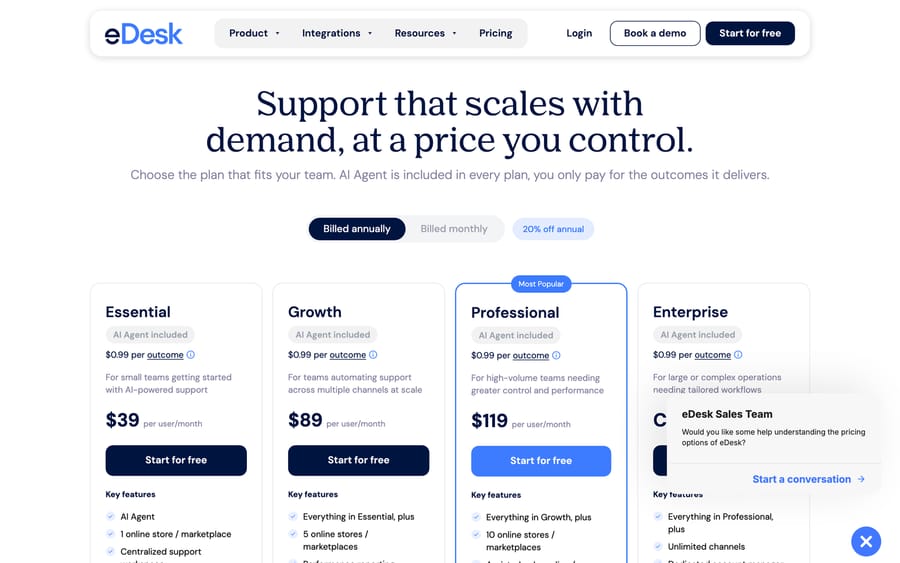
eDesk's AI Agent is included on every plan instead of gated to a top tier, but it isn't free to run. The plan price buys seats and channel connections. The AI itself is metered separately at $0.99 per outcome, where eDesk defines an outcome as a completed customer reply or a real action taken; a ticket the AI reads but doesn't act on isn't charged. That's worth naming as a design choice: pricing the AI on completed outcomes instead of per seat or per message means eDesk earns more only when the AI actually does something, a cleaner incentive than charging for API calls or attempted replies whether or not they land.
The plan tiers, billed annually (eDesk offers a 20% discount over monthly):
| Plan | Price | Channels/stores | Notable extras |
|---|---|---|---|
| Essential | $39/user/month | 1 | AI Agent, centralized workspace, live chat |
| Growth | $89/user/month | 5 | + performance reporting, CSAT surveys |
| Professional | $119/user/month | 10 | + assisted onboarding, 2 free read-only users |
| Enterprise | Custom | Unlimited | + dedicated account manager, multi-brand workflows |
On top of whichever plan you land on, budget the $0.99-per-outcome AI charge separately: 500 outcomes a month is $495 on top of the plan fee, 2,000 is $1,980. eDesk backs this with a 14-day full-feature trial with no credit card, and a "30-day guarantee": if your workload doesn't measurably drop in that window, it waives the subscription fee for the period. Confirm current tier limits and the outcome price at checkout, since eDesk has changed its pricing structure before and the numbers above are current as of this writing.
Where it stops
eDesk's AI is built around catalog, order and policy data pulled from the channels you connect, and that scope is both its strength and its ceiling. A few limits worth planning around:
- It's scoped to what a marketplace ticket needs. Returns, WISMO, cancellations, pre-sale product questions, and policy lookups are exactly the shape of question an ecommerce seller gets most. Anything that requires reasoning outside order and product data, such as a technical support escalation, a B2B account question, or a multi-step workflow across a system eDesk doesn't connect to, falls outside what the six-step process above was built for.
- The automation numbers are vendor-marketed, not independently verified. "Up to 65%" and the Cooks case study's 25% are the ceiling cases eDesk chose to publish. The real rate depends on how complete and current your per-channel policies are before the AI starts answering against them.
- Per-outcome pricing rewards predictable volume and punishes spikes. A seasonal surge in WISMO tickets during a shipping delay is exactly when the AI earns its keep, and exactly when the outcome bill jumps hardest, so model your busiest month, not your average one.
- Escalation is confidence-based, and confidence is a black box from the outside. eDesk says the agent holds back and escalates when it isn't sure, but it doesn't publish the threshold or let you tune it beyond the permissions set per action type.
Who eDesk suits
eDesk fits teams running support across three or more sales channels, where the same question ("where's my order," "can I return this") repeats across Amazon, Shopify, and a handful of others with genuinely different policies per channel. If ticket volume is dominated by order status, returns, and pre-sale product questions, and you're currently juggling separate seller-central inboxes to answer them, eDesk's channel-native AI is built for exactly that problem.
It's a weaker fit for a single-channel store, a B2B seller whose tickets are mostly account and contract questions, or a team whose support work is dominated by technical troubleshooting that doesn't reduce to a policy lookup. In those cases you're paying for channel breadth you won't use.
Where an AI agent layer fits on top
To be clear about the shape of the comparison: eDesk is a helpdesk with AI built in, and Macha is an AI agent layer that runs on top of a help desk a team already uses. It is not positioned as, and should not be read as, an alternative to eDesk itself. The two solve adjacent but different problems.
The gap shows up in practice for a marketplace seller that also runs a general support desk on Zendesk, Freshdesk, Gorgias or Front for everything eDesk's channel-native scope doesn't cover: custom integrations into internal tools, agents built for a specific workflow in plain-English instructions, or a support operation that wants to define its own agent behavior per use case instead of working within a fixed six-step intent model. Macha's pricing is one plan priced on ticket volume: $299/month for 750 tickets (about $0.40 per ticket at every tier), with setup and monitoring by the Macha team, included on every plan. There's also $50 of free usage (about 125 tickets), no credit card, no time limit to test it against your own tickets. If your channel mix is genuinely marketplace-shaped, eDesk's AI is the more specialized tool. If your support desk runs on one of the help desks Macha connects to and you want agents built to your own instructions, that's the different problem Macha solves.
FAQ
Does eDesk have AI built in, or is it a separate add-on? It's built in. The AI Agent is included on every plan (Essential through Enterprise), though it's metered separately at $0.99 per completed outcome instead of bundled free into the plan price.
How much does eDesk AI actually cost per month? Two numbers stack: the plan fee ($39 to $119 per user/month, billed annually, or custom for Enterprise) and the AI usage charge at $0.99 per outcome. A team generating 1,000 outcomes a month on the Growth plan with 3 seats would pay roughly $267 in plan fees plus $990 in AI outcomes. Model your own volume before committing.
What counts as an "outcome" in eDesk's pricing? A completed customer reply or a real action the AI takes on its own, such as a refund, a shipping label, or a status update. eDesk says a ticket the AI reads but doesn't act on isn't charged.
Can eDesk's AI issue refunds and generate shipping labels on its own? Yes, where you've granted it permission per channel and action type. It pulls the relevant policy for the channel the order came from before acting, and eDesk recommends starting it in a draft-only posture before widening its autonomy.
What's the difference between the AI Agent and Ava? The AI Agent works inside the ticket queue across every connected channel. Ava is the customer-facing chatbot on your storefront, answering pre-sale questions and handing post-sale ones into the same ticket system with order context intact.
Is eDesk's 65% automation figure realistic? Treat it as a ceiling case eDesk has chosen to publish rather than an average. The one case study eDesk names publicly (footwear brand Cooks) reports the AI handling about 25% of messages. The number depends heavily on how complete your per-channel policies are before you turn the AI on.
Is Macha an alternative to eDesk? No. Macha is an AI agent layer that runs on top of a help desk a team already uses (Zendesk, Freshdesk, Gorgias, or Front), and it doesn't replace a marketplace-native helpdesk like eDesk. Teams running both typically use eDesk for channel-native marketplace support and a layer like Macha for agents built to their own instructions on their general support desk.
Does eDesk offer a free trial? Yes, 14 days, full-featured, with no credit card required. eDesk also offers a 30-day guarantee: if the platform doesn't measurably cut your support workload in that window, it waives the subscription fee for the period.
Sources: eDesk homepage, eDesk pricing, eDesk AI Agent product page, the story behind the xSellco-to-eDesk rebrand.
Automate your support workflows
Macha's agents run multi-step workflows across the tools you already connect.