Intercom
 Shopify
 Stripe
 Slack
Slack Notion
 Google Workspace
 Confluence

What Is Fini AI and What Does It Cost in 2026? Features, Pricing and Alternatives


Fini AI is an AI support agent from a 14-person Y Combinator startup that bills $0.89, $0.69 or $0.49 per resolved ticket depending on plan. Its pricing page dropped the monthly plan fees in 2026, so the committed spend now has to come from Fini directly.
Key takeaways
- Fini AI charges per resolved ticket: $0.89 on Growth, $0.69 on Scale and $0.49 on Enterprise, with implementation included and no per-seat fees.
- Fini's pricing page lists up to 3,000 tickets a month on Growth and 10,000 on Scale, while its overage table says 2,000 and 8,000 resolutions.
- Fini AI was founded in 2022 in Amsterdam, went through Y Combinator's Summer 2022 batch and announced a $3.6M seed round led by Matrix Partners.
- Fini's Zero-Pay Guarantee promises 90% resolution in 90 days or the customer pays $0, and Enterprise buyers get a 90-day free pilot on live traffic.
- Fini voice AI costs $0.89 per answered call for the first 10,000 calls a month, falling to $0.59 and then $0.35 at higher volumes.

Fini AI (usefini.com) is an AI customer-support agent from a 14-person, Y Combinator-backed Amsterdam startup, and it charges per resolved ticket: $0.89 on Growth, $0.69 on Scale and $0.49 on Enterprise (usefini.com/pricing, checked 24 September 2026). It sits on top of the help desk you already run, answers from your knowledge and past tickets across chat, email and voice, and takes actions such as refunds. The pricing page no longer shows the monthly plan fees older guides quote, so confirm the committed spend with Fini before you budget.
| Question | Answer (checked 24 September 2026) |
|---|---|
| What it is | AI agent layer for customer support, sold on top of your help desk |
| Company | Founded 2022, Amsterdam, YC Summer 2022, about 14 people |
| Pricing unit | Per resolved ticket; no per-seat fees |
| Per-resolution rates | $0.89 Growth, $0.69 Scale, $0.49 Enterprise |
| Channels | Chat, email, widget, voice |
| Help desks | Zendesk, Intercom, HubSpot, Salesforce, Gorgias, LiveChat, Front, Freshdesk, Slack, custom |
| Trial | 90-day free pilot on Enterprise |
We build an AI support product ourselves, so we'll be upfront about that, but the goal here is a genuine guide to Fini. Where we can't verify something, we say so.
What is Fini AI?
Fini is a self-improving AI agent for customer support. It was founded in 2022 in Amsterdam by Deepak Singla and Hakim Khalafi (the latter an ex-Uber engineer), went through Y Combinator's Summer 2022 batch, and lists a team of about 14 on its Y Combinator profile. Fini announced a $3.6M seed round led by Matrix Partners on its own blog. The small team is an important fact to keep in mind throughout this guide.
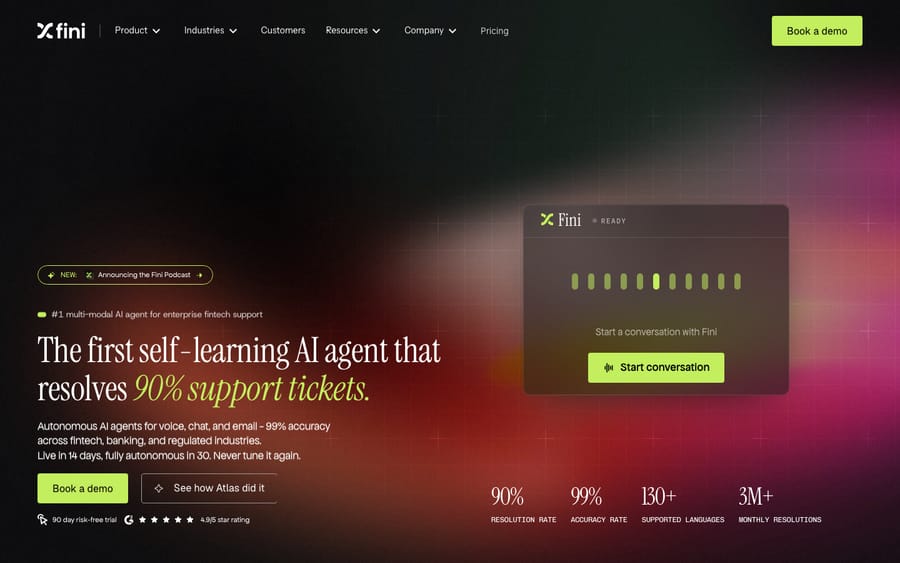
The pitch is straightforward: connect Fini to your help desk and knowledge sources, and its AI agent resolves customer questions across chat, email and voice without a human in the loop, learning and improving over time (usefini.com). Fini leans hard into regulated, high-stakes verticals (fintech, banking, insurance, healthcare, e-commerce and gaming) and backs that with certifications most early-stage startups don't have. Its homepage lists SOC 2 Type II, PCI DSS Level 1, ISO 27001, GDPR and HIPAA (BAA-ready), and the pricing page adds CCPA and says compliance is included on every plan.
Architecturally, Fini sits in the same category as Macha, Intercom Fin and Decagon: it's an AI agent layer that connects to the help desk you already run rather than a help desk replacement. It answers from your knowledge base and past tickets, and where you wire it up, it can take actions in connected systems.
How does Fini's AI agent work?
Fini's agent is built around three moving parts: knowledge, actions and a self-improvement loop.
Answering from your knowledge and past tickets
The foundation is your knowledge. You point Fini at your sources (help-center URLs, PDFs, Notion, Confluence, Google Drive and structured files like CSV, JSON or YAML) plus your historical support tickets, and the agent grounds its answers in that corpus rather than improvising from a generic model (myaskai teardown). Fini markets its approach as "RAGless" or reasoning-first: instead of classic retrieval over vector embeddings, it describes an LLM supervisor that orchestrates reasoning, a "query-writing AI" that pulls knowledge on demand, and guardrail and traceability layers, a framing it pitches as more accurate and auditable for regulated use (usefini.com). Its newest piece is Knowledge Atlas, which Fini describes as a knowledge base that improves itself; Scale plans get a nightly Atlas scan and Enterprise gets hourly knowledge updates.
The pricing page lists help desk connections to Zendesk, Intercom, HubSpot, Salesforce, Gorgias, LiveChat, Front, Freshdesk and Slack, plus custom integrations. The end goal is the familiar "answer from your KB and past tickets" outcome most AI agents target. If you want the mechanics of grounding an agent in your knowledge, our guide to connecting a knowledge base to an AI agent walks through it.
Taking actions, not just answering
Beyond answering, Fini can execute workflows: processing refunds, updating accounts, verifying identity and retrieving customer data through integrations with payment and backend systems like Stripe, Adyen, Braintree and Checkout.com (myaskai). Custom API actions are listed as a Scale extra on the pricing page. Action-taking is what separates an agent from a deflection chatbot that only points people at articles, and it's central to Fini's fintech positioning.
The self-improvement loop
Fini's headline differentiator is self-learning. The agent flags knowledge gaps, learns from real resolutions and, per Fini's homepage, needs no tuning: "Never tune it." It ships evaluation tooling to support this, including a test suite, audit trails and compliance guardrails on every plan, plus sentiment analysis, AI categorization and a PII Shield that redacts sensitive data (myaskai). How much of the "improves itself" claim holds up is something to probe in a pilot. Self-improvement still depends on the quality of your knowledge and the volume of corrections you feed back.
What does Fini claim about performance?
Fini markets aggressively on outcomes. Its homepage claims a 90% resolution rate at 99% accuracy, a 4.9/5 star rating, 130+ supported languages, "live in 14 days, fully autonomous in 30," and a Zero-Pay Guarantee: "90% resolution in 90 days, or you pay $0," proven on 1,000 of your real tickets (usefini.com). Treat these as vendor-reported figures, not audited benchmarks. The guarantee is a real de-risker and a point in Fini's favor. The resolution and accuracy numbers are self-selected best cases, and your results will depend on ticket mix and knowledge quality. A few early reviewers disputed the model quality outright; more on that below.
How much does Fini AI cost in 2026?
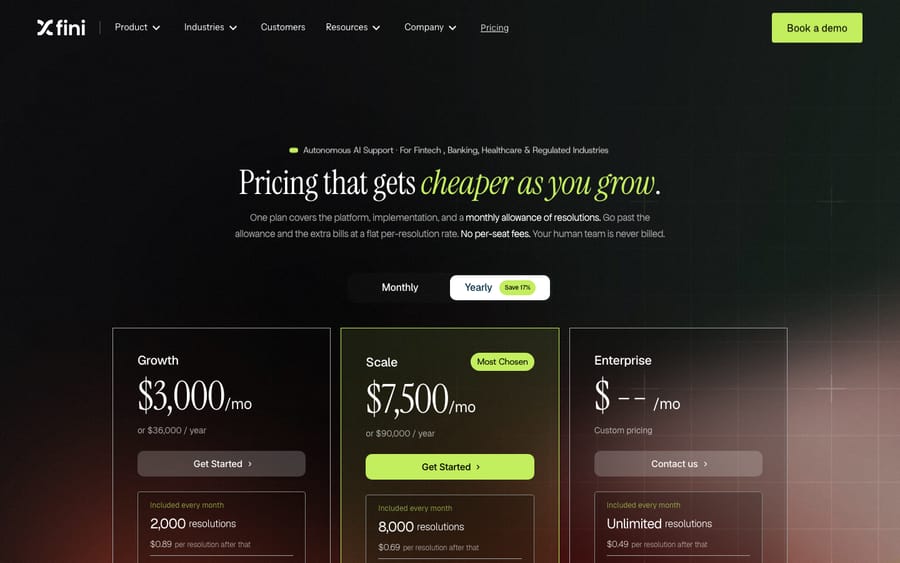
Read this section carefully, because Fini's pricing page has changed shape again. In June 2026 it showed monthly plan fees (about $3,600 for Growth and $9,000 for Scale). On 24 September 2026 it shows only per-resolution rates and a monthly ticket allowance, and says each plan "covers the platform, implementation, and a monthly allowance of tickets." There's no published monthly fee, so ask Fini for the committed amount in writing.
| Plan | Per resolved ticket | Tickets included per month | Notable extras |
|---|---|---|---|
| Growth | $0.89 | Up to 3,000 | Whole platform, implementation, voice at the standard rate card, shared customer success, priority email support |
| Scale (most chosen) | $0.69 | Up to 10,000 | White-glove onboarding, dedicated AI engineer, nightly Knowledge Atlas scan, Slack agent and SSO, multi-language, custom API actions |
| Enterprise | $0.49 | Unlimited | 90-day free pilot, dedicated engineer pod with a 15-minute SLA, uptime SLA, audit logs, data residency, switching-cost credit up to $50,000 |
Source: usefini.com/pricing. A few things worth flagging:
- The page contradicts itself on allowances. The plan cards say up to 3,000 and 10,000 tickets a month; the overage table lower down says 2,000 and 8,000 resolutions. Ask which figure goes in your contract.
- Overage runs at your tier's rate. Past the allowance, extra resolutions bill at $0.89, $0.69 or $0.49, monthly in arrears. Unused allowance rolls forward one month. Conversations reopened within 72 hours aren't billed twice, and greetings, spam and abandoned sessions are never billable.
- Voice is priced per answered call on every plan: $0.89 for the first 10,000 calls a month, $0.59 from 10,001 to 50,000, and $0.35 above that, with a per-minute alternative of $0.22, $0.18 and $0.14.
- Commitments discount the rate. Annual billing includes two months free. Two-year terms take 15% off Growth and Scale and 20% off Enterprise; three-year terms take 20% and 25%; upfront payment adds another 5% (10% on Enterprise, per the discount table).
- No setup fees or seat fees. Implementation is bundled, and your human team is never billed, which is a plus against enterprise peers that charge five figures to onboard.
Note the incentive in per-resolution billing: Fini earns more when its agent closes a ticket without a human, so "what counts as a resolution" is the clause that matters most. Fini defines it as a customer issue solved end to end with no human handover, and it lets you switch to a per-conversation metric at renewal if that works out cheaper.
One caveat: older third-party teardowns still describe a free Starter plan (50 questions, GPT-3.5) and a much cheaper ~$1,799 a month Growth minimum (myaskai). Those figures are gone from the current page, and so are the June 2026 fees. If you saw cheaper numbers elsewhere, they're stale.
Bottom line on pricing: Fini is mid-market-to-enterprise priced. Even the Growth allowance at $0.89 a resolution implies a four-figure monthly commitment, scaling into five and six figures a year with volume. It's easier to start than fully sales-led enterprise platforms (public rates, implementation included), but it's well past "swipe a card for $50 a month" SMB territory.
What are Fini's strengths?
- Resolution plus action-taking, not only deflection. Fini is built to resolve and act (refunds, account updates, identity checks), a real step beyond article-suggesting bots.
- Strong compliance posture for a startup. SOC 2 Type II, PCI DSS Level 1, ISO 27001, GDPR and HIPAA with BAA terms, at no compliance upcharge, is unusual for a company this size and valuable in fintech, banking and healthcare.
- The Zero-Pay guarantee and 90-day pilot. A pay-on-performance offer lowers buyer risk; few vendors put their fee on the line this directly.
- Hands-on team. The most consistent theme in reviews: the small founding team is responsive and actively tunes deployments (see "What do Fini's users say?").
- Help-desk-agnostic and quick to start. It layers onto whatever help desk you run and advertises a 14-day go-live, with no rip-and-replace migration.
- Public per-resolution rates. Unlike several enterprise competitors, Fini publishes its rates, which helps budgeting even without a listed plan fee.
What are Fini's limitations?
- It's a small company. About 14 people and a seed-stage balance sheet. That buys you a responsive team, but it's a vendor-risk and scale question for a large, mission-critical deployment.
- Aggressive, self-reported performance claims. 90% resolution and 99% accuracy are vendor figures with no independent audit. Pressure-test them in a pilot.
- Pricing volatility. The packaging has changed at least three times (a free tier, then public monthly fees, now rates only), and the current page gives two different allowances. Lock figures in writing.
- Early product-quality complaints. 2023 AppSumo reviewers flagged hallucinations, setup errors and a gap between the advertised model and what shipped (see below). The product has matured since, but it's part of the record.
- Depth against enterprise incumbents. Against heavily funded players like Decagon, Sierra or Intercom Fin, Fini's tooling and enterprise governance are leaner. Fine for many teams, a gap for the largest.
- Thin third-party review footprint. Roughly 47 G2 reviews (a secondhand figure from a third-party teardown that we couldn't confirm on G2) and a handful on AppSumo. The signal is positive but the sample is small.
What do Fini's users say?
The verifiable review picture is mostly positive but small, with the team consistently singled out and some early quality concerns on the record.
On G2 (roughly 47 reviews, strongly positive overall, though that count comes secondhand from a myaskai teardown and G2's page blocked our requests, so we couldn't confirm it or the star average), the recurring praise is the people behind the product:
"What truly sets Fini apart is their incredible development and support team, who are always readily available to assist with any queries or issues." — verified G2 reviewer (G2)
"Fini has been an incredible partner from implementation to customization… strong self-serve dashboard tools, exceptional issue response and resolution, compliance, reliability… The team at Fini is committed to our success and they're absolutely great to work with." — verified G2 reviewer (G2)
For balance, AppSumo tells a rougher early story. Fini sat at 3.78/5 from 9 reviews when we last checked, and 2023 buyers were blunt about product readiness:
"The quality is simply not there, this is not GPT-4 and actually inferior to GPT-3.5 Turbo." — AppSumo reviewer, 2023 (AppSumo)
Our read: customers who get hands-on attention from Fini's team report strong results, but the product had rough edges early on, and review volume is still thin. Verify current quality with your own pilot.
Who is Fini best for, and who should skip it?
Best for: mid-market companies in regulated or high-stakes verticals (fintech, banking, insurance, healthcare, e-commerce, gaming) that need compliance certifications included, want action-taking (refunds, account changes, KYC), and value a hands-on vendor willing to tune the deployment. The guarantee makes it attractive if you want to de-risk a first AI-agent rollout. Teams that want chat, email and voice under one agent fit too.
Not for: small businesses and low-volume teams (the entry commitment is steep and the old free tier is gone), enterprises that need a large vendor's track record for a mission-critical deployment, or teams whose support is simple knowledge-base Q&A that doesn't justify a four-figure monthly commitment.
What are the best Fini AI alternatives?
Fini sits in a crowded field. The shortlist:
- Intercom Fin: a mature, widely adopted AI agent with public per-outcome pricing; the default if you're already on Intercom. "Fin" and "Fini" are different products from different companies, which is easy to confuse.
- Decagon and Sierra: heavily funded enterprise AI agent platforms with deep tooling and sales-led, custom pricing; the heavier, pricier end of the market.
- Ada, Forethought, eesel: other automation-first players spanning enterprise and mid-market.
- Zendesk or Freshdesk native AI: if you're already on one of those, the built-in AI agents are the lowest-friction starting point. Our roundup of the best AI Zendesk alternatives lays out the trade-offs.
Update (September 2026), about Intercom's Fin rather than Fini: Salesforce completed its acquisition of Fin, the company that had renamed itself from Intercom on May 12, 2026, on September 10, 2026, in a deal worth about $3.6 billion. Worth weighing in any long-term Intercom or Fin decision. Fini is unaffected.
A note on where we fit, since we'd rather be upfront than pretend we're neutral. Macha is an AI agent layer that runs on top of your existing help desk (Zendesk, Freshdesk, Gorgias, Front, HubSpot or Intercom), and it's the closest category peer to Fini in this list, because both layer onto the desk you already run and answer from your knowledge base and past tickets. The differences: Macha is self-serve to start (you can begin with $50 of free usage, no credit card required rather than negotiating a commitment up front), and it bills per ticket, one charge per thread however many replies it takes, rather than per "resolution." Plans start at $299 a month for up to 750 tickets, with setup and monitoring by the Macha team included. Per-ticket billing keeps costs predictable and sidesteps the "what counts as a resolution?" argument. Fini's edge is its compliance breadth, voice and performance guarantee; Macha's is a lighter on-ramp and a flat per-ticket price. Which is right depends on your stack and scale. Macha on Zendesk covers how the layer model works.
How did we research this?
The plans, rates and feature detail in this guide come from Fini's own pricing page, homepage, blog and Y Combinator profile, re-read on 24 September 2026; that pass replaced the June 2026 monthly fees, which Fini no longer publishes. Enterprise terms beyond the published rates are quote-only, so nothing above them is a confirmed price. We have not run Fini on our own help desk, and G2 turned away our requests, so this guide carries no third-party review score of our own rather than an estimated one.
Frequently asked questions
What is Fini AI? Fini (usefini.com) is a self-improving AI agent for customer support, founded in 2022 in Amsterdam and backed by Y Combinator. Its agent resolves customer questions across chat, email and voice by answering from your knowledge base and past tickets, and can take actions like refunds and account updates. It layers onto existing help desks (Zendesk, Intercom, HubSpot, Salesforce, Freshdesk and others) and targets regulated verticals like fintech and banking.
How much does Fini AI cost? Fini's pricing page, checked 24 September 2026, lists per-resolution rates of $0.89 on Growth (up to 3,000 tickets a month), $0.69 on Scale (up to 10,000) and $0.49 on Enterprise (unlimited). It no longer shows a monthly plan fee, so ask for the committed amount. Annual billing includes two months free, multi-year terms take 15% to 25% off, and implementation is included with no seat fees.
What is the difference between Fini and Intercom Fin? They're different products with confusingly similar names. Fin is the AI agent from the company formerly called Intercom, now owned by Salesforce; Fini (usefini.com) is a separate, independent startup. Both are AI support agents built by different companies.
Is Fini AI good for small businesses? Generally no. With a per-resolution allowance that implies a four-figure monthly commitment and no free tier, Fini is aimed at mid-market and enterprise teams, especially in regulated industries. Smaller teams are usually better served by lighter, self-serve AI agents that layer onto an existing help desk.
Does Fini AI actually resolve 80–90% of tickets? Fini's homepage claims a 90% resolution rate; that's a vendor claim, not an audited figure. Real-world resolution depends on your ticket mix and knowledge quality. Fini's Zero-Pay Guarantee (90% resolution in 90 days or you pay $0) is a reasonable way to test the claim with limited downside. Get the exact terms in writing.
What are the main alternatives to Fini? Intercom Fin, Decagon, Sierra, Ada, Forethought and the native AI in Zendesk and Freshdesk are common peers. For teams that want an AI agent layered on the help desk they already run, with a self-serve on-ramp and per-ticket billing, Macha is a close, lighter-weight alternative.
Does Fini offer a free trial? Only on Enterprise. Enterprise prospects can run Fini free for 90 days on live traffic, with resolution, CSAT and accuracy targets agreed in writing; if the targets aren't met, you walk away without paying.
Simple per-ticket AI pricing
One thread with one person is one charge, however many replies it takes.