Intercom
 Shopify
 Stripe
 Slack
Slack Notion
 Google Workspace
 Confluence

Gleap Explained: What It Automates and Where It Stops (2026)


Gleap is an in-app support and feedback platform for software teams, and its AI, branded Kai, is the part most people searching for "Gleap" actually want to understand: what it answers on its own, what it costs beyond the base plan, and where a human still has to step in. This guide explains what Kai and its sibling agents do inside Gleap, how setup actually works, what you pay at each tier, where the automation stops, and where a separate AI agent layer can pick up what Gleap itself doesn't reach.

We build an AI agent layer for customer service ourselves. It connects to a team's existing help desk instead of replacing one, so we have a stake in this comparison. We checked Gleap's own product and pricing pages directly for this guide.
What Gleap is
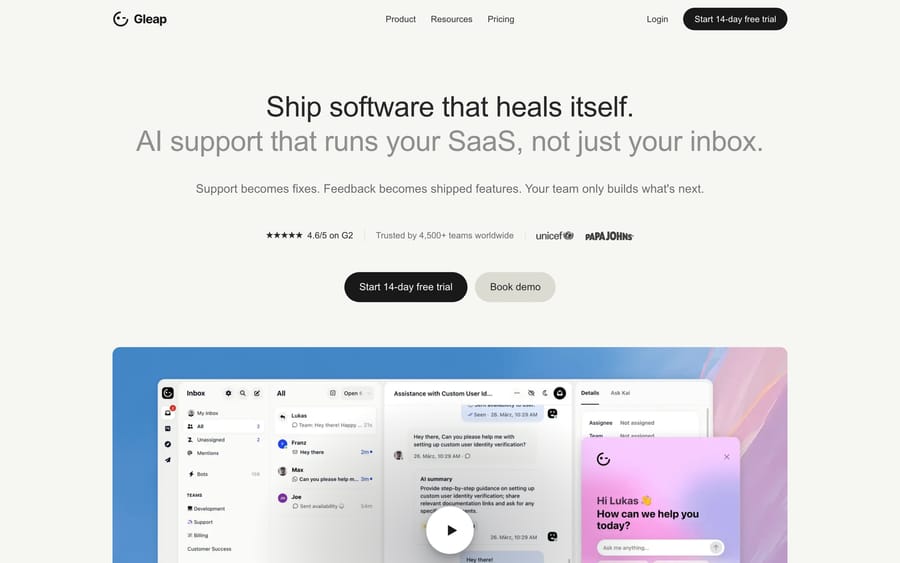
Gleap's homepage, describing itself as an AI support and self-healing software platform.
Gleap combines in-app bug reporting with session replay, live chat, a knowledge base, a public roadmap, and marketing automation into one platform, aimed at software teams that want feedback, support, and product signals in a single tool instead of four. Gleap says it serves more than 4,500 software teams, with named customers on its site including Microsoft, Squarespace, UNICEF, and Papa Johns. Its pitch is a closed loop: a bug gets reported, the AI investigates it, and in some cases a fix ships without an engineer opening the ticket first.
What Gleap's AI actually does
Gleap doesn't ship one AI feature. It ships four, under a shared brand called Kai, each doing a different job in the same pipeline.
- Kai is the support agent. Gleap's own claim is that it "resolves up to 80% of tickets instantly, in 80+ languages, on every channel, with answers from your real product knowledge," across six channels out of the box: the in-app web widget, mobile SDKs (iOS, Android, React Native, Flutter), email, WhatsApp Business, Instagram DMs, Facebook Messenger, and Telegram, all landing in one inbox.
- Kai Resolve is an investigation and routing layer. When Kai can't answer something directly, Resolve uses tools and APIs to dig into the issue and decide where it goes next: a safe operational action it can take itself, Kai Code for a development fix, Kai PM for a product decision, or a task in the human inbox.
- Kai Code is the part that turns a routed bug into an actual pull request, moving through what Gleap calls plan mode and build mode before a human reviews the change.
- Kai PM clusters feature requests and feedback into roadmap priorities, functioning as a product-management layer over the same conversation data the other three agents generate.
The mechanism behind Kai's answers is what makes it more than a scripted FAQ bot: it draws on seven kinds of source material, including reusable answer snippets, indexed public web pages, imported help articles (Gleap supports pulling these in from Intercom, Zendesk, and Freshdesk), uploaded files like PDFs and SOPs, connected code repositories, Notion pages and databases, and even YouTube videos. A ticket that needs the actual wording of a return policy and one that needs a line from a setup guide buried in a code comment can both, in principle, get answered from the same agent.
Setting it up
Gleap's own framing of setup is blunt: "Paste your domain. Point Kai at your help center. Done," with most teams live in under 10 minutes, according to Gleap. In practice that means dropping in the SDK, connecting whichever knowledge sources apply (help center, docs, code repo, Notion), and configuring topic restrictions before turning Kai loose. Gleap lets admins set escalation rules by subject, explicitly calling out medical, legal, and financial topics as ones an admin can restrict so Kai declines to advise on them instead of improvising an answer. That's a genuine safety valve. It's still on the team running Gleap to actually configure it; the defaults won't cover a regulated product on their own.
What it costs
Kai support is included from the entry tier, but the rest of the Kai family is gated behind higher plans, which is worth knowing before you price this out from the homepage alone.
- Starter ($49/mo annual, $59/mo monthly): 1 seat, 1 project, Kai AI support, live chat, in-app bug reporting, roadmap, and knowledge base.
- Team ($149/mo annual, $179/mo monthly): unlimited seats and projects, every support channel, custom domains, integrations, plus outreach tools like surveys and banners.
- Pro ($299/mo annual, $359/mo monthly): unlocks custom agents, every AI model, Kai PM, Kai Code, and Kai Resolve, with a 25% discount on AI token usage.
- Enterprise (from $999/mo annual, $1,199/mo monthly): adds SOC 2 and HIPAA BAA compliance, SSO, bring-your-own-key model access, a dedicated CSM, and a custom SLA.
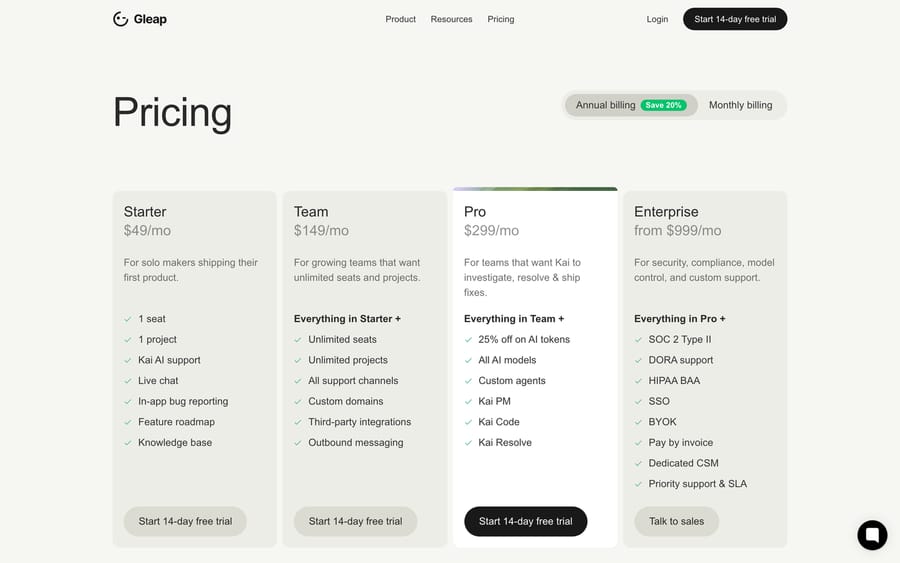
Gleap's pricing page, with annual billing toggled on and Kai PM, Kai Code, and Kai Resolve gated to the Pro tier.
On top of the plan fee, AI usage itself is billed by actual tokens and the model selected. Starter and Team run on automatic model selection; Pro is where you can choose a specific model and get the token discount. That's a meaningful incentive built into the pricing: Gleap earns more the more tokens Kai burns through, so a heavier model set to handle simple FAQ traffic costs you twice, once in the plan tier and once in the token bill, without necessarily answering any better.
Where it stops
Kai answers from what it's been pointed at. It's strong on questions with a documented answer somewhere in your help center, docs, code, or Notion, and weak on anything that requires looking up a specific customer's account state unless that's been separately wired in as one of Kai Resolve's "safe operational actions." Gleap's own materials don't spell out a general library of prebuilt account or billing actions the way a help-desk-native tool might. The investigation and action layer is described in terms of routing and safe operations, not a broad catalog of pre-built integrations.
The deeper automation, Kai Code shipping an actual pull request, is powerful but scoped to bugs Gleap's pipeline already investigated and routed. It's a fix constrained by whatever Kai Resolve decided the issue was, reviewed by a human before merge, not a general coding agent loose on your repo. Treat it as a meaningful productivity tool for the bug-report backlog rather than an unattended deploy pipeline.
Who it suits
Gleap fits teams that already treat bug reports, feature feedback, and support tickets as one connected stream, and that want the AI reading all of it instead of just the support inbox. A team that gets a steady flow of "this is broken" reports alongside "can you add X" requests, and wants both routed and partly resolved by the same system, is the shape Gleap is built for.
It's a weaker fit if your support volume is mostly generic customer service unrelated to your own product's bugs or roadmap, since a chunk of what you're paying for (Kai Code, Kai PM, the bug-reporting SDK) goes unused. In that case a simpler, help-desk-focused AI is a better price-to-value match.
Where an AI agent layer fits on top
Kai is built to answer from Gleap's own knowledge sources and to route bugs through Gleap's own pipeline. What it isn't built to do is reach into the rest of a support team's stack, like Shopify, Stripe, or an internal admin tool, to look something up or take an action on a specific customer's account. That's the gap Macha is built to fill. Macha runs as an agent layer connected to the help desk a team already uses, plus the systems around it, so an agent can check an order, verify a refund against policy, and act, with a confirmation gate before anything customer-facing goes out. It sits alongside a tool like Gleap. Gleap stays the system handling in-app feedback and bug triage, and Macha is the part reaching into the rest of the stack for the tickets that need account-specific action. Pricing runs on monthly ticket volume from $299/month for 750 tickets, about $0.40 a ticket at every tier (see pricing), with setup and monitoring by the Macha team included and $50 of free usage to start.
FAQ
What is Gleap? Gleap is an in-app support and feedback platform for software teams, combining bug reporting, live chat, a knowledge base, a public roadmap, and AI agents branded Kai into one product.
What does Gleap's Kai do? Kai is the AI support agent that answers routine questions across six channels using content pulled from a team's help center, docs, code repository, Notion, and other connected sources, claiming to resolve up to 80% of tickets instantly.
What are Kai Resolve, Kai Code, and Kai PM? Kai Resolve investigates issues Kai can't answer directly and routes them; Kai Code turns a routed bug into a pull request for human review; Kai PM clusters feedback into roadmap priorities. All three are gated to the Pro plan and above.
How much does Gleap cost? Starter is $49 to $59/month depending on billing term with Kai support included; Team is $149 to $179/month; Pro is $299 to $359/month and unlocks Kai PM, Kai Code, and Kai Resolve; Enterprise starts at $999 to $1,199/month. AI usage is billed separately by tokens and model.
How long does Gleap take to set up? Gleap says most teams have Kai live in under 10 minutes after adding the SDK and pointing it at a help center, though connecting a code repository, Notion, or imported help articles from another helpdesk adds time beyond that baseline.
Can Gleap's AI look up a specific customer's order or account? Only through a "safe operational action" configured in Kai Resolve. Gleap's own materials describe routing and investigation rather than a broad library of prebuilt account or billing integrations, so this typically needs custom setup.
Does Gleap have guardrails for sensitive topics? Yes. Admins can configure topic restrictions and escalation rules by subject, including medical, legal, and financial topics, so Kai declines to advise on restricted areas rather than answering anyway.
What are good alternatives if I need more than Gleap's built-in AI? Teams that need an AI agent to act across connected systems like Shopify, Stripe, or an internal admin tool, not just answer from Gleap's own knowledge sources, typically add a layer like Macha alongside Gleap rather than replacing it.
Sources: Gleap homepage, Gleap Kai page, Gleap pricing.
Automate your support workflows
Macha's agents run multi-step workflows across the tools you already connect.