Shopify
 Stripe
 Slack
Slack Notion
 Google Workspace
 Confluence

How Does Gorgias Self-Service Work? Help Center and Order Management (2026)


Gorgias self-service pairs a Help Center included on every plan with order-management flows that let shoppers track, return, cancel or report an order from chat. The flows need an active AI Agent subscription and a Shopify store, and return and cancel only submit a request for an agent to process.
Key takeaways
- Gorgias self-service pairs a Help Center included on every plan with Track, Return, Cancel and Report Issue flows that need an AI Agent subscription and Shopify.
- Gorgias Order Management requires Gorgias Chat installed, Shopify as the backend and an active AI Agent subscription, and it isn't compatible with BigCommerce or Magento 2.
- Shoppers log in to Gorgias Order Management with a 6-digit one-time code sent by email or SMS, from Chat, the Help Center or a Contact Form.
- Gorgias return and cancel buttons only submit a request, so an agent still approves and processes the refund or cancellation unless Macro actions or AI Agent handle it.
- Gorgias bills AI Agent at $1.50 per automated interaction past a plan's allowance, while Macha charges per ticket from $299 a month for up to 750 tickets.

Gorgias self-service has two parts: a Help Center knowledge base included on every Gorgias plan, and order-management flows (Track, Return, Cancel, Report Issue) that need an active AI Agent subscription and a Shopify store. Gorgias says its self-service tools deflect up to 50% of helpdesk tickets, and its docs say Order Management alone can automate up to 30% of live Chat volume (Gorgias docs and product pages, checked 24 September 2026).
| Self-service piece | Plan / add-on required | Platform |
|---|---|---|
| Help Center (knowledge base) | All Gorgias plans, no extra cost | Any |
| In-chat article recommendations | AI Agent features | Shopify only |
| Order Management (track/return/cancel/report) | Active AI Agent subscription + Gorgias Chat installed | Shopify only |
| Flows | AI Agent subscription | Shopify, BigCommerce, Magento 2 |
| AI Agent completing the action (auto-cancel, auto-refund) | AI Agent subscription + configured Actions | Shopify + connected apps |
What are the two halves of Gorgias self-service?
It helps to separate self-service into content and actions, because Gorgias prices and gates them differently.
Content is the Help Center: a hosted knowledge base of FAQ articles, how-to guides, and policy pages that a shopper can search before they ever open a conversation. It's deflection by reading: the customer finds the answer and never files a ticket. Per Gorgias' Help Center documentation, it's available on all Helpdesk plans, and you build it inside the helpdesk.
Actions are the order-management flows: track, return, cancel, and report-an-issue journeys that let a shopper do something to their order, or at least request it, without an agent. This is deflection by doing, and it's where the gating gets strict. If you're still getting oriented on the platform overall, our what is Gorgias primer covers how the helpdesk, chat, and automation layers fit together.
Is the Gorgias Help Center free?
Yes. Every Gorgias self-service setup starts with the Help Center, because it's the cheapest lever and the one every other feature reads from. You create it inside the helpdesk; Gorgias' Create a Help Center, Article, or Category guide walks through spinning up the site, organizing content into categories, and publishing your first articles. The one catch: you can't create a Help Center during the 30-day free trial.
The useful part is AI-assisted authoring. Per Gorgias' AI-generated article docs, Gorgias studies real ticket data in your helpdesk and offers five drafts for your most frequent questions, and each suggestion shows how many tickets publishing it could deflect. So you write the return-policy article with the biggest projected deflection first, not the one nobody searches for. New suggestions keep arriving every 3 to 6 months, and the Help Center's default language must be English for this to work.
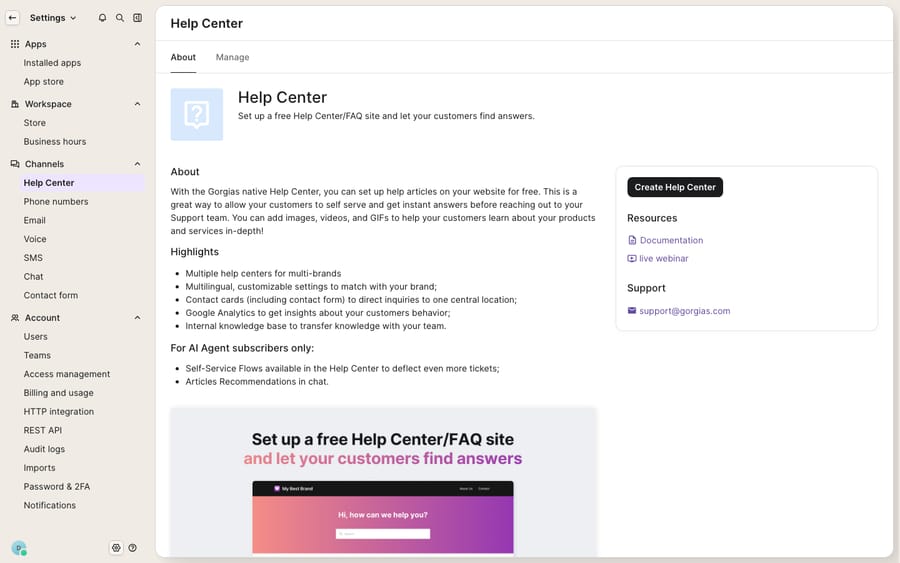
As the settings screen above notes, article recommendations inside chat and the order-management flows layer on top of this base, and they're tied to AI Agent and a Shopify store. The Help Center itself stays free; the automation that reads from it doesn't.
What can shoppers do in the order-management flows?
This is the part shoppers feel, and the part most "gorgias self service" searches are really about. Per Gorgias' Order Management documentation, the portal has four flows:
- Track: the shopper sees a detailed timeline of order events (shipped, in transit, delivered), synced directly from Shopify. You can add a general message when shipping is delayed. This is your WISMO fix.
- Return: the shopper submits a return request for eligible orders, with eligibility based on order-created or order-delivered dates and a day count you set. With Loop Returns connected, shoppers are sent to the Loop portal to finish.
- Cancel: the shopper submits a cancellation request for orders in the stages you allow (unfulfilled, processing fulfillment, or pending delivery).
- Report Issue: the shopper picks from a list of issues and creates a templated ticket.
Track and Return are switched on automatically once order management is active. Shoppers reach the flows from Chat, Help Center, and Contact Form and log in with a one-time password: a 6-digit code sent by email or SMS. No account, no password reset, just a code.
What return and cancel actually do. One line in the docs matters more than the marketing: shoppers can't trigger automatic refunds or cancellations, and "clicking the refund or cancellation buttons will only submit a request and an agent will still need to intervene." The flow removes the back-and-forth (the customer doesn't have to email asking how to start a return), but approval and processing still land on a human, who can do it with Macro actions, unless you configure the AI Agent to complete the task. Track is hands-off; return and cancel are request intake, not resolution.
What do you need before you can turn on order management?
Here's where teams get tripped up. The order-management flows are not a base-plan feature. Gorgias' Help Center Order Management docs list three conditions: Gorgias Chat installed on your website, Shopify as your backend (order management isn't compatible with BigCommerce or Magento 2), and an active AI Agent subscription. You configure it under Automate → [your Shopify store] → Channels, toggle Order Management on for the Help Center, then customize the flows in the Order Management tab.
Before you commit, look at how AI Agent is billed. On 24 September 2026 the Gorgias pricing page added AI Agent to each helpdesk plan as a monthly fee with a set number of automated interactions (on Starter, $30/mo for 30), then $1.50 per automated interaction past the limit. The incentive is plain: Gorgias earns more the more conversations its AI closes. For high-WISMO stores that automate aggressively, that model deserves a hard look, which is what our Gorgias AI Agent explainer digs into.
Which tickets does Gorgias self-service actually deflect?
Gorgias' Help Center product page says merchants using its self-service tools reduce helpdesk tickets by 50%, and the docs put order management at up to 30% of live Chat volume. The logic holds for the right ticket types. The tickets that deflect cleanly are the repetitive, low-judgment ones: "where is my order," "what's your return window," "can I still cancel." They're high-volume and answerable from data or a policy page.
Deflection works in three escalating tiers:
- Passive (Help Center): the shopper searches, reads, and leaves satisfied. Zero touch, included on any plan.
- Guided (flows): the chat widget walks the shopper through a track or return flow and resolves or takes in the request. Requires AI Agent.
- Active (Actions): the AI Agent performs the task, such as cancelling the order or updating the address, by calling your connected ecommerce apps. Requires AI Agent plus configured Actions.
The measurable win is concentrated in tier one and the Track flow, because those are the only fully hands-off paths. Returns and cancels look like tier three but, on the native flow, are guided request intake.
Where does Gorgias self-service stop?
Gorgias' self-service is well-built for what it targets. The Help Center costs nothing extra, the AI drafting lowers the effort of filling it, and Track is a clean, real deflection.
The edges are real too. Order actions are Shopify-only and need AI Agent: on BigCommerce, or on a helpdesk plan without AI Agent, the flows most people mean by "gorgias self service" aren't available. Return and cancel are request intake, not resolution on the native flow. And self-service is only as smart as your content and your flow branches: a question phrased outside the tree, or a policy edge case the article doesn't cover, falls through to a human. For the broader picture of what these systems can and can't reason about, AI agents for customer service is a useful frame.
How does an AI agent layer handle what the flows can't?
Macha runs on top of the Gorgias you already use as a live, native connector. It doesn't replace Gorgias, its Help Center, or its flows, and it isn't a helpdesk. Macha reads and writes the same tickets, so it can take the questions that fall outside a rigid flow: reasoning over a messy WISMO-plus-return-plus-discount message, pulling live order status through a custom tool that turns your OMS or 3PL API into something the agent can call, and drafting or posting a grounded reply in the same Gorgias conversation the customer opened.
The pricing difference is the load-bearing one. Gorgias' AI Agent charges per automated interaction. Macha bills per ticket: one conversation, charged once however many lookups, drafts and replies it takes, and never per resolution. Pricing starts at $299 a month for up to 750 tickets, about $0.40 each, so a store whose self-service traffic is mostly cheap, high-volume WISMO knows its ceiling before the month starts. Keep Gorgias' Help Center and flows as the front line for clean, in-tree cases, and put an agent on top for the reasoning-heavy tail the flow tree can't branch to. If chat is your main self-service surface, our Gorgias Chat explainer covers how the widget and flows present to shoppers.
FAQ
Is Gorgias self-service free? Partly. The Help Center (your knowledge base of FAQ and policy articles) is included on all Gorgias plans. The order-management flows (track, return, cancel, report an issue) require an active AI Agent subscription, Gorgias Chat, and a Shopify store, so they aren't part of the base plan.
Can customers cancel or refund their own orders in Gorgias? Not on the native flow. The cancel and return flows let a shopper submit a request, and Gorgias' docs say those buttons only create the request: an agent still approves and processes it, unless you automate the follow-through with Macro actions or a configured AI Agent action. The Track flow, by contrast, is fully self-serve.
Which platforms does Gorgias order management support? Shopify only. Per Gorgias' documentation, order management isn't compatible with BigCommerce or Magento 2, which get flows only. The Help Center itself has no platform restriction.
How much can self-service deflect? Gorgias says merchants using its self-service tools reduce helpdesk tickets by 50%, and its docs say order management can automate up to 30% of live Chat volume. The gains concentrate in repetitive questions like WISMO and return policy; results depend on how complete your Help Center and flows are, and edge cases still reach a human.
Can I add AI self-service to Gorgias without replacing it? Yes. Macha connects to Gorgias as a live native connector and runs on top of your existing helpdesk, Help Center, and flows. It handles the reasoning-heavy questions that fall outside a fixed flow, looks up live order data through custom tools, and bills per ticket, one conversation charged once, rather than per resolution.
Ready to give your Gorgias self-service a reasoning layer for the questions the flow tree can't answer? Start a free trial of Macha and connect it to your Gorgias in minutes.