Intercom
 Shopify
 Stripe
 Slack
Slack Notion
 Google Workspace
 Confluence

Hiver AI Explained: What It Automates and Where It Stops (2026)


Hiver is a customer service platform built to run inside Gmail, and its AI layer (AI Agents, AI Copilot, AI Knowledge Builder, and AI QA) ships on every paid plan instead of as a separate purchase. This explainer covers exactly what each piece automates, how you turn it on, what it costs at each tier, where the automation stops, and where a dedicated AI agent layer fits if Hiver's own AI isn't enough for your ticket volume.

What Hiver's AI actually does
Hiver was founded in 2011 by Nitesh Nandy and Niraj Ranjan Rout and has grown into an omnichannel platform (email, live chat, voice, WhatsApp) that still runs natively inside Gmail. Teams don't switch to a separate inbox to use it; the shared inbox, the automation rules, and now the AI all sit on top of Gmail itself. More than 10,000 teams reportedly use the platform, including Flexport, Harvard University, Upwork, and Epic Games.
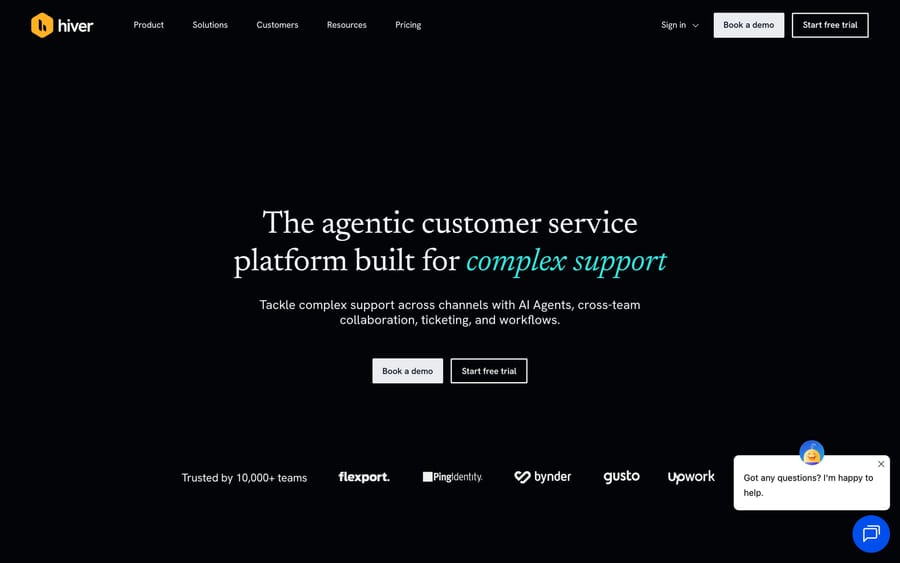
Hiver's homepage, positioned as "the agentic customer service platform built for complex support."
The AI layer is organized into four named pieces, and it's worth being precise about what each one actually does, because "AI" on a pricing page can mean four very different mechanisms:
- AI Agents handle requests end to end. The agent reads the incoming message, matches it against a request type you've configured, takes an action, and closes the ticket without a human touching it. This only runs on categories you've explicitly turned on; it doesn't freelance across every incoming ticket by default.
- AI Copilot sits next to a human agent instead of replacing them. It drafts a reply, surfaces a relevant knowledge-base article, and suggests a next step, so the agent's job becomes editing and sending rather than starting from a blank screen.
- AI Knowledge Builder scans resolved conversations for questions your knowledge base doesn't answer yet and recommends what to write. This is the most underrated of the four: instead of a support lead guessing what's missing from the help center, the system points at the actual gap, based on tickets that already happened.
- AI QA automatically scores agent responses for quality, a task usually handled by a human QA reviewer sampling a handful of tickets a week by hand. It's Elite-tier only, covered below.
How to set it up
Hiver's AI ships as part of the shared-inbox product you're already running, not a separate integration with its own setup flow. In practice, turning it on means two things. First, check your plan: Growth, Pro, and Elite all include AI Agents, Copilot, and Knowledge Builder, so most teams already have access without upgrading. Second, and more important, decide which request types AI Agents is allowed to resolve on its own versus which ones only get a Copilot draft for a human to review before sending.
That second decision is where teams get into trouble if they rush it. A team that switches on full autopilot for every ticket category before checking the output finds a bad autonomous reply after a customer complains about it, not before. The safer rollout is to start every new category on Copilot (draft-and-review), watch the drafts for a few weeks, and only move a category to full AI Agents automation once the drafts are consistently right.
AI Knowledge Builder needs less hand-holding to set up, since it's passive by design: it reads resolved conversations in the background and surfaces gaps for a human to act on, rather than taking any action itself. There's nothing to configure beyond having a knowledge base for it to compare against. AI QA, on Elite, works similarly in reverse: point it at a sample of resolved conversations and it scores them against whatever quality rubric your team already uses for manual reviews, which means the rubric itself still has to exist before the AI can apply it consistently.
What Hiver's AI costs
Hiver's AI capability is included in every paid tier rather than metered as an add-on, which is a real difference from vendors that charge separately for AI usage on top of the seat price. Bundling it this way is also an incentive worth naming: Hiver's business model earns from seats, not from AI volume, so it has no reason to nudge you toward routing more tickets through AI Agents than you'd otherwise choose to. The tiers, billed annually or monthly per user:
- Growth: $25/month (annual) or $35/month (monthly). Covers shared inboxes, omnichannel support, ticketing, rule automation, basic analytics, and the core AI trio (Agents, Copilot, Knowledge Builder).
- Pro: $55/month (annual) or $65/month (monthly). Adds customer portals, Slack channel management, SLAs, CSAT surveys, and advanced analytics, with the same AI trio included.
- Elite: $85/month (annual) or $95/month (monthly). Adds AI QA, AI Insights (topic organization and sentiment tracking), skill-based routing, and enterprise security controls (SSO, HIPAA, custom roles).
We checked hiverhq.com/pricing directly: new signups get a 7-day trial on the Elite plan with no credit card required, so you can test the full AI set, AI QA included, before choosing a tier. A separate Voice add-on runs $30/month per seat with 1,000 included minutes, billed apart from the core plan.
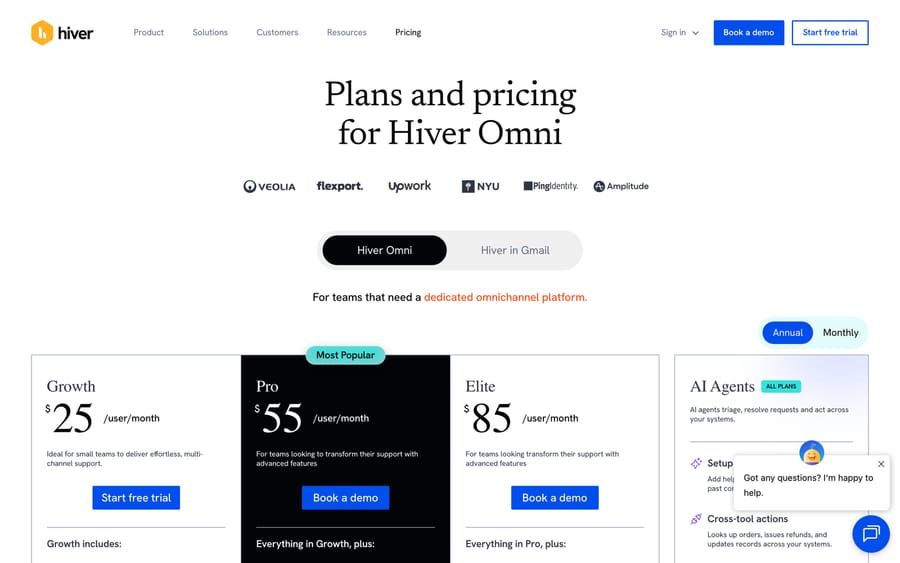
Hiver's pricing page: Growth, Pro, and Elite tiers, with AI Agents included on every plan.
Worth doing the arithmetic on what AI QA actually costs a team, since it's the one feature gated to the top tier. A 10-agent team on Pro pays $550/month (annual billing) with no AI QA. Moving that same team to Elite costs $850/month, a $300/month difference to add automated quality scoring, AI Insights, and the higher security tier together. Whether that's worth it depends on what a human QA reviewer's time is worth to you today: if nobody is currently sampling tickets for quality at all, $300/month for 10 seats is cheap insurance; if you already have a QA process that works, Elite mainly buys automation of a job someone's already doing.
Where Hiver's AI stops
AI Agents resolves what it's configured to resolve, scoped to the request types you define and the channels Hiver connects to: email, live chat, and the other surfaces inside its own omnichannel setup. It isn't a general-purpose agent-building platform. There's no equivalent of pointing an agent at an arbitrary internal tool or a custom API the way a dedicated agent-building product allows, so a workflow that needs to reach outside Gmail and Hiver's connected channels sits outside what this AI layer is built for.
AI QA and AI Insights only ship on Elite, so a team on Growth or Pro doesn't get automated quality scoring without upgrading a tier. And because the AI is bundled with Hiver's inbox rather than sold as a standalone product, per its published pricing page, buying the AI layer on its own to run alongside a different help desk isn't an option Hiver offers. The AI stays scoped to Hiver's own inbox, which is exactly the trade a bundled feature makes: simpler to buy, narrower in reach.
Who Hiver's AI suits
Hiver's AI suits teams already running, or seriously considering, Hiver as their help desk, who want AI handling routine requests and quality scoring without paying separately for a third-party AI tool layered on top. If Gmail-native workflows already matter to how your team operates, having AI bundled into the seat price instead of metered separately is a genuine cost advantage over a help desk that charges extra for its AI layer.
It's a weaker fit if your support tickets need to trigger actions in tools outside Hiver's connected channel list, or if you've outgrown what a bundled, inbox-scoped AI can configure and want an agent you can point at any internal API your team happens to run.
Where an AI agent layer fits on top
Hiver's AI is built to run inside Hiver, for Hiver's own channels, and that's a sensible design for a bundled feature. Macha solves a different problem: it's an AI agent layer that runs on top of the help desk a team already uses, most commonly Zendesk, Freshdesk, Gorgias, or Front, and connects to a much wider set of systems, from custom internal APIs to Shopify, Slack, and Stripe.
Macha isn't an alternative to Hiver, and it doesn't compete with it as an inbox. If your team runs on Hiver and its own AI Agents and Copilot already cover what you need, there's no reason to add anything else on top. Macha becomes relevant only when a team is choosing or already running one of the help desks Macha supports and wants agents that reach further than a bundled, inbox-scoped AI layer can. See Macha's pricing for how that model compares on a per-ticket basis.
FAQ
What is Hiver AI? It's the umbrella term for Hiver's built-in AI features: AI Agents (end-to-end resolution), AI Copilot (draft assistance for human agents), AI Knowledge Builder (finds knowledge-base gaps), and AI QA (automated quality scoring, Elite only).
How much does Hiver AI cost? AI Agents, Copilot, and Knowledge Builder are included on every paid tier: Growth ($25-35/user/month), Pro ($55-65/user/month), and Elite ($85-95/user/month). AI QA and AI Insights are exclusive to Elite.
Does Hiver have a free trial? Yes, a 7-day trial on the Elite plan with no credit card required, covering every AI feature Hiver offers.
Can Hiver's AI fully automate customer replies? AI Agents can resolve configured request types end to end without a human. Whether that setting is right for a given category depends on how much you trust the output; Copilot's draft-and-review model is the safer default for anything ambiguous.
Does Hiver's AI work outside Gmail? Hiver itself is omnichannel (email, live chat, voice, WhatsApp), and its AI operates across those connected channels. It doesn't extend to arbitrary outside tools the way a dedicated agent-building platform does.
Is Hiver's AI available on the cheapest plan? Yes. AI Agents, Copilot, and Knowledge Builder ship on Growth, Hiver's entry tier, alongside the higher tiers.
What's the difference between Hiver AI and adding a separate AI agent tool? Hiver's AI is bundled and scoped to Hiver's own inbox and connected channels. A separate AI agent layer like Macha runs on top of whichever help desk a team uses and can connect to a broader set of internal tools and APIs, at the cost of being a second product to manage instead of one bundled feature.
Who uses Hiver? Hiver reports more than 10,000 teams, with named customers including Flexport, Harvard University, Upwork, and Epic Games.
Sources: Hiver homepage, Hiver pricing, Hiver on Google Workspace Marketplace.
Automate your support workflows
Macha's agents run multi-step workflows across the tools you already connect.