Shopify
 Stripe
 Slack
Slack Notion
 Google Workspace
 Confluence

How to Integrate Freshdesk with HubSpot


Connecting Freshdesk to HubSpot sounds like one job, but it's really a decision. HubSpot holds who the customer is — their marketing history, their deals, their company record — while Freshdesk holds what they've asked for and how fast you answered. Wiring the two together means agents stop tab-hopping and sales stops guessing at support history. The catch is that "integrate" can mean anything from a free one-way contact push to a paid, field-mapped, two-way sync, and which one you pick decides which system becomes the source of truth. This guide walks through the real options — the free Freshworks app, the paid CRM Connector, and the HubSpot-side sync — with honest notes on sync direction, field mapping, and where each one stops.

Two apps, one confusing name
The first thing that trips people up: there isn't a single "HubSpot integration" for Freshdesk. There are at least three ways in, and they do genuinely different things.
The Freshdesk-Hubspot app on the Freshworks Marketplace is the simplest. It's Verified by Freshworks, free, and does exactly one thing: it pulls marketing contacts from HubSpot into your Freshdesk contacts. It's a one-way, HubSpot-to-Freshdesk push so your agents see who a person is without leaving the ticket. That's it — no ticket sync, no field mapping UI, no direction choice.
The HubSpot CRM Connector app is the heavier tool. Per Freshworks it syncs Contact and Account information between the two systems, lets you choose the direction, and gives you a field-mapping tab. It's a paid add-on — priced around $80 per 5,000 tasks at time of writing — and it runs on a recipe that fires roughly every 12 hours.
And the HubSpot-side Freshdesk data sync, published on HubSpot's own App Marketplace, syncs companies, contacts, and tickets and keeps records updated whenever either side changes. If you want two-way ticket visibility inside HubSpot, this is usually the one you're actually looking for.
Decision first: which record is source-of-truth?
Before you install anything, answer one question: when the same person exists in both systems with different data, who wins? That single decision drives everything else.
| Freshdesk-Hubspot app (free) | HubSpot CRM Connector (paid) | HubSpot-side data sync | |
|---|---|---|---|
| Publisher | Freshworks (Verified) | Freshworks (Verified) | HubSpot / partner |
| Records synced | Marketing contacts | Contacts + Accounts | Companies, contacts, tickets |
| Direction | One-way (HubSpot → Freshdesk) | Selectable either way | Two-way |
| Field mapping | None | Custom "Field Mapping" tab | Configurable |
| Sync cadence | On install/update | ~Every 12 hours | On create/update |
| Cost | Free | ~$80 / 5,000 tasks | Varies by HubSpot plan |
| Best for | "Just show me who this is" | Contact/account enrichment | True ticket + CRM sync |
The pattern to notice: free means one-way. The moment you want two systems to agree bidirectionally, you're either paying for the CRM Connector or configuring the sync from the HubSpot side — and you have to pick a winner per field, or you'll create a loop where each system keeps overwriting the other.
Step 1: Install the app from Admin → Apps
For the Freshdesk-side apps, the install path is the same. From the Freshworks Marketplace listing you'll see the Install button; from inside your help desk, the route is:
- Log in to Freshdesk and go to Admin → Apps (the Marketplace section).
- Search for HubSpot — you'll see both the free Freshdesk-Hubspot app and the HubSpot CRM Connector.
- Click Install on the one that matches the job from the table above.
- When prompted, enter your Freshdesk domain (
yourcompany.freshdesk.com) and your API key, then click Authenticate account.
Your API key lives under your Freshdesk profile settings. Treat it like a password — it grants full read/write access to your tickets and contacts, which is exactly why the connector can write records back.
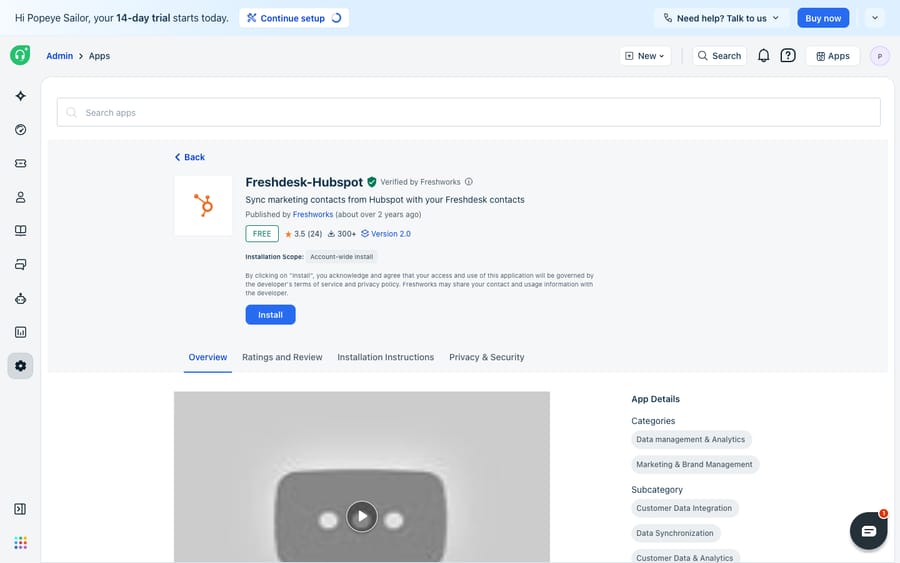
The listing above is the free app — note how the description scopes it tightly to marketing contacts and one direction. That honesty in the listing copy is a useful tell: if a Marketplace app doesn't advertise field mapping or a direction toggle, it doesn't have one.
Step 2: Choose the sync direction (CRM Connector)
This step only exists on the paid CRM Connector, and it's the one that matters most. During setup you decide whether records flow from Freshdesk to HubSpot or from HubSpot to Freshdesk. This is where you encode your source-of-truth decision:
- If HubSpot is your system of record for who a contact is (marketing owns the identity), sync HubSpot → Freshdesk so support always sees the canonical profile.
- If Freshdesk captures new people first (customers who email support before they're ever in the CRM), sync Freshdesk → HubSpot so sales and marketing inherit them.
- Many teams run both on different objects — HubSpot owns contact identity, Freshdesk owns ticket/interaction data — which is fine as long as no single field is being written from both ends.
Be honest with yourself here: bidirectional-on-every-field is where sync loops and overwrites come from. Pick a winner per object.
Step 3: Map the fields
Once the connection authenticates, open the Field Mapping tab. This is where you line up a Freshdesk contact field with its HubSpot counterpart — email to email, company to company, and any custom fields you care about. A few rules that save pain later:
- Map on a stable unique key (email is the usual one) so the connector matches existing records instead of creating duplicates.
- Only map fields you genuinely need synced. Every extra mapped field is another place the two systems can disagree.
- After mapping, use Test recipe to confirm data actually flows, then flip the recipe's enable toggle to start the scheduled sync.
Remember the CRM Connector runs on a schedule — roughly every 12 hours — so a change in one system won't appear in the other instantly. That's usually fine for contact enrichment; it's a problem if you expected live, second-by-second parity.
The honest limits — and where an AI layer picks up
Give the native integrations credit: for what they promise, they work. The free app reliably surfaces HubSpot contacts inside Freshdesk, and the CRM Connector genuinely handles contact-and-account sync with configurable direction. But there are real edges worth naming before you build on them.
The free app is one-way and marketing-contacts only. It won't push a Freshdesk-created contact back to HubSpot, and it doesn't touch tickets. If you need Freshdesk to feed HubSpot, that's the paid tier.
Two-way ticket sync isn't the Freshdesk-side story. Freshworks' own documentation notes that full two-way data flow with the CRM Connector app has limits — it syncs Contact and Account info, not tickets, and the richer bidirectional companies-contacts-tickets sync lives on the HubSpot-side Marketplace listing instead. So "integrate Freshdesk with HubSpot" often means installing on both sides, not one.
Sync is scheduled, not instant. The 12-hour cadence means the two systems are eventually consistent, not live. And cost scales with volume — $80 per 5,000 tasks is fine for a small team and adds up fast for a busy one.
Most importantly, a sync moves data; it doesn't act on it. Once the HubSpot record is sitting on the ticket, someone still has to read it, understand the customer's problem, and write the reply. That's the seam an AI agent layer fills. If you're already thinking about how to automate Freshdesk with AI, the synced CRM context is exactly the raw material that makes automation good instead of generic.
The broader category of AI agents for customer service exists to do the reasoning the sync can't — and it's worth understanding the build-versus-buy tradeoff before you reach for one. Macha is one such layer: it runs on top of the Freshdesk you already use as a native connector, and it does not replace Freshdesk, HubSpot, or your sync. You connect Macha to Freshdesk with your subdomain and API key, and it reads the same tickets — and the HubSpot fields synced onto them — to draft grounded replies, route by intent, and pull live account or deal data through a custom tool that turns a HubSpot or order API into something the agent can actually call at the moment of the ticket, instead of waiting 12 hours for the next sync. (Macha's connector is for Freshdesk specifically — not Freshchat, Freshservice, or Freshcaller — and credits are consumed per AI action, not per resolution; the pricing page has the breakdown.)
The clean division of labour: let HubSpot and Freshdesk sync own what's true about the customer, and layer an agent on top for the part the sync can't do — turning that context into an answer.
FAQ
Is the HubSpot Freshdesk integration free? There's a free option and a paid one. The Verified-by-Freshworks Freshdesk-Hubspot Marketplace app is free but only pulls HubSpot marketing contacts into Freshdesk one-way. The HubSpot CRM Connector app, which adds direction choice and field mapping, is a paid add-on — around $80 per 5,000 tasks at time of writing.
Does the integration sync two-way? It depends which app. The free app is one-way (HubSpot → Freshdesk). The paid CRM Connector lets you choose the direction and can sync Contact and Account data either way. For full two-way syncing of companies, contacts, and tickets, you typically install the Freshdesk data-sync app from HubSpot's own App Marketplace as well.
How do I install it? Go to Admin → Apps in Freshdesk, search for HubSpot, click Install on the app you want, then authenticate with your Freshdesk domain (yourcompany.freshdesk.com) and API key. On the CRM Connector you then set the sync direction, map fields under Field Mapping, run Test recipe, and enable the toggle.
How often does it sync? The CRM Connector runs on a schedule — roughly every 12 hours — so changes are eventually consistent rather than instant. The free contact app syncs on install and update.
Can I add AI on top of a Freshdesk-HubSpot setup without replacing anything? Yes. An AI agent layer like Macha connects to Freshdesk as a native connector and runs on top of your existing help desk and CRM sync — it doesn't replace them. It reads the HubSpot context synced onto tickets and drafts grounded replies or fetches live account data through a custom tool, while Freshdesk and HubSpot stay the systems of record.
Ready to turn your synced customer data into actual answers? Start a free trial of Macha and connect it to your Freshdesk in minutes.
Add AI agents to your Freshdesk
Macha reads the ticket, drafts the reply and takes the action, inside the Freshdesk you already run.