



 Intercom
 Shopify
 Stripe
 Slack
Slack Notion
 Google Workspace
 Confluence

Linear Freshdesk Integration: Connect Them for Your AI Agent (2026)


Support and engineering live in two systems, and your agents feel it on every bug report: a customer raises an issue in Freshdesk, but the fix, its status, and the engineer working on it are all in Linear — one tab over. Connecting the two is one of the most-requested integrations in customer support, and there's more than one way to do it depending on what you actually need.

This guide covers both: the native Freshdesk–Linear app (and where it stops), and how to give your AI agent live Linear issue lookups and actions right inside a ticket using a Custom Tool.
Framing first. Macha runs on top of the Freshdesk you already use — it's an AI-agent layer, not a Freshdesk or Linear replacement (and it connects to Freshdesk, the ticketing product, not Freshchat, Freshservice, or Freshcaller). Your agents keep working in Freshdesk; Macha reads the ticket, reasons, and reaches into Linear to answer or act.
The native option — and where it stops
Freshdesk does offer a native Linear integration: Freshworks' own Linear app lets an agent create, link, and view associated Linear issues right from the ticket. (There's also a "Linear for AI Agents" Freshworks app in the same family.) If all you need is a linked issue an agent creates and reads by hand, that may be enough.
Where it stops:
- It's a manual widget, not autonomous action. An agent works the panel; it doesn't let an AI agent decide to check an issue's status mid-conversation, file a fresh issue with the right details, and reason over the result.
- It's agent-driven by a human. Someone has to open the widget, create the issue, and read the status back — the app surfaces the link, but a person still drives it.
- It's fixed. You get the fields and actions the app exposes — not the specific query or write your workflow needs (e.g. "is the fix for this bug released yet?" or "create an issue in the right team with the customer's repro steps and a priority").
For a lot of teams, the widget is fine. For anyone who wants their AI agent to actually use Linear, there's a lighter, more flexible path.
What you actually want: the agent using Linear live
The high-value version of this integration isn't a hand-created issue — it's the agent doing the work. A customer reports a bug in Freshdesk; the agent recognizes it, checks Linear for a matching issue, and answers "yes, that's a known bug — the fix is in review" or files a new issue with the repro steps and links it — grounded in Linear, not a manual note. That's what a Custom Tool enables.
How to connect them with a Custom Tool
A Custom Tool is a single action you define once and point at Linear's API. No Marketplace app, no code.
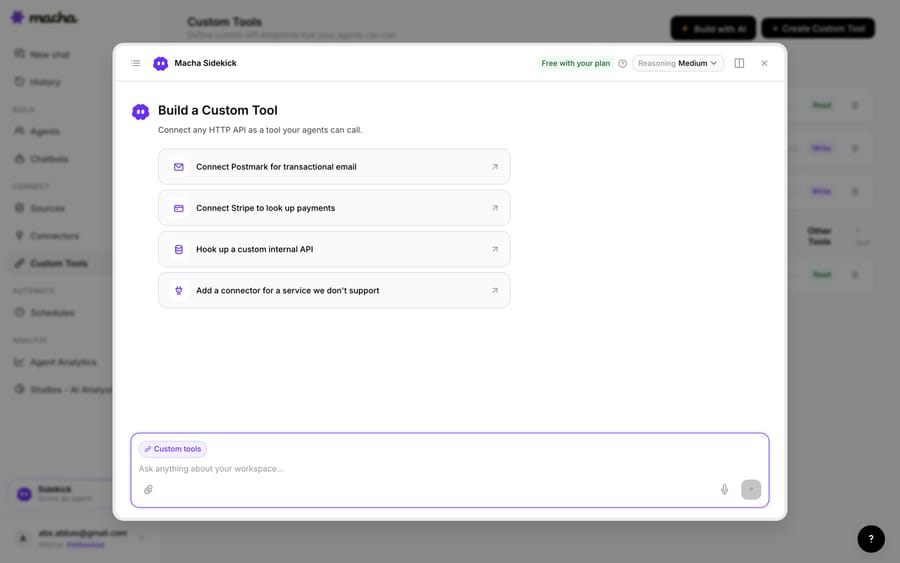
1. Point it at the Linear API. Linear exposes a GraphQL API (with an API key or OAuth); you give Macha the endpoint and credentials. The built-in Sidekick can scaffold the request from a plain-English description if you'd rather not fill in the form.
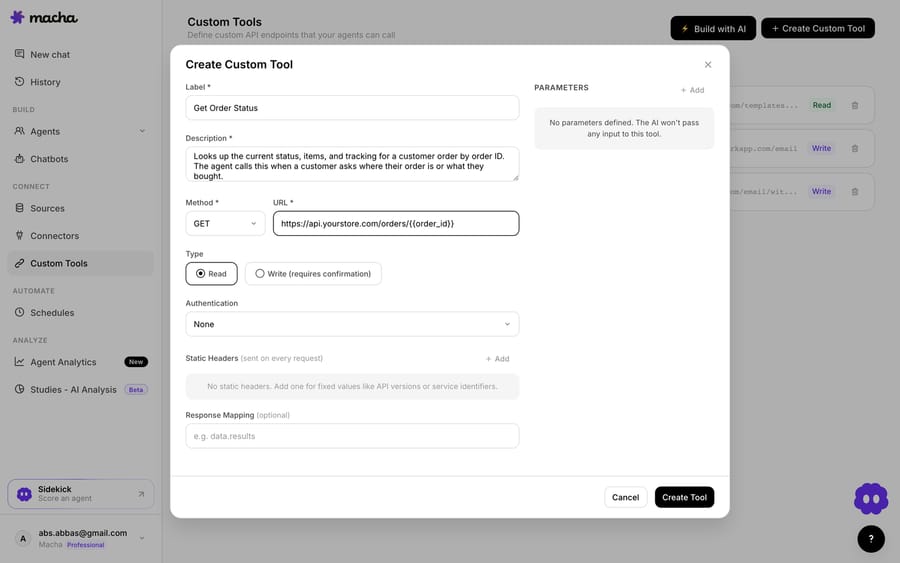
2. Define the action. Give it a label and a description the AI uses to decide when to call it — e.g. "Look up the status of a Linear issue by identifier" or "Create a Linear issue from a ticket" — set the method and URL (a query or mutation against the Linear API, with an {{issue_id}} or {{title}} placeholder), and choose Read or Write. A status lookup is a Read; creating or updating an issue is a Write, which requires confirmation before it runs.
3. The agent uses it live. Once the tool exists, the agent calls it mid-ticket, passes the issue identifier or the details it pulled from the conversation, and reasons over what Linear returns — answering "your issue is in review" or filing the bug and linking it back.
Read vs Write, and staying safe
Because a Custom Tool can reach into Linear, the guardrails matter: Read tools (status lookups) are free to call; Write tools (create an issue, update its state, add a comment) require confirmation. Each tool is scoped to one action, permissioned per agent, and every call is audited. Linear's API key or OAuth handles credentials, so secrets never live in the conversation.
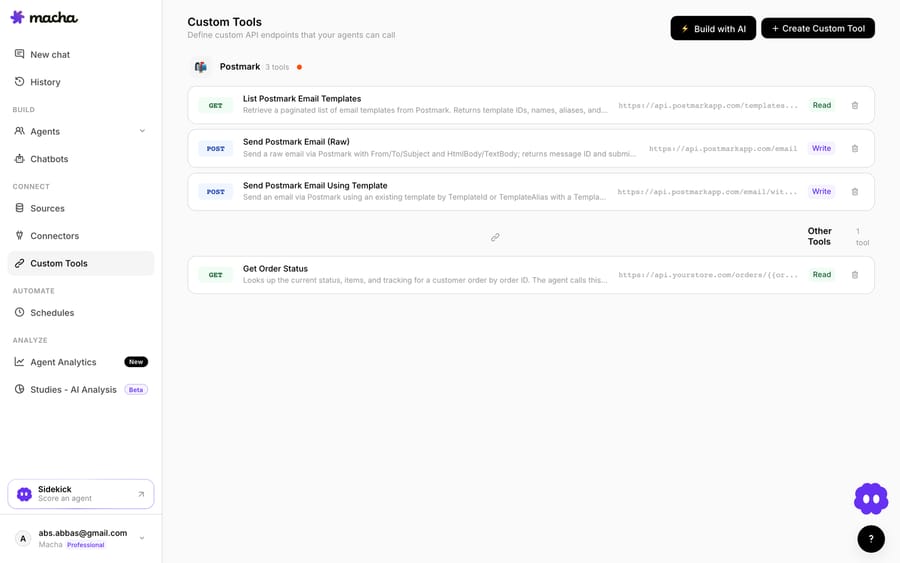
Teams usually build a few Linear tools and group them — a status lookup, a "create issue," an "update state" — alongside tools for their other systems.
Native app vs Custom Tool — which to use
- Use the native Linear app if you just want agents to manually create, link, and view issues from a widget and drive it by hand.
- Use a Custom Tool when you want your AI agent to look up an issue's live status or file one from the ticket on its own, you need a specific query or write the app doesn't expose, or you want it to happen automatically. The two can coexist.
Beyond the lookup
Once the agent can reach Linear, the same pattern covers more: check whether a fix has shipped before replying, read the priority and assignee to set customer expectations, file a well-formed issue with repro steps, or post the ticket link into the issue. And because Custom Tools aren't Linear-specific, the same approach connects your billing system, data warehouse, or internal API — see the Custom Tools integration directory for 200+ tools, or the full pillar on building custom Freshdesk integrations.
The bottom line
Freshdesk's native Linear app puts a linked issue on the screen. A Custom Tool puts Linear in your AI agent's hands — live status reads and issue creation, decided in context, no code. You describe the action, point it at the Linear API, and your Freshdesk agents can use it inside a ticket with Read/Write guardrails and a full audit trail.
Ready to try it? See how Custom Tools work, browse the integration directory, or start a free trial and wire up your first Linear tool today.
Frequently asked questions
Does Freshdesk have a native Linear integration? Yes — Freshworks' Linear app lets agents create, link, and view associated Linear issues from the ticket (there's also a "Linear for AI Agents" app). It's manual; a Custom Tool adds live, agent-driven status lookups and issue creation.
Do I need an engineer to connect Linear to Freshdesk this way? No. You describe the action in plain English and Macha's Sidekick scaffolds the Linear request, auth, and parameters. Technical teams can go deeper with full control over the query, headers, and response mapping.
Can the agent create Linear issues, or only read them? Both. Reads (status lookups) run freely; writes — creating an issue, updating its state, adding a comment — require a confirmation step, and you control which agents can use them.
Is it secure? Yes. The tool is scoped to a single action, permissioned per agent, authenticated via Linear's API key or OAuth, and every call is audited.
Add AI agents to your Freshdesk
Macha reads the ticket, drafts the reply and takes the action, inside the Freshdesk you already run.