Shopify
 Stripe
 Slack
Slack Notion
 Google Workspace
 Confluence

How to Look Up Stripe or Razorpay Payment History Inside a Support Ticket


A customer asks whether they were charged twice, and the answer sits in Stripe or Razorpay rather than the help desk. A Macha agent can run that lookup inside the conversation and summarize the charges, so nobody has to open the payment dashboard.
Key takeaways
- Macha looks up a customer's payment history mid-ticket with two tool calls, Get Customer then List Payments, and summarizes the result without the agent leaving the conversation.
- In Macha's worked example, a Stripe lookup retrieves 4 payments from the last 90 days, each $99.00 and Succeeded, and the agent reads them as a monthly subscription.
- Macha's Stripe connector can also Create Refund, Cancel Subscription and Create Payment Link, while the Razorpay connector is read-only: Get Customer, Get Payment, List Payments and List Orders.
- ChargeDesk lists 14 gateway options for its sidebar app, and Razorpay isn't one of them, so Razorpay billers get no off-the-shelf panel from it.
- A Macha payment-history lookup costs about $0.40 on the entry plan of $299 a month for 750 tickets, with no per-agent seat fees.

To look up a customer's payment history without leaving the ticket, connect Stripe or Razorpay to a Macha agent with an API key and give it two actions, Get Customer and List Payments; the agent finds the customer by email, lists their recent charges and writes a summary inside the conversation. Stripe's connector can also refund and charge, while Razorpay's is read-only (Get Customer, Get Payment, List Payments, List Orders).
| Stripe | Razorpay | |
|---|---|---|
| Find the customer | Get Customer | Get Customer |
| Read payments | List Payments · Get Payment | List Payments · Get Payment · List Orders |
| Act on it | Create Refund · Cancel Subscription · Create Payment Link | None (read-only) |
| Auth | API Key | API Key |
The fix most teams reach for is a sidebar app that mirrors payment data next to the ticket. That helps, but the agent still has to read a panel, interpret it and turn it into a sentence. An AI agent that runs the lookup on request and hands back a summary (or a drafted reply) removes that step. It also covers Razorpay, which the popular sidebar apps skip.
Macha isn't a help desk. It's an AI agent layer that sits on top of the help desk you already run (Zendesk, Freshdesk, Gorgias, Front, HubSpot or Intercom) and connects to the tools where the real data lives. Payment history is the canonical example.
What does a mid-conversation payment lookup look like?
Strip away the tooling and the task is simple: given a customer, show me what they've paid, when, how, and whether anything went wrong without making the agent (or the AI) go fishing.
Macha models this as a documented use case, Look up a customer's payment history. The agent (human or AI) asks in plain language; Macha resolves the customer in the payment provider, lists their recent payments, and summarizes. Here's the worked example straight from that flow:
Agent prompt: "Can you check what payments this customer has made? Their email is [email protected]." Macha: Found Stripe customer: Alex Johnson ([email protected]) · Retrieved 4 payments from the last 90 days. Payment history for Alex Johnson ([email protected]): - Mar 1 — $99.00 (Succeeded) — Visa ·4242 - Feb 1 — $99.00 (Succeeded) — Visa ·4242 - Jan 1 — $99.00 (Succeeded) — Visa ·4242 - Dec 1 — $99.00 (Succeeded) — Visa ·4242 Monthly subscription, all payments successful. Need me to look into anything specific?
Two tool calls did that, Get Customer then List Payments, and the agent never left the conversation. The important nuance is the last line: Macha doesn't just dump a table, it reads the table ("monthly subscription, all successful") the way a senior agent would. That interpretation is the part a sidebar panel can't do for you.
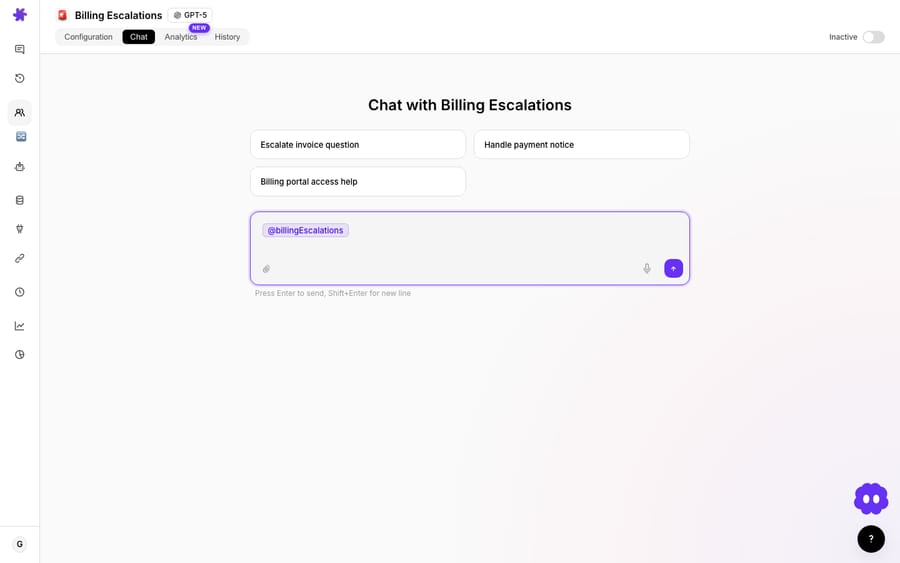
What can Macha pull from Stripe and Razorpay?
Both connectors are live and authenticate with a single API key (see the Stripe and Razorpay connector pages). For the lookup itself, the two map cleanly: resolve the customer, then list their payments filtered by status, amount, or date range, and pull a single payment's full detail when the customer is asking about one specific charge. Razorpay adds List Orders, which is handy when the question is order-shaped ("did my order go through?") rather than payment-shaped. Stripe goes further on the action side, with Create Refund, Cancel Subscription and Create Payment Link, so the same agent that looked up the history can process the refund when policy allows.
The Razorpay point deserves emphasis. Most Zendesk payment sidebar apps grew up around Western gateways: ChargeDesk, for instance, lists 14 gateway options on its homepage (Stripe, PayPal, Braintree, Shopify, Square and others, plus a "Custom" option) and Razorpay isn't one of them. If you bill in India (or anywhere Razorpay is your processor), the off-the-shelf "Stripe in your sidebar" route simply doesn't cover you. Macha treats Razorpay as a first-class connector with the same lookup pattern, so the support experience is identical regardless of which processor sits underneath.
How do you set up the lookup in Macha?
There's no code. The setup is three steps, and the third is where the judgment goes.
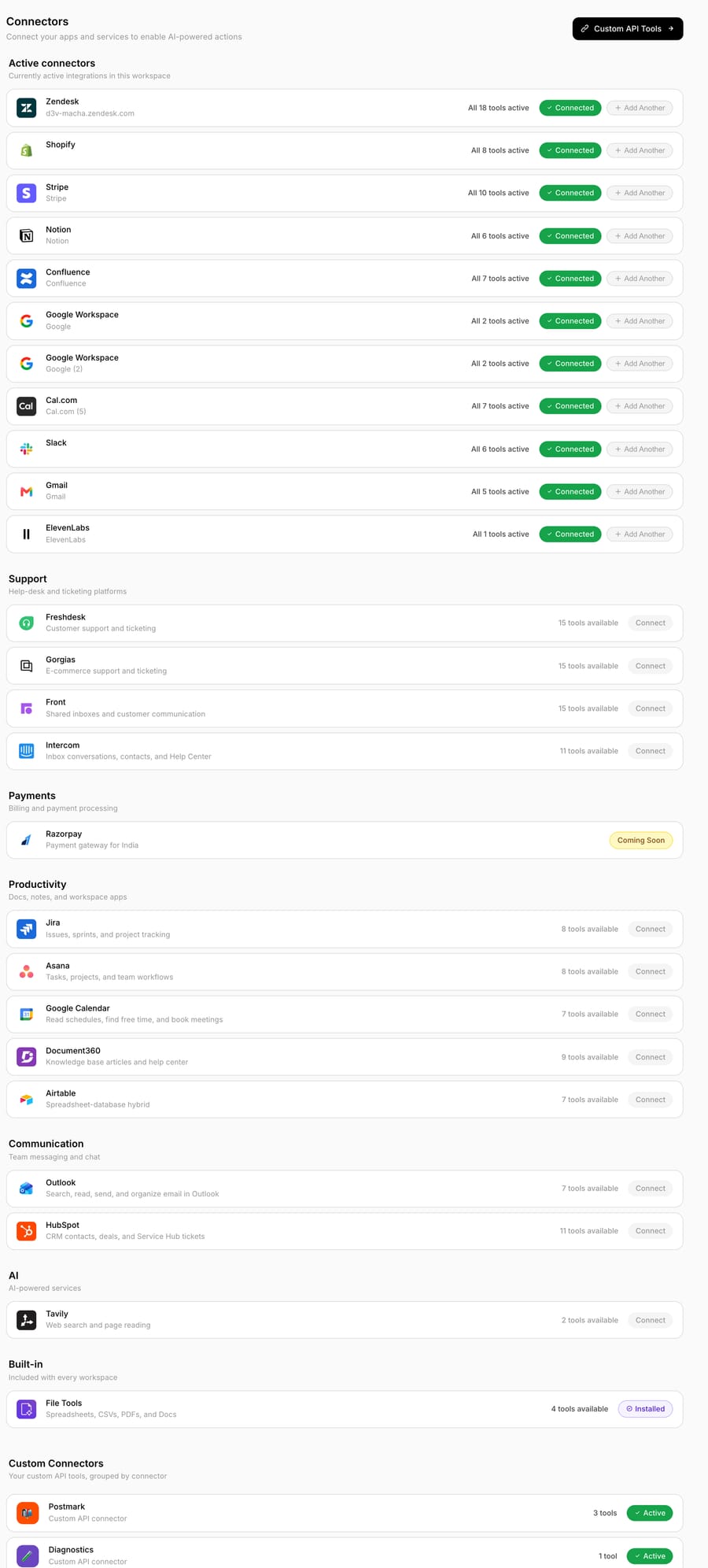
1. Connect the payment provider. Add Stripe or Razorpay from the connectors gallery with an API key. If you run multiple businesses or environments, Macha now lets you connect multiple accounts of the same connector, such as three separate Stripe accounts, each with its own credentials and name. When one agent gets several, Macha suffixes the tool names per account so the agent can target the right one.
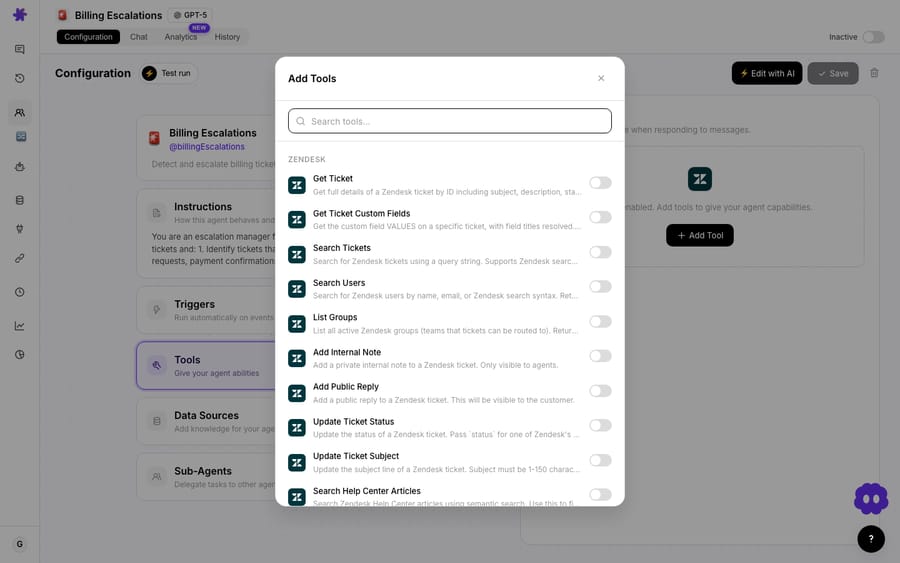
2. Give the agent the right tools. On the agent that handles billing tickets, attach the specific payment actions it's allowed to use. For a pure lookup agent, that's Get Customer and List Payments, nothing that can move money. Scope matters: an agent that should only read never gets Create Refund in its toolset.
3. Write the instruction. Tell the agent when to do this and how to present it, for example "When a ticket asks about charges, payments, or billing, find the customer in Stripe by their email, list their payments from the last 90 days, and summarize amounts, dates, statuses, and the card used. Flag anything that failed or looks duplicated. Do not issue refunds; draft a note for the agent instead." That last sentence is your guardrail.
Should the agent answer the customer or just brief your team?
The same lookup powers two different operating modes, and you'll likely want both.
Agent-assist (human in the loop). Macha runs the lookup and surfaces the summary for your agent, who reads it and replies. This is the safe default for anything touching money: the AI does the fetching and the reading, the human owns the send. Use it when the next step might be a refund, a credit, or a judgment call.
Resolve (autonomous). For low-risk, read-only questions ("what card is on file?", "when does my plan renew?", "did my last payment go through?") the agent can answer the customer directly and close the loop. No money moves, so the blast radius of a mistake is small.
The line between them is exactly the read/write line in the tools table above. Keep refunds and charges behind a human until you've watched the read-only behavior in production for a while.
How does this compare to a payment sidebar app?
Sidebar apps (ChargeDesk, Stripe by Zenplates, eOne's connector) are a mature, reasonable answer to this problem, and for some teams they're the right one. It's worth being honest about the trade:
| Sidebar app | Macha agent | |
|---|---|---|
| What the agent sees | A panel they read and interpret themselves | A written summary, already interpreted |
| Trigger | Always-on panel on every ticket | On demand, when the question calls for it |
| Can answer the customer for you | No, surfaces data only | Yes (assist) or autonomously (resolve) |
| Stripe | Yes | Yes |
| Razorpay | Often no (not in ChargeDesk's list) | Yes |
| Beyond payments | Payments only | Chains payment + helpdesk + Shopify + docs in one flow |
| Typical cost basis | Per agent/month (Stripe by Zenplates: $4.95/agent/mo with a 7-day trial, per Pluno's 2026 guide) | Per ticket (from $299/mo for 750) |
The honest summary: if all you want is a static panel of Stripe charges next to every Zendesk ticket and you bill on Stripe, a per-agent sidebar app is cheap and does the job. Macha earns its place when you want the lookup to be active (it answers, not just displays), when you bill on Razorpay, or when the payment lookup is one step in a longer chain: pull the order from Shopify, the payment from Stripe, the policy from your docs, then draft the reply.
(Competitor prices are from third-party sources checked 24 September 2026 and may change; verify on the vendor's own pricing page.)
What does a payment lookup cost on Macha?
Macha bills per ticket (one conversation with one person, charged once however many messages it takes) and never per "resolution." A single payment-history lookup is a couple of tool calls plus the model's reasoning, and none of that is billed on its own: the whole exchange is the one ticket, about $0.40 on the entry plan ($299 a month for 750 tickets). There are no per-agent seat fees on the lookup, and seats and agents are unlimited. See the pricing page for current plans, and note that the Stripe and Razorpay connectors are included as standard integrations. Plans run from $299 for 750 tickets to $3,999 for 10,000 a month, with setup and monitoring by the Macha team included.
When shouldn't you use an AI payment lookup?
This is genuinely useful, but it isn't magic. Set it up with these in mind:
- Identity resolution is the weak link. The lookup is only as good as the email match. If the customer writes from a different address than the one on their Stripe/Razorpay record, Get Customer can come back empty or, worse, match the wrong person. Instruct the agent to confirm the match (name + last-4) before trusting it, and to ask for the billing email when the ticket email doesn't resolve.
- Keep money-moving actions human-gated at first. Don't hand a new agent Create Refund or Cancel Subscription on day one. Run read-only, watch it, then expand scope deliberately.
- PCI and PII discipline. Macha surfaces what the provider returns: masked card last-4, never full PANs (Stripe and Razorpay don't expose those by design). Still, payment summaries are sensitive; keep them in agent-facing notes, not in messages that might get forwarded, and respect your data-handling policy.
- Multiple accounts need clear naming. If you've connected three Stripe accounts, the agent has to target the right one, so name them unambiguously so the lookup doesn't search the wrong business.
- A static panel may simply be enough. If your team only ever needs "show me the charges" on Stripe and never wants the AI to interpret or act, a sidebar app is a simpler, cheaper fit. Use the right tool.
FAQ
Does this replace my Stripe or Zendesk? No. Macha sits on top of both. Your payments still live in Stripe or Razorpay; your tickets still live in your helpdesk. Macha is the AI agent layer that reads across them and acts.
Which helpdesks does this work in? Zendesk, Freshdesk, Gorgias, Front, HubSpot or Intercom. The payment lookup behaves the same way regardless of which one you run.
Can the agent issue a refund after looking up the history? On Stripe, yes. Create Refund is available, but only if you attach that tool and (recommended) gate it behind human confirmation. Razorpay's connector is read-only today (Get Payment, List Payments, List Orders, Get Customer).
How far back does the history go? You control it in the instruction. List Payments filters by date range, status, and amount, so you can scope to "last 90 days," "failed only," or a single charge via Get Payment.
What about test charges and failed retries cluttering the result? Tell the agent to filter them — e.g. "exclude test-mode and only show succeeded or failed real payments." The model applies the filter as it summarizes, which is the advantage over a raw panel.
How much does a lookup cost? Nothing on its own. The lookup runs inside a ticket, and a ticket is charged once however many tool calls it takes. That's about $0.40 on the entry plan, with no per-agent seat fee. See pricing.
How fast can you try it?
If billing questions are quietly eating your handle time, this is one of the fastest wins to stand up: connect Stripe or Razorpay, attach Get Customer and List Payments to your billing agent, and write one instruction. Start a free trial ($50 of usage, no credit card, no time limit), or read the integration docs for the full walkthrough.
Written by Abbas (Customer Support & AI, Macha) · Reviewed by Ankeet Guha (Co-founder & CTO) · Published 2026-06-24 · Last updated 2026-09-24.