Shopify
 Stripe
 Slack
Slack Notion
 Google Workspace
 Confluence

NetSuite Zendesk Integration: How to Connect Them (Without a Native App) (2026)


A billing ticket lands in Zendesk, and the answer isn't in Zendesk. The customer's account, their open invoices, order history, and whether they're past due all live in NetSuite — your ERP, one tab (or one login) over. Connecting the two is a perennial ask for finance-adjacent support teams, and the way you do it matters, because Zendesk has no first-party native NetSuite app to reach for.

This guide covers the realistic options: the third-party sync tools that bridge NetSuite and Zendesk (and where they get heavy), and how to give your AI agent live NetSuite lookups right inside a ticket using a Custom Tool.
Framing first. Macha runs on top of the Zendesk you already use — it's an AI-agent layer, not a Zendesk or NetSuite replacement. Your agents keep working in Zendesk; Macha reads the ticket, reasons, and reaches into NetSuite to answer or act.
No native app — and what fills the gap today
Zendesk doesn't ship a first-party NetSuite connector. What exists instead are third-party integration apps — Celigo's NetSuite Connector, the NetSuite Connector by Faye, and NetSuite sidebar apps — that sit between the two systems and sync records like customers, invoices, orders, and returns into Zendesk.
Where they get heavy:
- They're sync-and-display, not agent action. They mirror records onto the screen; they don't let an AI agent decide to look something up mid-conversation, pass the right parameters, and reason over the result.
- They're an iPaaS project. These connectors are paid platforms with field mapping, sync schedules, and their own setup and maintenance tail — real work to stand up and keep running.
- They're fixed. You get the objects and sync behavior the connector was built for — not the specific query or write your workflow needs (e.g. "is this account past due?" or "what's the status of invoice #X?").
For teams that genuinely need bidirectional record sync across systems, an iPaaS connector earns its keep. For anyone who mostly wants their AI agent to answer a NetSuite question inside a ticket, there's a lighter path.
What you actually want: the agent using NetSuite live
The high-value version of this integration isn't a mirrored record — it's the agent doing the work. A customer emails Zendesk about a charge; the agent looks up their live NetSuite account by email, sees the open invoice and payment status, and answers "your invoice #1042 is paid" or "you have a balance due next week" — grounded in the ERP, not a stale synced copy. That's what a Custom Tool enables.
How to connect them with a Custom Tool
A Custom Tool is a single action you define once and point at NetSuite's API. No iPaaS platform, no code.
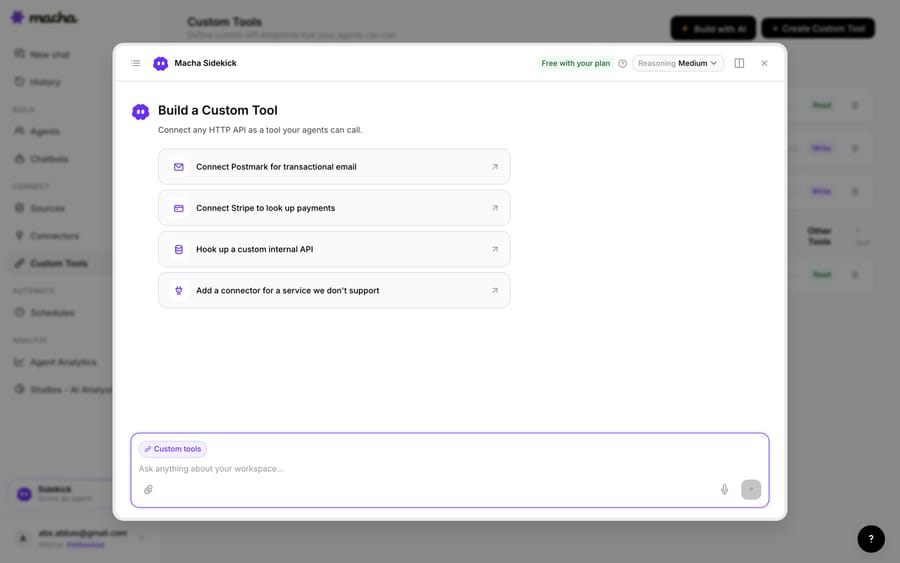
1. Point it at the NetSuite API. NetSuite exposes the SuiteTalk REST API (with token-based auth); you give Macha the endpoint and credentials. The built-in Sidekick can scaffold the request from a plain-English description if you'd rather not fill in the form.
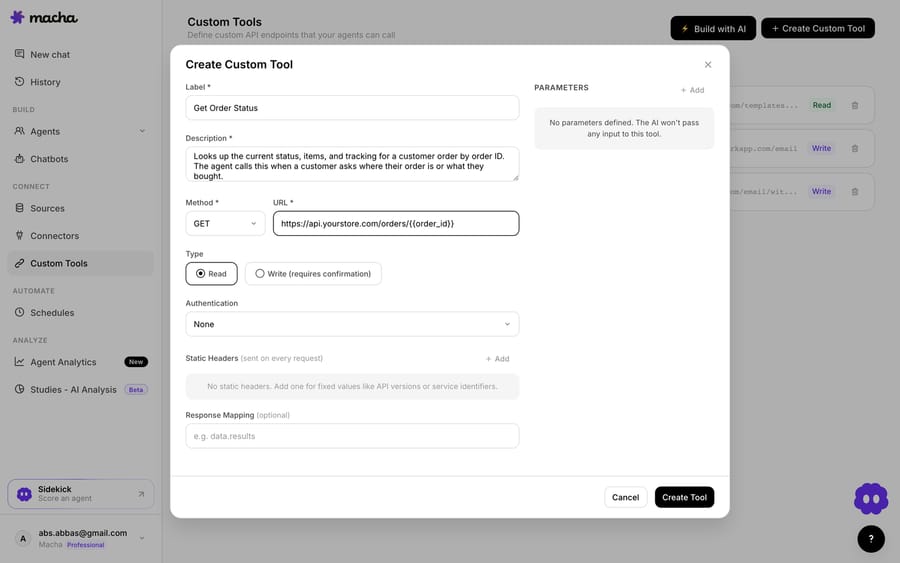
2. Define the action. Give it a label and a description the AI uses to decide when to call it — e.g. "Get the NetSuite customer, open invoices, and balance for a customer by email" — set the method and URL (a query against the SuiteTalk REST API, with a {{email}} placeholder), and choose Read or Write. Reading billing standing is a Read; updating a record or logging an interaction is a Write, which requires confirmation before it runs.
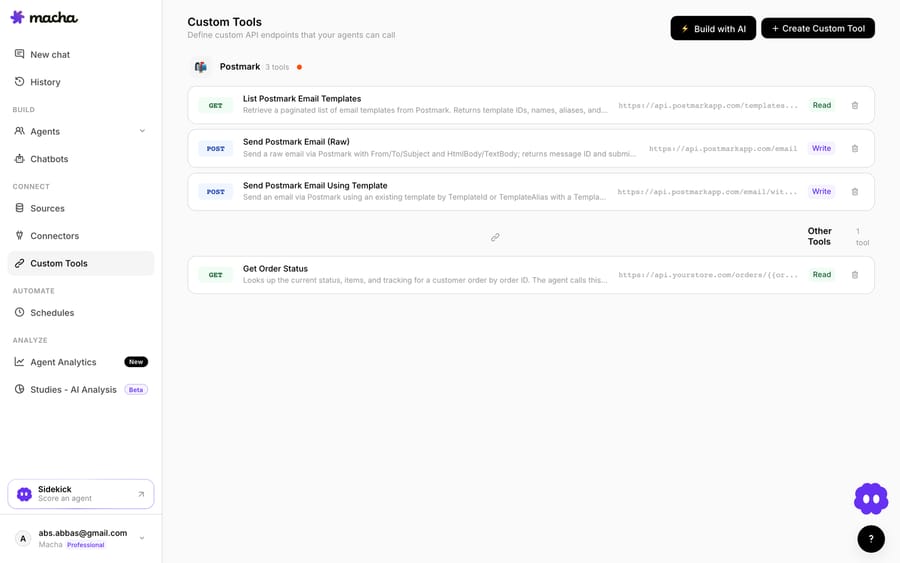
3. The agent uses it live. Once the tool exists, the agent calls it mid-ticket, passes the customer's email, and reasons over the NetSuite record it gets back — answering the billing question or taking the next step.
Read vs Write, and staying safe
Because a Custom Tool can reach into NetSuite, the guardrails matter: Read tools (account and invoice lookups) are free to call; Write tools (update a record, log an activity) require confirmation. Each tool is scoped to one action, permissioned per agent, and every call is audited. NetSuite's token-based auth handles credentials, so secrets never live in the conversation.
Teams usually build a few NetSuite tools and group them — a "get customer and balance," a "look up invoice status," a "log ticket to the account" — alongside tools for their other systems.
Third-party sync vs Custom Tool — which to use
- Reach for a third-party sync connector if you genuinely need bidirectional record sync between NetSuite and Zendesk — mirroring customers, invoices, and orders on a schedule — and you're prepared to run an iPaaS platform.
- Reach for a Custom Tool when you want your AI agent to look up live NetSuite data or act from the ticket, you need a specific query the connector doesn't expose, or you'd rather not stand up and maintain a sync platform. The two can coexist.
Beyond the lookup
Once the agent can reach NetSuite, the same pattern covers more: verify billing standing before answering, read the open invoice and due date, check order history, confirm an account's status, or log the ticket back to the customer record. And because Custom Tools aren't NetSuite-specific, the same approach connects your CRM, payment processor, or internal API — see the Custom Tools integration directory for 200+ tools, or the full pillar on building custom Zendesk integrations.
The bottom line
There's no first-party NetSuite app for Zendesk, and a full iPaaS sync is more than most support teams need. A Custom Tool puts NetSuite in your AI agent's hands — live lookups and actions, decided in context, no code, no sync platform to run. You describe the action, point it at the NetSuite API, and your Zendesk agents can use it inside a ticket with Read/Write guardrails and a full audit trail.
Ready to try it? See how Custom Tools work, browse the integration directory, or start a free trial and wire up your first NetSuite tool today.
Frequently asked questions
Does Zendesk have a native NetSuite integration? Not a first-party one. Integrations exist through third-party iPaaS/marketplace connectors (Celigo, Faye) that sync records between the systems. A Custom Tool skips the sync platform and gives your AI agent live NetSuite lookups and actions inside a ticket.
Do I need an engineer to connect NetSuite to Zendesk this way? No. You describe the action in plain English and Macha's Sidekick scaffolds the SuiteTalk request, auth, and parameters. Technical teams can go deeper with full control over the query, token-based auth, headers, and response mapping.
Can the agent update NetSuite, or only read it? Both. Reads (account and invoice lookups) run freely; writes — updating a record, logging an activity — require a confirmation step, and you control which agents can use them.
Is it secure? Yes. The tool is scoped to a single action, permissioned per agent, authenticated via NetSuite's token-based auth, and every call is audited.
Add AI agents to your Zendesk
Macha reads the ticket, drafts the reply and takes the action, inside the Zendesk you already run.