Shopify
 Stripe
 Slack
Slack Notion
 Google Workspace
 Confluence

Re:amaze AI Explained: What It Automates and Where It Stops (2026)


Re:amaze is a helpdesk built for ecommerce teams, owned by GoDaddy since 2021, and its AI Agent is the feature most Shopify and WooCommerce sellers are actually asking about when they search for it. This guide explains what that AI does inside Re:amaze, how you turn it on, what it costs beyond the base subscription, where it stops being useful, and where a separate AI agent layer can pick up what it can't do.

We build an AI agent layer for customer service ourselves. It sits on top of a help desk instead of replacing one, so we have a direct interest in this comparison. We checked Re:amaze's own pricing and product pages directly, and we're upfront that Re:amaze the helpdesk is not something we compete with or suggest replacing.
What Re:amaze is
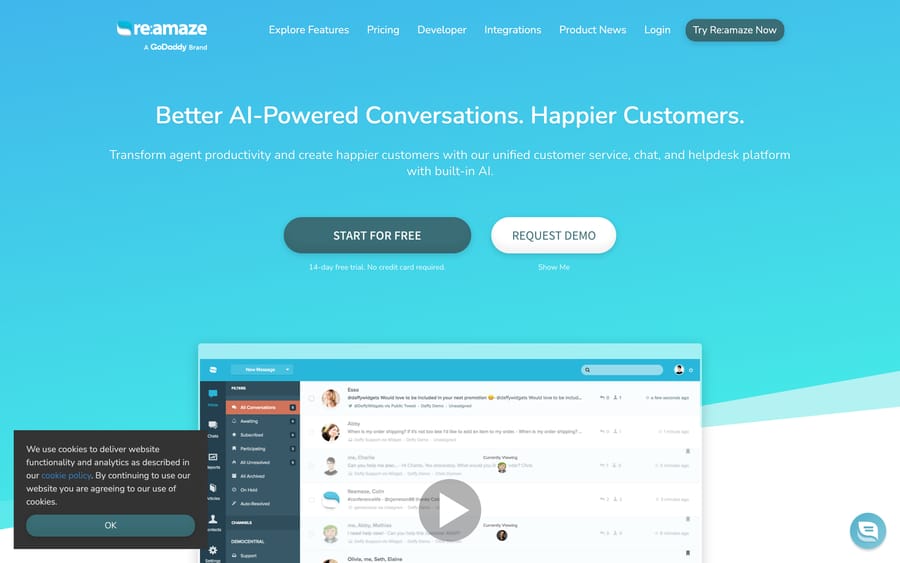
Re:amaze is a unified inbox for email, live chat, social messaging, SMS, VoIP, and video, aimed squarely at online stores. It bundles a public FAQ/help center, workflow automation, and live visitor monitoring into one interface, and it integrates with the tools an ecommerce team already runs: Shopify, Slack, Stripe, and Jira among them. GoDaddy acquired the company in 2021, per multiple industry reports at the time, and Re:amaze has continued operating under its own brand since. GoDaddy folded it into its small-business commerce tools and left the product name and interface alone.
What Re:amaze's AI Agent actually does
Re:amaze markets its AI under the name AI Agent, currently labeled Beta on the product's own AI page. The mechanism: your published Help Center articles become the AI's knowledge source directly, with no separate training step. Re:amaze's own language on this is specific: "Articles created acts a repository of knowledge that trains your AI Agent and chatbots. Updates made are added as context instantly. No complex workflows or training needed." In practice, that means editing a help article updates what the AI can say on the next conversation, without a re-index delay or a model retrain to wait for.
Inside a live conversation, the AI Agent does four things: drafts a reply for a human to review or send, summarizes a long back-and-forth so an agent doesn't have to re-read it, gauges the sentiment of the customer's message, and surfaces FAQ articles that match what's being asked. Re:amaze also ships a co-browse view where a human agent can "watch how AI is responding while you deep dive into research," which reads as an admission that the AI runs live traffic while someone still keeps an eye on it. This isn't a fully unsupervised deployment.
AI Agent versus Re:amaze's chatbots
Re:amaze sells two separate conversational features, and it's easy to conflate them when you're skimming the pricing page. Chatbots are the older, pre-built-and-custom automation flows, listed on the plan comparison as their own line item and marketed around triggering "business opportunities" like upsells and proactive outreach. The AI Agent is the newer, knowledge-base-driven layer described above. Re:amaze's own site doesn't spell out whether the chatbot builder runs on fixed decision trees or something more flexible, so if you're comparing the two, test both against the same handful of real questions before deciding which one handles your FAQ traffic and which one handles proactive messaging.
Setting it up
Getting the AI Agent running has three real steps. First, build out your Help Center: the more complete your published FAQ and article library, the more the AI actually has to draw from, since there's no separate ingestion pipeline beyond what you've already published. Second, turn on the AI Agent in your plan (it's included from the Basic tier up) and set which channels it's allowed to touch. Third, decide its posture: fully autonomous replies on simple, FAQ-shaped questions, or draft-and-review, where every AI-written reply waits for a human to approve it before it sends. Re:amaze doesn't publish a hard rule for what counts as a "resolution" for billing purposes beyond what's in the pricing page, so worth testing on a handful of real tickets before turning it loose broadly.
What it costs
AI is bundled into every paid plan instead of sold as a separate SKU, which changes the pricing conversation compared to a bolt-on chatbot add-on: on Re:amaze, the AI Agent question isn't whether to buy it, it's how many resolutions you'll use.
- Basic ($29/month per seat): 5 AI Agent resolutions per user per month included, additional resolutions billed at $0.85 each.
- Pro ($49/month per seat): 10 resolutions included, same $0.85 overage, plus AI Intents.
- Plus ($69/month per seat, Re:amaze's "most popular" tier): 20 resolutions included, same overage rate.
- Starter ($59/month flat, unlimited seats, capped at 500 conversations/month): includes Basic-tier features.
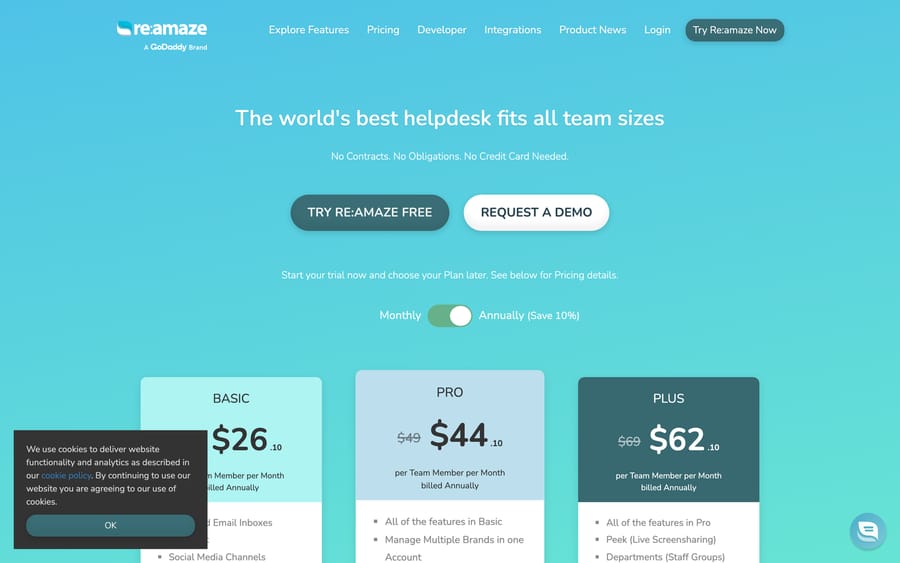
The per-resolution overage is the detail worth naming directly: Re:amaze earns $0.85 every time the AI Agent closes a ticket beyond your plan's allowance, which means the AI has a built-in reason to count more interactions as a "resolution," the same incentive every per-resolution AI product carries. That's not a reason to avoid the feature. It's a reason to check your actual resolution count against the invoice in month one instead of assuming the included allowance covers you.
Where it stops
The AI Agent works only with what's in your Help Center. It doesn't look up an order status, process a refund, or check inventory unless that logic is built separately through Re:amaze's workflow automation, and the product page doesn't describe any built-in action-taking beyond drafting, summarizing, and suggesting articles. It's a knowledge and drafting layer sitting on top of your existing content. Pulling a tracking number from Shopify on its own is outside what it does.
It's also explicitly Beta. Re:amaze doesn't publish accuracy numbers, hallucination rates, or a documented escalation policy for when the AI should hand off to a human beyond the co-browse view. A team running high ticket volume with real financial stakes in each answer should treat the current AI Agent as a drafting assistant to review until Re:amaze publishes more about how it decides a conversation is resolved.
Language support is another open question. Re:amaze's own pages describe the AI Agent purely in terms of Help Center content and channels, with no stated list of supported languages beyond what your articles are written in. If your store serves customers in more than one language, test the AI Agent against a non-English Help Center article before assuming it performs the same way it does in English.
Who it suits
Re:amaze's AI Agent is for teams already running Re:amaze as their helpdesk who want faster first drafts and fewer repeat lookups in the Help Center, without adding a separate tool or vendor relationship. If your ticket volume is FAQ-heavy (shipping windows, return policy, sizing questions) and your Help Center is genuinely maintained, the AI Agent earns its keep quickly, since it's drawing straight from content you'd otherwise expect an agent to search manually.
It's a weaker fit if your support load is mostly account-specific lookups (order status, subscription state, refund eligibility) that live in Shopify or a billing system, not in a help article. Those questions need the AI to reach into another system, take an action, and confirm it, which is a different job than drafting from a knowledge base.
Where an AI agent layer fits on top
This is the shape of automation Re:amaze's AI Agent doesn't cover: acting on customer and order data across the tools around the helpdesk, not just drafting from what's published in it. That's the specific gap Macha is built for. Macha runs as an agent layer connected to your help desk and to Shopify, Slack, Stripe, and other systems, so an agent can look up an order, check a refund policy against the actual order state, and take the next step, with a confirmation gate on anything customer-facing. It runs alongside Re:amaze rather than in place of it; the helpdesk stays the system of record for the conversation, and Macha is the part that reaches into the rest of your stack to answer the harder question. Pricing is on monthly ticket volume from $299/month for 750 tickets, about $0.40 a ticket at every tier (see pricing), with setup and monitoring by the Macha team included and $50 of free usage to start.
FAQ
What is Re:amaze? Re:amaze is a helpdesk built for ecommerce teams, combining email, live chat, social messaging, SMS, and video into one inbox, owned by GoDaddy since 2021.
What does Re:amaze's AI Agent do? It drafts replies, summarizes conversations, gauges sentiment, and suggests relevant Help Center articles, drawing directly on your published FAQ content with no separate training step.
How much does Re:amaze AI cost? It's bundled into every paid plan rather than sold separately. Basic includes 5 AI resolutions per user monthly, Pro includes 10, and Plus includes 20, with additional resolutions billed at $0.85 each on every tier.
Is Re:amaze's AI Agent fully autonomous? It can be, but Re:amaze also supports a draft-and-review mode where a human approves each AI-written reply before it sends, and the product includes a co-browse view for watching AI responses live.
Can Re:amaze's AI look up an order or process a refund? Not on its own. The AI Agent works from your Help Center content. Any action that reaches into Shopify or a billing system needs separate workflow automation or a connected agent layer.
Is GoDaddy involved in running Re:amaze day to day? Re:amaze operates under its own brand and product after the 2021 acquisition; GoDaddy owns the company but Re:amaze's own communications describe support and operations continuing as before.
What are good alternatives if I need more than Re:amaze's AI Agent? Teams that need an AI agent to take action across connected systems (order lookups, refunds, account changes), not just draft from a help center, typically add a layer like Macha on top of Re:amaze rather than replacing the helpdesk.
Sources: Re:amaze homepage, Re:amaze pricing, Re:amaze AI page, Re:amaze chatbot features, Re:amaze blog: Re:amaze joins GoDaddy.
Automate your support workflows
Macha's agents run multi-step workflows across the tools you already connect.