Intercom
 Shopify
 Stripe
 Slack
Slack Notion
 Google Workspace
 Confluence

Zendesk vs. Help Scout (2026): Depth vs. Simplicity


Zendesk and Help Scout sit at opposite ends of the help-desk spectrum. Zendesk is the deep, configurable, scale-to-enterprise platform. Help Scout is the simple, email-first desk built so a small team can be live this week with a personal, human touch — no "admin center" rabbit holes. The choice really is depth and scale vs. simplicity and speed. This guide uses verified June-2026 pricing (Help Scout's, notably, has changed) and stays neutral.
Short version: Help Scout if you want a fast, friendly, low-overhead desk for a small-to-mid team; Zendesk if you need automation, omnichannel, voice, and scale.
The 30-second verdict
| If you are… | Pick |
|---|---|
| A small-to-mid team that wants to be live this week | Help Scout |
| Doing mostly email + chat with a personal tone | Help Scout |
| A SaaS/startup/SMB without a dedicated admin | Help Scout |
| Running high-volume support with complex routing/SLAs | Zendesk |
| Needing native voice / contact center | Zendesk |
| Scaling to enterprise, multi-brand, deep analytics | Zendesk |
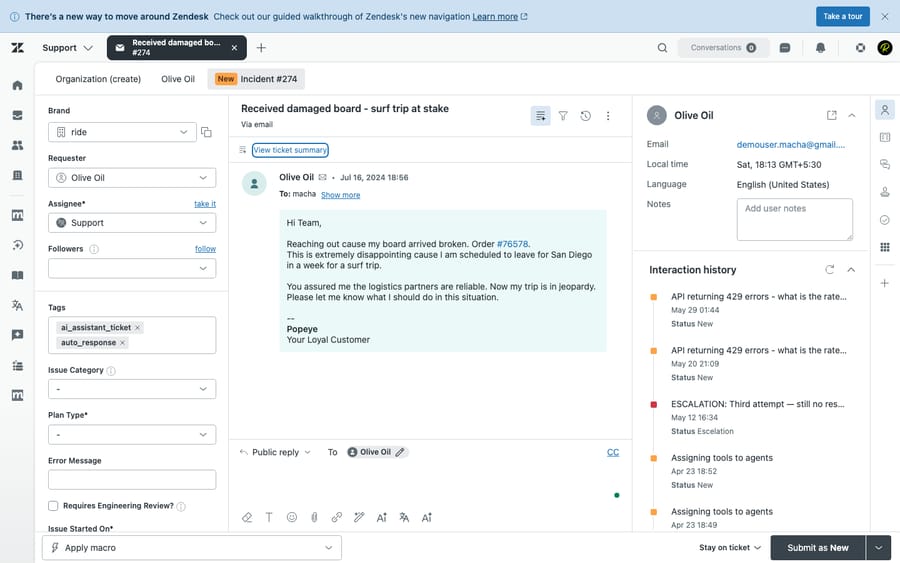
How we compared: Zendesk and Help Scout pricing is verified against each vendor's official page (June 2026), including Help Scout's reversion to per-user pricing. Features are checked against the products — and we ran Zendesk hands-on in a live test account (screenshot below). User sentiment comes from real G2, Capterra, and TrustRadius reviews. Macha is our own product — we flag that wherever it comes up.
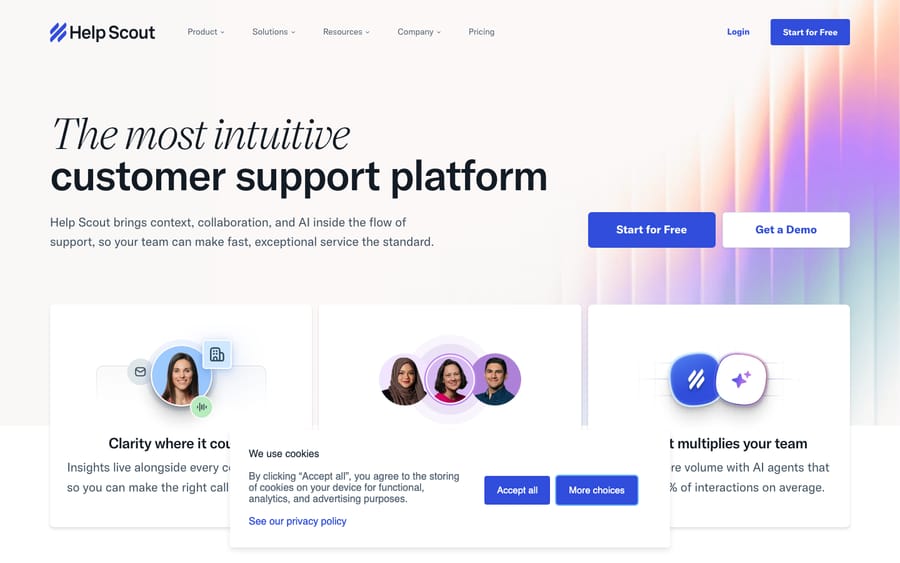
Pricing: Help Scout went back to per-user
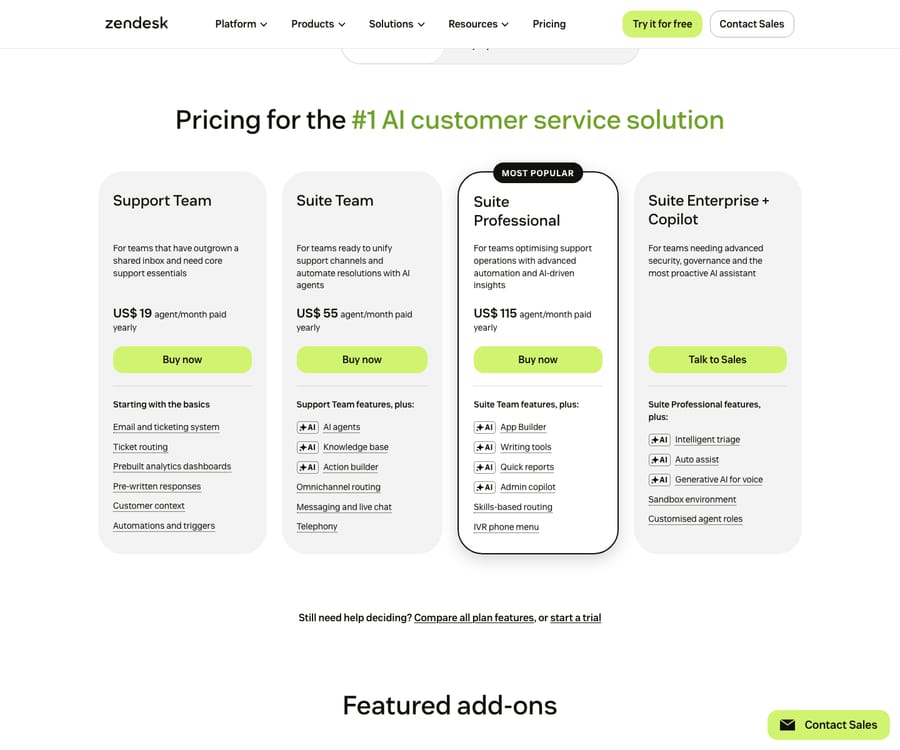
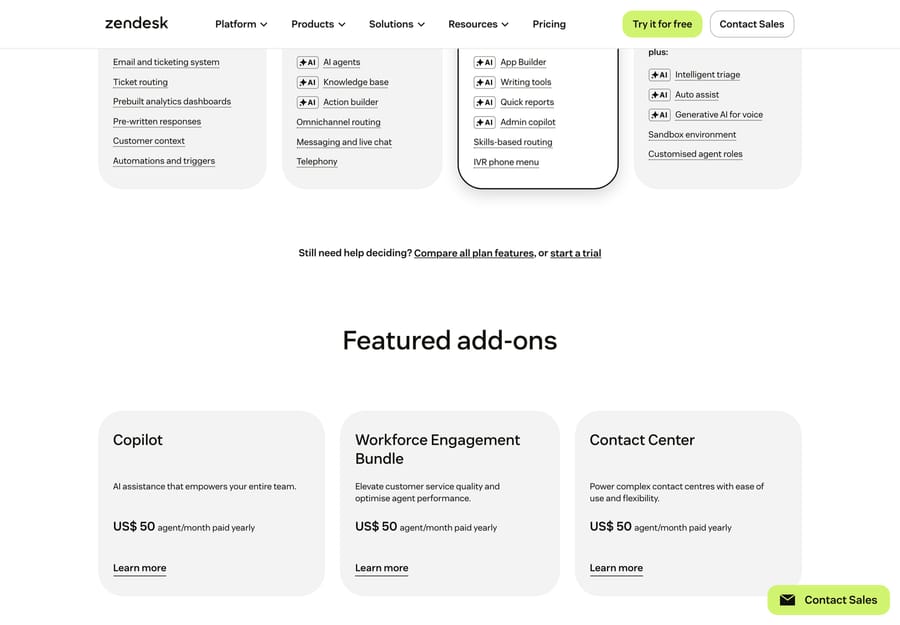
Zendesk Suite (per agent/month, annual): Support Team $19, Suite Team $55, Suite Professional $115, Enterprise contact sales; Copilot AI add-on $50/agent (Professional+ only); AI agents ~$1.50–$2.00 per automated resolution. Source: Zendesk pricing.
Beyond the per-seat plans, Zendesk’s AI and CX capabilities are sold as separate add-ons — each priced per agent on top of your base plan:
Help Scout (per user/month): Free (up to 5 users), Standard $25, Plus $45, Pro $75 — with unlimited contacts on all paid plans. Source: Help Scout pricing.
There's a story worth knowing here: in late 2024 Help Scout briefly switched to a contacts-based model (pay by how many people you talk to), got significant customer pushback, and reverted to straightforward per-user pricing. Several comparison articles still quote the dead contacts model — if you see it, it's out of date. The current model is simple per-seat with unlimited contacts.
The AI pricing is where Help Scout quietly wins on cost:
- Help Scout bundles AI Assist, AI Summarize, and AI Drafts free on paid plans, and its autonomous chatbot, AI Answers, costs $0.75 per resolution.
- Zendesk charges $50/agent for Copilot (agent-assist) and ~$1.50–$2.00 per resolution for autonomous AI — roughly double Help Scout's per-resolution rate, with the seat add-on on top.
So at comparable seats Help Scout is cheaper, and its AI economics are meaningfully friendlier — though, as below, Help Scout's AI is also lighter.
Feature-by-feature: who wins what
| Capability | Winner | Why |
|---|---|---|
| Shared inbox & agent workspace | Help Scout | Email-style inbox, zero ticket jargon — faster for agents and friendlier for customers |
| Ease of use & setup | Help Scout | Live in hours, not weeks; no admin rabbit holes (its single biggest selling point) |
| Omnichannel (email/chat/voice/social) | Zendesk | True omnichannel incl. native voice/IVR; Help Scout is email-first (chat via Beacon, no native voice) |
| Automation / workflows | Zendesk | Triggers, automations, macros, skills-based routing, SLAs — far deeper |
| Native AI | Zendesk (depth) / Help Scout (value) | Zendesk's AI is more autonomous; Help Scout's is cheaper and bundled but lighter |
| Knowledge base & self-service | Tie (Help Scout for SMB) | Help Scout Docs is clean and quick; Zendesk Guide is more powerful/multi-brand but heavier |
| Reporting / analytics | Zendesk | Explore + custom dashboards go deeper |
| Integrations | Zendesk | ~1,500+ marketplace apps vs Help Scout's ~100+ |
| Live chat widget | Zendesk (power) / Help Scout Beacon (simplicity) | Beacon blends chat + help articles elegantly; Zendesk messaging is richer |
| Scalability | Zendesk | Built for enterprise volume, multi-brand, governance |
| Collaboration | Help Scout | @mentions, private notes, collision detection — designed for tight teams |
The pattern: Help Scout optimizes for a small team's speed and a personal customer experience; Zendesk optimizes for depth, automation, and scale.
Strengths & weaknesses, honestly
Help Scout — strengths: fastest time-to-value; intuitive email-style UI; personal, human customer experience (no ticket numbers); transparent, lower pricing with free agent-assist AI and a cheap chatbot ($0.75/resolution); clean Docs + Beacon combo. Help Scout — weaknesses: no native voice/phone; lighter automation, routing, and SLAs; shallower reporting; fewer integrations (~100); AI is more assistive than autonomous, and can hit ceilings as you scale.
Zendesk — strengths: deep automations, routing, SLAs, multi-brand; true omnichannel incl. voice; 1,500+ integrations; the most advanced native AI; enterprise-grade scale, security, governance, analytics. Zendesk — weaknesses: steeper setup and learning curve; expensive once add-ons stack (Copilot, QA, WFM, per-resolution AI), with overages that auto-bill; can feel impersonal/heavy for a small team that just wants email.
What real users say
Both products rate well, but the base and the recurring complaints differ — and they map almost perfectly onto the depth-vs-simplicity story. (Observed June 2026.)
| G2 | Capterra | Other | |
|---|---|---|---|
| Help Scout | 4.4 / 5 (~430) | 4.6 / 5 (226) | TrustRadius — small base (~5 reviews)* |
| Zendesk | 4.3 / 5 (~6,000+) | 4.4 / 5 (4,081) | TrustRadius 8.7/10 |
\*Help Scout's TrustRadius base is tiny, so treat that platform's score as anecdotal, not representative. Its Capterra rating (4.6) edges Zendesk's (4.4), and Zendesk's far larger review base reflects a much bigger install footprint.
- Help Scout — praised for exactly what it sells: simplicity and a low learning curve. "Clear and intuitive design is what I like most. While beginners don't need instructions to get started, they are readily available" (Zofia M., Customer Success Lead, Capterra, Mar 2025). The recurring knocks are the limits of that simplicity — thinner interface depth and fewer templates as you scale: "The platform's interface, especially the inbox UI, has a lot of room for improvement, and there is currently just one knowledgebase template available" (Lillian G., Human Resources Generalist, Capterra, Aug 2023). Reviewers elsewhere echo lighter reporting and automation once volume grows.
- Zendesk — praised for feature breadth and value across channels: "Zendesk Suite offers strong value for money considering the wide range of features included — ticketing, automation, analytics, and omnichannel support" (Ifra S., Zendesk Developer, Capterra, Dec 2025). The two dominant criticisms are pricing/add-on creep and Zendesk's own support quality: "Their support is some of the worst I've ever experienced and keeps getting worse" (Katie Y., Head of Customer Success, Capterra, Mar 2025).
The pattern matches the rest of this guide: Help Scout users love the simplicity and bump into its ceilings; Zendesk users get the depth but complain about what it costs and how it's supported.
Who each is genuinely for
- Help Scout → small-to-mid teams (roughly 2–50 agents) that value simplicity over configurability — SaaS startups, SMBs, agencies, B2B teams doing mostly email + chat support where a personal tone matters and there's no admin to babysit the tool. Ideal when you want to be live this week.
- Zendesk → mid-market to enterprise support orgs needing scale, depth, and automation — high ticket volume, true omnichannel (incl. voice), complex routing/SLAs, multi-brand, heavy reporting, and large-scale autonomous AI deflection — and that have the resources to configure and maintain it.
The AI question — assistive vs. autonomous, and a third path
Honestly: Help Scout's AI is mostly assistive (rewrite, summarize, draft, plus a competent KB-grounded chatbot at $0.75/resolution), while Zendesk's is more autonomous but pricier and more volatile (per-resolution overages auto-bill). But both share the same ceiling — their AI is anchored to their own help-desk data and resolves mostly FAQ-style tickets. Neither natively excels at autonomous resolution that requires pulling from order systems, multiple knowledge sources, or taking real actions across tools.
That's the case for an independent AI agent layer on top of the desk. A layer like Macha connects to your full knowledge and backend systems to autonomously resolve a higher share of tickets — order lookups, account actions, multi-step issues — while escalating cleanly into the same inbox. It raises the deflection ceiling on Help Scout (whose native AI is lighter) and adds resolution depth on Zendesk without forcing the full Copilot + per-resolution stack. It's helpdesk-agnostic and priced per action — an automation layer on top of your desk, not a replacement. The honest caveat: a layer is another vendor and integration to manage, it only resolves as well as the knowledge you connect, and per-action pricing isn't free at high volume — it's additive, not a free win. (More: native AI vs. an AI layer.)
Before you switch: migration realities
- Help Scout → Zendesk (scaling up): expect a model shift from "conversations/mailboxes" to "tickets/triggers/automations." Conversations, customers, tags, and saved replies (→ macros) and Docs (→ Guide) migrate with standard tools, but you'll re-architect workflows and routing and budget setup time.
- Zendesk → Help Scout (simplifying): map tickets → conversations, macros → saved replies, Guide → Docs. Simpler target, but you'll lose deep automation/routing and native voice — re-scope processes.
- Either direction: automations don't port 1:1, and you'll preserve CSAT history/customer IDs where you can. Run a pilot inbox before full cutover.
Frequently asked questions
Is Help Scout cheaper than Zendesk? Generally yes — comparable per-user prices ($25/$45/$75 vs Zendesk's $55/$115), free agent-assist AI, and a chatbot at $0.75/resolution (about half Zendesk's per-resolution rate). Compare total cost including AI at your volume.
Did Help Scout change its pricing? Yes — it briefly used a contacts-based model in late 2024, then reverted to per-user pricing with unlimited contacts. Articles citing contacts-based tiers are out of date.
Is Zendesk better than Help Scout? For automation, omnichannel, native voice, analytics, and scale — yes. For simplicity, speed-to-launch, and a personal customer experience — Help Scout. It depends on whether your constraint is depth or simplicity.
Does Help Scout have AI? Yes — free AI Assist/Summarize/Drafts plus an autonomous chatbot (AI Answers) at $0.75/resolution. It's cheaper than Zendesk's AI but lighter on autonomy.
Can I get stronger autonomous AI without switching? Yes — an AI agent layer like Macha adds autonomous, KB-grounded resolution on top of Help Scout or Zendesk, priced per action.
The bottom line
Choose Help Scout if you want a fast, friendly, low-overhead desk for a small-to-mid team that values a personal customer experience — and friendlier AI economics. Choose Zendesk if you need depth, automation, omnichannel, native voice, and enterprise scale, and can invest in configuring it. And keep the AI decision separate: both native bots lean assistive, so an AI layer on top can add genuine autonomous resolution to whichever desk fits your team.
Want autonomous resolution on top of Help Scout or Zendesk? See how Macha layers AI agents over your help desk, priced per action. 7-day free trial, no credit card required. Start Trial.
Add AI agents to your Zendesk
Macha reads the ticket, drafts the reply and takes the action, inside the Zendesk you already run.