Intercom
 Shopify
 Stripe
 Slack
Slack Notion
 Google Workspace
 Confluence

Zendesk vs. Jira Service Management (2026): CX vs. IT Service


The most important thing to know about Zendesk vs. Jira Service Management is that they're aimed at different jobs. Zendesk is built for external customer support — the omnichannel conversations your customers start. Jira Service Management (JSM), from Atlassian, is built for internal IT and dev service — incidents, change requests, and IT tickets, tightly wired to Jira Software and Confluence. They both "do tickets," but the buyer, the workflows, and the pricing model are different. This guide keeps it neutral and current (June 2026).

Short version: Zendesk for customer-facing CX; JSM for internal ITSM and engineering-adjacent service — and plenty of companies run both.
The 30-second verdict
| If you are… | Pick |
|---|---|
| A customer support / CX team (email, chat, social, voice) | Zendesk |
| An IT, DevOps, or internal service desk | Jira Service Management |
| Already living in Jira Software / Confluence | Jira Service Management |
| Needing ITIL incident/problem/change + asset/CMDB | Jira Service Management |
| Running high-volume external support at scale | Zendesk |
| Both a customer support team and an internal IT desk | Often both (they integrate natively) |
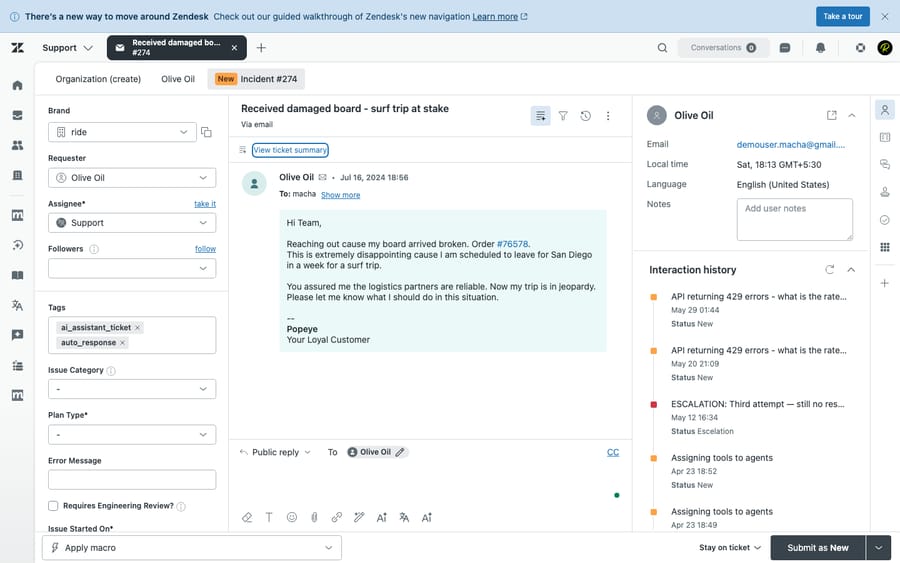
How we compared: pricing is verified against each vendor's official page (June 2026); features are checked against the products — and we ran Zendesk hands-on in a live test account (screenshots below). User sentiment comes from real G2, Capterra, and Gartner reviews. Important caveat we keep front-of-mind: a large share of JSM reviews describe internal IT/ITSM use (incidents, change, CMDB for employees), not external customer support — so we weight that context rather than comparing apples to oranges. Macha is our own product — we flag that wherever it comes up.
Pricing: two different models
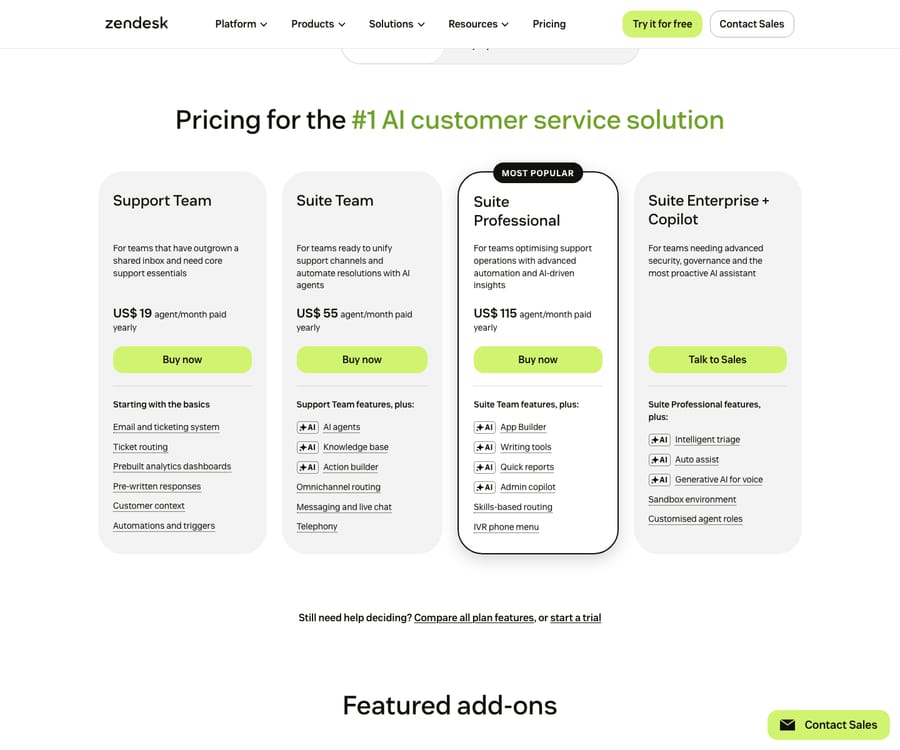
Zendesk Suite (per agent/month, annual): Support Team $19, Suite Team $55, Suite Professional $115, Enterprise contact sales; Copilot AI add-on $50/agent, plus AI agents billed per automated resolution (~$1.50 committed / ~$2.00 pay-as-you-go). Source: Zendesk pricing. Per-resolution rates are third-party-reported — confirm in a quote.
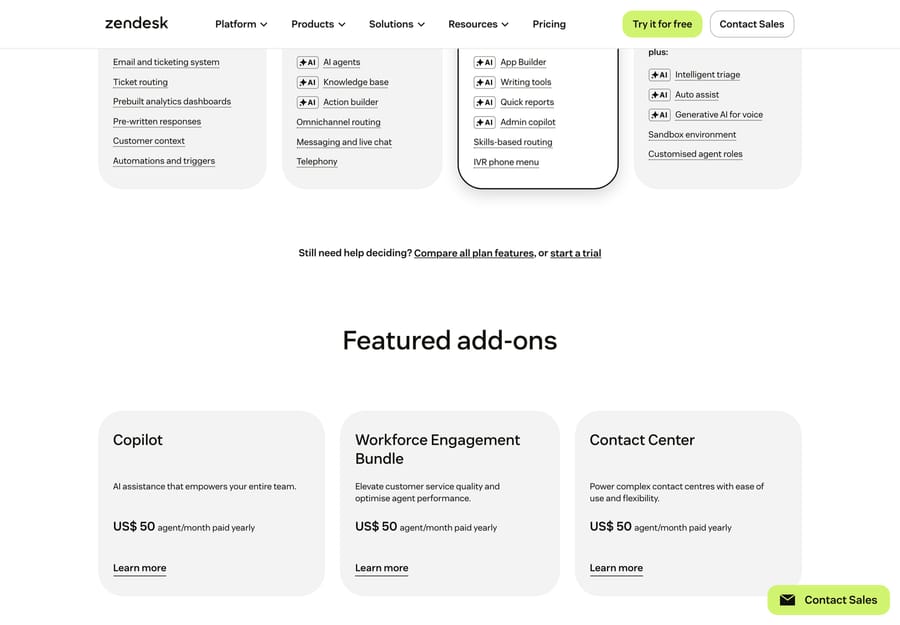
Beyond the per-seat plans, Zendesk’s AI and CX capabilities are sold as separate add-ons — each priced per agent on top of your base plan:
Jira Service Management (per agent/month, annual): Free (up to 3 agents), Standard ~$19–20, Premium ~$48–51, Enterprise custom. Source: Atlassian JSM pricing. Two things make JSM's model genuinely different — and cheaper for the right buyer:
- Only agents are billed. Everyone who submits requests — employees raising IT tickets, approvers, stakeholders — is free. For an internal IT desk serving thousands of employees with a few dozen agents, that's a massive TCO advantage Zendesk's per-agent model doesn't match.
- A sliding volume discount. The per-agent price drops as you add agents (rather than fixed bracket jumps), so list figures vary by headcount — check Atlassian's live calculator for your exact number. (The ~$19/~$48 figures are mid-tier estimates; confirm on the calculator.)
And the AI difference is stark: JSM bundles its AI — Atlassian Intelligence and Rovo (search, chat, and a Virtual Service Agent) come with paid plans, with monthly credit allowances (roughly 25 / 70 / 150 credits per user on Standard / Premium / Enterprise) and no overage charges as of mid-2026. Zendesk, by contrast, charges for AI three ways: the base plan, the $50/agent Copilot add-on, and per-resolution fees. At scale, Zendesk's AI is the bigger, less predictable bill; JSM's is bundled.
Feature-by-feature: who wins what
| Capability | Winner | Why |
|---|---|---|
| Customer-support ticketing & agent workspace | Zendesk | Conversational, omnichannel agent workspace purpose-built for CX |
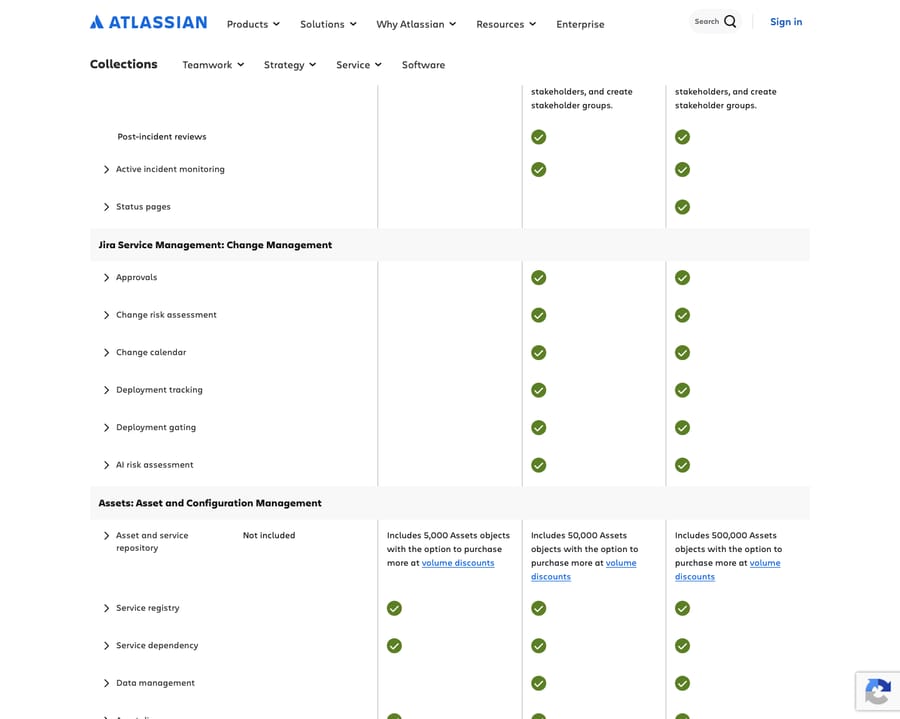
| ITSM (incident/problem/change/CMDB/assets) | JSM (decisive) | ITIL-aligned out of the box, with native Assets/CMDB |
| Omnichannel customer support (email/chat/voice/social) | Zendesk | Native voice, SMS, social; JSM has no native phone/social |
| Automation | Split | Zendesk wins customer-facing bot/dialogue automation; JSM wins backend ITSM/DevOps rules |
| Native AI | Split | Zendesk AI = stronger external autonomous resolution; Rovo = stronger internal IT ops, and bundled |
| Knowledge base / self-service | Zendesk | Built-in help center; JSM splits KB into Confluence (extra dependency) |
| Reporting | Zendesk | Real-time multichannel analytics no-code; JSM often needs Atlassian Analytics |
| Dev integration (Jira Software) | JSM (decisive) | Native, tight link to Jira Software + Confluence — unbeatable for eng orgs |
| Ease of setup | Zendesk | Faster onboarding for support; JSM's ITSM depth has a steeper curve for non-IT users |
| Voice | Zendesk | Native contact center; JSM has no native telephony |
The pattern: Zendesk is the better customer-support tool; JSM is the better internal IT/dev service desk — especially if your engineers already live in Jira.
Strengths & weaknesses, honestly
Zendesk — strengths: best-in-class omnichannel CX; intuitive agent workspace; fast setup; strong native KB and real-time reporting; mature customer-facing AI agents. Zendesk — weaknesses: no free tier; expensive at scale (base + Copilot + per-resolution stack); weaker ITSM/root-cause depth; lighter backend automation.
JSM — strengths: deep ITIL/ITSM (incident/problem/change/Assets/CMDB); per-agent pricing with free request submitters; unmatched Jira/Confluence/dev integration; AI bundled (no add-on fee); Data Center/on-prem option. JSM — weaknesses: steep learning curve for non-IT/CX users; weak external channels (no native voice/social); KB depends on Confluence; can feel overwhelming for simple customer support; best AI gated to Premium+.
What real users say
Both rate well (4.3–4.5 across G2/Capterra), but read the reviews with one filter on: much of JSM's praise and criticism comes from internal IT users, not customer-support teams. (Observed June 2026.)
| G2 | Capterra | Gartner | |
|---|---|---|---|
| Zendesk | 4.3 / 5 (~6,000+) | 4.4 / 5 (4,081) | listed (~918 reviews) |
| Jira Service Management | 4.3 / 5 (~962) | 4.5 / 5 (770) | 4.5 / 5 (~1,119)* |
\*G2/Gartner block automated reads, so JSM's Gartner count is from search snippets — directional. JSM's overall review base (~770–1,100) is meaningfully smaller than Zendesk's (4,000+ on Capterra alone).
- Zendesk — praised as an easy, omnichannel CX platform: "a very good tool to provide customer support in an omnichannel way, it's easy to use" (Pablo T., CX Consultant, Capterra, Dec 2025). The recurring knock is price at scale: "packed full of features… [but] for organizations with a tighter budget, it might be hard to justify the price" (Alexandra V., People Business Partner, Capterra, Mar 2026).
- Jira Service Management — praised for ecosystem depth and tailorable workflows: "integrates seamlessly with other tools in the Atlassian ecosystem and allows teams to build highly tailored workflows" (Benjamin T., IT Systems Administrator, Capterra, May 2026). The dominant criticism is complexity: "the main drawback for me was the complexity that comes with its flexibility… they can make the system feel clunky" (Adam P., Managing Consultant, Capterra, Jun 2026). Note how IT-centric the praise is — that's the tell for who JSM is really built for.
Who each is genuinely for
- Zendesk → external customer support / CX teams, SMB through enterprise; high-volume omnichannel support, e-commerce/retail, non-technical support orgs that want fast deployment and the best customer-facing experience.
- Jira Service Management → internal IT, DevOps, HR, and facilities service desks; engineering orgs already on Jira/Atlassian; enterprises needing ITIL-aligned incident/change/asset management; and orgs with many request submitters but fewer agents (the pricing model rewards exactly that shape).
When to run both (the common real answer)
Because Zendesk and JSM integrate natively, a lot of companies don't choose — they run Zendesk for external customer support and JSM for internal IT/dev. A customer ticket that needs engineering work syncs from Zendesk into Jira, with status and closure flowing back. Migrating between them is uncommon; the usual pattern is adding the second tool for the job it's best at. Consolidate onto one only when your customer-service and IT processes are genuinely the same workflow — which, for most companies, they aren't.
The AI question — and where a layer helps
Both vendors have real AI, but with different shapes: Zendesk's autonomous resolution is strong for customers yet monetized aggressively (add-on + per-resolution, so cost scales unpredictably with volume); JSM's Rovo is bundled but internally oriented and credit-capped, great for IT ops and less so for external multichannel customer resolution. For a team that wants deep, cost-predictable autonomous resolution across whichever backend they run, neither native AI is a perfect fit.
That's the case for an independent AI agent layer on top of the help desk. A layer like Macha is helpdesk-agnostic — it adds autonomous resolution on top of Zendesk (or alongside JSM), reads knowledge across sources rather than one platform's KB, and prices per AI action instead of per vendor-defined resolution. It's not a help-desk replacement; it's the AI layer you add. The honest caveat: a layer is another vendor and integration to maintain, it only resolves as well as the knowledge you connect, and per-action pricing still costs money at volume — it's additive, not free. (More: native AI vs. an AI layer.)
Frequently asked questions
Is Jira Service Management a Zendesk competitor? Only partly. JSM competes with Zendesk on ticketing, but it's built for internal IT/dev service (ITSM), while Zendesk is built for external customer support. Many companies use both.
Which is cheaper, Zendesk or JSM? For internal IT desks, JSM is usually cheaper — only agents are billed (request submitters are free), AI is bundled, and the per-agent price drops with volume. Zendesk's per-agent + AI add-on + per-resolution model costs more at scale.
Can JSM handle customer support? It can, but it's not its strength — no native voice/social and a Confluence-dependent KB. For customer-facing CX, Zendesk is the better fit.
Do they work together? Yes — Zendesk and Jira integrate natively, which is why running Zendesk for CX and JSM for IT is so common.
Can I get autonomous AI on either without the per-resolution cost? Yes — an AI agent layer like Macha adds autonomous AI on top of your help desk, priced per action, no migration.
The bottom line
Choose Zendesk if your job is customer support — it's stronger on omnichannel, self-service, and customer-facing AI. Choose Jira Service Management if your job is internal IT or dev service — it's deeper on ITSM, cheaper for high-submitter/low-agent teams, bundles its AI, and is unbeatable if you're already on Atlassian. And if you have both jobs, running both is the sensible answer. Keep the AI decision separate: a layer on top can add autonomous resolution without per-resolution lock-in.
Run Zendesk and want autonomous AI on top — priced per action, not per resolution? See how Macha layers AI agents over your help desk. 7-day free trial, no credit card required. Start Trial.
Add AI agents to your Zendesk
Macha reads the ticket, drafts the reply and takes the action, inside the Zendesk you already run.