







 Shopify
 Stripe
 Slack
 Notion
 Google Workspace
 Confluence


Can You Use a Different AI Agent in Intercom Instead of Fin? Your Options in 2026


Yes. You can keep Intercom as your inbox and let another AI agent answer your conversations, because Intercom's API lets an outside app reply as a teammate or a bot and leave internal notes. There are three routes: install an agent from the Intercom App Store, connect an agent layer such as Macha that the vendor sets up for you, or build your own on the API. Fin bills only when it reaches an outcome, at $0.99 each, so conversations you route to another agent stop adding to Fin's bill.
Key takeaways
- Intercom's Reply to a conversation endpoint accepts replies from an admin or a bot, and a note message type that only teammates see, which is how third-party agents work inside Intercom.
- Fin charges $0.99 per outcome on Intercom's pricing page, checked November 21, 2026, and conversations handed to your team without an outcome aren't charged.
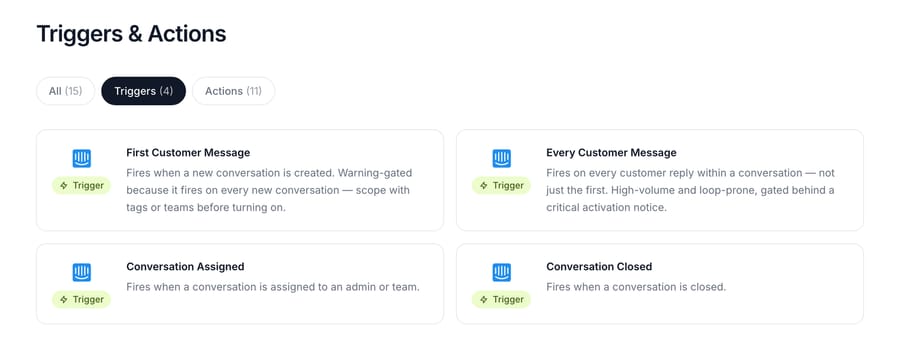
- Macha's Intercom connector has 11 tools and 4 triggers, including Add Internal Note and First Customer Message, and the Macha team builds and runs the agent.
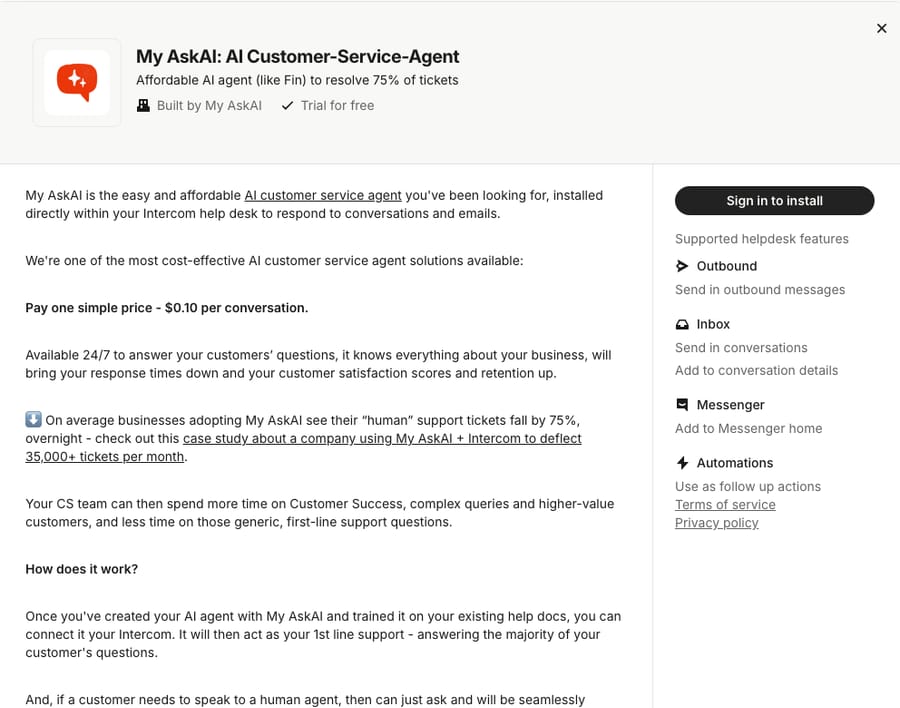
- My AskAI, eesel, Fini, Pluno, Quickchat and Aissist all list AI agents on the Intercom App Store, priced from Aissist's free tier to per-resolution plans such as Fini's $0.89 and Pluno's €0.90 plus a platform fee.
- The safest way to swap is to run the new agent in notes mode on one category while Fin keeps answering everything else.

What are the options for an AI agent inside Intercom?
| Route | Examples | Where it lives | Who builds it | How you pay (checked Nov 21, 2026) |
|---|---|---|---|---|
| Keep Fin | Fin | Native to Intercom | You, in Intercom | $0.99 per outcome plus seats |
| An agent layer set up for you | Macha | Connects to Intercom by sign-in; replies, notes, tags, assigns, closes | The Macha team, on the trial and every plan | about $0.40 per ticket, $299/month for 750 tickets |
| An App Store agent | My AskAI, eesel, Fini, Pluno, Quickchat, Aissist | Installed from the Intercom App Store | Mostly you; some vendors help on higher tiers | Per conversation, per credit or per resolution |
| Build your own | Your code on the Intercom API | Webhooks in, API replies out | Your engineers | Model and hosting costs plus upkeep |
All four keep Intercom as the system of record. Your Messenger, inboxes, workflows, reporting and help center stay where they are, and only the thing writing the answers changes.
How does a third-party AI agent reply inside Intercom?
The mechanism is Intercom's own REST API, not a special partner program. The Reply to a conversation endpoint, POST /conversations/{conversation_id}/reply, takes a type of admin, bot or user. An admin reply needs an admin_id and accepts three message types: comment (a reply the customer sees), note (an internal note only teammates see) and quick_reply (buttons). So an outside agent can do two very different things in the same conversation: answer the customer, or draft an answer as a note and leave the send to a person.
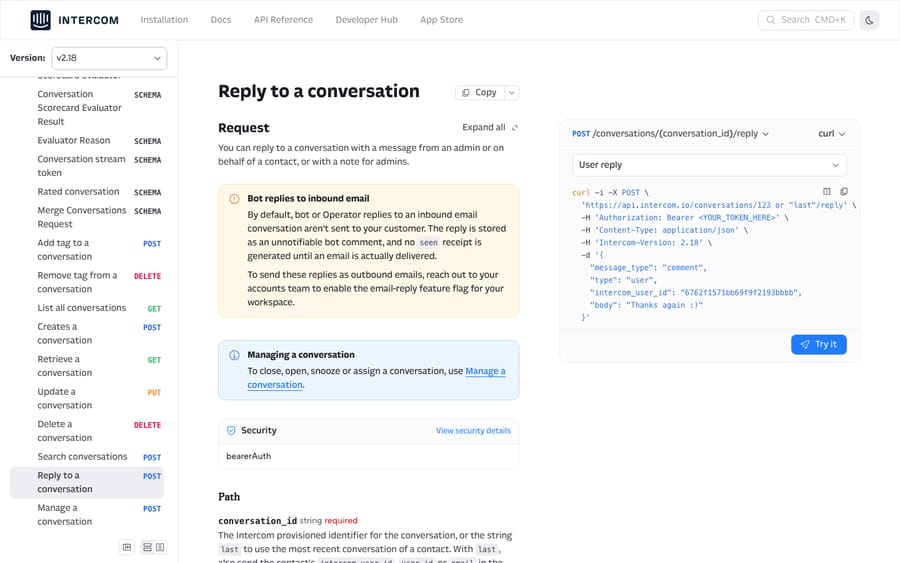
The agent learns about new messages through webhooks or polling, reads the conversation and the contact, decides, and writes back. Our Intercom API guide covers authentication and rate limits if you're building this yourself, and how to build an AI agent for Intercom walks through the build-versus-connector choice.
Three practical details decide how it looks to your team:
- Whose name is on the reply. Macha's connector posts customer-visible replies "as the connected admin," so the reply shows under the teammate account you connect. Pluno's listing says Deflection AI "integrates into Intercom via a dedicated or shared seat." If you want the agent to have its own name in reports, give it its own teammate seat, which costs a seat on your plan.
- Email replies. Intercom's reference notes that bot or Operator replies to inbound email conversations aren't sent to the customer by default; sending them as email needs a feature flag your Intercom accounts team turns on. The caveat names bot and Operator replies, so check which identity your agent replies as before you turn it on for email.
- What the agent can change. Replying is the minimum. Tagging, assigning to a team and closing decide whether the agent fits your existing Intercom workflows or leaves cleanup for your team.
What happens to Fin when another agent answers?
Fin only runs where you deploy it. Intercom's Fin explainer says Fin "shows up for your customers how and when you decide," by audience, region and channel, and you add it to Workflows where you want it. Narrow that audience and Fin stops seeing the conversations you've moved.
The bill follows. Fin's pricing page charges per outcome, once per conversation, and says you aren't charged when a conversation goes to your team without an outcome. An outcome is counted when the customer confirms the issue is resolved, doesn't ask for more help after Fin responds, or Fin completes a Procedure, including handoffs, per Intercom's pricing FAQ. A conversation another agent handles from the start never reaches any of those, so it adds nothing to Fin's line.
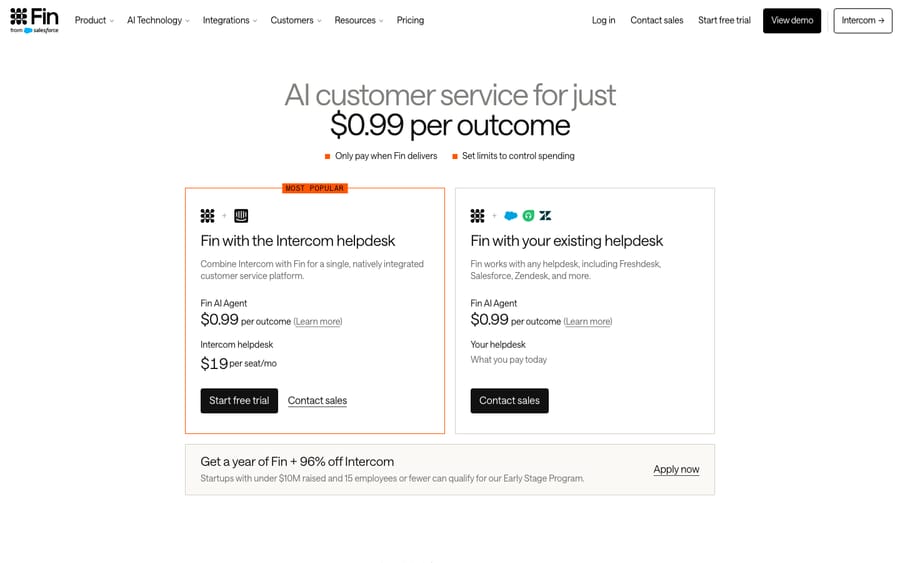
Two things to watch. Intercom's seat plans include Fin, so you keep paying for seats ($29, $85 or $132 a month billed annually) whichever agent answers. And if both agents are live on the same audience, they can both answer the same customer, so scope each one to its own topics, channels or segments before you turn the second one on. Fin's handoff message is a common source of confusion when two systems share a conversation; our guide to Fin's handoff setup covers where that message is configured.
Which AI agents keep Intercom as the inbox?
The question comes up on Reddit because the options are hard to find. A post in r/intercom from October 2026 said the App Store's AI category had become hard to browse, that searching turned up tools that were hard to compare, and that the poster couldn't find a straightforward native Intercom integration for two enterprise agents that come up a lot. The poster wanted to keep Intercom and change only the AI. In a June 2026 thread about cutting a Fin bill, a vendor replied that its agent runs in notes mode next to Fin so you can compare answers before switching; several other replies were vendors too.
They exist, in two groups. Macha connects to Intercom through its own 11-tool connector, and the Macha team builds and runs the agent. A set of App Store agents, including My AskAI, eesel, Fini, Pluno, Quickchat and Aissist, install from the Intercom App Store, and most of them you configure yourself; their prices run from Aissist's free tier to per-resolution plans such as Fini's $0.89 per resolved ticket and Pluno's €0.90 per closed ticket plus a platform fee. Our roundup of the best AI agents for Intercom scores all nine on the same rubric, so we won't repeat the list here.
How much does a different agent cost compared with Fin?
The billing unit matters more than the headline price. Fin earns $0.99 every time it reaches an outcome, so the better it gets, the more it costs. That pricing earns the vendor more as your resolution rate rises, whether or not your team's workload falls by the same amount. Per-conversation pricing charges for every conversation the agent handles, resolved or not, so the price is predictable and doesn't rise as the agent improves.
At 750 conversations a month, using list prices and leaving seats out:
| Fin at 50% outcomes | Fin at 70% outcomes | Macha | My AskAI Pro | |
|---|---|---|---|---|
| Billed units | 375 outcomes | 525 outcomes | 750 tickets | 750 of 1,000 tickets |
| Monthly cost | about $371 | about $520 | $299/month for 750 tickets | $199 |
| Setup and tuning | Your team | Your team | The Macha team, included | Your team |
My AskAI is the cheapest line, and Fin's cost depends on how well it does. The row that changes the decision is the last one. A self-serve agent needs someone to write its instructions, review drafts, fix knowledge gaps and retest after every change. Macha's price includes that work: setup and a dedicated success manager who handles your changes, on the trial and every plan.
How do you test another agent next to Fin without risk?
Run it where a mistake can't reach a customer, on one category at a time.
- Pick the category Fin handles worst. Pull a month of Fin conversations and find the topic with the most escalations or reopens: billing questions that need account data, refunds, order changes.
- Connect the new agent in notes mode. It drafts an internal note on each conversation in that category, and your team sends, edits or discards it. Nothing changes for the customer.
- Compare for two weeks. Count how many drafts went out unchanged, how many needed edits, and how often Fin's answer on the same topic was wrong.
- Move the category. When the drafts are right, take that topic out of Fin's audience and let the new agent reply. Fin keeps everything else.
- Repeat. Each category you move comes off Fin's outcome bill.
That's the same rollout the Macha team runs. The triage use case shows the first step: read each new conversation, pull the contact's profile, check the Help Center, then reply or hand off with a private note.
Where does Macha fit if you want to keep Intercom?
Macha runs AI agents inside the help desk a team already uses, and Intercom is one of Zendesk, Freshdesk, Gorgias, Front, Gladly, Crisp, HubSpot or Intercom. It fits an Intercom team that wants a different agent without anyone on the team building or tuning it. The Macha team analyzes about a month of your past conversations, builds the knowledge base and the agent, tests it on a sample, and runs it in safe mode with drafts as internal notes until you're happy. Built-in Shopify and Stripe connectors cover order and billing lookups, and anything else with an API connects through a custom API tool the team sets up during onboarding.
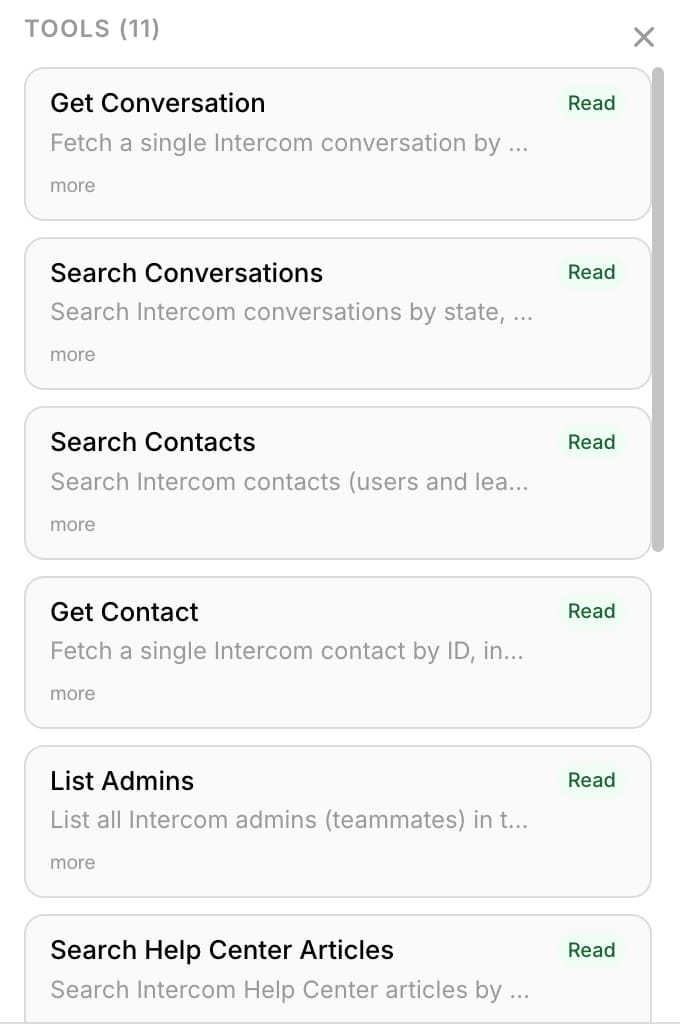
Pricing is about $0.40 per ticket, one charge per conversation however many messages it takes, from $299/month for 750 tickets, and that includes setup and a dedicated success manager who handles your changes. The trial is $50 of free usage (about 125 tickets), no credit card, no time limit. There's more on how Macha runs on Intercom, the Intercom connector, the done-for-you setup and pricing, and a head-to-head in Macha vs Intercom Fin. It's the wrong fit if Fin already resolves most of your volume well and your bill is comfortable; then the cheaper move is fixing the topics Fin misses, which our Fin vs AI agent layer comparison covers.
Common questions
Can you turn Fin off and still use Intercom?
Yes. Fin runs only on the audiences, channels and workflows you deploy it to, and Intercom's seat plans work without Fin answering anything. You keep paying for seats; Fin outcomes stop when Fin stops reaching them.
Does a third-party AI agent need an Intercom seat?
It depends on the vendor. Macha replies as the admin account you connect, and Pluno's listing says it uses a dedicated or shared seat. A dedicated seat gives the agent its own name in reports and costs one seat on your plan.
Can two AI agents run in Intercom at the same time?
Yes, but give each one its own scope. Two agents on the same audience can both answer one customer. Narrow Fin's audience to the topics it keeps and point the new agent at the rest, or run the new one in notes mode only.
Will another agent read my Intercom help center?
Most do. Macha's connector searches Help Center articles, My AskAI and eesel import them, and Quickchat imports them in one click. Check whether the agent also reads past conversations, which is where most of your real answers live.
Is it cheaper to replace Fin?
At 750 conversations, Fin costs about $371 to $520 a month at 50% to 70% outcomes, against $299/month for 750 tickets for Macha with setup and a success manager included. The answer changes with your volume and resolution rate, so run your own numbers from Fin's last three invoices.
How we researched this
We read the October 2026 Reddit posts that ask this question and the June 2026 r/intercom thread on cutting a Fin bill through the arctic-shift Reddit archive on November 21, 2026, and paraphrased them without usernames. We checked Fin's billing on intercom.com/pricing and fin.ai/pricing, the reply and note mechanics on Intercom's API reference, and Fin's deployment controls in Intercom's help center, all on November 21. Third-party features and prices come from each vendor's Intercom App Store listing, Intercom page and pricing page, read the same day; Pluno prices in euros. Macha's tools and triggers come from Macha's own Intercom connector and its public integration page, which we captured ourselves. The cost table multiplies list prices at a stated volume; it isn't a measured bill. We didn't install any agent on a live Intercom workspace for this post. We make Macha.
To see a different agent working in your own Intercom without touching Fin, start a trial: you connect Intercom once, and the Macha team builds the first agent in safe mode.