
 Shopify
 Stripe
 Slack
Slack Notion
 Google Workspace
 Confluence

AI Customer Service for Shopify: 7 Shopify AI Agents and Chatbots Compared (2026)


Seven Shopify AI agents and chatbots compared on what they can read and change in a Shopify store, how they bill and what the cheapest plan costs, with a worked cost for a 1,500-ticket month.
Key takeaways
- Gorgias AI Agent costs $1.00 per automated interaction on monthly billing and $0.90 billed annually, and it can cancel, edit or reship Shopify orders only inside the Gorgias help desk.
- Shopify Inbox is free and runs Shopify's own AI agent on the catalog, inventory and policies, but its App Store listing describes no refund or cancellation action.
- Siena charges a $750 monthly platform fee plus $0.90 per automated ticket, while Yuma's Starter bundle costs $14,400 a year for about 12,000 resolutions on a 12-month commitment.
- Tidio Lyro starts at $32.50 a month billed annually for 50 conversations and bills every chat with an AI reply, while Richpanel charges $0.20 per AI-handled conversation plus seats.
- Macha's Shopify connector has eight tools, including Create Refund and Cancel Order, and the Macha team builds, tests and runs the agent for you, included at about $0.40 a ticket from $299 a month for 750 tickets.

AI customer service for a Shopify store comes in three shapes, and the help desk you already run decides which one fits. Gorgias sells its AI Agent at $1.00 per automated interaction on monthly billing ($0.90 billed annually) and lets it cancel, edit and reship Shopify orders inside the Gorgias help desk. Shopify Inbox gives every store a free AI agent that answers product questions but doesn't change orders. A third group, from Siena and Yuma to Tidio Lyro, Richpanel and Macha, adds an AI agent to a help desk you keep or bundles one with its own. The table compares seven of them on what they can read and change in Shopify, how they bill, and what the cheapest plan costs.
Which Shopify AI agents and chatbots can read and change orders?
| Shopify AI agent | Runs on | Reads in Shopify | Changes in Shopify (documented) | Billing unit | Entry price (5 Oct 2026) |
|---|---|---|---|---|---|
| Shopify Inbox (Shopify's own agent) | Shopify Inbox | Catalog, inventory, store policies; purchase history for buyers signed in with Shop | No refund or cancel action described on the app listing | None | Free |
| Gorgias AI Agent | Gorgias help desk only | Orders, customers, products | Cancel unfulfilled order, edit shipping address, remove or replace an item, reship for free, add an order note | Automated interaction, also billed as a help desk ticket | $40/mo on Starter: $10 help desk plus $30 for 30 interactions |
| Siena | Zendesk, Gorgias, Gladly, Kustomer, Intercom, Dixa | Orders and customers | Address updates, refunds, replacements, return labels (marketing page) | Automated ticket | $750/mo platform fee plus $0.90 per ticket |
| Yuma | Zendesk, Gorgias, Kustomer, Salesforce, Front, Gladly | Products, orders, inventory, customers | Refund, cancel, reship, tag orders | Full resolution (any human touch voids it) | $14,400/yr Starter, about 12,000 resolutions, 12-month commitment |
| Macha | Zendesk, Freshdesk, Gorgias, Front, HubSpot or Intercom | Products with stock levels, discounts, orders, customers | Create Refund (all remaining items), Cancel Order (refund and restock by default) | Ticket (one thread, whatever the outcome) | $299/mo for 750 tickets, setup done for you by the Macha team included |
| Tidio Lyro | Tidio, or standalone beside another help desk | Products for recommendations; order status through Lyro Actions | Shipping address change on unfulfilled orders, start a return (Lyro Actions) | Lyro conversation (any chat with one AI reply, resolved or not) | $32.50/mo billed annually for 50 conversations ($39 monthly) |
| Richpanel | Richpanel help desk | Customer orders | Update shipping address, send replacement, refund order | AI-handled conversation | $0.20 per conversation, $200/mo AI minimum, plus seats from $69 per agent |
We read every price from the vendor's own pricing page in a US-locale browser on 5 October 2026, and the Shopify actions from each vendor's docs or product pages. "Documented" means the vendor names the action; a vendor that sells custom actions may do more on a paid setup. Prices move, so check your own quote before you commit.
Read the table by its fourth column. The question that separates a Shopify AI chatbot from a Shopify AI agent is whether it can change the order or only talk about it. Shopify Inbox talks. Gorgias, Yuma, Siena, Richpanel and Macha can change orders, each with a different list of actions and a different price for doing it.
What can AI actually resolve for a Shopify store?

Ecommerce AI is good at one category: high-volume, post-purchase, repetitive tickets where the answer lives in data you already have. A well-configured agent reliably handles:
- WISMO / order status: "where is my order?" is the most common ecommerce ticket type and the clearest win. The agent looks up the order, reads the fulfillment and tracking status, and answers with the real state instead of a canned link.
- Returns and exchanges: checking eligibility against your policy, generating a return label, and starting an exchange. The better tools execute this end to end rather than explaining the steps.
- Cancellations of unshipped orders: canceling and refunding an order that hasn't left the warehouse, within the window your policy allows.
- Address edits and subscription tweaks: fixing a shipping address before fulfillment, or pausing or skipping a subscription if you run Recharge or similar.
- Pre-purchase FAQs and product questions: sizing, materials, stock, shipping timelines, and basic product recommendations.
What it's not reliably good at: judgment calls, angry escalations, fraud and chargebacks, anything needing a policy exception, and one-off edge cases. Plan for the AI to take the repetitive share of the queue and route the rest to a human with full context, not for a magic 90%.
What does an AI agent need from your store?
Whichever path you pick, AI customer service for Shopify runs on two inputs:
- Live order data: a connection to Shopify (and Recharge or Loop if you use them) so the agent can read order status, tracking, and customer history, and take actions like issuing a refund or canceling an order.
- A knowledge base: your help center articles, shipping and returns policies, and brand voice, so the agent grounds its answers in your rules instead of guessing.
If either input is thin, automation rates suffer. A clean help center and a solid order connection matter more than which vendor's logo is on the box. Which of your other Shopify apps an agent can reach is mapped in AI agent integrations for Shopify brands.
Shopify's own AI agent: Shopify Inbox
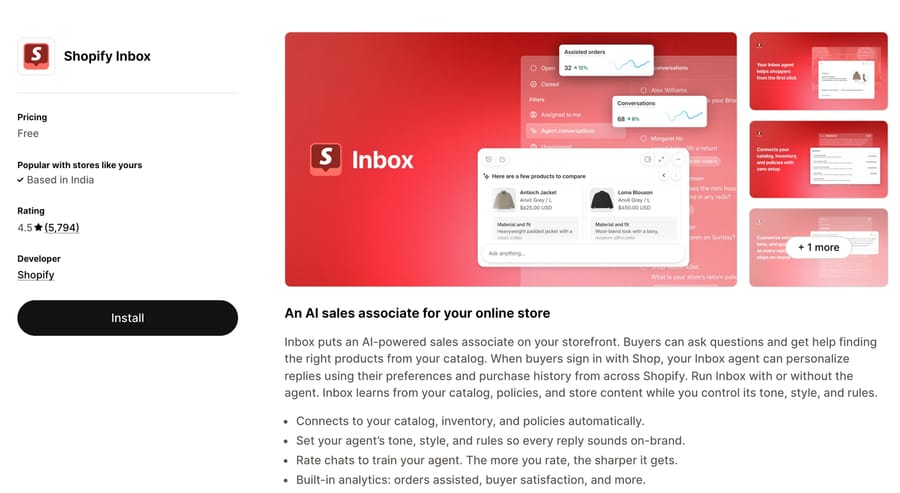
Shopify Inbox is free, made by Shopify, and rated 4.5 from 5,794 reviews on the App Store (Shopify App Store). Its listing describes the agent as a sales associate: it connects to your catalog, inventory and policies, recommends products, and personalizes replies with preferences and purchase history when the buyer signs in with Shop. "Order updates" sits in its list of automated responses.
What the listing doesn't describe is the agent refunding, canceling or editing an order. That fits the incentive. Shopify earns when a store sells more, so its free agent is built to answer the pre-purchase question and push the cart forward. Post-purchase work like a refund or an address change still lands in your inbox. If most of your tickets are "does this come in blue?", Inbox may be enough. If most are "where's my order and can I change it?", you'll need one of the agents below.
How does the Gorgias AI Agent work, and what does it cost?
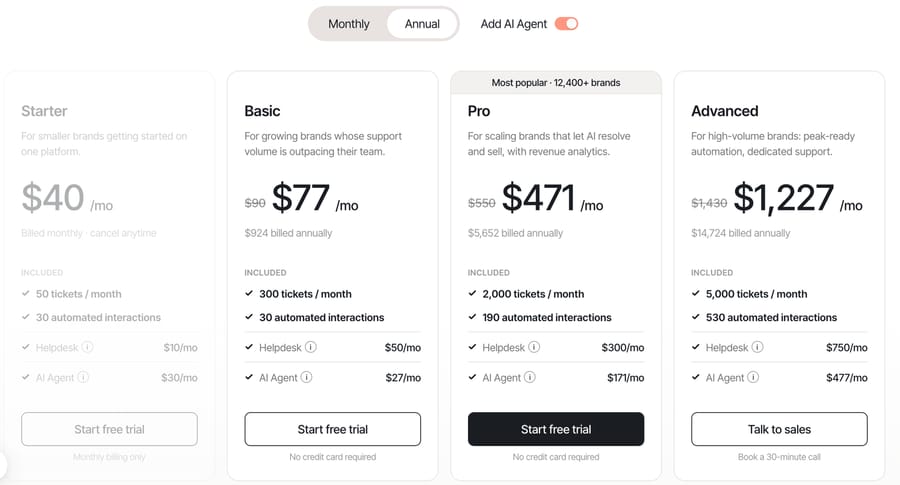
If you're already on Gorgias, the ecommerce-first help desk built around Shopify, the native AI Agent is the first thing to evaluate. Nothing else on this list has as much Shopify order work documented out of the box. Gorgias's help center lists six Shopify order actions: cancel an order, edit the shipping address, remove an item, replace an item, reship for free, and add an order note. Cancel, address edits and item removal need the order to be unfulfilled (Gorgias). None of the six is a standalone refund, though Cancel refunds the full amount paid and removing or replacing an item refunds the difference (Gorgias). Subscription changes run through separate Recharge, Skio and Loop actions. Gorgias also runs chat, email, SMS and voice from the same help desk, and the agent hands off to a human with context when it can't resolve a request.
On monthly billing the AI Agent comes in bundles priced at $1.00 per automated interaction: $30 for 30 on Starter and Basic, $190 for 190 on Pro, $530 for 530 on Advanced. Annual billing cuts that to $0.90 ($27, $171 and $477). Past the bundle, Gorgias's AI Agent pricing guide puts monthly overage at $1.00 to $2.00 per interaction by tier on support-only plans, and $1.50 on Support + Shopping Assistant plans; our cost model below uses $1.50 (Gorgias AI Agent pricing guide). The cheapest way in is Starter at $40 a month, monthly billing only: $10 for 50 help desk tickets plus the $30 AI bundle (Gorgias pricing).
An interaction counts when the AI closes a conversation with no human reply within 72 hours, and that same conversation is also billed as a help desk ticket. Per-resolution pricing has a clear incentive: Gorgias earns more the more of your queue its agent closes, which is fine when your work maps to discrete conversations. It's also why the bill rises during a sale or a shipping delay, exactly when volume spikes. We dig into the mechanics in Gorgias AI Agent explained, and compare the agents that run on Gorgias in the best AI agents and chatbots for Gorgias.
All of this is tied to the Gorgias help desk. Brands on another desk would have to migrate to get it, which is why the next option exists.
How do you add AI if your store runs on Zendesk or Freshdesk?
Plenty of Shopify brands don't run Gorgias. They're on Zendesk or Freshdesk, often because they grew into a business that's more than a storefront: B2B lines, multiple channels, regulated products, a global team. For these brands the path is a dedicated AI agent layer that sits on top of the help desk you already use.
The foundation is already there: both platforms ship an official, free Shopify app that surfaces a customer's recent orders, payment, and shipping status inside the ticket without leaving the help desk. One 2026 housekeeping item: since January 1, 2026 you can't create new legacy custom apps in the Shopify admin, so new custom connections are built in the Shopify Dev Dashboard; existing apps keep working (Shopify changelog). That order context is the data input; your Zendesk Guide or Freshdesk knowledge base is the second.
On top of that, an AI agent layer reads tickets, drafts and sends replies, takes actions, and escalates the edge cases. Three of the layers in the table price for very different stores:
- Siena works on Zendesk, Gorgias, Gladly, Kustomer, Intercom and Dixa (Siena integrations). Its site says it can update addresses, generate labels, issue refunds and send replacements in a single flow. The price is a $750 monthly platform fee plus $0.90 per automated ticket (Siena pricing). The page doesn't say whether a ticket bills only when it's resolved, so ask.
- Yuma runs on Zendesk, Gorgias, Kustomer, Salesforce, Front and Gladly, and says it "refunds, cancels, reships, tags orders" in Shopify (Yuma). Yuma says you pay only for fully automated resolutions. Every plan carries a 12-month commitment paid upfront: Starter is $14,400 a year for about 12,000 resolutions, roughly $1.20 each; a monthly plan bills $1.50 per over-quota ticket (Yuma pricing).
- Macha runs on Zendesk, Freshdesk, Gorgias, Front, HubSpot or Intercom and has its own built-in Shopify connector; details are in the Macha section below.
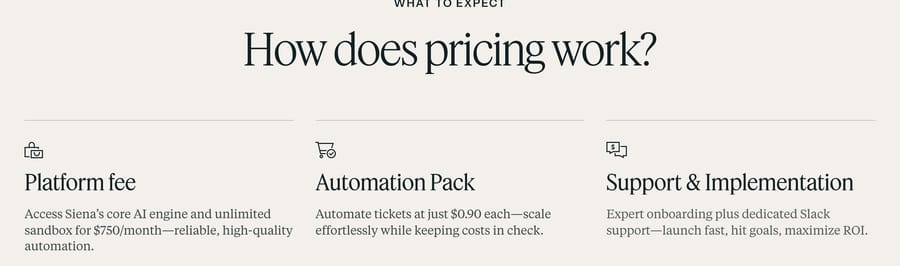
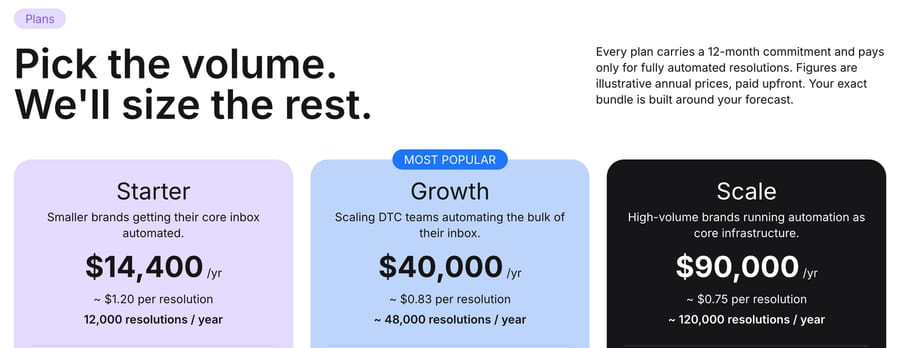
The two pricing models reward different things. A platform fee earns Siena money in a month when its agent closes nothing, so it suits brands with enough volume to make $750 a rounding error. A prepaid annual bundle earns Yuma money on your forecast rather than your result: a brand that buys Starter and uses 7,200 resolutions has paid $2.00 for each one it used.

The advantage of this path is that you keep the help desk, reporting, SLAs, and workflows you've already paid for, and add AI where the volume is, rather than ripping out your support stack to chase an ecommerce-native bot. It's the same logic we lay out in why an AI layer beats replacing your help desk.
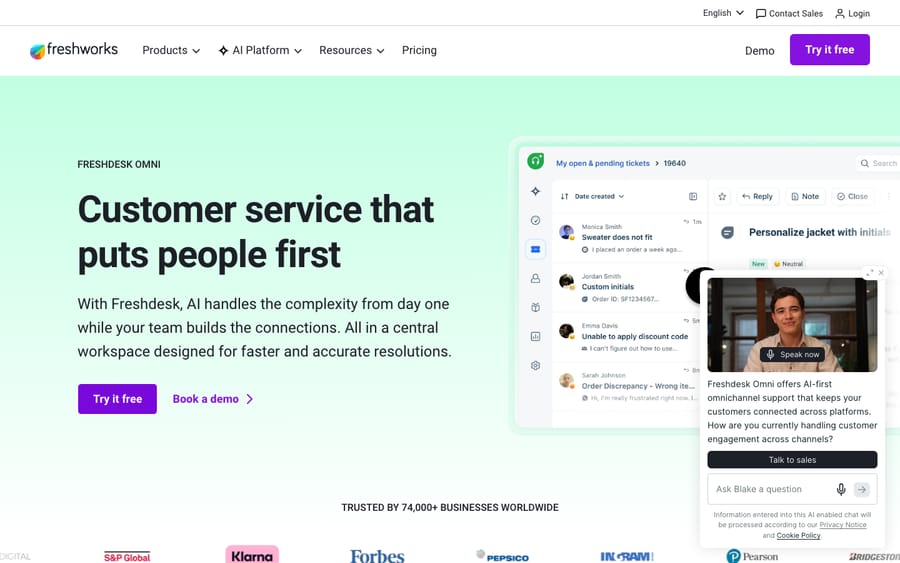
Freshdesk has leaned into this with its Freshdesk Omni positioning, a unified support platform with built-in AI, so brands standardizing on Freshworks can add ecommerce automation without leaving the ecosystem.
Other layers play here too: eesel works on top of Zendesk and Freshdesk, and Fin works across Zendesk as well as its own platform. The common thread is that they assume you're keeping a real help desk and want AI on top of it.
Update (September 2026): Salesforce completed its acquisition of Fin on September 10, 2026, and plans to fold it into Agentforce (Salesforce). Worth weighing in any long-term Intercom or Fin decision.
Standalone ecommerce AI chatbots
The third family skips the traditional help desk and bolts AI onto your storefront, usually starting as a chat widget that handles both sales and support. These suit smaller stores, sales-led brands, or teams whose ticket volume doesn't yet justify a full help desk.
- Tidio (Lyro): live chat plus the Lyro AI agent, sold with Tidio's help desk or on its own beside Zendesk and others. Lyro starts at $32.50 a month billed annually, or $39 monthly, for 50 conversations, and the first 50 conversations are free for life. A Lyro conversation is any chat with at least one AI reply, so you pay whether or not it resolves (Tidio pricing). Lyro Actions cover order status checks, shipping address changes on unfulfilled orders and starting a return, built against the store's API (Tidio). Self-serve tiers stop at 1,000 conversations a month; above that, Premium (from 3,000 Lyro conversations) is a sales-quoted plan.
- Zipchat: an AI chatbot focused on conversion as much as support. Plans start at $64 a month billed annually for 750 AI replies, with a sales and cart-recovery emphasis (Zipchat).
- Richpanel: an ecommerce help desk with its own AI agent. Its homepage lists getting customer orders, updating a shipping address, sending a replacement and refunding an order as Shopify actions, each off until you turn it on (Richpanel). The AI costs $0.20 per AI-handled conversation with a $200 monthly AI minimum, on top of seats that started at $69 per agent a month on yearly contracts in our render of the pricing page (Richpanel pricing).
- Rep AI, Fin, and others: increasingly blur the line between storefront concierge and full support agent.
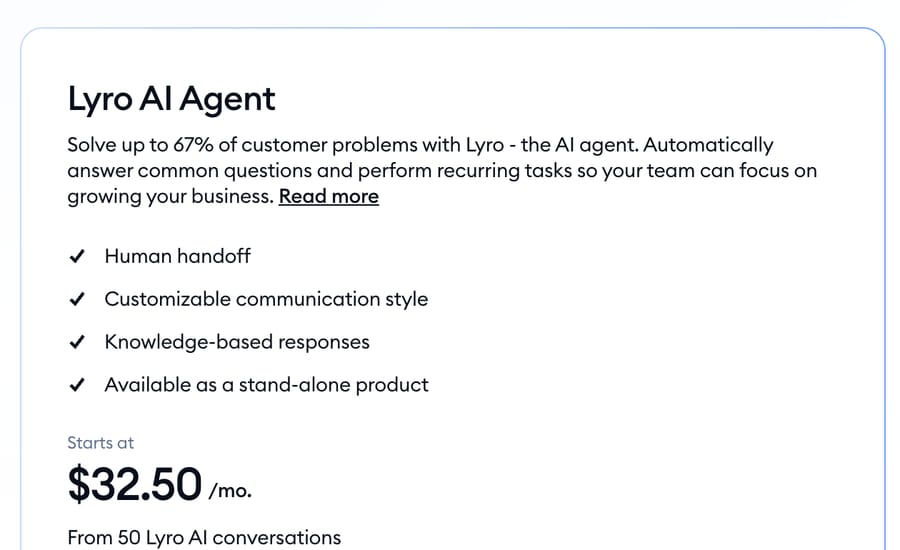
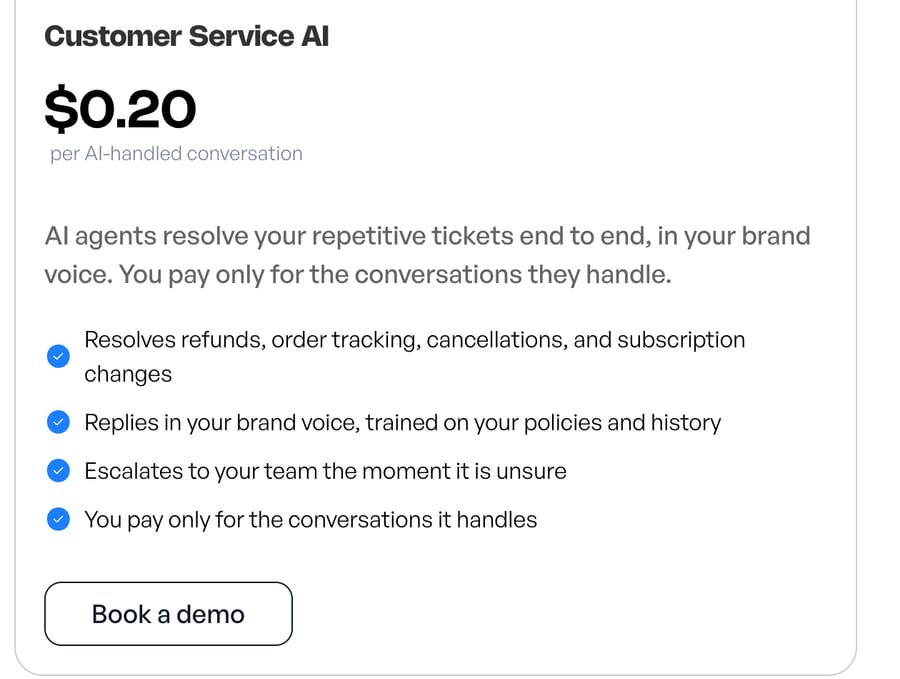
Standalone tools are fast to launch and cheaper at low volume, but you may outgrow them. Per-conversation billing like Lyro's charges for the chat whether the AI solved it or handed it over, so the vendor earns the same either way. If your support operation matures into multi-channel, multi-brand, or B2B territory, a chat-widget-first tool can hit a ceiling that a proper help desk plus an AI layer wouldn't.
What does a Shopify AI agent cost at 1,500 tickets a month?
Here is one synthetic store, priced on each vendor's published numbers: 1,500 support tickets a month, an AI agent that touches all of them and fully resolves 600 (40%), and three human agents. Help desk costs are included only where the AI vendor sells the help desk too.
| Option | Monthly cost at 1,500 tickets | How we got there |
|---|---|---|
| Shopify Inbox | $0 | Free, but no refund, cancel or address-change action to run |
| Gorgias Pro, monthly billing | $1,165 (help desk included) | $360 help desk (2,000 tickets) + $190 AI bundle (190 interactions) + 410 extra interactions x $1.50 = $615 |
| Siena | $1,290 to $2,100, plus your help desk | $750 + 600 x $0.90 = $1,290 if only resolved tickets bill; $750 + 1,500 x $0.90 = $2,100 if every automated ticket bills |
| Yuma Starter | $1,200, plus your help desk | $14,400 a year / 12, paid upfront; 600 x 12 = 7,200 of the 12,000 bundled resolutions used |
| Macha | $599, plus your help desk | 1,500 tickets falls in the $599 tier (1,500 tickets); one charge per ticket whatever the outcome |
| Richpanel | $507 (help desk included) | 1,500 x $0.20 = $300 AI + 3 seats x $69 = $207, on a yearly contract |
| Tidio Lyro | Quote needed | Self-serve tiers stop at 1,000 Lyro conversations a month; Premium (from 3,000) is quoted by sales |
Two things decide the ranking more than the sticker price. First, whether the AI vendor also sells you the help desk: Gorgias and Richpanel look different once you add the Zendesk or Freshdesk seats the others assume you already pay for. Second, how your resolution rate moves. At 20% resolved, Gorgias drops to $715 and Siena's low case to $1,020, while Macha and Yuma don't change, because they bill on tickets or a prepaid bundle. At 60%, Gorgias rises to $1,615. Per-resolution pricing tracks your success; per-ticket pricing tracks your volume.
Which option should you pick for your current stack?
- You're on Gorgias (or about to choose it): evaluate the native AI Agent first. Nothing else matches its documented Shopify order actions on that stack. Budget $1.00 per automated interaction on monthly billing ($0.90 on annual) on top of the help desk plan, and $1.00 to $2.00 per interaction past the bundle on monthly plans, depending on tier.
- You're on Zendesk or Freshdesk: don't rip it out. Install the official free Shopify app for order context, then add a dedicated AI agent layer (Macha, Siena, Yuma, eesel, or Fin) to automate the WISMO, returns and cancellation volume inside the workspace you already run. Siena and Yuma price for brands with thousands of resolutions a month; start with Macha on Zendesk if you want per-ticket billing from 750 tickets and an agent that someone else sets up: the Macha team analyzes your past tickets, builds the knowledge base and the agent, and runs it in safe mode until the drafts are right.
- Your tickets are mostly pre-purchase questions: try Shopify Inbox first. It's free and it's built to sell.
- You have no real help desk yet and you're a smaller or sales-led store: start with a standalone ecommerce AI like Tidio Lyro or Zipchat, which are fast to launch and cheap at low volume, and graduate to a help desk plus AI layer when your operation outgrows a chat widget.
- You're still choosing a help desk: weigh ecommerce-native (Gorgias or Richpanel) against general-purpose-plus-AI (Zendesk or Freshdesk). Our best help desk for ecommerce breakdown walks through that trade-off.
Whichever path you take, fix the two inputs first: a clean order connection and a clean knowledge base. An agent with refund rights and a stale returns policy will refund the wrong orders faster.
Where does Macha fit for a Shopify store?
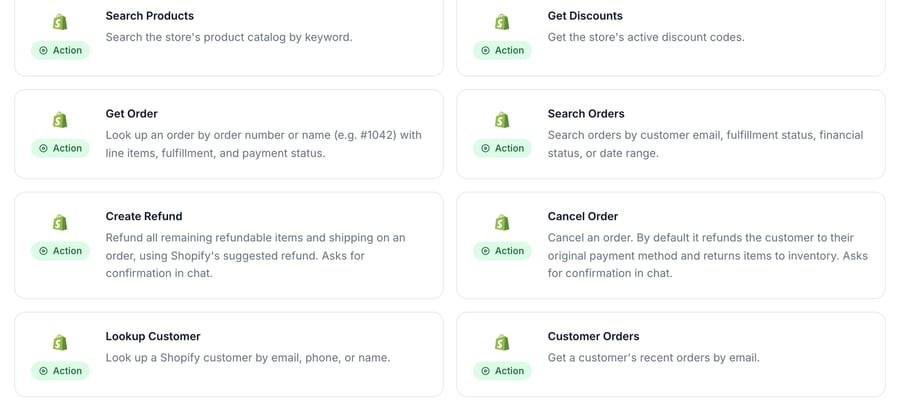
Because this is a Macha guide, the straight version: Macha is not a help desk and not a Gorgias replacement. Macha is an AI agent layer that runs on top of Zendesk, Freshdesk, Gorgias, Front, HubSpot or Intercom, and it fits teams already running one of those desks who want the agent working inside the ticket rather than in a separate chat widget. It connects to Shopify directly through its built-in Shopify connector, which has eight tools: Search Products, Get Discounts, Get Order, Search Orders, Create Refund, Cancel Order, Lookup Customer and Customer Orders. Create Refund refunds all remaining refundable items and shipping, using Shopify's suggested refund; it can't refund a partial amount. Cancel Order refunds to the original payment method and restocks by default. In dashboard chat both ask for confirmation before the change goes through; on a trigger run they execute directly when the agent's instructions say to, so the instructions carry the policy.
In a test run on our demo store on 28 September 2026, Search Products returned stock with each product (availableForSale, totalInventory and each variant's inventoryQuantity), so a "is this back in stock?" ticket gets a live answer. An address change or an item swap isn't one of the eight tools; it would need a custom API tool against Shopify's Admin API, which Macha's team sets up during onboarding, and the same goes for Loop, Recharge or a tracking app, as our Shopify integrations map shows. On Gorgias, its own AI Agent covers more order edits out of the box.
Macha is the done-for-you option in this list. Your part is connecting your help desk, Shopify and the other tools your answers come from, which takes about 15 minutes. The Macha team then analyzes about a month of your past tickets, builds the knowledge base and the agent, tests it on a sample of those tickets, and runs it in safe mode, with drafts as internal notes in your help desk, until the drafts are right. It goes live in under a week.
Macha bills per ticket: one thread with one person is one charge, however many replies or tool calls it takes, on one plan from $299 a month for 750 tickets; the 1,500-ticket store above lands on the $599 tier. That's about $0.40 a ticket, which includes the setup and a dedicated success manager who handles your changes afterwards: new ticket categories, instruction edits, new tools. There are no overages: agents pause when the month's tickets run out. The pricing page has every tier, and the trial is $50 of free usage with no credit card.
Frequently asked questions
What is the best AI chatbot for Shopify? It depends on your help desk and your ticket mix. On Gorgias, the native AI Agent has the most documented Shopify order actions. On Zendesk or Freshdesk, an AI agent layer (Macha, Siena, Yuma, eesel or Fin) adds AI without replacing your stack; Macha is the pick if you want the agent built and run for you, with setup and a dedicated success manager included at about $0.40 a ticket. For mostly pre-purchase questions, the free Shopify Inbox agent is the cheapest start, and Tidio Lyro or Zipchat suit a small store with no help desk.
Does Shopify have its own AI agent for customer service? Yes. Shopify Inbox is free and includes an AI agent that answers buyers from your catalog, inventory and policies and personalizes replies for shoppers signed in with Shop. Its App Store listing describes it as a sales associate and doesn't describe refund, cancel or address-change actions, so post-purchase changes still need a person or another agent.
What can AI actually resolve for a Shopify store? The high-volume, post-purchase tickets: WISMO and order status, returns and exchanges, cancellations of unshipped orders, address edits, and subscription tweaks, plus pre-purchase FAQs. It needs two inputs to do this well: a live Shopify order connection and a solid knowledge base. Judgment calls, fraud and policy exceptions still go to a human.
Do I need Shopify Plus for an AI agent? No. The tools here work with standard Shopify; what matters is connecting your order data (via each platform's Shopify app or connector) and your help center. Since January 1, 2026, new custom apps are created in the Shopify Dev Dashboard rather than the Shopify admin.
How much does AI customer service for Shopify cost? It depends on the billing unit. Gorgias AI Agent is $1.00 per automated interaction on monthly billing and $0.90 annually, on top of the help desk plan. Siena is $750 a month plus $0.90 per ticket. Yuma starts at $14,400 a year. Tidio Lyro starts at $32.50 a month for 50 conversations on annual billing. Richpanel's AI is $0.20 per conversation plus seats. Macha is per ticket, from $299 a month for 750 tickets.
How much of my support can AI realistically automate? It depends on how repetitive your queue is and how clean your help center is. Vendor figures are marketing claims or guarantees, not baselines: Tidio says Lyro solves up to 67% of customer problems, and Richpanel advertises a 50% automation guarantee. Measure it on your own tickets before you budget.
How we researched this
We checked each vendor's pricing page in a US-locale headless Chrome on 5 October 2026 and we captured the screenshots above the same day: Gorgias (annual and monthly views), Siena, Yuma, Tidio (annual and monthly toggles), Richpanel and the Shopify Inbox App Store listing. Shopify actions come from Gorgias's help center article on Shopify order actions, the Siena, Yuma and Richpanel product pages, and Tidio's Lyro Actions page, all read the same day; these are documented capabilities, and we did not run any competitor's agent. Richpanel's pricing page rendered seat prices differently across loads ($69 and $99 per agent in our render; other renders have shown $99 and $119), so treat its seat figure as approximate. Macha's eight Shopify tools match the in-app tool picker on our demo account (checked 28 September 2026) and the public integration page; the stock fields come from a test run on our Shopify test store that day. The 67% (Tidio) and 50% (Richpanel) automation figures are vendor self-reports. The 1,500-ticket store is synthetic, and so is every example: the arithmetic is in the cost table, with the sensitivity cases worked as $360 + $190 + (300 - 190) x $1.50 = $715 and $750 + 300 x $0.90 = $1,020 at 20% resolved, and $360 + $190 + (900 - 190) x $1.50 = $1,615 at 60%. Vendors revise pricing and packaging often, so confirm specifics before relying on them.