Shopify
 Stripe
 Slack
Slack Notion
 Google Workspace
 Confluence

What Are the Best LiveAgent Alternatives in 2026? 8 Help Desks Compared on Price


Freshdesk is the best all-round LiveAgent alternative for most growing teams, Zoho Desk is the cheapest full help desk, and Gorgias wins for Shopify stores. Below are eight alternatives with current vendor prices, G2 and Capterra ratings, and how each differs from LiveAgent.
Key takeaways
- Freshdesk is the best all-round LiveAgent alternative for most growing teams, at $19, $55 or $89 per agent a month billed annually, with no free plan on its pricing page.
- LiveAgent costs $15 to $69 per agent a month billed annually, so most alternatives cost more per seat and teams switch for interface, reporting or AI rather than price.
- Zoho Desk is the cheapest full LiveAgent alternative, free for up to 3 users and then from $7 per agent a month billed annually.
- Intercom charges $29 a seat billed annually for Essential plus $0.99 per Fin outcome, and Salesforce completed its acquisition of Fin on 10 September 2026.
- Macha does not connect to LiveAgent, but it bills per ticket from $299 a month for 750 tickets on help desks such as Freshdesk and Zendesk.

Freshdesk is the best all-round LiveAgent alternative for most growing teams, at $19, $55 or $89 per agent a month billed annually, while Zoho Desk is the cheapest full help desk from $7 and Gorgias is the pick for Shopify stores. LiveAgent itself costs $15 to $69 per agent a month billed annually, so almost every move on this list costs more per seat; teams switch for a newer interface, deeper reporting or stronger AI, not for price. We re-checked every vendor price on its own pricing page in September 2026. Ratings are G2 and Capterra readings from mid-2026 and move a little every month.
Which LiveAgent alternatives are worth comparing in 2026?
| Tool | Rating (G2 / Capterra) | Starting price | Best for | vs LiveAgent |
|---|---|---|---|---|
| Freshdesk | 4.4 / 4.5 | $19/agent/mo (annual); no free plan | All-round value at scale | Newer UI, stronger AI; AI sessions metered |
| Zoho Desk | 4.4 / 4.5 | Free for 3 users, then $7–$40/agent/mo | Budget teams in the Zoho stack | Cheaper at entry, deeper, busier UI |
| Zendesk | 4.3 / 4.4 | Support Team $19; Suite from $55/agent/mo | Scaling teams wanting depth | More extensible; several times the price |
| Help Scout | ~4.4 / 4.6 | Free for 5 users; paid from $25/user/mo | Simplicity-first small/mid teams | Cleaner, friendlier; less configurable |
| Tidio | 4.6 / 4.7 | Free, then $24.17/mo billed yearly | SMB live chat + AI chatbot | Better modern chat + Lyro AI; less ticketing |
| Crisp | 4.5 / 4.5 | Free, then $45/mo per workspace | Startups wanting chat + AI cheap | Modern multichannel inbox; smaller scale |
| Gorgias | 4.6 / 4.6 | $10/mo help desk only (ticket-based) | Shopify / DTC ecommerce | Ecommerce-native; not for non-retail |
| Intercom (Fin) | 4.5 / 4.5 | $29/seat/mo (annual) + Fin $0.99 per outcome | AI-first, chat-led SaaS | Much stronger AI; usage-based bill |
Prices from each vendor's pricing page, September 2026. Ratings are mid-2026 readings and approximate.
Why do teams look for a LiveAgent alternative?
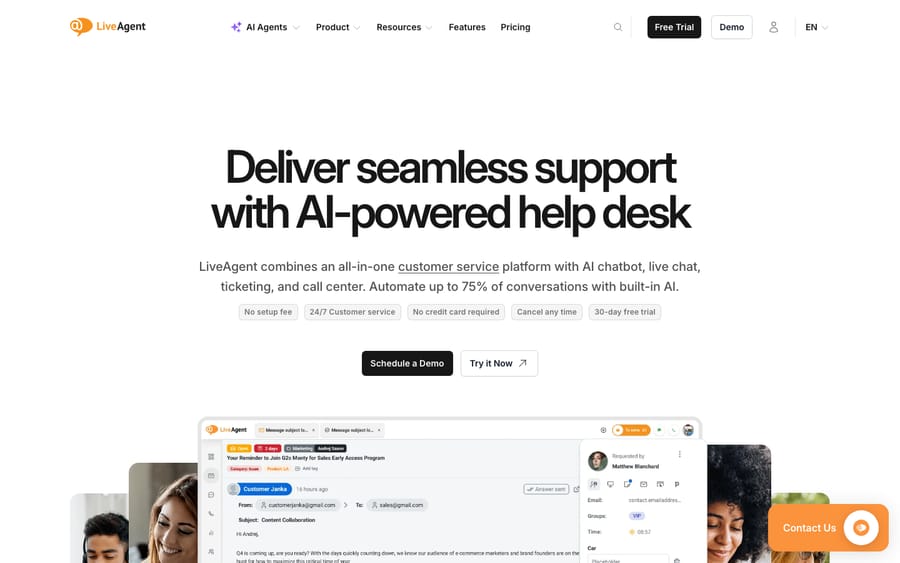
LiveAgent isn't a bad tool. It's a specific one: ticketing, native live chat and a built-in call center in one product, from $15 per agent a month billed annually ($19 monthly), with a 30-day trial. The reasons teams move on cluster around a few themes:
- The interface feels dated. The most consistent critique across G2 and Capterra is that the UI looks older than newer AI-first tools, with a learning curve that stretches onboarding.
- Reporting is basic. Reviewers describe analytics as limited and hard to customize: confusing exports and shallow dashboards.
- The mobile apps lag. Both the agent and phone apps draw repeated complaints from teams that work tickets on the go.
- AI is light. LiveAgent's automation is thinner than the metered AI agents now sold by Intercom, Tidio, Zendesk, Freshdesk and Gorgias. If deflection is your goal, this is the gap.
- Cost scales with agents. The headline price is low, but it's per agent, so the bill climbs with every seat, and several of the better features sit in the $49 and $69 tiers.
None of this is disqualifying. It means the right alternative depends on which of these is your actual bottleneck.
How did we compare them?
We stuck to established, currently selling tools a LiveAgent team could realistically migrate to. For each we pulled live pricing from the vendor's own page, the G2 and Capterra star ratings with approximate review counts, and read G2, Capterra and Trustpilot sentiment for recurring praise and complaints. G2's review pages return a 403 to automated fetches, so the verbatim quotes below come from Capterra, which serves them publicly. Confirm prices on each vendor's page before you sign. (New to the category? Start with what LiveAgent is and our best help desk software guide.)
What are the 8 best LiveAgent alternatives?
1. Freshdesk: the all-round value upgrade
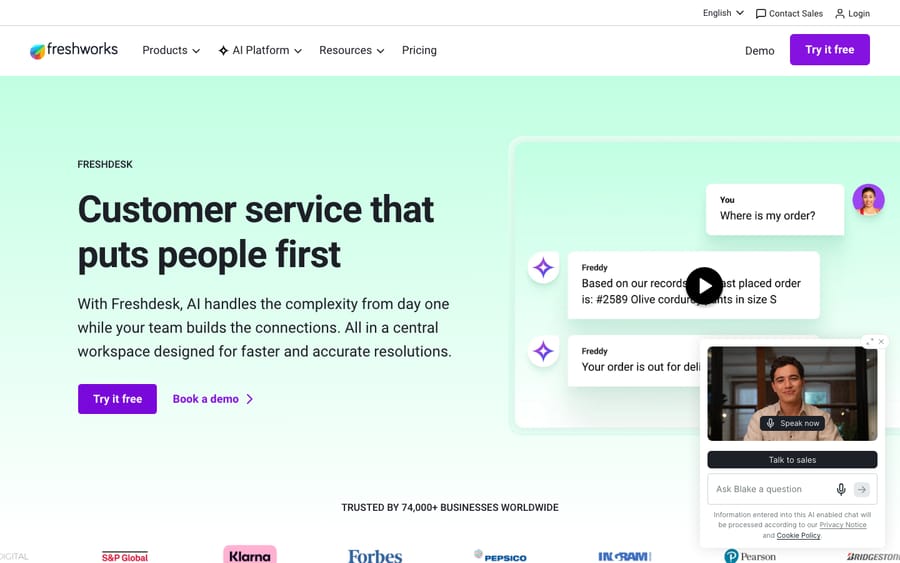
What it is: An omnichannel help desk from Freshworks with ticketing, automation, SLAs, a knowledge base and the Freddy AI suite. It hits the same "lots of capability for the money" note as LiveAgent with a newer interface and a bigger app marketplace. Who it's for: Teams that like LiveAgent's value positioning but have outgrown its UI and reporting. Pricing: Growth $19, Pro $55, Enterprise $89 per agent a month billed annually, with a 14-day trial. The pricing page shows no free plan; a separate Free program covers up to 2 agents for 6 months. Every account gets 500 Freddy AI Agent sessions once, then pays $49 per 100 sessions, and Freddy Copilot is a $29 per agent add-on on Pro and Enterprise. Rating: G2 4.4/5 (~3,700 reviews), Capterra 4.5/5 (~3,300). vs LiveAgent: Stronger automation, reporting and marketplace, the natural graduation from LiveAgent. The catch is that the useful AI is metered or sold per seat, so model the total at your volume. Freshdesk is also one of the help desks Macha runs on, which matters if you want an AI layer later (more below).
"It's generally an easy platform to navigate. The overall UI is clean, modern, and not too cluttered." — David N., IT Operations Manager (Computer Software), Capterra
2. Zoho Desk: the budget pick with the most depth
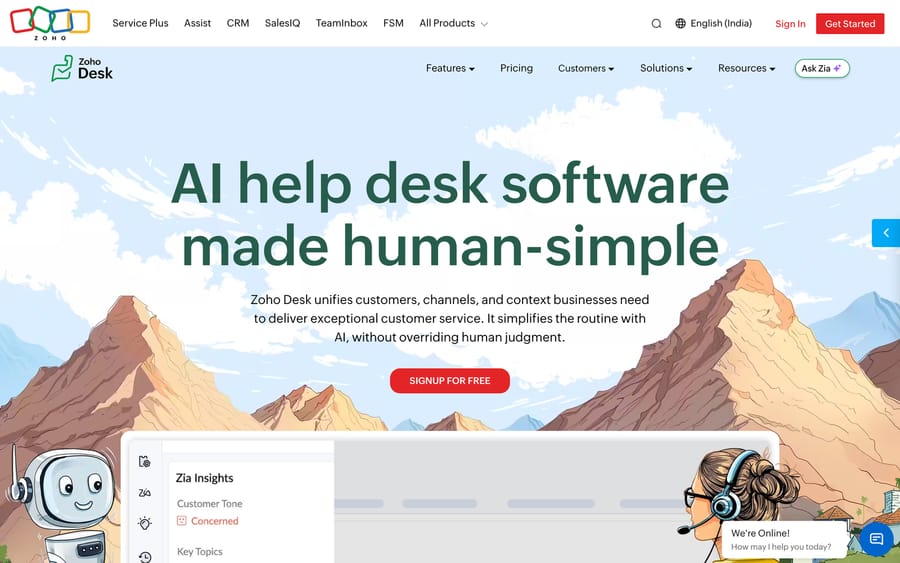
What it is: A feature-rich omnichannel help desk with Blueprint workflows, the Zia AI assistant and tight links into the rest of the Zoho suite. Who it's for: Cost-conscious teams that want the most capability per dollar, especially anyone already on Zoho CRM or Zoho One. Pricing: Free for up to 3 users, then Express $7, Standard $14, Professional $23, Enterprise $40 per agent a month billed annually, with a 15-day trial. Zoho serves prices by region, so check the figure in your own currency. Rating: G2 4.4/5 (~6,500 reviews), one of the largest review bases in the category. vs LiveAgent: Cheaper at the entry tier and deeper in raw features, with much better reporting. The UI is busier and "can feel cluttered", and the ecosystem pull is strongest if you're already in Zoho.
"It integrates with all the other Zoho products, making it super simple to get a full picture of what the client is doing." — Brooke E., CEO (E-Learning), Capterra
3. Zendesk: the enterprise-grade option
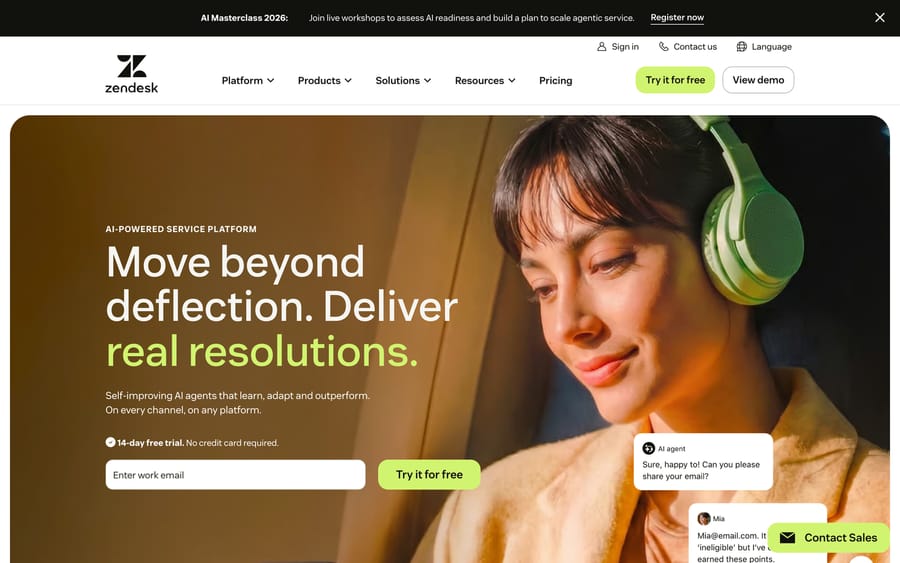
What it is: The category heavyweight: omnichannel ticketing, a mature marketplace, deep reporting and native AI agents built partly on its Ultimate and Forethought acquisitions (the Forethought deal completed on 26 March 2026). Who it's for: Teams that have outgrown a value help desk and want configurability, analytics and a large ecosystem, with the budget to match. Pricing: Support Team from $19 per agent a month; the Suite runs Suite Team $55 and Suite Professional $115 billed annually, with Enterprise quoted by sales. Zendesk's pricing page says AI agents are included and billed per automated resolution, and lists the rate: $1.50 per committed resolution and $2.00 pay-as-you-go. Copilot is $50 per agent a month on Suite Professional and above. Rating: G2 4.3/5 (~6,700 reviews). vs LiveAgent: More extensible and far stronger on analytics, a different weight class. It also costs several times more once you add AI, so it's overkill for the small teams LiveAgent serves best. If you want AI without leaving Zendesk, see how an AI agent layer works on Zendesk.
4. Help Scout: the simpler, human-first inbox
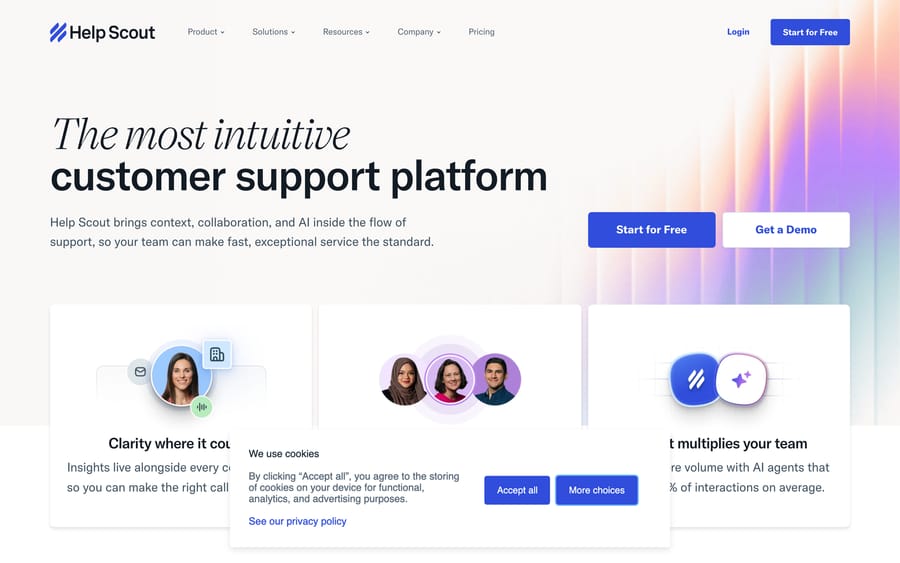
What it is: A conversation-style help desk built around a shared inbox, a knowledge base (Docs) and live chat (Beacon), with AI layered in. It hides the ticket machinery so it feels like email. Who it's for: Small and mid-sized SaaS and services teams that find LiveAgent heavy and want fast onboarding. Pricing: A Free plan for up to 5 users with one inbox, then Standard $25, Plus $45, Pro $75 per user a month billed annually. AI Answers, the chatbot, costs $0.75 per AI-resolved conversation on top. Rating: G2 ~4.4/5 (~430 reviews), Capterra 4.6/5, consistently praised for ease of use. vs LiveAgent: Friendlier and faster to adopt, with a better-looking inbox. Help Scout has no built-in call center and fewer channels, so it's a swap toward simplicity, not feature count.
"Help Scout has a clean, intuitive interface that doesn't overwhelm users with unnecessary complexity." — Krystal M., People Operations (IT & Services), Capterra
5. Tidio: the SMB live chat and AI chatbot
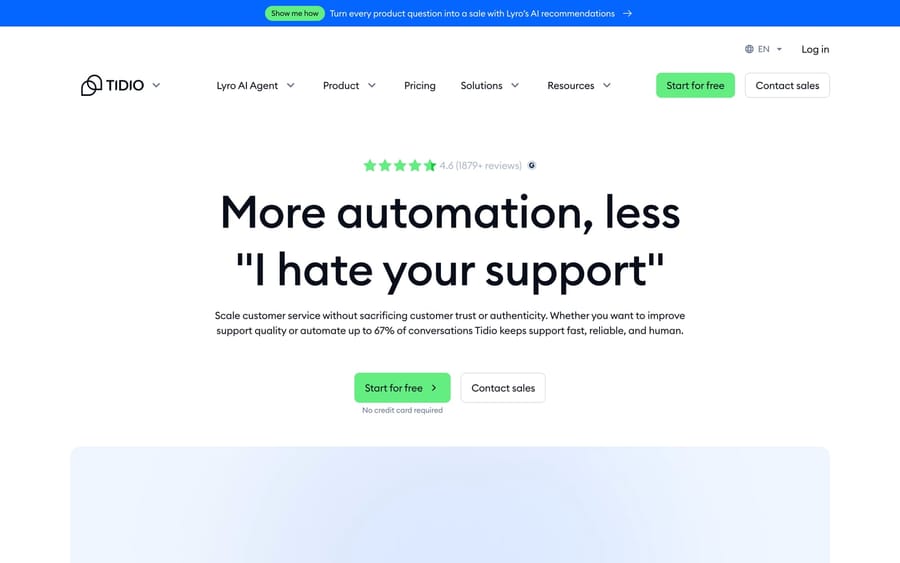
What it is: A live-chat-first platform with the Lyro AI chatbot, flows and a help desk module, built for SMBs and ecommerce that lead with chat. Who it's for: Small teams whose support is mostly website chat and who want an AI chatbot that deflects routine questions out of the box. Pricing: A free plan, then Starter $24.17 and Growth from $49.17 a month billed yearly ($29 and $59 monthly), and Plus from $300 a month. Lyro is sold separately from $32.50 a month for 50 conversations. Rating: G2 4.6/5 (~1,880 reviews), Capterra 4.7/5 (~590), among the best rated on this list. vs LiveAgent: A newer chat experience and stronger native AI, but lighter as a multichannel help desk and no call center. Best if chat and deflection matter more than omnichannel ticketing.
"We use Tidio daily to manage customer inquiries, and what we like most is its intuitive interface and the ability to centralize chats, emails, and more." — Krisanpal S., Capterra
6. Crisp: the startup-friendly chat and AI inbox
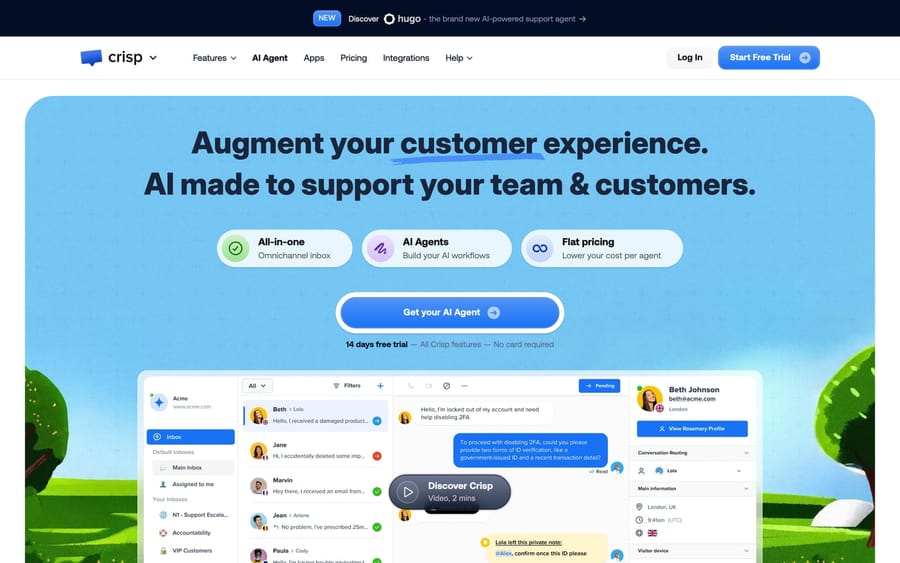
What it is: A shared inbox that blends live chat, a chatbot, email and social into one workspace, with MagicReply and AI features. Who it's for: Early-stage startups that want a chat-led inbox with AI at a flat price rather than per seat. Pricing: A free plan (2 seats), then Mini $45 (4 seats), Essentials $95 (10 seats), Plus $295 (20 seats) a month, billed per workspace, with extra seats at $10. Paid plans include a monthly AI credit allowance. Rating: G2 4.5/5 (~220 reviews), Capterra ~4.5/5, praised for affordability and responsive support. vs LiveAgent: A chat-centric experience with flat workspace pricing that can undercut LiveAgent for tiny teams. It's built for smaller scale than LiveAgent's call-center-plus-ticketing setup.
"Free version truly helping early stage product launches. We use it for chat on our website. It's amazing." — Mahesh A., Head of Marketing (IT), Capterra
7. Gorgias: the ecommerce specialist
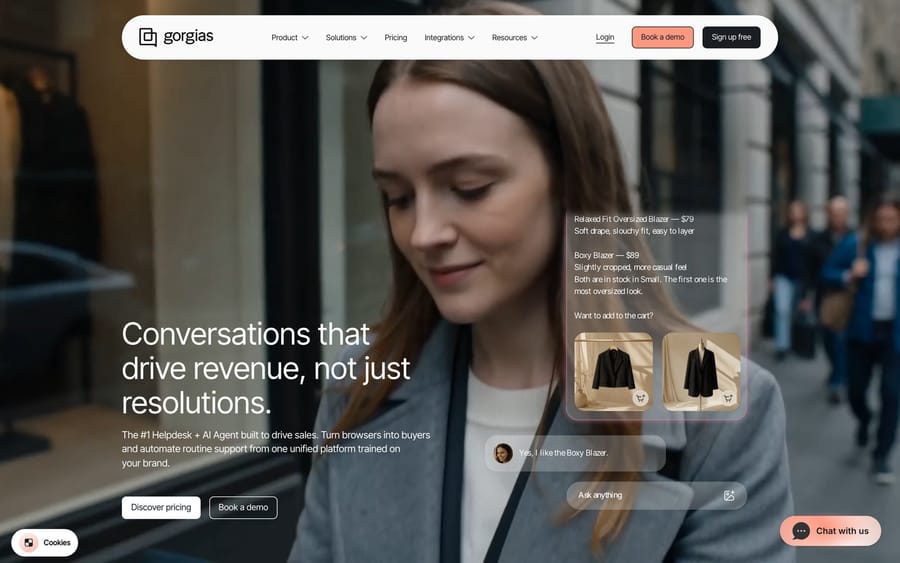
What it is: The Shopify-era help desk, built for ecommerce. It pulls order, refund and subscription data into the ticket, and its AI Agent handles order-status, returns and product questions. Who it's for: Shopify, BigCommerce and DTC brands whose support is mostly about orders. Pricing: Billed on monthly ticket volume, not seats. The help desk alone runs Starter $10, Basic $60, Pro $360 and Advanced $900 a month; Starter with AI Agent is $40. AI Agent costs $0.85 to $1.00 per automated interaction depending on plan, $1.50 past the included bundle, and each automated interaction also counts as a help desk ticket. Rating: G2 4.6–4.7/5 (~1,200 reviews), Capterra 4.6/5. vs LiveAgent: Far better for retail out of the box, with Shopify depth LiveAgent can't match. It's a poor fit outside ecommerce, and ticket-based pricing spikes in sale season.
"Brilliant — very impressed, from the training provided to the platform itself, and will use it again in the future as business grows." — Jade L., Customer Relations (Retail), Capterra
8. Intercom (with Fin AI): the AI-first, chat-led platform
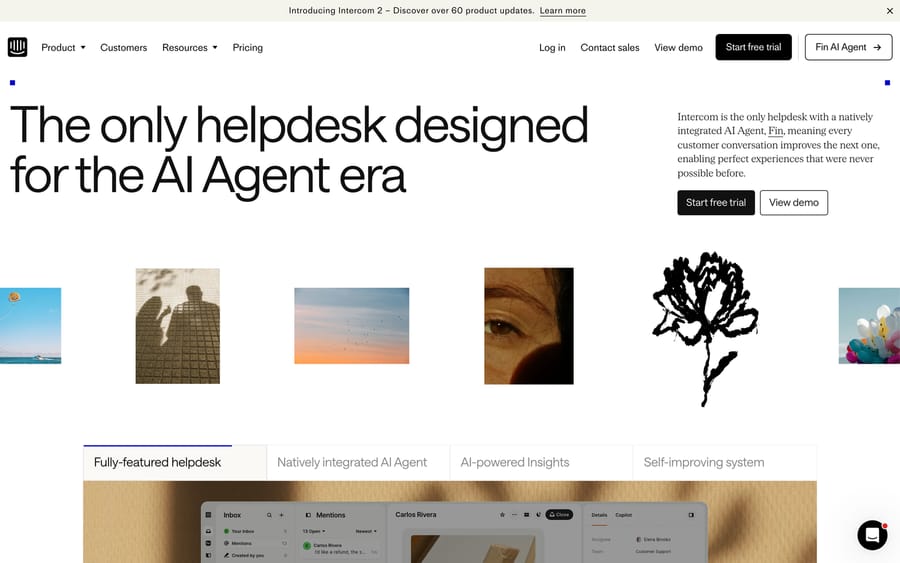
What it is: A messenger-first support platform whose Fin AI agent is the best-known per-outcome AI product in the category. Salesforce completed its acquisition of Fin, the company formerly called Intercom, on 10 September 2026, and cites a 76% average resolution rate. Who it's for: SaaS and digital-first companies whose support skews to in-app chat and email. Pricing: Essential $29, Advanced $85 and Expert $132 per seat a month billed annually (Intercom has also shown $19 for Essential in a pricing test), plus Fin at $0.99 per outcome. The 50-outcome monthly minimum applies only when Fin runs on a help desk other than Intercom. Rating: G2 4.5/5 (~3,800 reviews across Intercom and Fin). vs LiveAgent: A much stronger messenger and AI agent, but the usage-based bill is the opposite of LiveAgent's cheap per-seat model. Weigh the Salesforce ownership in any multi-year decision.
"The live chat is fast and responsive, and the ability to see user activity in real time adds a layer of context that makes support feel proactive rather than reactive." — Davis O., Customer Support Team Lead (IT & Services), Capterra
Can you add an AI layer instead of switching help desks?
Only if you're willing to move off LiveAgent. A disclosure: we make Macha, and it runs on Zendesk, Freshdesk, Gorgias, Front, HubSpot or Intercom. It does not connect to LiveAgent, so it isn't a LiveAgent alternative and isn't on the list above.
It matters in one scenario. If your real problem was light AI and weak deflection rather than LiveAgent's ticketing, some teams fix that by adding an AI agent layer to their help desk instead of buying a help desk with metered AI built in. Several of the alternatives above are desks Macha runs on, so if you're migrating anyway, picking one keeps that door open. Macha reads the customer's question, pulls from your connected order and CRM data and help center, drafts or sends replies inside your existing workflow, and hands off to a human with context when it isn't confident.
Pricing model: per ticket, one charge per thread however many replies it takes, from $299 a month for 750 tickets (about $0.40 each), with setup and monitoring by the Macha team included. We bill per ticket rather than per resolution because a per-resolution vendor earns more from every ticket it counts as solved, and outcomes depend heavily on how good your connected data and knowledge are.
The watch-out: Macha is only as good as the integrations and knowledge you connect, and it won't help while you're on LiveAgent. If your problem is LiveAgent's ticketing or UI, one of the eight alternatives is the right move. See how the layer works, or start with $50 of free usage, no credit card required.
What do real users say about LiveAgent and the alternatives?
LiveAgent holds Capterra 4.7/5 (~1,776 reviews) and G2 ~4.5/5, with praise centered on value, fast live chat and broad channels, and the criticisms above showing up consistently. Two verbatim Capterra reviews:
"The cost can jump to be so high when you are having more agents to use the solution, and would lead to decreased ROI for small businesses." — Product Manager (Consumer Goods), Capterra, February 2026
"The interface feels slightly outdated compared to some modern support tools, and it takes a little time for new users to understand all the features." — Project Manager (IT), Capterra, March 2026
Set against the alternatives' quotes above (Freshdesk's clean UI from David N., Zoho Desk's Zoho-stack pull from Brooke E., Help Scout's no-fuss interface from Krystal M., Tidio's multichannel inbox from Krisanpal S., Crisp's free tier from Mahesh A., Gorgias's retail polish from Jade L. and Intercom's context-rich chat from Davis O.), the pattern is plain: people like LiveAgent's price and breadth, and they leave for a newer interface, deeper reporting or stronger AI.
How do you choose the right LiveAgent alternative?
- Name your real reason for leaving. Dated UI: Freshdesk or Help Scout. Weak reporting: Zendesk or Zoho Desk. Light AI: Tidio, Intercom, or an AI layer on a desk Macha supports. Ecommerce: Gorgias. Don't switch platforms to fix one feature you could add.
- Match the tool to your channel mix. Omnichannel value at scale: Freshdesk or Zoho Desk. Chat- and AI-led: Tidio, Crisp or Intercom. Simplicity-first email and chat: Help Scout. Order-driven retail: Gorgias.
- Model the total cost, including AI. LiveAgent's appeal is a low, predictable price. Intercom charges $0.99 per outcome, Help Scout $0.75 per AI-resolved conversation, Freshdesk $49 per 100 sessions after the first 500, and Gorgias up to $1.50 per automated interaction. Add that to seats at your real volume before comparing.
- Weigh migration cost honestly. Moving help desks means data migration, retraining and rebuilt workflows. Worth it for a structural problem, overkill for one feature gap.
- Pilot on a real slice of your queue. Run the shortlist on live tickets and measure resolution rate, CSAT and first-response time against your LiveAgent baseline before you commit.
Frequently asked questions
What is the best LiveAgent alternative in 2026? It depends on why you're leaving. Freshdesk is the best all-round value upgrade at $19 per agent a month billed annually; Zoho Desk the deepest budget option; Zendesk the enterprise choice; Help Scout the simplicity pick; Tidio and Crisp the chat-and-AI SMB tools; Gorgias owns ecommerce; and Intercom leads on AI deflection. If your only frustration is weak AI, note that an AI layer like Macha runs on Zendesk, Freshdesk, Gorgias, Front, HubSpot or Intercom (not LiveAgent), so migrating to one of those keeps that option open.
What's the cheapest alternative to LiveAgent? Zoho Desk is free for up to 3 users, then from $7 per agent a month billed annually, which undercuts LiveAgent's $15 entry tier. Help Scout is free for up to 5 users, and Tidio and Crisp have free plans if you're chat-led. Freshdesk no longer shows a free plan on its pricing page. Add AI costs when comparing; the base price is rarely the final number.
How is LiveAgent different from these alternatives? LiveAgent's edge is being a cheap, true all-in-one: ticketing, native live chat and a built-in call center at $15 to $69 per agent a month billed annually. Most alternatives beat it on one axis: Freshdesk and Zendesk on UI, ecosystem and AI; Zoho Desk on depth per dollar; Help Scout, Tidio and Crisp on a simpler experience; Gorgias on ecommerce. The trade-off is usually price or breadth.
Do I have to replace LiveAgent to get better AI? Yes, for now. You can pick an alternative with strong native AI (Tidio, Intercom, Zendesk, Freshdesk), or migrate to a desk Macha runs on and add an AI agent layer like Macha, billed per ticket from $299 a month for 750 tickets. Macha does not integrate with LiveAgent, so staying put isn't an option for that route.
Is Freshdesk or Zoho Desk better than LiveAgent? For most growing teams, both offer a newer interface, stronger automation and better reporting. Freshdesk has the cleaner experience and bigger marketplace; Zoho Desk gives more depth per dollar, especially inside the Zoho stack. LiveAgent stays competitive on raw price and its built-in call center. See our best help desk software guide for the wider field.
Who owns Intercom and Fin now? Salesforce completed its acquisition of Fin, the company formerly called Intercom, on 10 September 2026, and says Fin keeps serving existing customers. Fin still costs $0.99 per outcome, so the price hasn't changed, but a multi-year Intercom decision now depends on Salesforce's roadmap.